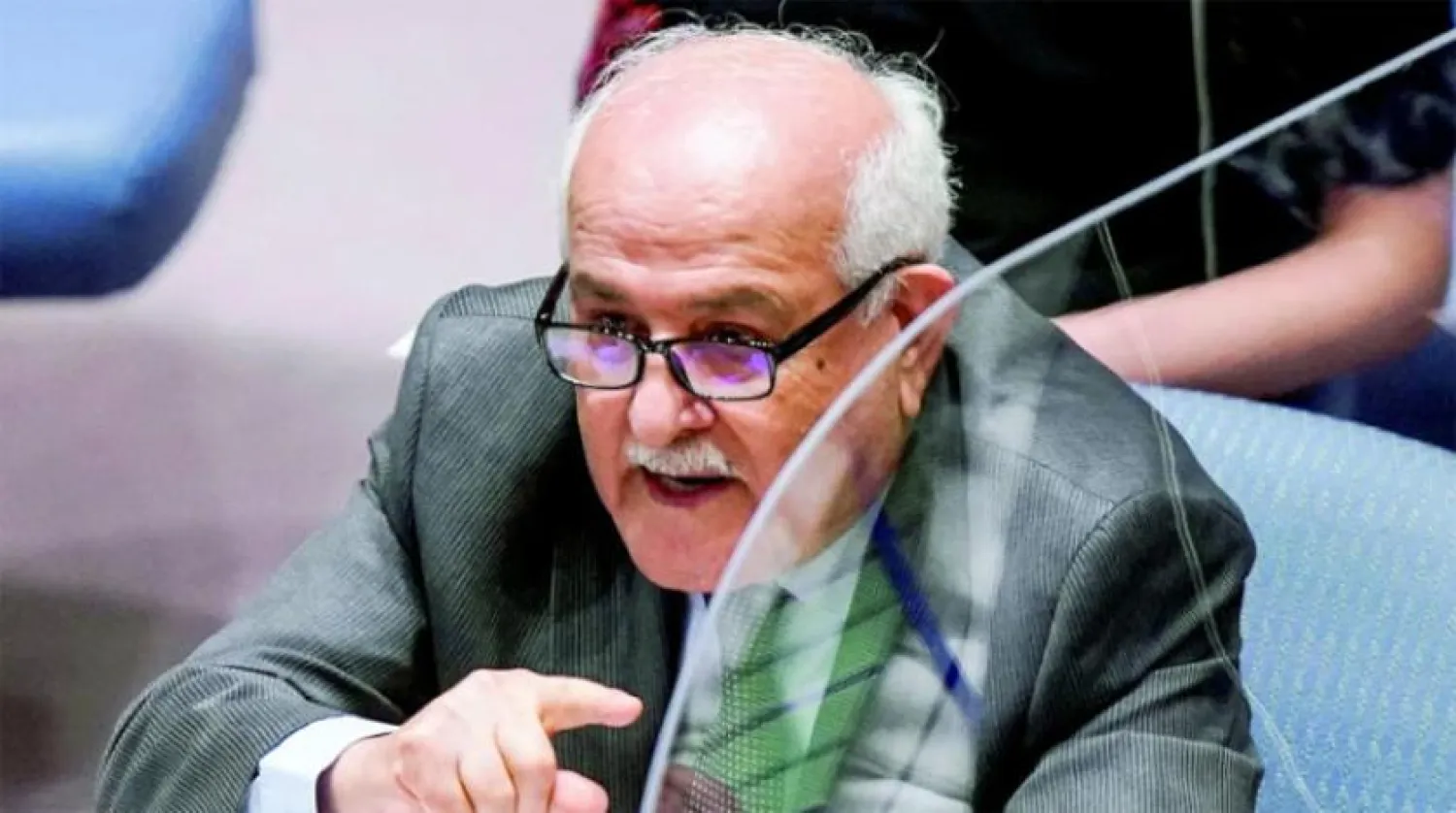
Permanent Observer of the State of Palestine Riyad Mansour speaking at the Security Council meeting in New York on Monday about the situation in the Middle East and Palestine (Reuters)
Permanent Observer of the State of Palestine Riyad Mansour speaking at the Security Council meeting in New York on Monday about the situation in the Middle East and Palestine (Reuters)
The United Nations has voiced “grave concern” over the escalating violence in the West Bank and called for the immediate lifting of siege against Gaza.
UN Secretary-General Antonio Guterres called on all sides to “demonstrate calm in the West Bank or Gaza and on the relevant authorities to carry out independent, transparent investigations into all deaths and injuries,” said UN spokesman Stephane Dujarric.
“We’re, obviously, very concerned about the increased violence that we’ve seen in the occupied West Bank, including the killing Tuesday of three Palestinians in Nablus and one in Hebron following clashes with Israeli security forces,” Dujarric noted.
He affirmed that the ceasefire brokered by the UN and Egypt on Sunday has been “holding so far,” citing the UN Special Coordinator for the Middle East Peace Process, Tor Wennesland, briefing Monday to the Security Council in this regard.
“Humanitarian partners are responding to the needs of affected families through cash assistance and the provision of non-food items,” the spokesman affirmed.
Meanwhile, the Bureau of the UN General Assembly Committee on the Exercise of the Inalienable Rights of the Palestinian People (CEIRPP) appealed for the “immediate lifting of the siege against Gaza, now in its 15th year.”
It also called on Israel, the occupying power, to end practices of collective punishment against Palestinians in Gaza.
In a statement issued on Monday, the CEIRPP called for the start of negotiations leading to an end to Israel’s occupation of the Palestinian territory and the implementation of two-State solution based on relevant UN resolutions and international law.
It underscored the need to ensure accountability for persistent rights violations of international human rights and humanitarian law committed in the occupied Palestinian territory, including during military operations in Gaza.
The Bureau condemned the “serious escalation of violence between Israel and Palestinian Islamic Jihad fighters that started on August 5, following Israeli airstrikes and artillery attacks on densely populated areas.”
It commended Egypt for its mediation role in deescalating the situation, while calling on all sides to exercise maximum restraint to protect civilians and prevent further casualties.
PM Mohammed Shia Al-Sudani, head of the Popular Mobilization Forces Faleh Al-Fayyad, and PMF's chief of staff Abu Fadak (government media)
Despite continuous American demands for the Iraqi authorities to curb and dismantle factions, observers noted that the meetings of the leaders of the Coordination Framework have not been tackling this issue.
This could threaten the loss of American support for the new government, while experts propose a 5-step approach to resolve the matter.
The American insistence on dismantling armed factions has become recently highly clear through a series of punitive measures, beginning with a $10 million reward for information leading to the leader of Kataib Hezbollah, Abu Hussein Al-Hamidawi, then placing seven factions on sanctions and terrorism lists, and finally a similar reward for information about Abu Alaa Al-Wala'i, leader of Kataib Sayyid al-Shuhada.
Contrary to the discourse that escalated about three months ago regarding the necessity of disarming factions and restructuring the Popular Mobilization Forces (PMF), the Coordination Framework forces remain silent, despite the factions' actual involvement in the war with Iran and their missile attacks inside Iraqi territory and abroad on some Arab Gulf states.
War undermined efforts
A leading source from the Coordination Framework states that the war launched by the United States and Israel against Iran "undermined what could be called efforts to integrate the factions."
The source confirms to Asharq Al-Awsat that "the Coordination Framework had indeed begun preliminary discussions on mechanisms for addressing the issue, but the war ... provided the appropriate pretext for the factions to refuse to disarm, considering that the war represents an existential threat to them."
The source points out that "the leaders of the Coordination Framework recognize the seriousness and magnitude of the risks posed by American demands, but they are forced to ignore them due to pressure from the factions and the Iranian actor," indicating that "some forces and figures that possess armed factions have a genuine desire to integrate their elements into the army and restructure the PMF, but they appear incapable of taking any action due to the regional developments and the stalled efforts to form a government."
Dismantling the Funding System
Writer and political researcher Dr. Basil Hussein believes that dismantling the factions is linked to what he calls the "funding system."
He told Asharq Al-Awsat that the Coordination Framework forces are “a fragile coalition where disparate interests intersect.”
He points out that "armed factions are not merely an executive arm in the hands of political parties; rather, they are often the backbone upon which these parties are built economically, politically, and socially."
He further states that "any serious attempt to dismantle the factions will inevitably mean dismantling the entire funding system, which amounts to political suicide for anyone who undertakes it. Therefore, such efforts will always remain incomplete and selective, avoiding any harm to the core structure upon which the militias' influence rests."
In addition to these reasons, Hussein believes that "dismantling the factions is not a purely Iraqi decision; rather, it relates to the Iranian vision that has long viewed these factions as a cornerstone of Tehran's forward defense strategy.”
He adds that "when American pressure on the factions intensifies and their room for maneuver narrows, they will reluctantly bend rather than willingly, resorting to a superficial solution that masks their facade without touching their essence. They may change their name while retaining their structure, and formally dissolve into state institutions while maintaining their networks, weapons, and loyalties outside any actual oversight."
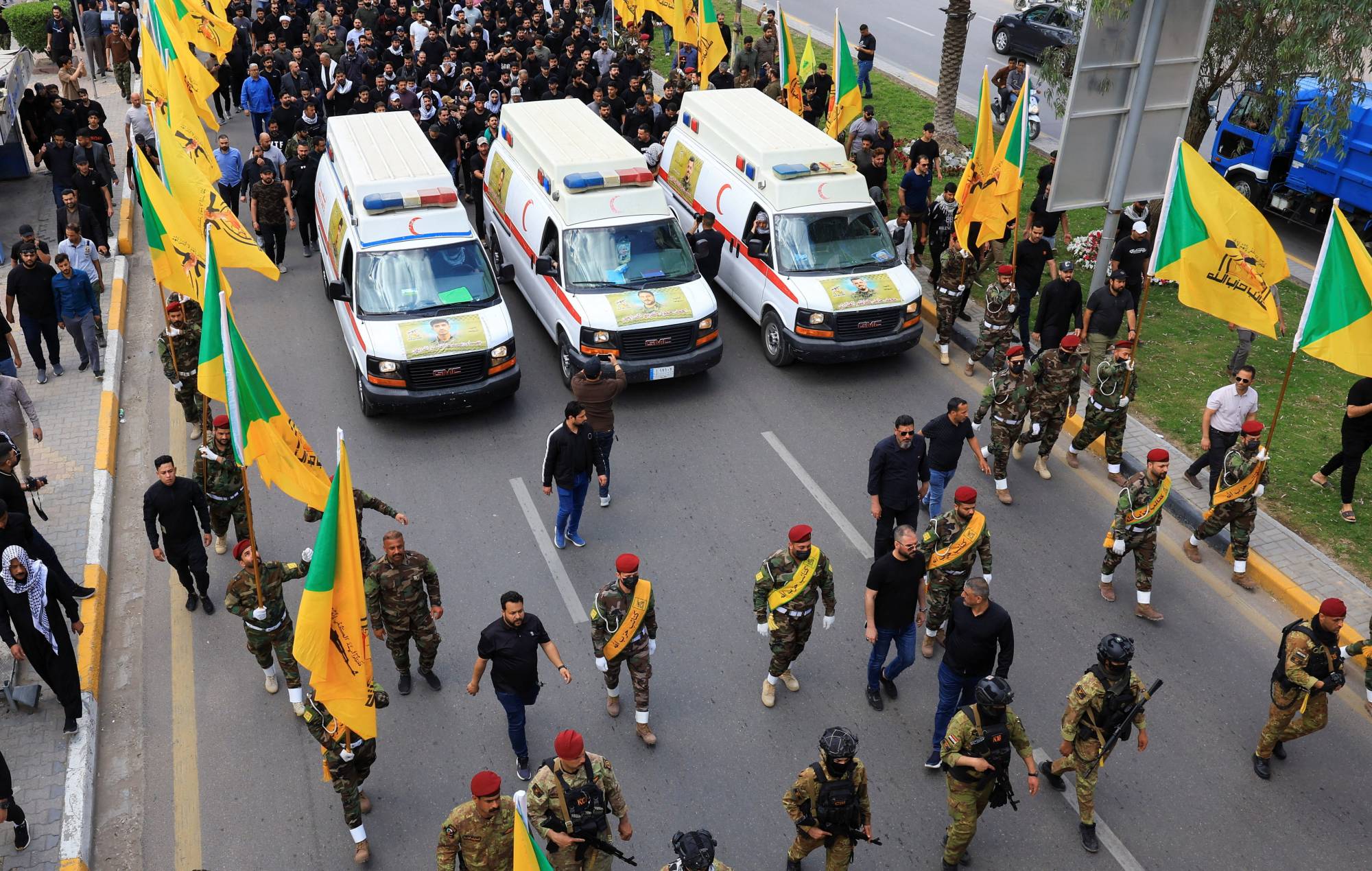
Mourners attend the funeral of fighters with Iraq’s Popular Mobilisation Forces who were killed in an airstrike, in Baghdad, Iraq, April 8, 2026. REUTERS/Thaier Al-Sudani
5 Steps to a Solution
For his part, Firas Elias, Professor of Political Science at the University of Mosul and a specialist in Iranian studies, proposes an approach that includes five steps that would help dismantle the factions.
He believes that the future of armed factions in Iraq will directly depend on the future of the war between Tehran and Washington, as they "will be directly affected by the outcome of this war."
Elias tells Asharq Al-Awsat that "discussing practical ways to deal with armed factions requires developing a new approach for the post-war phase. The practical method is not (immediate dismantling), but rather a gradual re-engineering of power through the state."
Elias anticipates that if the Framework forces succeed in forming a government, and under American pressure, they may move along five paths: "First: separating the PMF as an official body from the factions as political-military arms, establishing that the PMF, which receives salaries from the state, is exclusively subject to the Commander-in-Chief, while any formation that retains independent decision-making or external affiliation is treated as an entity outside the state."
The second move involves "controlling money before weapons. The most effective approach is to audit salaries, contracts, crossings, companies, economic offices, and transfers. When informal resources are cut off, the factions become less capable of maneuvering."
In the third path, Elias expects "restructuring leadership by changing sensitive positions within the PMF Commission, transferring some brigades to distant sectors away from the borders, integrating selected units into the army or Federal Police, and retiring undisciplined leaders or assigning them to symbolic positions."
The Iraqi expert adds a fourth path related to "dismantling from within, not through confrontation. The government may differentiate between three types: factions amenable to integration, factions requiring political containment, and completely resistant factions. The approach to dealing with them would be piecemeal: incentives for the disciplined, isolation for the resistant, and legal pressure on those involved."
He concludes with the fifth path, which concerns "transforming American pressure into internal political leverage. The Framework might tell the factions: either adhere to state discipline, or face sanctions, financial isolation, and security measures that affect everyone. Here, American pressure becomes a tool in the hands of the government, not merely an external threat."
Despite these five paths, Elias believes that "the 'Framework will not dismantle the factions in one stroke, because they are part of its political structure. However, it may work to gradually strip them of their military and financial independence, while retaining the PMF designation in a disciplined, institutional manner."
Four Killed in Israeli Strikes on Southern Lebanonhttps://english.aawsat.com/arab-world/5266384-four-killed-israeli-strikes-southern-lebanon
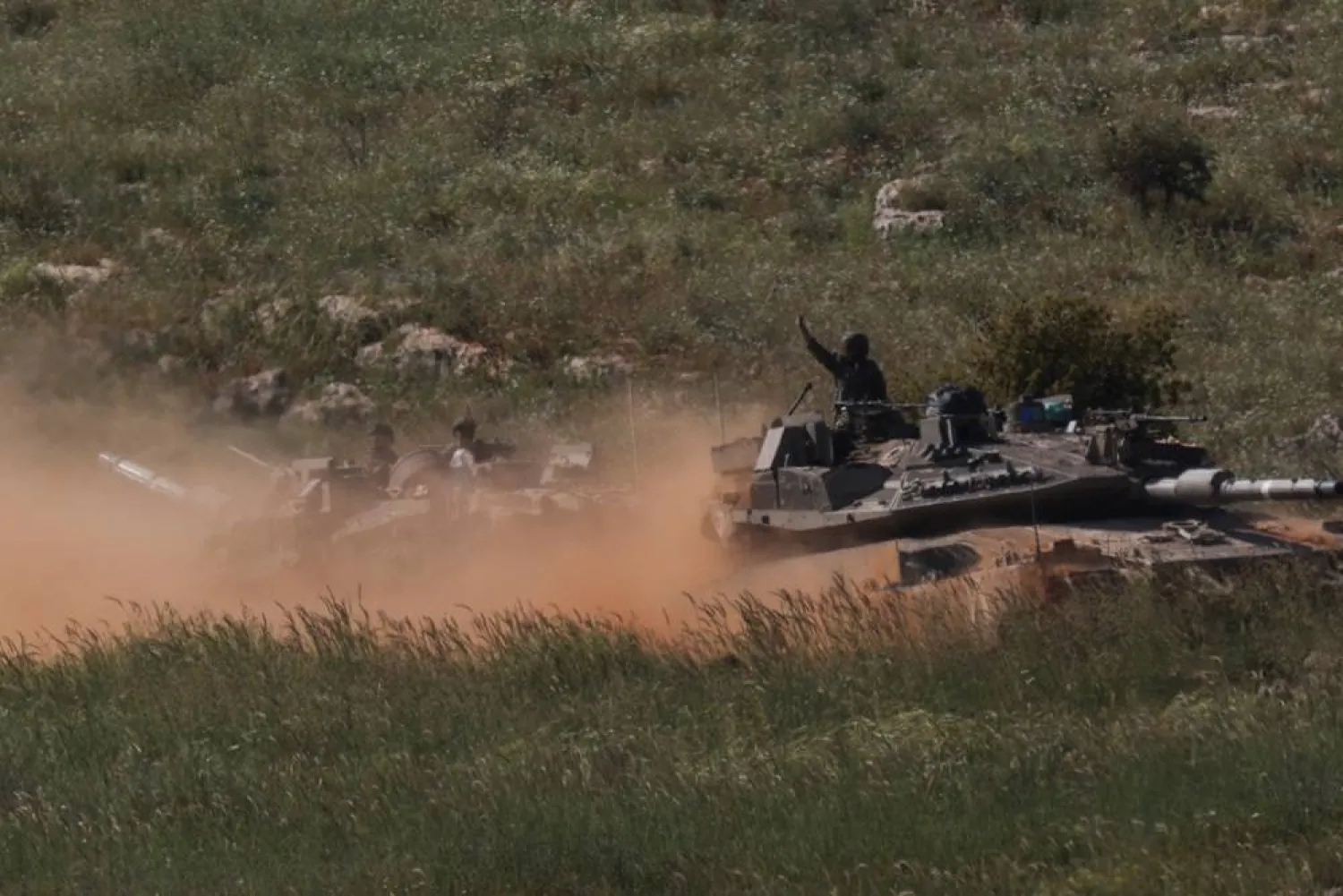
Israeli tanks drive in Lebanon, as seen from the Israeli side of the Israel-Lebanon border, in northern Israel, April 25, 2026. (Reuters)
TT
TT
Four Killed in Israeli Strikes on Southern Lebanon
Israeli tanks drive in Lebanon, as seen from the Israeli side of the Israel-Lebanon border, in northern Israel, April 25, 2026. (Reuters)
Four people were killed on Saturday in Israeli strikes on southern Lebanon, Lebanon's state news agency reported, while the Israeli military said Hezbollah had fired rockets at Israel, the latest challenges to a tenuous, recently extended ceasefire.
The ceasefire agreed between Israel and Lebanon has led to a significant reduction in hostilities, but Israel and Iran-backed Hezbollah have continued to clash in southern Lebanon, where Israel has kept soldiers in the self-declared buffer zone.
The Israeli military said on Saturday that it had struck loaded rocket launchers belonging to Hezbollah in three locations in southern Lebanon overnight and targeted several Hezbollah fighters in separate strikes.
It was unclear whether the deaths reported by the state news agency were linked to those Israeli strikes.
The Israeli military restated its warning for Lebanese residents not to approach the Litani River area in southern Lebanon while it battles Hezbollah.
It said it had intercepted a "suspicious aerial target" within the area its forces are presently occupying, and that two rockets were fired by Hezbollah into northern Israel, one of which was intercepted. There were no reports of casualties.
A Hezbollah lawmaker said on Friday that a US-mediated ceasefire in the war with Israel was meaningless, a day after it was extended for three weeks. The truce had been due to expire on Sunday.
Syria to Begin Trying Assad-Era Figures on Sunday, Says Justice Officialhttps://english.aawsat.com/arab-world/5266381-syria-begin-trying-assad-era-figures-sunday-says-justice-official
Residents gather in a street after Friday prayers to celebrate the arrest of Amjad Yousef, a key suspect in the 2013 Tadamon massacre, in Tadamon, Syria, April 24, 2026. (Reuters)
TT
TT
Syria to Begin Trying Assad-Era Figures on Sunday, Says Justice Official
Residents gather in a street after Friday prayers to celebrate the arrest of Amjad Yousef, a key suspect in the 2013 Tadamon massacre, in Tadamon, Syria, April 24, 2026. (Reuters)
Trials of prominent figures from the rule of ousted Syrian leader Bashar al-Assad are set to begin this weekend, a justice ministry official told AFP on Saturday, starting with a former security official.
"The first trial sessions for symbolic former Syrian regime figures will begin on Sunday" with Atif Najib, who was arrested in January of last year, the official told AFP on condition of anonymity.
Najib is the former head of political security in south Syria's Daraa province, the cradle of the country's 2011 uprising, and is accused of orchestrating a crackdown there. He is also a cousin of the ousted leader.
The ministry official said trials would follow for Wassim al-Assad -- another of the former president's cousins -- and Amjad Youssef, the main suspect in a 2013 massacre who was arrested this week, as well as "pilots who took part in bombing Syrian cities and towns".
Syria's civil war began with a brutal crackdown on pro-democracy protests and spiraled into a 13-year conflict that killed more than half a million people.
Assad's forces pounded opposition-held areas, including with airstrikes and crude barrel bomb attacks, while tens of thousands of people disappeared, some into the country's brutal prison system.
Since seizing power in December 2024, Syria's new authorities have repeatedly announced the arrests of former officials, vowing to provide justice and accountability for Assad-era atrocities.
Assad fled to Russia with only a handful of confidants, abandoning senior officials and security officers, some of whom reportedly went abroad or took refuge in the coastal heartland of Assad's Alawite minority.
Syrian Justice Minister Mazhar al-Wais said Friday on X that the Damascus criminal court was ready "for the moment that victims have long waited for: the start of public trials", calling them "part of the transitional justice process".
Rights groups, activists and the international community have repeatedly emphasized the importance of transitional justice in the war-ravaged country.
The protest movement against Assad began in Daraa on March 15, 2011, after 15 students were arrested for allegedly writing anti-government slogans on the city's walls.
Residents said the students were tortured, leading to a protest to demand their release that ended in bloodshed.
Najib, blamed for the crackdown, was dismissed soon after. He was on a US Treasury sanctions list alongside other Syrian officials.
Wassim al-Assad was arrested last June. The US Treasury sanctioned him in 2023, saying he had led a paramilitary unit and was "a key figure in the regional drug trafficking network".
لم تشترك بعد
انشئ حساباً خاصاً بك لتحصل على أخبار مخصصة لك ولتتمتع بخاصية حفظ المقالات وتتلقى نشراتنا البريدية المتنوعة