

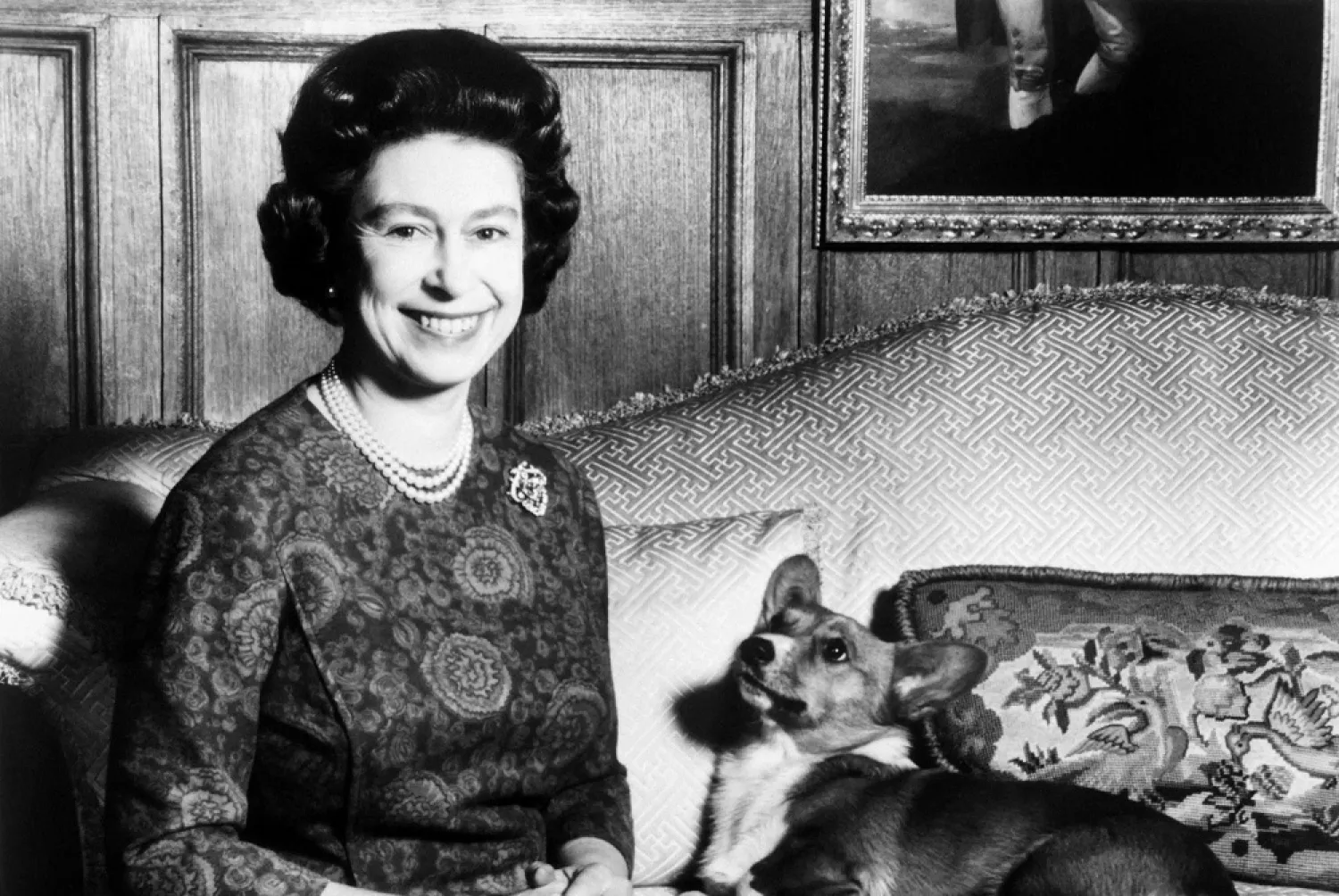

A Queen and Her Corgis: Elizabeth Loved Breed from Childhood

In this file photo taken on February 26, 1970 Queen Elizabeth II poses with her corgis dog. (AFP)
TT

A Queen and Her Corgis: Elizabeth Loved Breed from Childhood

In this file photo taken on February 26, 1970 Queen Elizabeth II poses with her corgis dog. (AFP)

For many people around the world, the word corgi is forever linked to Queen Elizabeth II.

Princess Diana once called them a "moving carpet" always by her mother-in-law's side. Stubby, fluffy little dogs with a high-pitched bark, corgis were the late queen's constant companions since she was a child. She owned nearly 30 throughout her life, and they enjoyed a life of privilege fit for a royal pet.

Elizabeth’s death last week has raised public concerns over who will care for her beloved dogs. Some speculate they will be sent off to live with other royal family members, while others say this task might be given to palace staff.

"One of the intriguing things people are wondering about at the funeral is whether a corgi is going to be present," said Robert Lacey, royal historian and author. "The queen’s best friends were corgis, these short-legged, ill-tempered beasts with a yap that doesn’t appeal to many people in Britain, but was absolutely crucial to the Queen."

Elizabeth’s love for corgis began in 1933 when her father, King George VI, brought home a Pembroke Welsh corgi they named Dookie. Images of a young Elizabeth walking the dog outside their lavish London home would be the first among many to come over the decades.

When she was 18, she was given another and named it Susan, the first in a long line of corgis to come. Later there were dorgis — a dachshund and corgi crossbreed — owned by the queen. Eventually they came to accompany her in public appearances, and became part of her persona.

Throughout Elizabeth's 70 years on the throne, the corgis were by her side, accompanying her on official tours, reportedly sleeping in their own room at Buckingham Palace with daily sheet changes, and occasionally nipping the ankles of the odd visitor or royal family member.

Three of them even appeared alongside the queen as she climbed into James Bond’s waiting helicopter in the spoof video that opened the 2012 Summer Olympics in London.

British author Penny Junor documented their feisty lives in a 2018 biography "All the Queen’s Corgis."

She writes that Elizabeth walked and fed the dogs, chose their names and when they died, buried them with individual plaques. Care for the corgis had fallen largely on the queen’s trusted dressmaker and assistant Angela Kelly and her page Paul Whybrew.

The corgis were also present when the queen welcomed visitors at the palace, including distinguished statesmen and officials. When the conversation lulled, Elizabeth would often turn her attention to her dogs to fill the silence.

"She was also concerned about what would happen to her dogs when she is no longer around," Junor wrote, noting that some royal family members did not share her fondness for the corgis.

After the death of her corgi Willow in 2018, it was reported that the queen would not be getting any more dogs.

But that changed during the illness of her late husband, Prince Philip, who died in 2021 at age 99. She turned once again to her beloved corgis for comfort. In the spring, on what would have been Philip's 100th birthday this year, the queen was given another dog.

In addition to her human family, Elizabeth is survived by two corgis, a dorgi, and a cocker spaniel.




Saudi Arabia Establishes Royal Institute of Anthropology to Study Social Change

The establishment of the institute provides a scientific platform for documenting heritage and deepening awareness of local culture through anthropological research. (SPA)
TT

Saudi Arabia Establishes Royal Institute of Anthropology to Study Social Change

The establishment of the institute provides a scientific platform for documenting heritage and deepening awareness of local culture through anthropological research. (SPA)

Saudi Arabia has approved the establishment of the Royal Institute of Anthropology and Cultural Studies, marking a significant step toward expanding research on Saudi society and documenting its social transformations.

The institute, approved by the Saudi Cabinet on Tuesday, is expected to strengthen scholarly work related to the study of Saudi communities through rigorous scientific methods.

Saudi Minister of Culture Prince Badr bin Abdullah bin Farhan Al Saud welcomed the decision and thanked the Kingdom’s leadership for supporting the initiative.

He said the institute would serve as “a trusted narrator of our culture and a beacon of inspiration in studies that seek to understand humanity.”

Prince Badr added that the institute would provide a scientific platform for documenting Saudi heritage and deepening awareness of local culture through anthropological research. He noted that its work would help generate meaningful cultural insights and encourage cultural exchange with the wider world.

Saudi Arabia holds particular significance in anthropology and cultural studies because of its deep historical and civilizational heritage, which stretches back centuries.

The Kingdom is also characterized by wide cultural, social and regional diversity reflected in lifestyles, customs and traditions, language and oral expression, as well as literature, performing arts, architecture, visual arts, culinary traditions and fashion. Together, these elements provide rich material for academic study, analysis and documentation.

The institute will develop both academic and applied research in anthropology and cultural studies. Its work will include examining local communities, patterns of daily life, symbolic systems, social transformations and forms of cultural expression across the Kingdom.

It will also document both tangible and intangible cultural heritage within their social and historical contexts, including the knowledge systems, practices and values associated with them. The aim is to provide a comprehensive scientific understanding of cultural elements as part of the living human experience.

Observers and academics say the decision also reflects a shift in attitudes toward anthropology in Saudi Arabia.

Dr. Hamza bin Qablan Al-Mozainy said the institute’s establishment demonstrates growing recognition of the field’s importance. Speaking to Asharq Al-Awsat, he noted that anthropology once faced strong resistance in academic circles.

He cited the experience of Dr. Saad Al-Sowayan, one of the Kingdom’s pioneering anthropologists, who encountered opposition when he attempted to introduce the discipline in universities. As a result, Al-Sowayan carried out much of his research outside academic institutions, producing influential studies on Saudi society.

Al-Mozainy said Saudi society remains insufficiently studied, making it a rich field for future anthropological research. He added that the discipline helps societies better understand themselves and address both their strengths and their challenges.


Kenya Arrests Man Trying to Smuggle Over 2,000 Live Ants in his Luggage

People arriving at the Jomo Kenyatta International Airport (JKIA), in Nairobi, Kenya, on 06 March 2026. EPA/DANIEL IRUNGU
TT

Kenya Arrests Man Trying to Smuggle Over 2,000 Live Ants in his Luggage

People arriving at the Jomo Kenyatta International Airport (JKIA), in Nairobi, Kenya, on 06 March 2026. EPA/DANIEL IRUNGU

A man was arrested with more than 2,200 live garden ants in his luggage at Nairobi's main airport this week amid a rise in cases of smuggling of the insects in Kenya.

Chinese national Zhang Kequn, 27, was arrested at Jomo Kenyatta International Airport on Tuesday while he was trying to leave the country, court filings seen by Reuters on Thursday showed. Immigration officials flagged a "stop order" on Zhang's passport after he ⁠evaded arrest in ⁠Kenya last year.

Ant aficionados pay large sums to maintain colonies in large transparent vessels known as formicariums, which offer a literal window into the species' complex social structures and behaviors.

Last year four men were fined $7,700 each ⁠for trying to traffic thousands of ants valuable to Kenya's ecosystem in a case that experts said signaled a shift in biopiracy from trophies like elephant ivory to lesser-known species.

Investigators said a search of Zhang's luggage recovered 2,238 ants, including 1,948 packed in test tubes and the rest in three rolls of "soft tissue papers".

They said Zhang had been in Kenya for ⁠two ⁠weeks and had mentioned three accomplices who supplied him with the ants.

The Kenya Wildlife Service told the court that it needed more time to complete investigations, including examining an iPhone and a MacBook recovered from Zhang.

The wildlife service said a similar consignment of ants had been seized in Bangkok on Tuesday that originated from Kenya, indicating the existence of a widespread and organized ant-smuggling network.


King Penguins Are the Rare Species Benefiting from Warming World. But that Could Change

In this photo provided by Gaël Bardon, part of the king penguin colony is visible at La Baie du Marin, Possession Island, Crozet Archipelago, Jan. 16, 2026. (Gaël Bardon/CSM/CNRS/IPEV via AP)
TT

King Penguins Are the Rare Species Benefiting from Warming World. But that Could Change

In this photo provided by Gaël Bardon, part of the king penguin colony is visible at La Baie du Marin, Possession Island, Crozet Archipelago, Jan. 16, 2026. (Gaël Bardon/CSM/CNRS/IPEV via AP)

The warming world has disrupted the timing for plant and animal reproduction, and it's usually bad news for species that depend on each other — like flowers blooming too early and pollinating bees arriving too late. But researchers have found the rare critter that's getting a boost from the change: King penguins.

A new study of 19,000 king penguins in a sub-Antarctic island chain found their breeding is starting 19 days earlier than it did in 2000. Mating earlier has increased the breeding success rate by 40%, according to a study in Wednesday's journal Science Advances.

The study of timing in nature is called phenology. It's been a major concern for biologists because predators and prey and pollinators and plants are mostly adapting to warmer climates at different rates. And that means crucial mismatches in timing.

It's especially common in birds and pollinating species such as bees. Most birds, especially in North America, aren't keeping pace with changes in phenology, according to Clemson University biological sciences professor Casey Youngflesh, who wasn't part of the study.

Having a species like the king penguin adapt so well to seasonal shifts and timing changes “is unprecedented,” said study co-author Celine Le Bohec, a seabird ecologist at the French science agency CNRS. “It's quite striking.”

Unlike other penguins — which are threatened with dwindling numbers because of earlier breeding — the king penguin has the ability to breed from late October to March. And they are taking advantage of that flexibility, Le Bohec said.

They are succeeding even though the water is warming and the food web that they rely on is changing with it, said Le Bohec and study lead author Gaël Bardon, a seabird ecologist at the Scientific Centre of Monaco.

“They can adjust really well their foraging behavior,” Bardon said. “We know that some birds are going directly to the south, to the polar front. Some are going to the north. Some are staying around the colony and so they can adjust their behavior and that’s what makes king penguins cope really well with such changes for the moment.”

Le Bohec added that it may only be a temporary adjustment to an environment that is changing quickly. "So that’s why for the moment the species is able to cope with this change, but till when? This, we don’t know, because it’s going very, very fast.”

Other penguins that have limited diets are more threatened by changes coming from a warming ocean and the makeup of the food chain. But king penguins — which are so abundant they are considered a species of least concern — can eat other prey besides the lanternfish that makes up their primary diet, researchers said.

“The king penguin may have a bit of flexibility as a trick up its sleeve, and may be in a good position to adapt as their environment changes,” said Michelle LaRue, a professor of Antarctic marine science at the University of Canterbury in New Zealand who was not part of the study. But she said she wonders what happens after breeding because king penguins live 20 or more years in the wild and this study looks at only a small part of their lifespan.

Outside scientists are just as cautious as Le Bohec and Bardon over whether to declare the king penguins a rare good-news climate change story.

“Winning for this species might mean losing for another species if they are competing for resources,” The Associated Press quoted Clemson's Youngflesh as saying.

Ignacio Juarez Martinez, a biologist at Oxford University in the United Kingdom, who conducted a study of different penguins with earlier breeding, said: “This study shows that king penguins might be a winner for now, which is excellent news, but climate change is ongoing and future changes to currents, precipitation or temperatures can undo these gains.”