


Iran Vows ‘No Leniency’ against Wave of Women-Led Protests

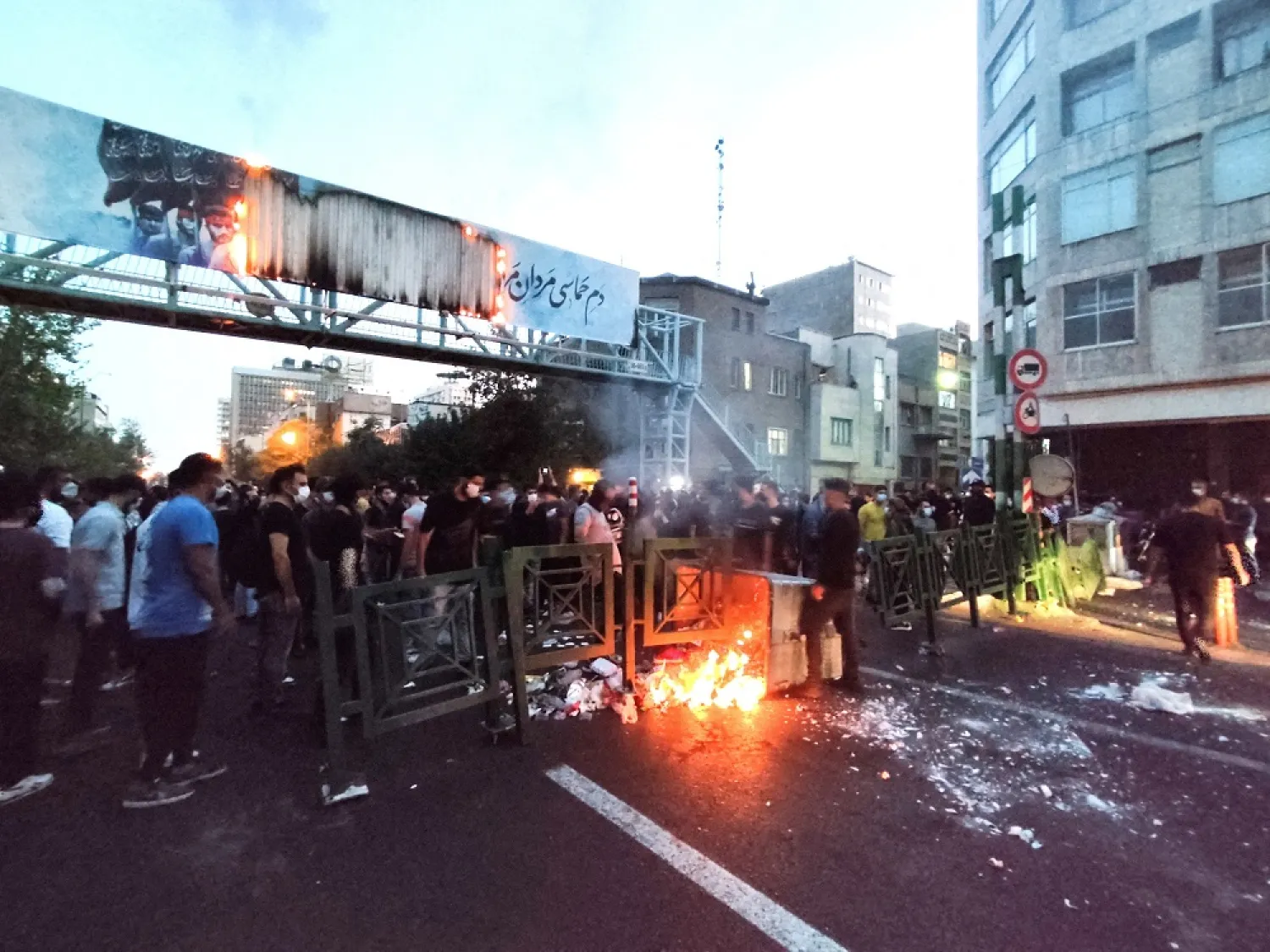
People light a fire during a protest over the death of Mahsa Amini, a woman who died after being arrested by the country's "morality police", in Tehran, Iran September 21, 2022. (West Asia News Agency via Reuters)
TT

Iran Vows ‘No Leniency’ against Wave of Women-Led Protests

People light a fire during a protest over the death of Mahsa Amini, a woman who died after being arrested by the country's "morality police", in Tehran, Iran September 21, 2022. (West Asia News Agency via Reuters)

Iran's judiciary chief vowed no leniency Sunday against the wave of unrest that has rocked the country since the death of young Kurdish woman Mahsa Amini in the custody of the morality police.

The warning from Gholamhossein Mohseni Ejei came after nine nights of protests and street clashes, and it echoed earlier comments by Iran's ultra-conservative President Ebrahim Raisi.

At least 41 people have died so far, mostly protesters but including members of the country's security forces, according to an official toll, although human rights groups say the real figure is higher.

The judiciary chief "emphasized the need for decisive action without leniency" against the core instigators of the "riots", the judiciary's Mizan Online website said.

Hundreds of demonstrators, reformist activists and journalists have been arrested amid the mostly night-time demonstrations that have spread to scores of cities since unrest first broke out after Amini's death on September 16.

Security forces have fired live rounds and bird shots, rights groups charge, while protesters have hurled rocks, torched police cars, set ablaze state buildings, and shouted "death to the dictator".

Iran's largest protests in almost three years have been led by women, triggered by anger over the republic's strictly enforced gender-based dress code.

Amini, whose Kurdish first name was Jhina, was arrested on September 13 for allegedly breaching the rules that mandate tightly-fitted hijab head coverings and which ban, among other things, ripped jeans and brightly colored clothes.

Some Iranian women protesters have since removed and burnt their hijabs in the rallies and cut off their hair, some dancing near large bonfires to the applause of crowds that have chanted "zan, zendegi, azadi" or "woman, life, freedom".

'Outrage and hope'
Iranian Academy Award-winning filmmaker Asghar Farhadi was the latest to add his voice of support for Iran's "progressive and courageous women leading protests for their human rights alongside men".

"I saw outrage and hope in their faces and in the way they marched in the streets," he said in a video message on Instagram. "I deeply respect their struggle for freedom."

The world has learnt of the violence largely through shaky mobile phone footage posted on social media, even as authorities have throttled internet access.

Web monitor NetBlocks reported that Mobinnet, one of Iran's largest network operators, saw a "nation-scale disruption", with WhatsApp, Instagram and Skype having already been blocked.

This followed older bans on Facebook, Twitter, TikTok and Telegram.

Protests abroad have been held in solidarity with Iranian women in Athens, Berlin, Brussels, Istanbul, Madrid, New York and Paris, among other cities.

'Foreign plots'
Iran -- which is ruled by supreme leader Ali Khamenei, 83, and which has been hit with tough economic sanctions over its nuclear program -- has blamed "foreign plots" for the unrest.

The foreign ministry said Sunday it had summoned Britain's ambassador over what it described as an "invitation to riots" by Farsi-speaking media based in London, and Norway's envoy over "unconstructive comments" made by his country's parliament speaker.

Foreign ministry spokesman Hossein Amir-Abdollahian criticized "the US interventionist approach in the affairs of Iran... including its provocative actions in supporting the rioters".

Iran has also organized large rallies in defense of the hijab and conservative values.

Pro-government rallies were held Sunday, with the main event taking place in Enghelab (Revolution) Square in central Tehran, where demonstrators voiced support for mandatory hijab laws.

"Martyrs died so that this hijab will be on our head," said demonstrator Nafiseh, 28, adding that she was opposed to making the wearing of the hijab voluntary.

Another demonstrator, 21-year-old student Atyieh, called for "strong action against the people who are leading" the protests.

The main reformist group inside Iran, the Union of Islamic Iran People's Party, however, has called for the repeal of the mandatory dress code.

Human rights groups based abroad have sought to shine light on the turmoil rocking Iran, citing their own sources in the country.

Oslo-based group Iran Human Rights has put the death toll at 54, excluding security personnel.

Iranian authorities have yet to state the cause of death of Amini, who activists say died as a result of a blow to the head.

Interior Minister Ahmad Vahidi has said Amini was not beaten and that "we must wait for the final opinion of the medical examiner".



US Suspends Flights at El Paso Airport for 'Special Security Reasons'

FILE - A Federal Aviation Administration sign hangs in the tower at John F. Kennedy International Airport in New York, March 16, 2017. (AP Photo/Seth Wenig, File)
TT

US Suspends Flights at El Paso Airport for 'Special Security Reasons'

FILE - A Federal Aviation Administration sign hangs in the tower at John F. Kennedy International Airport in New York, March 16, 2017. (AP Photo/Seth Wenig, File)

The top US aviation agency said Tuesday it is stopping all flights to and from El Paso International Airport in Texas for 10 days over unspecified "security reasons."

The flight restrictions are in effect from 11:30 pm on Tuesday (0630 GMT Wednesday) until February 20 for the airspace over El Paso and an area in neighboring New Mexico's south, according to the Federal Aviation Administration (FAA).

"No pilots may operate an aircraft in the areas" covered by the restrictions, the FAA said in a notice, citing "special security reasons" without elaborating.

El Paso International Airport in a social media post said all flights, "including commercial, cargo and general aviation," would be impacted by the move.

The airport, which is served by major US airlines like Delta, American and United, encouraged travelers to "contact their airlines to get most up-to-date flight status information."

In a separate statement to the New York Times, it said that the restrictions had been issued "on short notice" and that it was waiting for guidance from the FAA.


Russia Says It Won’t Breach Limits of Expired Nuclear Treaty if US Does the Same 

Russian Foreign Minister Sergei Lavrov reacts during a meeting with Tanzanian Minister of Foreign Affairs and East African Cooperation Mahmoud Thabit Kombo (not pictured), in Moscow, Russia, 09 February 2026. (EPA)
TT

Russia Says It Won’t Breach Limits of Expired Nuclear Treaty if US Does the Same 

Russian Foreign Minister Sergei Lavrov reacts during a meeting with Tanzanian Minister of Foreign Affairs and East African Cooperation Mahmoud Thabit Kombo (not pictured), in Moscow, Russia, 09 February 2026. (EPA)

Russia will keep observing the missile and warhead limits in the New START nuclear treaty with the United States, which expired last week, as long as Washington continues to do the same, Foreign Minister Sergei Lavrov said on Wednesday.

The 2010 treaty ran out on February 5, leaving the world's two biggest ‌nuclear-armed powers ‌with no binding constraints on their ‌strategic ⁠nuclear arsenals for ⁠the first time in more than half a century.

US President Donald Trump declined a formal proposal from Russian President Vladimir Putin to voluntarily abide by the New START limits for another year. ⁠Lavrov said Moscow would stick ‌to the limits ‌itself for now anyway.

"Our position is that this ‌moratorium on our side that ‌was declared by the president is still in place, but only as long as the United States doesn't exceed the said limits," ‌Lavrov told parliament's lower house, the State Duma.

The treaty's expiry has ⁠spurred ⁠fears of a three-way arms race involving Russia, the US and China, which has far fewer warheads than the other two countries but is arming rapidly.

Some analysts say, however, that Russia is keen to avoid the cost of such a contest at a time when its state budget is feeling the strain from its four-year-old war in Ukraine.


After Vance Visit, the Kremlin Says Russia Will Develop Ties with Armenia and Azerbaijan 

A handout photo made available by the Press Service of the President of the Republic of Azerbaijan shows Azerbaijan's President Ilham Aliyev (R) and US Vice President JD Vance (L) during a meeting in Baku, Azerbaijan, 10 February 2026. (EPA/Azerbaijan Presidential Press Service Handout)
TT

After Vance Visit, the Kremlin Says Russia Will Develop Ties with Armenia and Azerbaijan 

A handout photo made available by the Press Service of the President of the Republic of Azerbaijan shows Azerbaijan's President Ilham Aliyev (R) and US Vice President JD Vance (L) during a meeting in Baku, Azerbaijan, 10 February 2026. (EPA/Azerbaijan Presidential Press Service Handout)

Russia intends to further develop its relations with both Armenia and Azerbaijan, the Kremlin said on Wednesday, after US Vice President JD Vance visited the two South Caucasus nations.

The United States and Azerbaijan signed a strategic partnership, and Vance signed a nuclear deal with Armenia which operates an ageing ‌Soviet-era nuclear ‌power plant and is ‌looking to ⁠commission a new ⁠one.

Kremlin spokesman Dmitry Peskov said Azerbaijan and Armenia were sovereign countries who had the right to develop their own foreign policies and that Moscow had deep mutually-beneficial ties with both nations.

"We have ⁠a huge range of bilateral ‌relations with both Baku ‌and Yerevan, covering all possible areas. These ‌include mutually beneficial trade and economic cooperation, ‌mutual investments, cultural relations, and so on.

"And, of course, we intend to further develop our relations with our partners so that they ‌are beneficial not only for us, but also for them."

Peskov said ⁠Russia ⁠was well placed to tender for any new nuclear power plant in Armenia.

"As the most advanced country in the world in this field, Russia is capable of withstanding the highest level of international competition," said Peskov. "If such competition is demanded by partners, Russia is capable of providing better quality for many years to come at a lower cost."