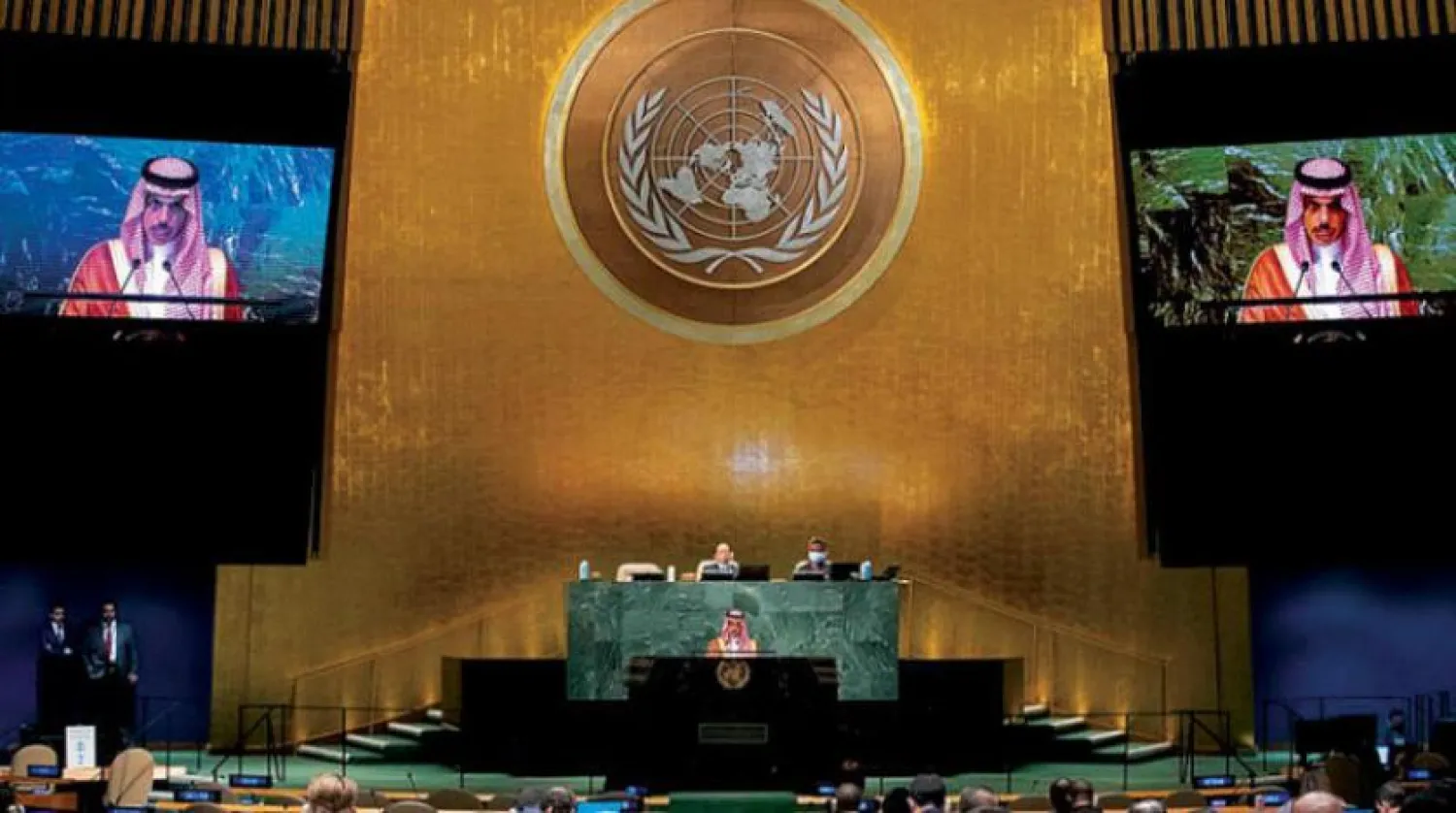

Saudi Minister of Foreign Affairs Prince Faisal bin Farhan confirmed the Kingdom's commitment to the UN charter and its continuous support for the principles of international legitimacy aimed at maintaining international peace and security.
The Minister called for cooperation based on mutual respect for the sovereignty and independence of states, resolving disputes by peaceful means, and not resorting to the threat of force.
Prince Faisal explained in the speech he delivered on Saturday before the 77th UN General Assembly that the Kingdom's participation in the founding of the United Nations and the signing of the San Francisco Charter is in line with the teachings of the true Islamic religion and authentic Arab traditions.
- Security Council reform
The Saudi minister renewed his country's call for reforming the Security Council to enable the organ to be fairer, more representative of today's world, and better able to address common challenges.
The Kingdom will continue to support multilateral international action within the framework of the UN principles to enhance international cooperation and actively participate and take the initiative in everything that contributes to a more peaceful and just world and achieve a promising future.
The Minister also renewed Saudi Arabia's emphasis on returning to the voice of reason and activating channels of dialogue, negotiation, and peaceful solutions to stop the fighting, protect civilians, and provide opportunities for peace, security, and development.
He stressed the need for dialogue to silence the guns, protect civilians, and provide prospects for peace and development, welcoming all efforts to reach a political solution to end the Russian Federation-Ukraine crisis.
He referred to his country's position supporting all international efforts, noting that the crisis needed to be resolved through a political solution to protect civilians.
He indicated that the Middle East is in dire need of combined efforts to ensure a future commensurate with the aspirations of the region's people, noting that the Jeddah Security and Development Summit "reflects our common affirmation" on the importance of "collective action for the stability of the Middle East."
The Summit also showed full support for the UN efforts to resolve conflicts peacefully, and joint determination to enhance regional and international interdependence and integration.
Bin Farhan stressed the importance of intensifying cooperation within the framework of the UN Charter, based on respect for states' sovereignty, non-interference in their internal affairs, and respect for independence.
- Middle East security
The top Saudi diplomat affirmed that the security and stability of the Middle East region require an acceleration in finding a just and comprehensive solution to the Palestinian issue following international legitimacy resolutions and the Arab Peace Initiative.
"Middle East security relies upon a solution to the Palestinian issue according to the 1967 borders."
The Kingdom condemns all unilateral measures that undermine the two-state solution and calls for its immediate and complete halt.
On the Yemeni issue, bin Farhan reiterated the Kingdom's commitment to supporting all efforts to consolidate the armistice and enable the Presidential Leadership Council to perform its roles.
He also underlined the importance of the truce in Yemen to bring peace under relevant Security Council resolutions and noted that the Kingdom continues to meet Yemen's humanitarian and development needs.
However, obstacles to importing basic foodstuffs and aid must be lifted, and the roads near the besieged city of Taiz must be opened.
Saudi Arabia also supports security and stability in Iraq and has worked to develop various aspects of cooperation bilaterally and collectively, and is currently working to reinforce their cooperation, particularly concerning electricity.
The Foreign Minister drew attention to the need to confirm adherence to Security Council resolutions to preserve Syria's unity and stability and supports the Special Envoy's efforts to bring about a political solution to the conflict in Syria under Security Council resolution 2254 (2015).
He emphasized the need to prevent renewed violence, maintain ceasefire agreements, and allow humanitarian aid to reach all Syrians in need.
Bin Farhan affirmed his country's support for Lebanon's sovereignty, security, and stability, stressing the importance of implementing comprehensive structural political and economic reforms that ensure the country overcomes its political and economic crisis.
He said: "Lebanon should not be a starting point for the export of drugs and weapons."
On the Sudanese issue, he said Saudi Arabia continues to encourage dialogue between the Sudanese parties, wishing Sudan and its people stability and prosperity.
"We support the water security of Egypt and Sudan."
Saudi Arabia renewed its full support for the Libyan ceasefire agreement, calling for economic and structural reforms to help the country emerge from its current crisis.
He stressed that the country could not become a breeding ground for terrorism and drug trafficking, as this would destabilize the region.
Bin Farhan called for the departure of foreign forces, fighters, and mercenaries without delay, per Security Council Resolution 2570.
He stressed the need to ensure humanitarian support for Afghanistan, which also must not become a base for terrorist operations.
- Non-Proliferation of Nuclear Weapons
The Saudi minister urged the international community to work to prevent the spread of nuclear weapons, emphasizing that international peace and security cannot be achieved with weapons of mass destruction.
He called on the international community to counter the proliferation of weapons and to make the Middle East an area free from the same, noting that international peace and security cannot be achieved through an arms race or possession of weapons of mass destruction but rather through international cooperation to achieve development and progress.
The Minister called on Iran to urgently fulfill its nuclear commitments, cooperate with the International Atomic Energy Agency (IAEA), and take serious steps to build confidence with its neighbors and the international community.
He pointed out that humanity faces common challenges threatening opportunities for economic recovery after the pandemic, most notably the security and adequacy of food and energy supplies, the resilience of supply chains, environmental challenges, and climate change.
"We're keen to support the global economic recovery by contributing to maintaining the balance of energy markets."
- Climate change challenges
The Foreign Minister affirmed the Kingdom's great interest and awareness of the importance of dealing with the challenges of climate change and the need to address its adverse effects and contribute to achieving the goals of the Paris Agreement.
The Kingdom effectively and responsibly supports the requirements of a gradual and responsible transition towards more sustainable and diversified energy systems and sources.
"Achieving these goals requires everyone's participation, taking into account the different national and regional conditions and the comprehensive economic and social goals of sustainable development, enhancing global energy security, and ensuring energy access for all."
Prince Faisal said Saudi Arabia had launched the Saudi Green Initiative and Green Middle East Initiative to promote clean energy and plans to reduce its annual emissions by 2030 and achieve carbon neutrality by 2060.
- Balance of the energy markets
Prince Faisal said: "We're keen to support the global economic recovery by contributing to maintaining the balance of energy markets."
He stressed the importance of investing in fossil energy and its clean technologies over the next two decades to meet the growing global demand and spare the world the adverse effects of unrealistic policies.
"The unrealistic policies aim to exclude the main energy sources without regard to the negative effects on global supply chains, inflation, high energy prices, increased unemployment rates, and other social, economic and security effects."
Saudi Arabia is working with its international partners to mitigate the adverse effects of armed conflicts and their repercussions on food security.
He stressed the importance of facilitating the export of grains and foodstuffs because of the increased food prices, which will push many to face the threat of starvation.
The Kingdom has made significant contributions, with a total of $2.89 billion in food and agricultural security assistance.
Saudi Arabia and regional partners allocated $10 billion for food security in coordination with ten national and regional development funds.
- Countering Terrorism
The Foreign Minister indicated that the international community succeeded in countering terrorism and extremism and must continue to work to confront and eradicate this scourge that has nothing to do with any race or religion.
He reiterated the need for the international community to confront the countries that support and sponsor terrorism and extremism and seek to exploit their extremist ideologies for expansion, creating chaos and destruction.
Saudi Arabia continues its efforts to build and develop to meet the aspirations of its future generations, improve the quality of life, contribute to the empowerment of women and youth, develop creativity and innovation, and establish the values of openness, dialogue, tolerance, and coexistence.
"The Kingdom attaches great importance to human rights, and its regulations have included explicit texts aimed at promoting and protecting these rights," he said.
Prince Faisal said the request to host the Expo 2030 under the theme "The Era of Change: Together for a Foresighted Tomorrow" was inspired by the ambitious Saudi vision.
"If the Kingdom wins the organization of the Expo, it will work to restore this exhibition to its original idea for which the Expo was established and to explore the future of the planet and the advanced technology that this future hold, including the sustainable development goals."
Prince Faisal also thanked all countries that have announced their support for the Kingdom's bid.