

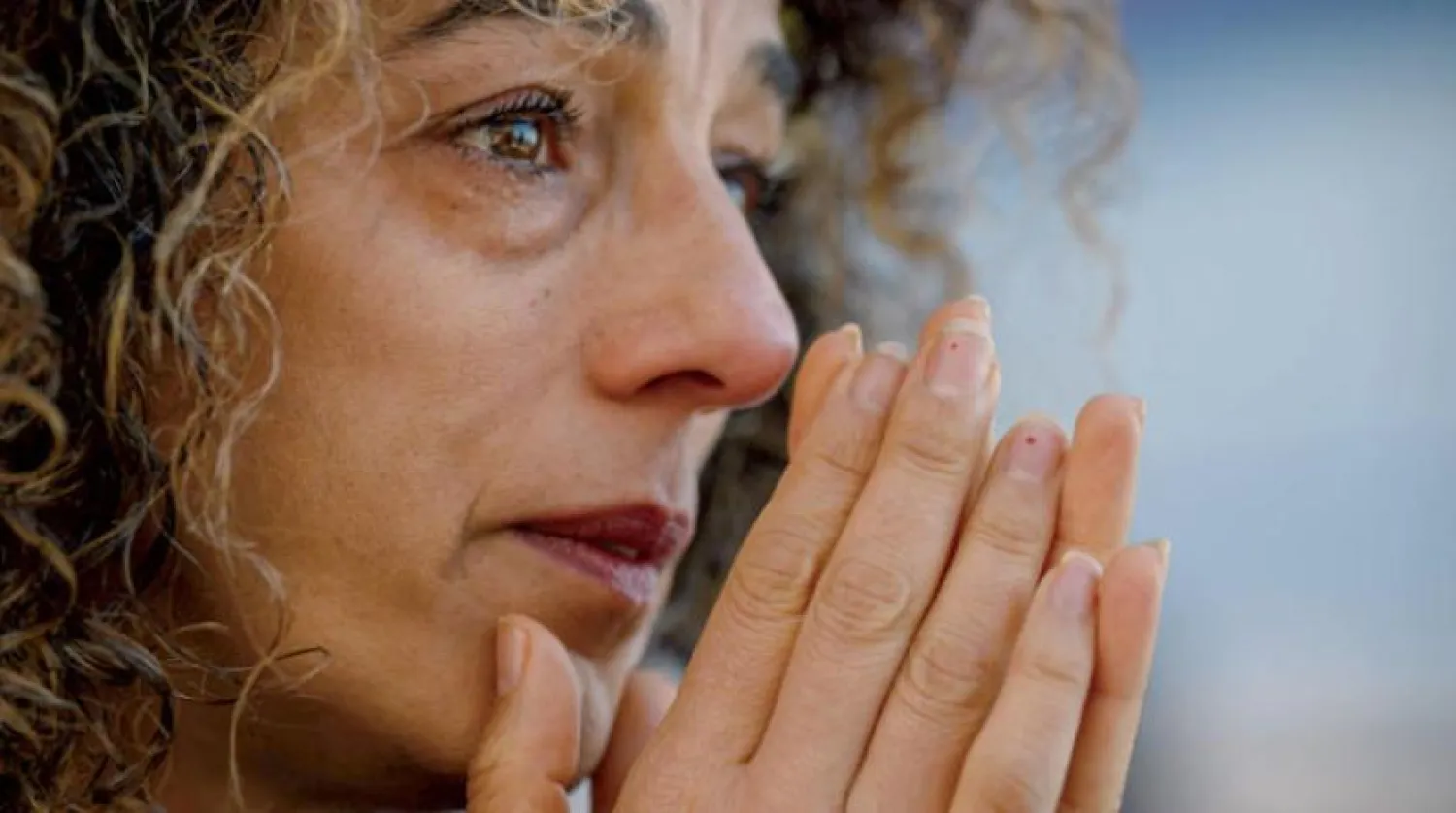

Activist: Veil Protests Present Iran with its 'Berlin Wall' Moment

 Iranian-American activist Masih Alinejad. AFP
Iranian-American activist Masih Alinejad. AFP
TT

Activist: Veil Protests Present Iran with its 'Berlin Wall' Moment

 Iranian-American activist Masih Alinejad. AFP
Iranian-American activist Masih Alinejad. AFP

Iran may use the veil as a tool of oppression, but the hijab is also the weakest pillar of an embattled regime trying to forestall its own "Berlin Wall" moment, an Iranian-American activist based in New York tells AFP.

Masih Alinejad, 45, who fled Iran in 2009, became known in 2014 after she launched a social media campaign called mystealthyfreedom.org that encourages Iranian women to protest against the obligation to wear the hijab in their country.

In her opinion, Iranian women rejecting the mandatory hijab will have a similar effect as the fall of the Berlin Wall in 1989, which marked the beginning of the end of the Soviet Union.

The journalist and activist now has 500,000 followers on Twitter and eight million followers on Instagram, where she posts dozens of photos or videos every day of Iranian women removing their hijab or images of the violent repression in her homeland.

She has become a voice in exile for the protests that have rocked Iran since their initial spark: the death on September 16 of 22-year-old Mahsa Amini at the hands of morality police in Tehran.

Alinejad's public standing increased markedly in mid-2021, when US prosecutors indicted four "Iranian intelligence agents" for plotting in 2018 to kidnap her and whisk her back to Iran, where one of her brothers was also imprisoned.

"To me, the compulsory hijab is like the Berlin Wall. If we tear this wall down, the Islamic Republic won't exist," Alinejad told AFP, a flower peeking out from her curly and voluminous hair.

The comparison with the toppling of the Berlin Wall is dear to her and clearly needles Iran's supreme leader Ali Khamenei, who in a speech this week said "US political elements" making the analogy do not feel sorry "for the death of a young girl," but instead have broader political aims.

"That actually shows you that compulsory hijab is the weakest pillar of the Islamic Republic. That is why the regime is really scared of this revolution," Alinejad said.

She argued that if Iranian women succeed in saying no "to those who are telling them what to wear, these women will be more powerful to say no to (a) dictator."

The crackdown on the demonstrations caused the death of dozens of people, human rights organizations say.

The hijab "is a tool to oppress us... to control women" and "to control the whole society through women," Alinejad said.

Iran's TikTok generation is protesting the use of women's bodies as "a political platform for our government, for the Islamic regime to write its own ideology."

Far from her country of birth, Alinejad has found employment as host of a program on the Persian service of Voice of America, the US government-funded outlet. She's also faced criticism on social media for taking a hard line opposing any negotiation with Tehran on nuclear issues. Some see her as serving US interests and feeding Islamophobia.

She offers a tart response that brings tears to her eyes: "I invite them all to go to Afghanistan, to go to Iran."

Alinejad says fear has been a constant presence both inside Iran and abroad.

Exiled life in the United States holds its own dangers. "I'm not safe here in America," she said, recalling the 2018 kidnapping attempt against her.

More recently, in late July, a man was arrested after loitering around her home in Brooklyn. The FBI found a Kalashnikov in his car. Since then, the activist has had to move.



Iran Warns Will Not Give Up Enrichment Despite US War Threat

Traffic moves through a street in Tehran on February 7, 2026. (Photo by ATTA KENARE / AFP)
TT

Iran Warns Will Not Give Up Enrichment Despite US War Threat

Traffic moves through a street in Tehran on February 7, 2026. (Photo by ATTA KENARE / AFP)

Iran will never surrender the right to enrich uranium, even if war "is imposed on us,” its foreign minister said Sunday, defying pressure from Washington.

"Iran has paid a very heavy price for its peaceful nuclear program and for uranium enrichment," Abbas Araghchi told a forum in Tehran.

"Why do we insist so much on enrichment and refuse to give it up even if a war is imposed on us? Because no one has the right to dictate our behavior," he said, two days after he met US envoy Steve Witkoff in Oman.

The foreign minister also declared that his country was not intimidated by the US naval deployment in the Gulf.

"Their military deployment in the region does not scare us," Araghchi said.


Washington Post Publisher Will Lewis Stepping Down Days after Big Layoffs

A person walks outside The Washington Post headquarters in Washington, DC, USA, 04 February 2026. EPA/JIM LO SCALZO
TT

Washington Post Publisher Will Lewis Stepping Down Days after Big Layoffs

A person walks outside The Washington Post headquarters in Washington, DC, USA, 04 February 2026. EPA/JIM LO SCALZO

Washington Post publisher Will Lewis said Saturday that he’s stepping down, ending a troubled tenure three days after the newspaper said that it was laying off one-third of its staff.

Lewis announced his departure in a two-paragraph email to the newspaper's staff, saying that after two years of transformation, “now is the right time for me to step aside.” The Post's chief financial officer, Jeff D'Onofrio, was appointed temporary publisher, The Associated Press reported.

Neither Lewis nor the newspaper's billionaire owner Jeff Bezos participated in the meeting with staff members announcing the layoffs on Wednesday. While anticipated, the cutbacks were deeper than expected, resulting in the shutdown of the Post's renowned sports section, the elimination of its photography staff and sharp reductions in personnel responsible for coverage of metropolitan Washington and overseas.

They came on top of widespread talent defections in recent years at the newspaper, which lost tens of thousands of subscribers following Bezos' order late in the 2024 presidential campaign pulling back from a planned endorsement of Kamala Harris, and a subsequent reorienting of its opinion section in a more conservative direction.

Martin Baron, the Post’s first editor under Bezos, condemned his former boss this week for attempting to curry favor with President Donald Trump and called what has happened at the newspaper “a case study in near-instant, self-inflicted brand destruction.”

The British-born Lewis was a former top executive at The Wall Street Journal before taking over at The Post in January 2024. His tenure has been rocky from the start, marked by layoffs and a failed reorganization plan that led to the departure of former top editor Sally Buzbee.

His initial choice to take over for Buzbee, Robert Winnett, withdrew from the job after ethical questions were raised about both he and Lewis' actions while working in England. They include paying for information that produced major stories, actions that would be considered unethical in American journalism. The current executive editor, Matt Murray, took over shortly thereafter.

Lewis didn't endear himself to Washington Post journalists with blunt talk about their work, at one point saying in a staff meeting that they needed to make changes because not enough people were reading their work.

This week's layoffs have led to some calls for Bezos to either increase his investment in The Post or sell it to someone who will take a more active role. Lewis, in his note, praised Bezos: “The institution could not have had a better owner,” he said.

“During my tenure, difficult decisions have been taken in order to ensure the sustainable future of The Post so it can for many years ahead publish high-quality nonpartisan news to millions of customers each day,” Lewis said.

The Washington Post Guild, the union representing staff members, called Lewis' exit long overdue.

“His legacy will be the attempted destruction of a great American journalism institution,” the Guild said in a statement. “But it’s not too late to save The Post. Jeff Bezos must immediately rescind these layoffs or sell the paper to someone willing to invest in its future.”

Bezos did not mention Lewis in a statement saying D'Onofrio and his team are positioned to lead The Post into “an exciting and thriving next chapter.”

“The Post has an essential journalistic mission and an extraordinary opportunity,” Bezos said. “Each and every day our readers give us a roadmap to success. The data tells us what is valuable and where to focus.”

D'Onofrio, who joined the paper last June after jobs at the digital ad management company Raptive, Google, Zagat and Major League Baseball, said in a note to staff that "we are ending a hard week of change with more change.

“This is a challenging time across all media organizations, and The Post is unfortunately no exception,” he wrote. “I've had the privilege of helping chart the course of disrupters and cultural stalwarts alike. All faced economic headwinds in changing industry landscapes, and we rose to meet those moments. I have no doubt we will do just that, together.”


US Concerned About Expansion of Terrorism in Sahel, West Africa

Members of the Nigeria Armed Forces interact with residents following an attack in Woro, Kwara State, on February 5, 2026. (Photo by Light Oriye Tamunotonye / AFP)
TT

US Concerned About Expansion of Terrorism in Sahel, West Africa

Members of the Nigeria Armed Forces interact with residents following an attack in Woro, Kwara State, on February 5, 2026. (Photo by Light Oriye Tamunotonye / AFP)

The United States is concerned by the “expansion” of al-Qaeda affiliates in the Sahel and West Africa, including Jama'at Nusrat al-Islam wal-Muslimin (JNIM) and ISIS-Sahel’s territorial gains.

US Ambassador to the United Nations Mike Waltz shared the concern in his remarks at this week’s UN Security Council Briefing on Terrorist Threats to International Peace and Security caused by terrorist acts.

Highlighting JNIM and ISIS-Sahel’s territorial gains and use in particular of kidnapping for ransom, Waltz said the threats are increasingly diffuse and complex as they involve foreign fighters converging in multiple conflict zones.

The diplomat cited the latest Analytical Support and Sanctions Monitoring Team report, which showed that terror cells continue to adapt and exploit instability across Africa, the Middle East, and South Asia.

Waltz said ISIS’ growing focus on Africa, and the resilience of its cells in Syria and Iraq, and the persistent threat from ISIS-K in Afghanistan, truly reinforces the need for sustained, coordinated counterterrorism efforts.

Washington is particularly concerned by terrorist groups’ exploitation of new technologies, such as commercial satellite communications, artificial intelligence, drones and cryptocurrencies, he said.

“All of these further complicates the threat landscape and it requires our vigilance, vigilance from Member States and particularly where I think there is room for all of us to improve – is our coordination with the private sector as we face this threat,” Waltz added.

The ambassador called for further disruption of terrorist financing networks, saying the recent successes in Somalia and in West Africa demonstrate that following the money and stopping the money to these various groups can have bold decisive effects.

He said the US commends UN Member States whose counterterrorism operations have constrained ISIS and al-Qaeda, especially in Iraq, Syria, and Somalia.

He also urged all states to strengthen cooperation, including intelligence sharing and joint operations, and to support the effective implementation and evolution of the 1267 sanctions regime.

“Member States should collaborate on screening and information sharing to prevent terrorist movement across borders, in support of UN Security Council Resolution 2396,” Waltz noted.

Last November, the United Kingdom, which currently chairs the UN Security Council, expressed similar concern about the proliferation of terrorist groups in the Sahel and West Africa.

The US has sent a small team of troops to Nigeria, the general in charge of the US command for Africa said on Tuesday, the first acknowledgment of US forces on the ground since Washington struck by air on Christmas Day.

General Dagvin RM Anderson, head of the US military's Africa Command AFRICOM, said the US team was sent after both countries agreed that more needed to be done to combat the terrorist threat in West Africa.

“That has led to increased collaboration between our nations to include a small US team that brings some unique capabilities from the United States,” he told journalists during a press briefing in Dakar on Tuesday.