

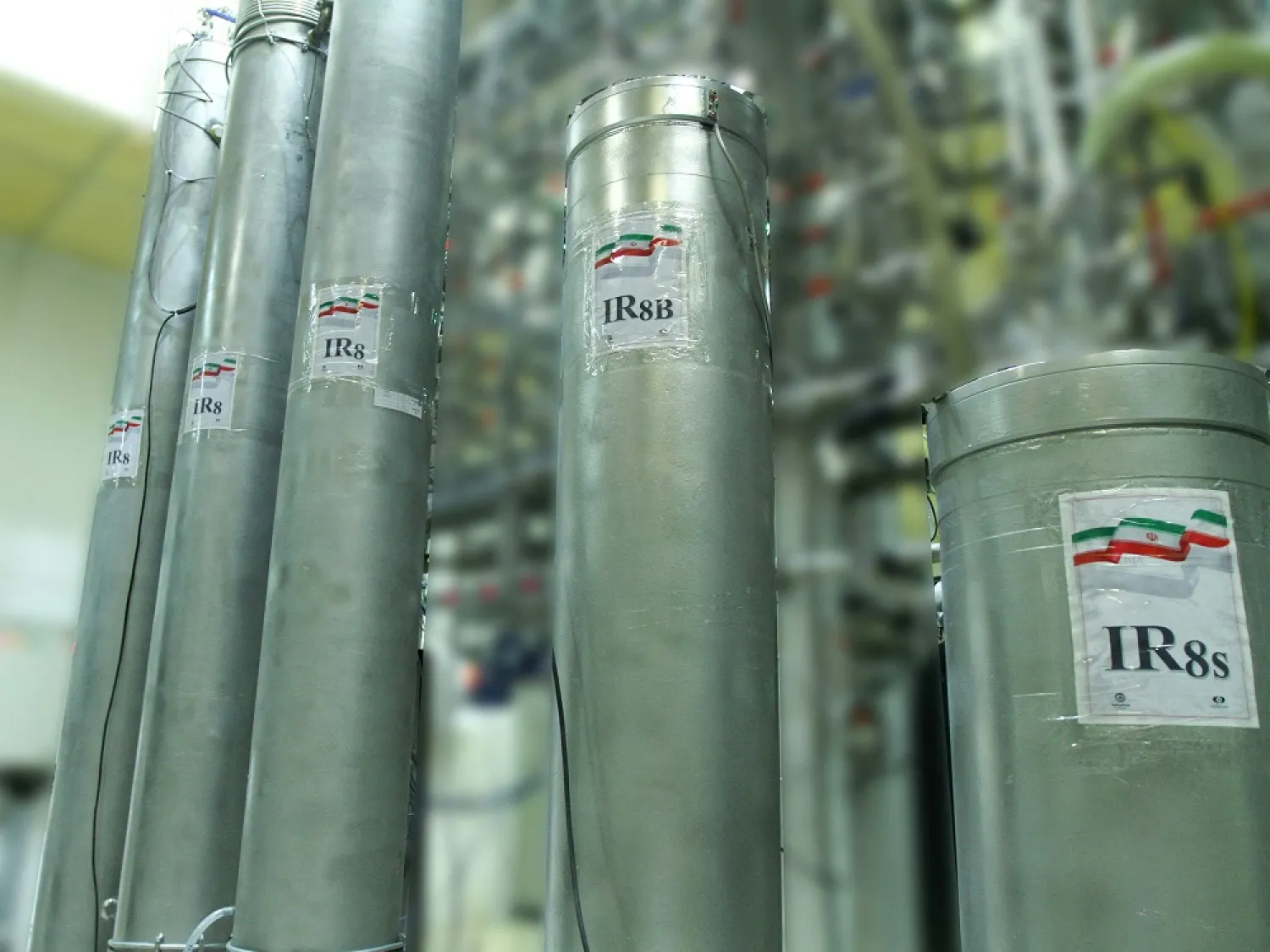

Iran Racing to Expand Enrichment at Underground Plant, IAEA Report Shows

A handout file photo, released by Iran's Atomic Energy Organization on November 4, 2019, shows the atomic enrichment facilities Natanz nuclear research center, some 300 kilometers south of capital Tehran. (Photo by Atomic Energy Organization of Iran / AFP)
TT

Iran Racing to Expand Enrichment at Underground Plant, IAEA Report Shows

A handout file photo, released by Iran's Atomic Energy Organization on November 4, 2019, shows the atomic enrichment facilities Natanz nuclear research center, some 300 kilometers south of capital Tehran. (Photo by Atomic Energy Organization of Iran / AFP)

Iran is rapidly expanding its ability to enrich uranium with advanced centrifuges at its underground plant at Natanz and now intends to go further than previously planned, a confidential UN nuclear watchdog report seen by Reuters showed on Monday.

While indirect talks between Iran and the United States on reviving the 2015 Iran nuclear deal have stalled, Tehran has brought onstream an ever larger number of advanced centrifuges the deal bans it from using to produce enriched uranium.

These machines are far more efficient than the first-generation IR-1, the only centrifuge that the deal lets Iran use to grow its stock of enriched uranium. Iran has been adding them particularly at two underground sites at Natanz and Fordow that may be designed to withstand potential aerial bombardment.

The third of three cascades, or clusters, of advanced IR-6 centrifuges recently installed at the underground Fuel Enrichment Plant (FEP) at Natanz has now come onstream, said the International Atomic Energy Agency report to member states.

Diplomats say the IR-6 is Iran's most advanced centrifuge.

Iran has also quickly completed the installation of seven cascades that were either not finished or at a very early stage of installation on Aug. 31, Monday's ad hoc report showed.

End-August marked the last visit by inspectors mentioned in the IAEA's most recent quarterly report.

Those seven cascades, one of IR-4 centrifuges and six of IR-2m machines, were fully installed but not yet enriching, Monday's report said.

Iran has also informed the IAEA it plans to add an extra three cascades of IR-2m machines at the FEP, on top of the 12 already announced and now installed, the report showed.

Of those three extra IR-2m cascades, installation has already started on two of them, the report said.

The report also showed that all the centrifuges enriching at Natanz were still producing uranium hexafluoride (UF6) gas enriched to up to 5% but now they were being fed with natural UF6. That contrasted to the quarterly report issued in September that said on Aug. 31 the centrifuges were being fed with UF6 enriched to up to 2%. It did not explain the change.

In 2018, then-President Donald Trump pulled the United States out of the Iran deal and re-imposed sanctions against Iran that the deal had lifted. Iran responded by breaching the restrictions on its nuclear activities imposed by the deal.

If the deal is revived Iran will have to put its advanced centrifuges into storage, diplomats say.



US Fires on Iran Tankers as Talks Hang in Balance

US and Iran flags are seen in this illustration taken June 18, 2025. REUTERS/Dado Ruvic/Illustration/File Photo
TT

US Fires on Iran Tankers as Talks Hang in Balance

US and Iran flags are seen in this illustration taken June 18, 2025. REUTERS/Dado Ruvic/Illustration/File Photo

A US warplane disabled two Iranian tankers to enforce a port blockade on Friday, after Washington's top diplomat said he was awaiting Tehran's response to the latest proposed deal to end the Gulf conflict.

US Central Command said an F/A-18 Super Hornet had used precision munitions on the two ships to prevent them from continuing to Iran, as Iranian media reported "sporadic clashes" with US vessels in the Strait of Hormuz, AFP reported.

The latest incidents came after an overnight exchange of fire that triggered fears of a breakdown in the Gulf ceasefire, and after US Secretary of State Marco Rubio told reporters in Rome that Washington hoped to receive Tehran's answer to the US proposal later on Friday.

Rubio said Iran must not control the Strait of Hormuz, where the flare-ups took place, but added: "We're expecting a response from them today at some point... I hope it's a serious offer, I really do."

Washington has sent Iran, via Pakistani mediators, a proposal to extend the truce in the Gulf to allow talks on a final settlement of the conflict launched 10 weeks ago with US-Israeli strikes on Tehran.

Iran's foreign ministry spokesman Esmaeil Baqaei said Friday that the proposal was still "under review, and once a final decision is reached, it will certainly be announced", according to the ISNA news agency.


Iran Says Redirects US-sanctioned Oil Tanker to Its Shores

FILE PHOTO: An aerial view of the Iranian shores and the island of Qeshm in the strait of Hormuz, December 10, 2023. REUTERS/Stringer/File Photo
TT

Iran Says Redirects US-sanctioned Oil Tanker to Its Shores

FILE PHOTO: An aerial view of the Iranian shores and the island of Qeshm in the strait of Hormuz, December 10, 2023. REUTERS/Stringer/File Photo

Iran said on Friday it redirected a US-sanctioned oil tanker carrying Iranian oil back to its shores, though it was unclear from its statement why it would have returned it, reported AFP.

"The Islamic Republic of Iran's navy, through a specially planned operation in the Sea of Oman, seized the offending tanker Ocean Koi," the army said in a statement carried by state television, adding that the oil belonged to Iran.

It said the ship was redirected to Iran's southern shores after it sought "to damage and disrupt Iran's oil exports," without elaborating.


Meloni Meets Rubio as Iran War Strains Italy-US Ties

US Secretary of State Marco Rubio leaves the San Damaso courtyard after meeting Pope Leo XIV at the Vatican, May 7, 2026. REUTERS/Yara Nardi
TT

Meloni Meets Rubio as Iran War Strains Italy-US Ties

US Secretary of State Marco Rubio leaves the San Damaso courtyard after meeting Pope Leo XIV at the Vatican, May 7, 2026. REUTERS/Yara Nardi

Italian Prime Minister Giorgia Meloni met US Secretary of State Marco Rubio on Friday at a moment of unusual strain between her government and President Donald Trump's administration, driven largely by the war with Iran.

Rubio is in Italy for a two-day trip aimed at easing ties with Pope Leo after unprecedented attacks on the pontiff by Trump, while also addressing Washington's frustration over Italy's refusal to support the US-Israeli war on Iran.

Meloni had been one of Trump's firmest supporters in Europe, cultivating close ties with him and presenting herself as a natural ‌bridge between Washington ‌and other EU states that had no natural political ‌affinity ⁠with the Republican ⁠US leader.

But that alignment has come under increasing strain in recent months, as the Iran war has forced her to balance loyalty to the United States against Italian public animosity to the war and the growing economic cost of the conflict.

Before heading to the prime minister's office, Rubio met Italy's Foreign Minister Antonio Tajani, who said the talks had been positive.

"I am convinced ⁠that Europe needs America, Italy needs America, but the United ‌States also needs Europe and Italy," Tajani ‌told reporters.

Meloni and Rubio were expected to discuss the situation in the Gulf, as ‌well as Russia's war on Ukraine, US tariffs on European goods and ‌the outlook for Cuba, which Washington is seeking to isolate both diplomatically and economically.

TRUMP'S ATTACKS ON POPE

The Italians will also be keen for a readout on Rubio's meetings at the Vatican. Trump's recent attacks on Pope Leo crossed a sensitive ‌line in overwhelmingly Catholic Italy and prompted Meloni to call them "unacceptable."

Her criticism in turn drew a sharp rebuke ⁠from Trump, who said ⁠she lacked courage and had let Washington down. He subsequently threatened to withdraw US troops from Italy.

Meloni said on Monday she would not support such a move, but acknowledged that the decision "doesn't depend on me".

Italy last month refused to allow US aircraft to use the Sigonella air base in Sicily for combat operations linked to the Iran conflict. Italian officials have said Washington had not sought prior authorization from Rome for the use of the site.

Defense Minister Guido Crosetto, a close Meloni ally, later warned that the Iran war was putting US global leadership at risk and said he feared the "madness" of nuclear escalation.

Pollsters say Meloni's ties to Trump could prove a potential liability with voters ahead of national elections due next year.