

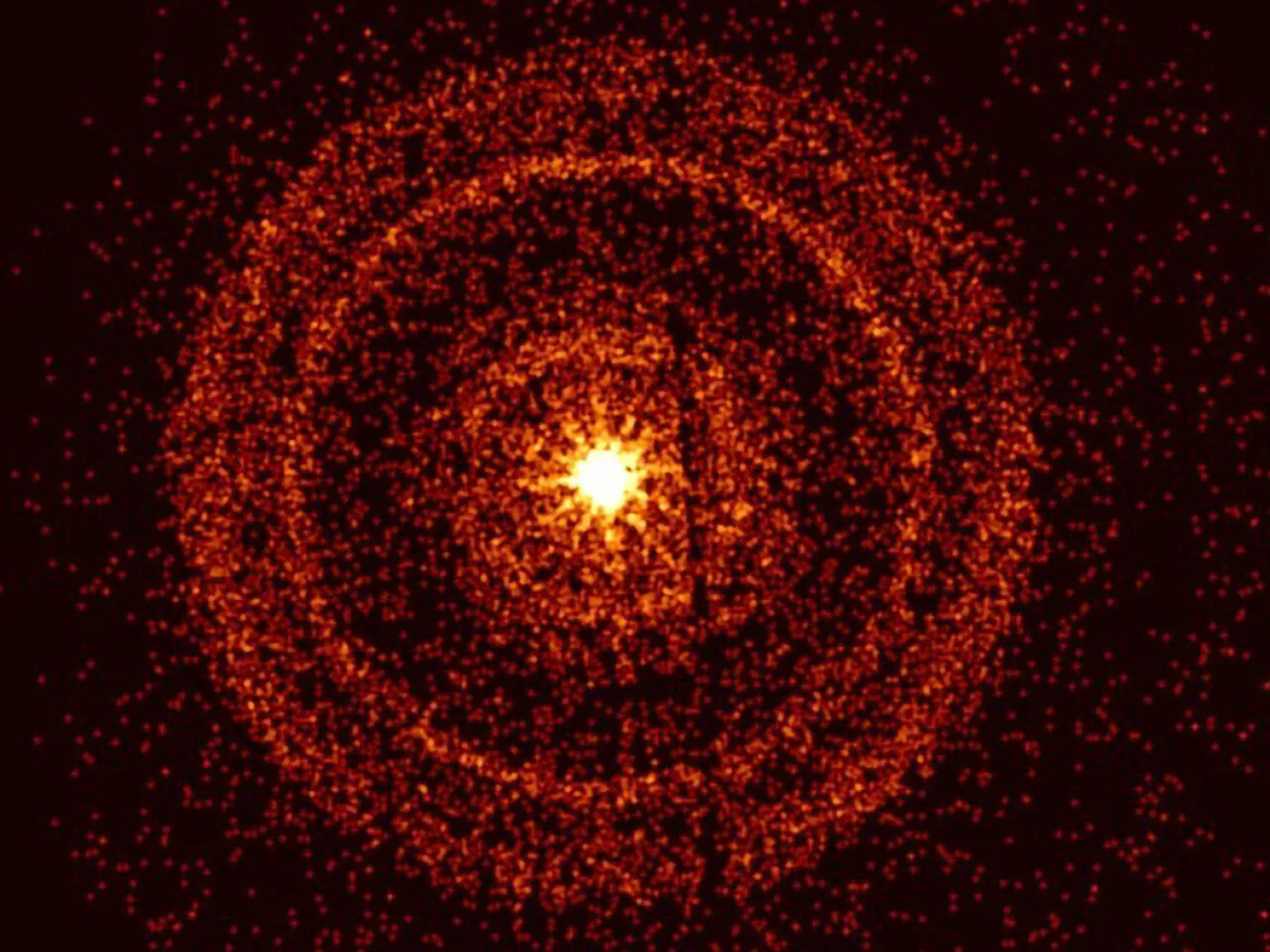

Astronomers are Captivated by Brightest Flash Ever Seen

This picture provided by NASA on October 14, 2022 shows the Swift’s X-Ray Telescope capturing the afterglow of GRB 221009A about an hour after it was first detected Handout NASA/Swift/A. Beardmore (University of Leicester)/AFP
TT

Astronomers are Captivated by Brightest Flash Ever Seen

This picture provided by NASA on October 14, 2022 shows the Swift’s X-Ray Telescope capturing the afterglow of GRB 221009A about an hour after it was first detected Handout NASA/Swift/A. Beardmore (University of Leicester)/AFP

Astronomers have observed the brightest flash of light ever seen, from an event that occurred 2.4 billion light years from Earth and was likely triggered by the formation of a black hole.

The burst of gamma-rays -- the most intense form of electromagnetic radiation -- was first detected by orbiting telescopes on October 9, and its afterglow is still being watched by scientists across the world, AFP said.

Astrophysicist Brendan O'Connor told AFP that gamma-ray bursts that last hundreds of seconds, as occurred on Sunday, are thought to be caused by dying massive stars, greater than 30 times bigger than our Sun.

The star explodes in a supernova, collapses into a black hole, then matter forms in a disk around the black hole, falls inside, and is spewed out in a jet of energy that travels at 99.99 percent the speed of light.

The flash released photons carrying a record 18 teraelectronvolts of energy -- that's 18 with 12 zeros behind it -- and it has impacted long wave radio communications in Earth's ionosphere.

"It's really breaking records, both in the amount of photons, and the energy of the photons that are reaching us," said O'Connor, who used infrared instruments on the Gemini South telescope in Chile to take fresh observations early Friday.

"Something this bright, this nearby, is really a once-in-a-century event," he added.

Gamma-ray research first began in the 1960s when US satellites designed to detect whether the Soviet Union was detonating bombs in space ending up finding such bursts originating from outside the Milky Way.

"Gamma-ray bursts in general release the same amount of energy that our Sun produces over its entire lifetime in the span of a few seconds -- and this event is the brightest gamma ray burst," said O'Connor.

This gamma-ray burst, known as GRB 221009A, was first spotted by telescopes including NASA's Fermi Gamma-ray Space Telescope, Neil Gehrels Swift Observatory, and Wind spacecraft on Sunday morning Eastern time.

- 1.9 billion-year-old movie -
It originated from the direction of the constellation Sagitta, and traveled an estimated 1.9 billion years to reach Earth -- less than the current distance of its starting point, because the universe is expanding.

Observing the event now is like watching a 1.9 billion-year-old recording of those events unfold before us, giving astronomers a rare opportunity to glean new insights into things like black hole formation.

"That's what makes this sort of science so addictive -- you get this adrenaline rush when these things happen," said O'Connor, who is affiliated with the University of Maryland and George Washington University.

Over the coming weeks, he and others will continue watching for the signatures of supernovas at optical and infrared wavelengths, to confirm that their hypothesis about the origins of the flash are correct, and that the event conforms to known physics.

Unfortunately, while the initial burst may have been visible to amateur astronomers, it has since faded out of their view.

Supernova explosions are also predicted to be responsible for producing heavy elements -- such as gold, platinum, uranium -- and astronomers will also be on the hunt for their signatures.

Astrophysicists have written in the past that the sheer power of gamma-ray bursts could cause extinction level events here on Earth.

But O'Connor pointed out that because the jets of energy are very tightly focused, and aren't likely to arise in our galaxy, this scenario is not something we should worry much about.



Louvre Thieves Escaped With 30 Seconds to Spare, Probe Reveals

The daring robbery at the Louvre took place in broad daylight © Dimitar DILKOFF / AFP
TT

Louvre Thieves Escaped With 30 Seconds to Spare, Probe Reveals

The daring robbery at the Louvre took place in broad daylight © Dimitar DILKOFF / AFP

The thieves who stole priceless crown jewels from the Louvre in October escaped with just 30 seconds to spare due to avoidable security failures at the Paris museum, a damning investigation revealed on Wednesday.

The probe, ordered by the culture ministry after the embarrassing daylight heist, revealed that only one of two security cameras was working near the site where the thieves broke in on the morning of Sunday October 19, according to AFP.

Agents in the security headquarters also did not have enough screens to follow the images in real-time, while a lack of coordination meant police were initially sent to the wrong place once the alarm was raised, the report unveiled at the French Senate's Culture Commission, stated.

"It highlights an overall failure of the museum, as well as its supervisory authority, to address security issues," the head of the commission, Laurent Lafon, said at the start of a hearing.

One of the most startling revelations was that the robbers left only 30 seconds before police and private security guards arrived on the scene.

"Give or take 30 seconds, the Securitas (private security) guards or the police officers in a car could have prevented the thieves from escaping," the head of the investigation, Noel Corbin, told senators.

He said that measures such as a modern security camera system, more resistant glass in the door cut open with angle grinders, or better internal coordination could have prevented the loss of the crown jewels -- worth an estimated $102 million -- which have still not been found.

Security risks were highlighted in several reports commissioned by management of the Louvre, including a 2019 audit by the jewellery company Van Cleef & Arpels.

The evaluation said the balcony used by the thieves was a weak point in security and could be reached by using an extendable ladder -- exactly what transpired in the heist.

Corbin confirmed that under-fire Louvre boss Laurence des Cars had been unaware of the audit which was carried out by her predecessor, Jean-Luc Martinez.

"The recommendations were not acted on and they would have enabled us to avoid this robbery," Corbin said, adding that there had been a lack of coordination between the two state-appointed administrators.

Police believe they have arrested all four thieves, who escaped on powerful motorbikes, having carried out the heist in the Apollo Gallery in around 10 minutes in total.

The revelations on Wednesday are likely to pile more pressure on des Cars, who was already facing calls to resign.


Prince Mohammed bin Salman Royal Reserve Launches Live Turtle Tracking Program

This data will fill a critical regional knowledge gap and drive unified, cross-border conservation strategies for these globally endangered species - SPA
TT

Prince Mohammed bin Salman Royal Reserve Launches Live Turtle Tracking Program

This data will fill a critical regional knowledge gap and drive unified, cross-border conservation strategies for these globally endangered species - SPA

In a milestone for marine conservation, Prince Mohammed bin Salman Royal Reserve has launched a live satellite tracking program for hawksbill and green turtles, including the first known tagging of a pre-nesting, egg-carrying green turtle in the Red Sea, SPA reported.

This data will fill a critical regional knowledge gap and drive unified, cross-border conservation strategies for these globally endangered species.

The team, led by Senior Marine Ecologist at Prince Mohammed bin Salman Royal Reserve Dr. Ahmed Mohammed and KAUST Beacon Development’s Senior Marine Megafauna Specialist Dr. Hector Barrios-Garrido, successfully in-water captured and tagged three critically endangered (IUCN) hawksbill turtles and seven green turtles. The tags transmit real-time movement data identifying foraging grounds, migratory corridors, and most crucially the nesting site of the egg-carrying green turtle, ensuring the appropriate protection and management is in place. The program continues the reserve’s long-term commitment to marine conservation, expanding its turtle nest monitoring and protection program in operation since 2023.

The reserve protects 4,000km² of Red Sea waters, 1.8% of the Kingdom’s marine area, and a coastline of 170km, the longest coastline under management by a single entity in the Kingdom. Linking NEOM and Red Sea Global, this forms an 800km corridor of protected Red Sea coastline. It is a refuge for five of the world’s seven turtle species and a breeding ground for green and hawksbill turtles. The reserve’s ranger teams monitor turtle activity both on shore and at sea, protecting nesting sites critical to natal homing, the biological instinct that drives turtles to return to the same beaches where they were born.

‘’Critically endangered hawksbill turtles face an extremely high risk of extinction in the wild within our lifetime. With fewer than 200 breeding-age females remaining in the Red Sea, their survival depends on closing vital knowledge gaps to enable their effective conservation,” said CEO of Prince Mohammed bin Salman Royal Reserve Andrew Zaloumis.

He added, “Hawksbill turtles hatching on the reserve’s protected beaches range across 438,000 km² of open sea bordered by eight MENA countries, before returning some three decades later to the same sandy beach to lay their eggs. Our satellite tagging and tracking program is a game-changer, providing the real-time data needed to identify their critical staging, foraging, and rookery areas across the Red Sea. The data will support national and regional conservation efforts to drive forward a much-needed unified ecosystem-wide turtle conservation management plan.’’

The reserve’s ongoing turtle conservation supports Saudi Arabia’s commitments under the UNEP Convention on Migratory Species and the IOSEA Marine Turtle Memorandum of Understanding by strengthening habitat protection and regional cooperation through scientific knowledge-sharing across the Red Sea.

Senior Marine Ecologist at the reserve Dr. Ahmed Mohammed stated, ‘’These state-of-the-art, lightweight tags are designed to operate for at least 12 months, providing continuous data that will enable detailed analysis of seasonal patterns, developmental habitats, and contribute valuable insights to regional and global sea turtle research. Additionally, depth sensors will reveal sea grass meadows, essential foraging grounds for green turtles and critical blue carbon sinks."

Despite the recent global reclassification of green turtles by the IUCN, regionally, they are still regarded as vulnerable and conservation dependent. All five marine turtle species resident in the Red Sea are listed under the Convention on Migratory Species (CMS), to which Saudi Arabia became a party in 1979. Turtles remain at risk from entanglement in fishing nets, habitat degradation, and illegal poaching. While these threats are absent within the reserve’s protected waters, ecosystem-wide management strategies that span political boundaries are necessary and the reserve continues to share data with the wider conservation and scientific community and partner with SHAMS on local and regional conservation strategies.

One of eight Royal Reserves, the 24,500 km² Prince Mohammed bin Salman Royal Reserve stretches from the lava plains of the Harrats to the deep Red Sea in the west, connecting NEOM, Red Sea Global, and AlUla. It is home to the Public Investment Fund's (PIF) Wadi Al Disah project and Red Sea Global’s Destination AMAALA.

The reserve encompasses 15 distinct ecosystems. At just 1% of the Kingdom’s terrestrial area and 1.8% of its marine area, it boasts over 50% of the Kingdom’s species, making it one of the most biodiverse protected areas in the Middle East.

Prince Mohammed bin Salman Royal Reserve is one of eight royal reserves established by royal decree and overseen by the Royal Reserves Council chaired by His Royal Highness Prince Mohammed bin Salman bin Abdulaziz Al Saud, Crown Prince and Prime Minister. The reserve’s program is integrated with Saudi Arabia’s wider sustainability and conservation programs, including the Saudi Green and Middle East Green Initiatives.


National Greening Program to Plant 400,000 Seedlings in North Riyadh Geopark

The projects falls in line with the objectives of the Kingdom’s Vision 2030 - SPA
TT

National Greening Program to Plant 400,000 Seedlings in North Riyadh Geopark

The projects falls in line with the objectives of the Kingdom’s Vision 2030 - SPA

The National Greening Program, affiliated with the National Center for Vegetation Cover Development and Combating Desertification (NCVC), has launched its first afforestation project in the North Riyadh Geopark, located in Thadiq Governorate.

The project aims to plant 400,000 seedlings by 2030 as part of the program’s efforts to help rehabilitate environmentally degraded sites, in line with the objectives of the Kingdom’s Vision 2030, SPA reported.

Representatives from government agencies, environmental associations, and some students and staff from the local schools participated in the first phase of the afforestation project.