

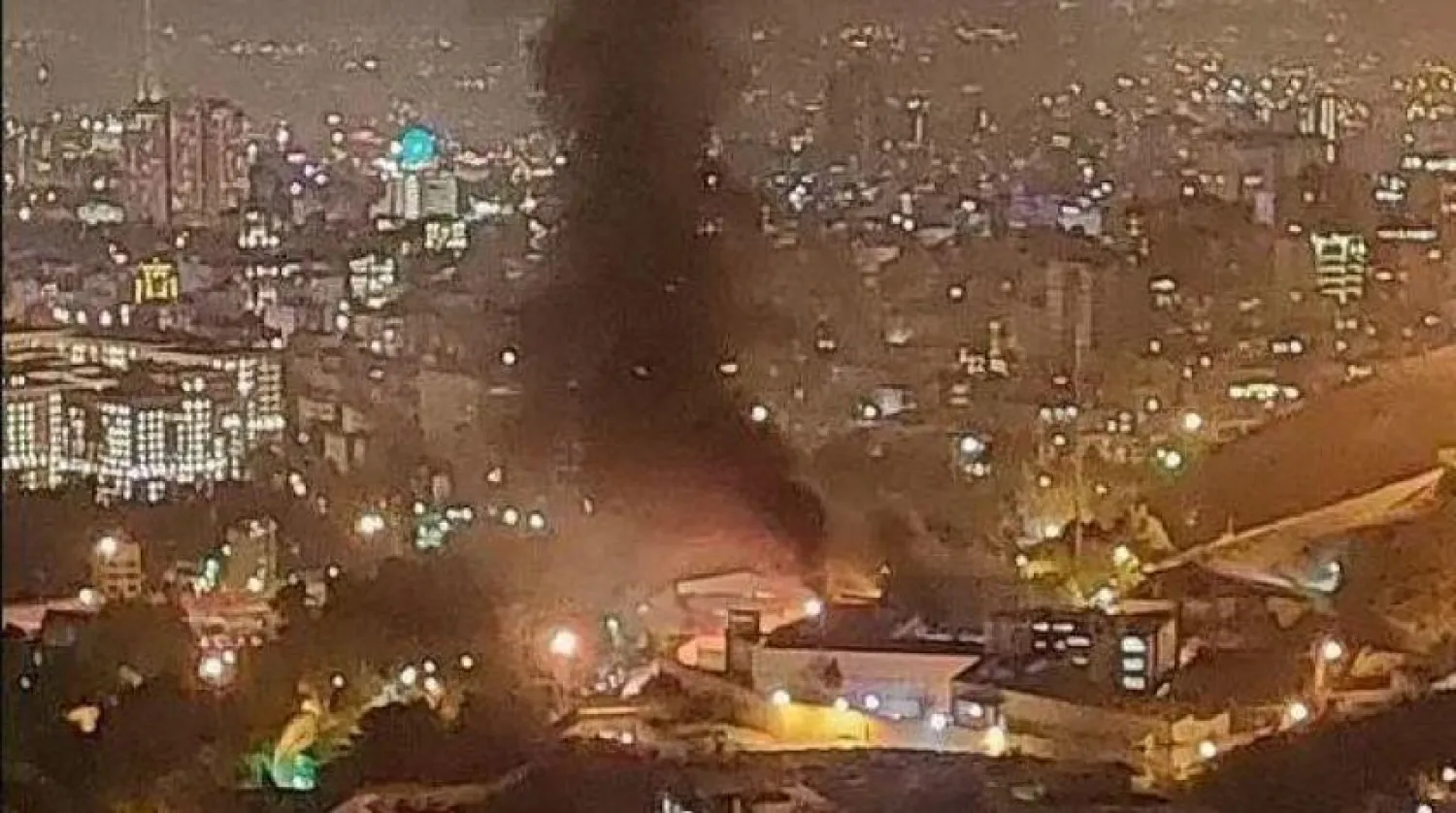

Fire, Clashes Erupt at Iran's Evin Prison

Flames and a plume of smoke could be seen billowing into the night sky. (Iranian media)
TT

Fire, Clashes Erupt at Iran's Evin Prison

Flames and a plume of smoke could be seen billowing into the night sky. (Iranian media)

A fire and clashes erupted at Tehran's notorious Evin prison Saturday night as the protest movement sparked by Mahsa Amini's death in custody entered a fifth week.

The facility in northern Tehran is infamous for the ill-treatment of political prisoners and also holds foreign detainees. Hundreds of those detained during the demonstrations over Amini's death have reportedly been sent there.

Flames and a plume of smoke could be seen billowing into the night sky, and the sound of what appeared to be gunfire could be heard in video footage shared on Twitter by the Oslo-based Iran Human Rights.

"A fire is spreading in Evin prison" and an "explosion was heard" from the facility, the 1500tasvir social media channel, which monitors protests and police violations, said on Twitter.

Chants of "Death to the dictator" -- one of the main slogans of a month-long protest movement that has flared over the death of Amini -- could be heard in the background of the video, AFP reported.

Amini, 22, died on September 16, three days after falling into a coma following her arrest by Iran's notorious morality police over an alleged breach of the strict dress code for women.

Iranian state media said early Sunday that the fire caused during "riots and clashes" at the prison had been extinguished.

Citing a Tehran prosecutor, the IRNA news agency said the situation was now calm and that the clashes had "nothing to do with the recent unrest in the country". IRNA earlier reported at least eight injured at the jail.

Evin prison holds foreign inmates including French-Iranian academic Fariba Adelkhah and US citizen Siamak Namazi, whose family said he was taken back into custody this week after a temporary release.

Reacting to reports of the fire, Namazi's family said in a statement to AFP shared by their lawyer that they were "deeply concerned" and had not heard from him.

They urged Iran's authorities to grant him "immediate" means to contact his family and to grant him a furlough "as he clearly isn't safe in Evin Prison."

The sister of another US citizen held at Evin, businessman Emad Shargi, said his family was "numb with worry" in a Twitter post.

Australian academic Kylie Moore-Gilbert, who was held in Evin for most of her 800-plus days behind bars in Iran, said she had heard all the women political prisoners were safe.

"I recently received word from two different family members of political prisoners currently inside," Moore-Gilbert, who was released in November 2020, told AFP early Sunday.

"They assure me that all of the women within the female political prisoner ward of Evin are safe and unharmed."

US State Department spokesman Ned Price said Washington was monitoring the incident "with urgency", warning that Iran was "fully responsible for the safety of our wrongfully detained citizens" and calling for their quick release.

Award-winning dissident Iranian filmmaker Jafar Panahi and reformist politician Mostafa Tajzadeh are also reportedly held at Evin.



Russia Says It Won’t Breach Limits of Expired Nuclear Treaty if US Does the Same 

Russian Foreign Minister Sergei Lavrov reacts during a meeting with Tanzanian Minister of Foreign Affairs and East African Cooperation Mahmoud Thabit Kombo (not pictured), in Moscow, Russia, 09 February 2026. (EPA)
TT

Russia Says It Won’t Breach Limits of Expired Nuclear Treaty if US Does the Same 

Russian Foreign Minister Sergei Lavrov reacts during a meeting with Tanzanian Minister of Foreign Affairs and East African Cooperation Mahmoud Thabit Kombo (not pictured), in Moscow, Russia, 09 February 2026. (EPA)

Russia will keep observing the missile and warhead limits in the New START nuclear treaty with the United States, which expired last week, as long as Washington continues to do the same, Foreign Minister Sergei Lavrov said on Wednesday.

The 2010 treaty ran out on February 5, leaving the world's two biggest ‌nuclear-armed powers ‌with no binding constraints on their ‌strategic ⁠nuclear arsenals for ⁠the first time in more than half a century.

US President Donald Trump declined a formal proposal from Russian President Vladimir Putin to voluntarily abide by the New START limits for another year. ⁠Lavrov said Moscow would stick ‌to the limits ‌itself for now anyway.

"Our position is that this ‌moratorium on our side that ‌was declared by the president is still in place, but only as long as the United States doesn't exceed the said limits," ‌Lavrov told parliament's lower house, the State Duma.

The treaty's expiry has ⁠spurred ⁠fears of a three-way arms race involving Russia, the US and China, which has far fewer warheads than the other two countries but is arming rapidly.

Some analysts say, however, that Russia is keen to avoid the cost of such a contest at a time when its state budget is feeling the strain from its four-year-old war in Ukraine.


After Vance Visit, the Kremlin Says Russia Will Develop Ties with Armenia and Azerbaijan 

A handout photo made available by the Press Service of the President of the Republic of Azerbaijan shows Azerbaijan's President Ilham Aliyev (R) and US Vice President JD Vance (L) during a meeting in Baku, Azerbaijan, 10 February 2026. (EPA/Azerbaijan Presidential Press Service Handout)
TT

After Vance Visit, the Kremlin Says Russia Will Develop Ties with Armenia and Azerbaijan 

A handout photo made available by the Press Service of the President of the Republic of Azerbaijan shows Azerbaijan's President Ilham Aliyev (R) and US Vice President JD Vance (L) during a meeting in Baku, Azerbaijan, 10 February 2026. (EPA/Azerbaijan Presidential Press Service Handout)

Russia intends to further develop its relations with both Armenia and Azerbaijan, the Kremlin said on Wednesday, after US Vice President JD Vance visited the two South Caucasus nations.

The United States and Azerbaijan signed a strategic partnership, and Vance signed a nuclear deal with Armenia which operates an ageing ‌Soviet-era nuclear ‌power plant and is ‌looking to ⁠commission a new ⁠one.

Kremlin spokesman Dmitry Peskov said Azerbaijan and Armenia were sovereign countries who had the right to develop their own foreign policies and that Moscow had deep mutually-beneficial ties with both nations.

"We have ⁠a huge range of bilateral ‌relations with both Baku ‌and Yerevan, covering all possible areas. These ‌include mutually beneficial trade and economic cooperation, ‌mutual investments, cultural relations, and so on.

"And, of course, we intend to further develop our relations with our partners so that they ‌are beneficial not only for us, but also for them."

Peskov said ⁠Russia ⁠was well placed to tender for any new nuclear power plant in Armenia.

"As the most advanced country in the world in this field, Russia is capable of withstanding the highest level of international competition," said Peskov. "If such competition is demanded by partners, Russia is capable of providing better quality for many years to come at a lower cost."


Iran President Says Will Not ‘Give in to Excessive Demands’ 

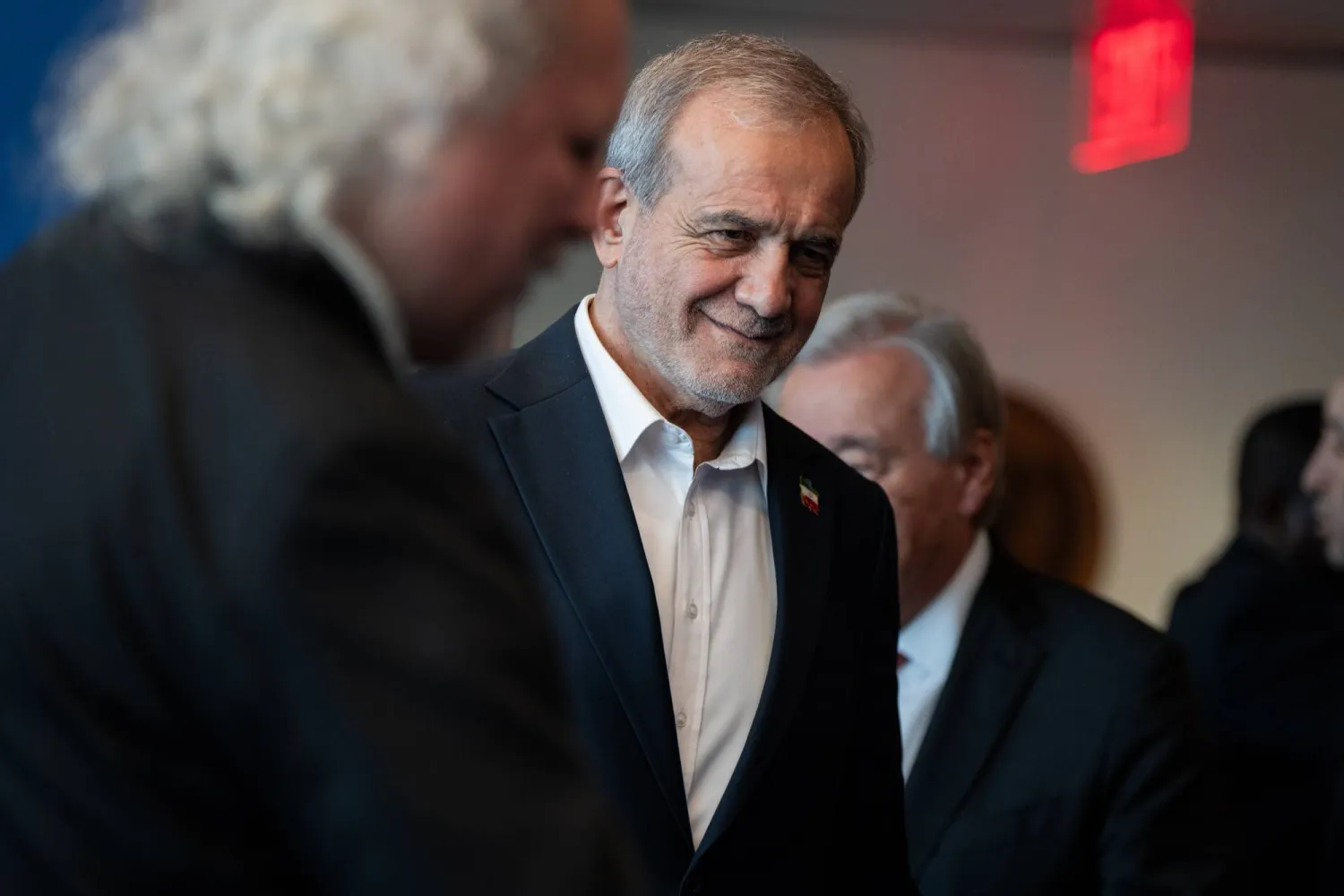
Masoud Pezeshkian, the President of Iran, attends the United Nations General Assembly at United Nations headquarters, on Sept. 25, 2025. (AP)
TT

Iran President Says Will Not ‘Give in to Excessive Demands’ 

Masoud Pezeshkian, the President of Iran, attends the United Nations General Assembly at United Nations headquarters, on Sept. 25, 2025. (AP)

Iranian President Masoud Pezeshkian said Wednesday that his country would "not yield to excessive demands" on its nuclear program, after Tehran resumed talks with the United States.

"Our country, Iran, will not yield to their excessive demands," he said in a speech at Azadi Square in the capital for the 47th anniversary of Iran's revolution.

"Our Iran will not yield in the face of aggression, but we are continuing dialogue with all our strength with neighboring countries in order to establish peace and tranquility in the region."

Iran marked the revolution anniversary as the country’s theocracy remains under pressure, both from US President Donald Trump who suggested sending another aircraft carrier group to the Middle East and a public angrily denouncing Tehran's bloody crackdown on nationwide protests.

The commemoration represented a spit-screen view of life in Iran, with state television showing hundreds of thousands of people across the country attending pro-government rallies, which included the burning of American flags and cries of “Death to America!”

A top Iranian security official traveled Qatar on Wednesday after earlier visiting Oman, which has mediated this latest round of negotiations. Just before the official's arrival, Qatar's ruling emir received a phone call from Trump.

In his speech, Pezeshkian also insisted that his nation was “not seeking nuclear weapons. ... and are ready for any kind of verification.” However, the United Nations’ nuclear watchdog — the International Atomic Energy Agency — has been unable for months to inspect and verify Iran’s nuclear stockpile.

“The high wall of mistrust that the United States and Europe have created through their past statements and actions does not allow these talks to reach a conclusion,” Pezeshkian said.

Tehran’s missile capabilities are a red line and “non-negotiable,” said Ali Shamkhani, adviser to Iran's supreme leader said at the commemoration. 

Commemoration overshadowed by crackdown

On Iranian state TV, authorities broadcast images of people taking to the streets across the country Wednesday to support the theocracy and its 86-year-old Supreme Leader Ali Khamenei.

But on Tuesday night, as government-sponsored fireworks lit the darkened sky, witnesses heard shouts from people’s homes in the Iranian capital, Tehran, of “Death to the dictator!”

In the streets Wednesday, people waved images of Khamenei and Khomeini, the founder of the Islamic Republic, alongside Iranian and Palestinian flags. Some chanted “Death to America!” and “Death to Israel!” Others criticized Iran's exiled crown prince, Reza Pahlavi, who had been calling for anti-government protests.

“I am here to say we don’t stop supporting our leader and our country as the Americans and Israelis are increasingly threatening" us, said Reza Jedi, a 43-year-old participant.

Among Iran's 85 million people, there is a hard-line element of support for Iran's theocracy, including members of the country's powerful paramilitary Revolutionary Guard, which crucially put down the protests last month in a bloody suppression that killed thousands and saw tens of thousands detained, according to activists.

Also, many Iranians often take part in pro-theocracy demonstrations as they are government employees or turn up to enjoy the carnival atmosphere of a government-sponsored holiday. Iran has 2.5 million government employees, with a fifth in Tehran alone.

While not directly addressing the bloodshed by authorities, Pezeshkian acknowledged the crackdown that began in earnest on Jan. 8 had “caused great sorrow.”

“We are ashamed before the people, and we are obligated to assist all those who were harmed in these incidents,” he said. “We are not seeking confrontation with the people.”

However, he also criticized what he described as “Western propaganda” over the crackdown.

One man sadly watched the commemoration from a sidewalk in Tehran, not taking part.

“I regularly participated in the rally in past years,” said the man, who spoke on condition of anonymity for fear of reprisal. “But how can I do that now as the streets' asphalt were bloodied last month?”

Larijani in Qatar

As the commemoration took place, senior Iranian security official Ali Larijani left Oman for Qatar, a Mideast nation that hosts a major US military installation and one that Iran attacked in June after the US bombed Iranian nuclear sites during the 12-day Iran-Israel war.

The state-run Qatar News Agency reported that Emir Sheikh Tamim bin Hamad Al Thani spoke with Trump about “the current situation in the region and international efforts aimed at de-escalation and strengthening regional security and peace,” without elaborating.

Speaking to the Russian state channel RT, Iranian Foreign Minister Abbas Araghchi said Tehran still does “not have full trust for the Americans.”

“Last time we negotiated, last June we were in the middle of negotiation then they decided to attack us and that was a very very bad experience for us,” he said. “We need to make sure that that scenario is not repeated and this is mostly up to America.”

Despite that concern, Araghchi said it could be possible “to come to a better deal than Obama,” referencing the 2015 nuclear deal with world powers Iran reached when former US President Barack Obama was in office. Trump in his first term unilaterally withdrew America from the accord.