
Report: Israeli Restrictions Caused Death of 7 Patients in Gaza this Year

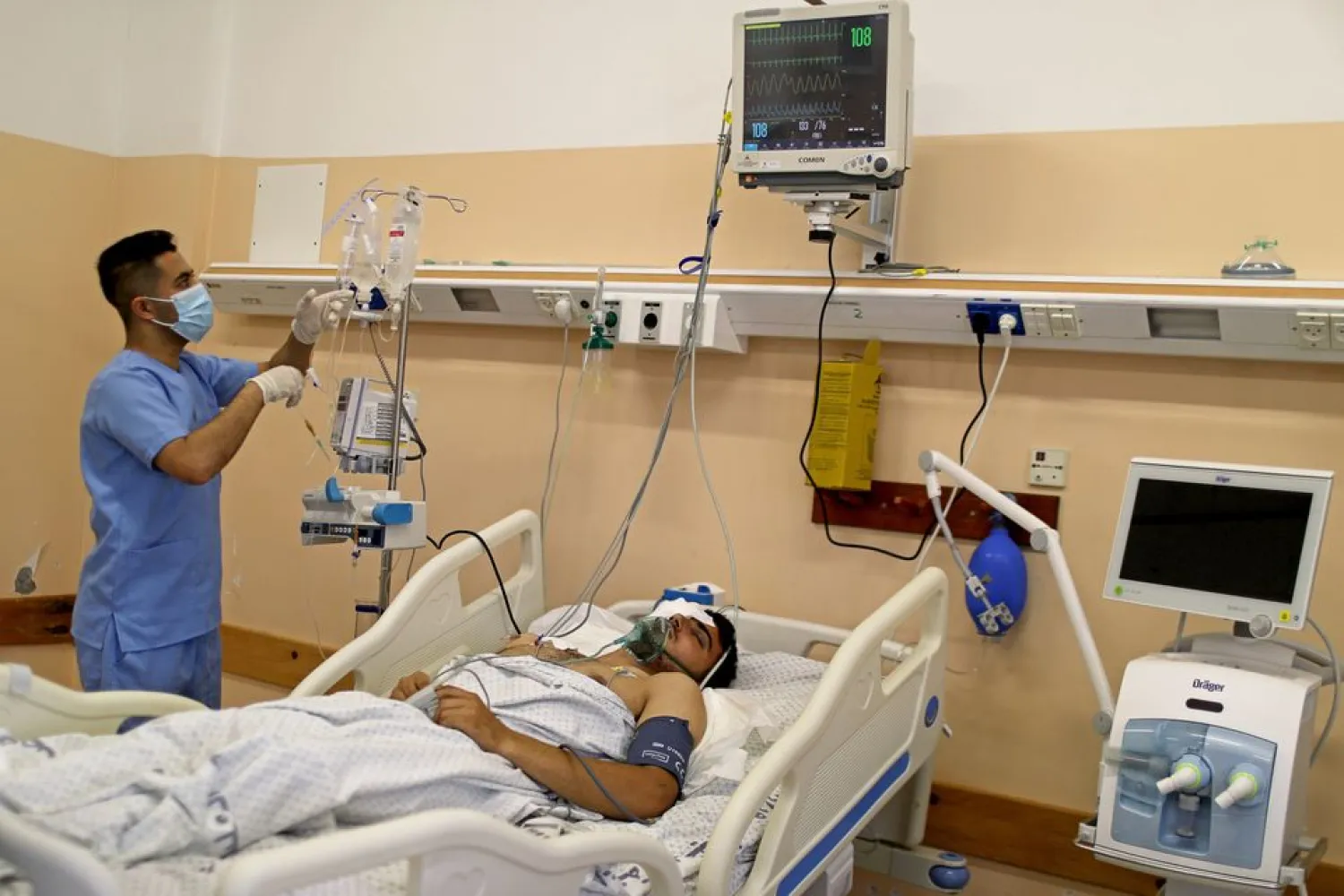
A wounded Palestinian man lies on a bed in a hospital in Gaza City on May 17, 2021. REUTERS/Mohammed Salem
TT

Report: Israeli Restrictions Caused Death of 7 Patients in Gaza this Year

A wounded Palestinian man lies on a bed in a hospital in Gaza City on May 17, 2021. REUTERS/Mohammed Salem

The Palestinian Center for Human Rights (PCHR) published a new report that underlined that the Israeli authorities’ restrictions on travel of Gaza Strip patients have caused the death of seven patients and obstructed the travel of 5,000 to receive treatment.  

The report underscores that from 2008 to 2021, the Israeli occupation authorities obstructed the travel of 73,955 patients referred for treatment at the hospitals in the West Bank, including occupied Jerusalem, or Israel.  

This number is out of the 204,086 permit requests for treatment (i.e., 36.2 percent of the total requests.)

According to the report, since the beginning of 2021 until 31 August 2022, the Israeli authorities have obstructed the travel of 5,001 out of 13,270 patients (i.e., 37.6 percent out of the total requests) who applied for travel permits for treatment at the hospitals in the West Bank, including occupied Jerusalem, or Israel. 

The report titled as “Medical Treatment Request Under Study” sheds light on the suffering of Gaza Strip patients due to the Israeli restrictions on their travel for treatment abroad.

It lays out the Israeli occupation authorities’ violations of international humanitarian law and disavowal of their obligations to guarantee the Gaza Strip patients’ right to freedom of movement and secure access to health services as well as their right to travel for treatment of their serious diseases, which is not available in the Gaza Strip’s hospitals.

The Israeli restrictions on travel of the Strip’s patients is one of the most crucial obstacles that deny their access to proper treatment and adequate medical care.

The report highlights the impact of the ongoing Israeli-imposed closure on the Gaza Strip for 16 years and its implications on the frail healthcare system and its facilities in the Strip through rendering it incapable of providing treatment services for the serious diseases and thereby forcing it to refer patients for treatment abroad.

Based on patients’ testimonies to PCHR’s researchers, the Israeli obstacles have taken different forms, including depriving patients of treatment abroad without clarifying reasons “under study”, and denying patients travel for treatment under the pretext that it is available in the Gaza Strip or by claiming that their disease do not pose threat to their lives.

Other forms are depriving patients of travel for having a related family member in violation of Israeli laws, preventing donors from traveling with patients for organ donation and transplantation and saving the patients’ lives, delaying responses to patients making them miss their pre-set hospital appointments.

All these obstacles have led to deterioration of their health conditions and putting their life at serious risk that would cause the death of some of them. 

This is not the first report to monitor the sufferings of Gaza patients.  

The Physicians for Human Rights–Israel appealed last month to the Supreme Court of Israel to allow parents in Gaza to accompany their children during their travel to receive treatment in Israeli or Palestinian hospitals in the West Bank and Jerusalem.  

In 2021, the rejection rate of such requests jumped to 32 percent, as the occupation authorities rejected 812 requests out of 2,578 requests submitted. In 2020, 17 percent of minors’ requests to leave the Gaza Strip were rejected for the purpose of receiving medical care not available in the Strip (347 out of 2,070 requests). 

In its recommendations in the report, PCHR demands the international community exert pressure on Israel to fulfil its duties as an occupying power under the international humanitarian law. 

Moreover, PCHR urges the High Contracting Parties to observe the Israeli authorities’ obligations codified in the concluding observations by the Committee on Economic, Social and Cultural Rights, which call for adherence to the basic rules and principles approved by the United Nations; most significantly the right to enjoy the highest attainable standard of health.  


Hamas’s Meshal Rejects Disarmament or 'Foreign Rule'

Boys walk past the rubble of destroyed buildings in the Jabalia camp for Palestinian refugees in the northern Gaza Strip on February 8, 2026. (Photo by Omar AL-QATTAA / AFP)
TT

Hamas’s Meshal Rejects Disarmament or 'Foreign Rule'

Boys walk past the rubble of destroyed buildings in the Jabalia camp for Palestinian refugees in the northern Gaza Strip on February 8, 2026. (Photo by Omar AL-QATTAA / AFP)

A senior Hamas leader said Sunday that the Palestinian movement would not surrender its weapons nor accept foreign intervention in Gaza, pushing back against US and Israeli demands.

"Criminalizing the resistance, its weapons, and those who carried it out is something we should not accept," Khaled Meshal said at a conference in Doha.

"As long as there is occupation, there is resistance. Resistance is a right of peoples under occupation ... something nations take pride in," said Meshal, who previously headed the group.

A US-brokered ceasefire in Gaza is in its second phase, which foresees that demilitarization of the territory -- including the disarmament of Hamas -- along with a gradual withdrawal of Israeli forces.

Hamas has repeatedly said that disarmament is a red line, although it has indicated it could consider handing over its weapons to a future Palestinian governing authority.

Israeli officials say that Hamas still has around 20,000 fighters and about 60,000 Kalashnikovs in Gaza.

A Palestinian technocratic committee has been set up with a goal of taking over the day-to-day governance in the battered Gaza Strip, but it remains unclear whether, or how, it will address the issue of demilitarization.

The committee operates under the so-called "Board of Peace," an initiative launched by US President Donald Trump.

Originally conceived to oversee the Gaza truce and post-war reconstruction, the board's mandate has since expanded, prompting concerns among critics that it could evolve into a rival to the United Nations.

Trump unveiled the board at the World Economic Forum in the Swiss ski resort of Davos last month, where leaders and officials from nearly two dozen countries joined him in signing its founding charter.

Alongside the Board of Peace, Trump also created a Gaza Executive Board - an advisory panel to the Palestinian technocratic committee - comprising international figures including US envoys Steve Witkoff and Jared Kushner, as well as former British prime minister Tony Blair.

On Sunday, Meshal urged the Board of Peace to adopt what he called a "balanced approach" that would allow for Gaza's reconstruction and the flow of aid to its roughly 2.2 million residents, while warning that Hamas would "not accept foreign rule" over Palestinian territory.

"We adhere to our national principles and reject the logic of guardianship, external intervention, or the return of a mandate in any form," Meshal said.
"Palestinians are to govern Palestinians. Gaza belongs to the people of Gaza and to Palestine. We will not accept foreign rule," he added.


Rescue Teams Search for Survivors in Building Collapse that Killed at Least 2 in Northern Lebanon

A Lebanese flag is pictured, in the aftermath of a massive explosion, in Beirut's damaged port area, Lebanon August 17, 2020. REUTERS/Hannah McKay
TT

Rescue Teams Search for Survivors in Building Collapse that Killed at Least 2 in Northern Lebanon

A Lebanese flag is pictured, in the aftermath of a massive explosion, in Beirut's damaged port area, Lebanon August 17, 2020. REUTERS/Hannah McKay

At least two people were killed and four rescued from the rubble of a multistory apartment building that collapsed Sunday in the city of Tripoli in northern Lebanon, state media reported.

Rescue teams were continuing to dig through the rubble. It was not immediately clear how many people were in the building when it fell.

The bodies pulled out were of a child and a woman, the state-run National News Agency reported.

Dozens of people crowded around the site of the crater left by the collapsed building, with some shooting in the air.

The building was in the neighborhood of Bab Tabbaneh, one of the poorest areas in Lebanon’s second largest city, where residents have long complained of government neglect and shoddy infrastructure. Building collapses are not uncommon in Tripoli due to poor building standards, according to The AP news.

Lebanon’s Health Ministry announced that those injured in the collapse would receive treatment at the state’s expense.

The national syndicate for property owners in a statement called the collapse the result of “blatant negligence and shortcomings of the Lebanese state toward the safety of citizens and their housing security,” and said it is “not an isolated incident.”

The syndicate called for the government to launch a comprehensive national survey of buildings at risk of collapse.


Israel to Take More West Bank Powers and Relax Settler Land Buys

A view of Israeli settlement of Maale Adumim, in the West Bank, Sunday, June 18, 2023. (AP)
TT

Israel to Take More West Bank Powers and Relax Settler Land Buys

A view of Israeli settlement of Maale Adumim, in the West Bank, Sunday, June 18, 2023. (AP)

Israel's security cabinet approved a series of steps on Sunday that would make it easier for settlers in the occupied West Bank to buy land while granting Israeli authorities more enforcement powers over Palestinians, Israeli media reported.

The West Bank is among the territories that the Palestinians seek for a future independent state. Much of it is under Israeli military control, with limited Palestinian self-rule in some areas run by the Western-backed Palestinian Authority (PA).

Citing statements by Finance Minister Bezalel Smotrich and Defense Minister Israel Katz, Israeli news sites Ynet and Haaretz said the measures included scrapping decades-old regulations that prevent Jewish private citizens buying land in the West Bank, The AP news reported.

They were also reported to include allowing Israeli authorities to administer some religious sites, and expand supervision and enforcement in areas under PA administration in matters of environmental hazards, water offences and damage to archaeological sites.

Palestinian President Mahmoud Abbas said the new measures were dangerous, illegal and tantamount to de-facto annexation.

The Israeli ministers did not immediately respond to requests for comment.

The new measures come three days before Prime Minister Benjamin Netanyahu is scheduled to meet in Washington with US President Donald Trump.

Trump has ruled out Israeli annexation of the West Bank but his administration has not sought to curb Israel's accelerated settlement building, which the Palestinians say denies them a potential state by eating away at its territory.

Netanyahu, who is facing an election later this year, deems the establishment of any Palestinian state a security threat.

His ruling coalition includes many pro-settler members who want Israel to annex the West Bank, land captured in the 1967 Middle East war to which Israel cites biblical and historical ties.

The United Nations' highest court said in a non-binding advisory opinion in 2024 that Israel's occupation of Palestinian territories and settlements there is illegal and should be ended as soon as possible. Israel disputes this view.