Iran Protests at Point of ‘No Return’, Says Nazanin Zaghari-Ratcliffe

Demonstrators rally at the National Mall to protest against the Iranian regime, in Washington, Saturday, Oct. 22, 2022, following the death of Mahsa Amini in the custody of the country's notorious "morality police." (AP)
TT

Iran Protests at Point of ‘No Return’, Says Nazanin Zaghari-Ratcliffe

Demonstrators rally at the National Mall to protest against the Iranian regime, in Washington, Saturday, Oct. 22, 2022, following the death of Mahsa Amini in the custody of the country's notorious "morality police." (AP)

Protests engulfing Iran have reached a point of "no return" as demonstrators demand wide reforms beyond the end of mandatory hijab rules, said British-Iranian charity worker Nazanin Zaghari-Ratcliffe, who spent six years detained in Tehran.

She said the government's crackdown on the popular revolt and shutdown of the internet showed it was scared of losing control.

"The anger has been building up for many, many years," said Zaghari-Ratcliffe as demonstrations raged for a sixth week, triggered by the death in police custody of 22-year-old Mahsa Amini after she was accused of wearing her headscarf improperly.

"We can see a coming together for one single goal, and that is freedom. The protests are really, really powerful this time. I don't think we've ever seen the unity we're seeing now," said Zaghari-Ratcliffe, describing Amini's death as the "spark for an explosion".

The protests have grown into one of the boldest challenges to the regime since the 1979 revolution even if they do not appear close to toppling a government that has deployed its powerful security apparatus to quell the unrest.

"There is a generational shift which plays a massive role in the new movement," said Zaghari-Ratcliffe, who works for the Thomson Reuters Foundation as a project manager and will address the charity's annual Trust Conference on Wednesday.

"This is the generation of social media and TikTok and the internet. They know more about the world and their rights than we did. They have a lot more courage than we did."

The uprising has seen women tear off and burn their veils, with crowds calling for the downfall of Supreme Leader Ali Khamenei.

Thousands have been detained by security forces and more than 200 killed including children, according to rights groups.

Solitary confinement

Zaghari-Ratcliffe, 43, was arrested at Tehran airport in 2016 after a trip to see her parents with her then 22-month-old daughter Gabriella.

She was separated from her daughter, whom she was still breastfeeding, and put in solitary confinement in a tiny windowless cell.

Zaghari-Ratcliffe was later convicted of plotting to overthrow the clerical establishment. She denied all the charges against her and the case was widely seen as political.

She was freed in March with another dual national, Anousheh Ashouri, after Britain repaid a historic debt to Tehran.

During her detention in Tehran's Evin prison, Zaghari-Ratcliffe said she met many women who had received long jail terms for protesting against Iran's mandatory hijab rule, including one 19-year-old sentenced to 24 years.

She said the current protests were a greater threat to the regime than previous ones because they had attracted broader support, with labor unions now organizing strikes which could potentially paralyze the economy.

"There's no return from here," she said. "This is not just about forced hijab any more. It's also about the repressive rules they've been imposing on people for a very, very long time. It's about unemployment, it's about lifestyle, it's about freedom to have access to information and the internet."

Internet shutdowns

Iran has shut down the internet and blocked access to platforms such as Instagram and WhatsApp to stop people organizing protests and sharing images with the outside world.

"Shutting down the internet is exactly what they are doing when they put people in solitary (confinement), only on a bigger scale," said Zaghari-Ratcliffe.

"They disconnect you from the outside world so the world doesn't know what is happening to you and you can't tell them. They want people to be scared and feel forgotten."

Zaghari-Ratcliffe said she would continue to speak up for other detainees, including UK-born environmentalist Morad Tahbaz who was expected to fly back to Britain with her in March but was kept behind at the last moment.

He was released on bail with an electronic tag in Tehran in July.

"My story is the story of many people in Iran who remain in prison. I've got the responsibility to be their voice," said Zaghari-Ratcliffe, adding that the protests made her proud to be an Iranian woman.

"It's a shame for those of us living in enforced exile that we cannot be with the women on the streets, but we are certainly very proud," she said.

Zaghari-Ratcliffe is settling back into London with her daughter and husband Richard, who ran a long campaign for her release including a three-week hunger strike while camped outside the Foreign and Commonwealth Office.

But she said she could not feel entirely free while friends were still in jail.

"Freedom is a very relative concept. I'm free in terms of coming out of prison and coming back home to my family in London. But I have left a part of me in Iran," she said.

"I won't be completely free until my country is free."



Trump Hints at Land Strike as Venezuela Pressure Mounts

A US Air Force C-130J Super Hercules aircraft approaches for landing at Rafael Hernandez Airport, amid tensions between US President Donald Trump's administration and the government of Venezuelan President Nicolas Maduro, in Aguadilla, Puerto Rico, December 28, 2025. (Reuters)
TT

Trump Hints at Land Strike as Venezuela Pressure Mounts

A US Air Force C-130J Super Hercules aircraft approaches for landing at Rafael Hernandez Airport, amid tensions between US President Donald Trump's administration and the government of Venezuelan President Nicolas Maduro, in Aguadilla, Puerto Rico, December 28, 2025. (Reuters)

A throwaway remark last week by President Donald Trump has raised questions about whether US forces may have carried their first land strike against drug cartels in Venezuela.

Trump said the US knocked out a "big facility" for producing trafficking boats, as he was discussing his pressure campaign against Venezuelan President Nicolas Maduro in an interview broadcast Friday.

"They have a big plant or a big facility where they send, you know, where the ships come from," Trump said in an interview with billionaire supporter John Catsimatidis on the WABC radio station in New York.

"Two nights ago we knocked that out. So we hit them very hard."

Trump did not say where the facility was located or give any other details. US forces have carried out numerous strikes in both the Caribbean Sea and eastern Pacific Ocean since September, killing more than 100 people.

The Pentagon referred questions about Trump's remarks to the White House. The White House did not respond to requests for comment from AFP.

There has been no official comment from the Venezuelan government.

Trump has been saying for weeks that the United States will "soon" start carrying out land strikes targeting drug cartels in Latin America, but there have been no confirmed attacks to date.

The Trump administration has been ramping up pressure on Maduro, accusing the Venezuelan leader of running a drug cartel himself and imposing an oil tanker blockade.

Maduro has accused Washington of attempting regime change.


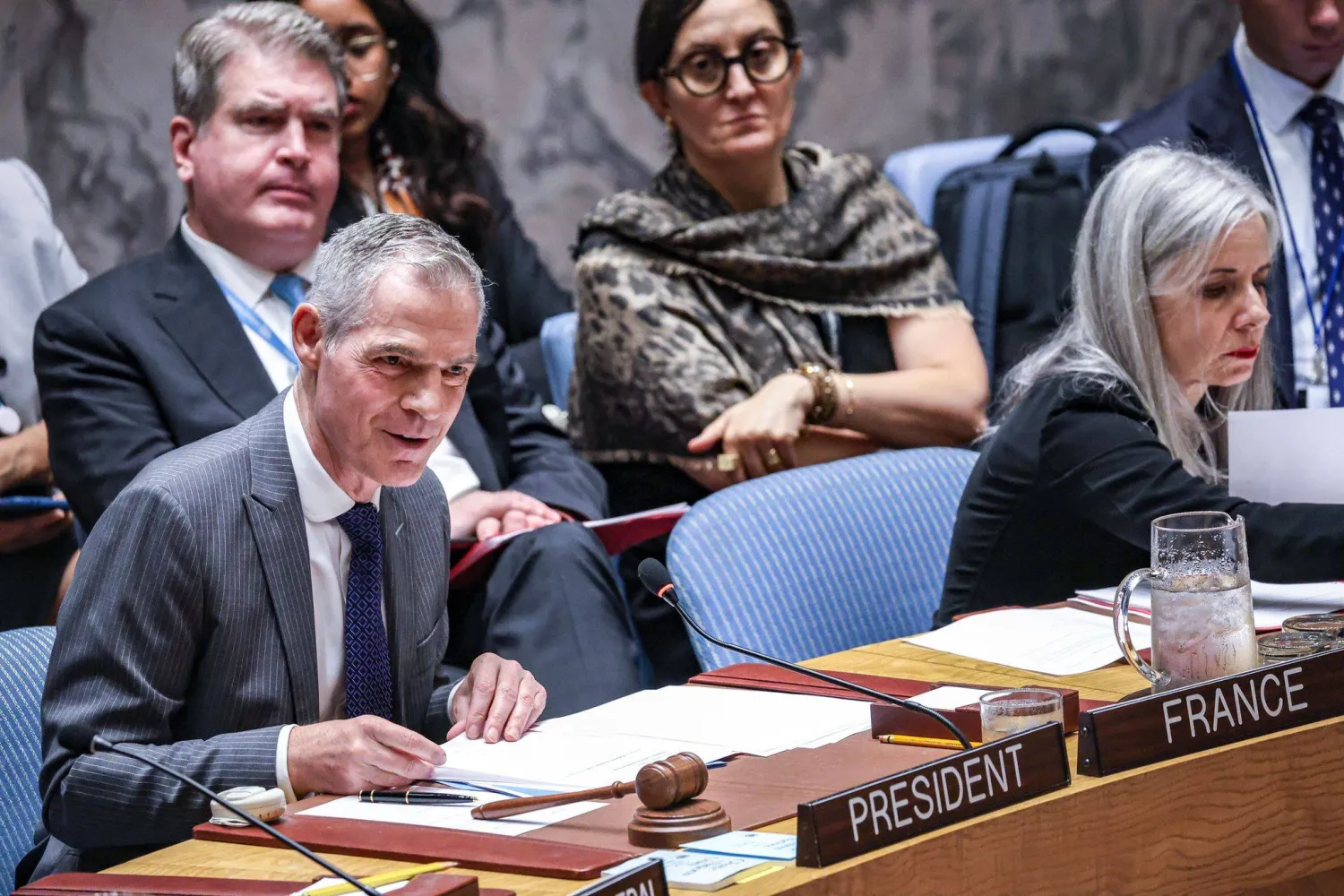
UN Chief Says ‘Get Serious’ in Grim New Year Message

 UN Secretary-General Antonio Guterres. (AFP)
UN Secretary-General Antonio Guterres. (AFP)
TT

UN Chief Says ‘Get Serious’ in Grim New Year Message

 UN Secretary-General Antonio Guterres. (AFP)
UN Secretary-General Antonio Guterres. (AFP)

The United Nations urged global leaders Monday to focus on people and the planet in a New Year's message depicting the world in chaos.

"As we enter the new year, the world stands at a crossroads. Chaos and uncertainty surround us. Division. Violence. Climate breakdown. And systemic violations of international law," UN Secretary-General Antonio Guterres said in a video message.

In 2026, as war rages in Ukraine and elsewhere, world leaders must work to ease human suffering and fight climate change, he added.

"I call on leaders everywhere: Get serious. Choose people and planet over pain," said Guterres, criticizing the global imbalance between military spending and financing for the poorest countries.

Military spending is up nearly 10 percent this year to $2.7 trillion, which is 13 times total world spending on development aid and equivalent to the entire gross domestic product of Africa, he said.

Wars are raging at levels unseen since World War II, he added.

"In this New Year, let's resolve to get our priorities straight. A safer world begins by investing more in fighting poverty and less in fighting wars. Peace must prevail," said Guterres, who will be serving his last year as secretary general.


Türkiye and Armenia Agree to Simplify Visa Procedures to Normalize Ties

Türkiye’s President Recep Tayyip Erdogan, right, and Armenia's Prime Minister Nikol Pashinyan shake hands before a meeting at Prague Castle in Prague, Czech Republic, Thursday, Oct. 6, 2022. (Turkish Presidency via AP, File)
TT

Türkiye and Armenia Agree to Simplify Visa Procedures to Normalize Ties

Türkiye’s President Recep Tayyip Erdogan, right, and Armenia's Prime Minister Nikol Pashinyan shake hands before a meeting at Prague Castle in Prague, Czech Republic, Thursday, Oct. 6, 2022. (Turkish Presidency via AP, File)

Türkiye and Armenia have agreed to simplify visa procedures as part of efforts to normalize ties, Türkiye’s Foreign Ministry announced Monday, making it easier for their citizens to travel between the two countries.

Relations between Türkiye and Armenia have long been strained by historic grievances and Türkiye’s alliance with Azerbaijan. The two neighboring countries have no formal diplomatic ties and their joint border has remained closed since the 1990s.

The two countries, however, agreed to work toward normalization in 2021, appointing special envoys to explore steps toward reconciliation and reopening the frontier. Those talks have progressed in parallel with efforts to ease tensions between Armenia and Azerbaijan.

Türkiye supported Azerbaijan during its 2020 conflict with Armenia for control of the Karabakh region, known internationally as Nagorno-Karabakh, a territorial dispute that had lasted nearly four decades.

The Turkish Foreign Ministry said in a statement posted on social platform X that Ankara and Yerevan agreed that holders of diplomatic, special and service passports from both countries would be able to obtain electronic visas free of charge as of Jan. 1.

“On this occasion, Türkiye and Armenia reaffirm once again their commitment to continue the normalization process between the two countries with the goal of achieving full normalization without any preconditions,” the ministry said.

Türkiye and Armenia also have a more than century-old dispute over the deaths of an estimated 1.5 million Armenians in massacres, deportations and forced marches that began in 1915 in Ottoman Türkiye. Historians widely view the event as genocide.

Türkiye denies the deaths constituted genocide, saying the toll has been inflated and those killed were victims of civil war and unrest. It has lobbied to prevent countries from officially recognizing the massacres as genocide.