


Lebanon: Reducing Chances of Electing a President, Berri Abandons Dialogue

Lebanese Parliament Speaker Nabih Berri (DPA)
TT

Lebanon: Reducing Chances of Electing a President, Berri Abandons Dialogue

Lebanese Parliament Speaker Nabih Berri (DPA)

The chances for Lebanon to find consensus on a successor to Michel Aoun, whose term in office ended on Monday, have dropped after Parliament Speaker Nabih Berri canceled a previous invitation for major political parties to meet and try to reach an agreement on a presidential candidate.

The head of the Parliament's office said in a brief statement on Wednesday that Berri will not be able to call for dialogue “following the opposition expressed by two groups: the Lebanese Forces and the Free Patriotic Movement.”

The two most prominent Christian blocs, who hold considerable weight in parliament, have rejected Berri’s call given that their leaders are natural candidates for the presidency.

Christian politician and former minister Sejaan Azzi, in statements to Al Jadeed news channel, said that “now was the time to elect a president, not the time for dialogue.”

Considering the rejection of influential Christian parties to engage in dialogue, sources close to Berri confirmed that he respects the blocs’ choices.

“Calling for dialogue is not a crime. It remains a virtue despite the reluctance of some parties,” the sources, who requested anonymity, affirmed to Asharq Al-Awsat.

“If dialogue is not a way to solve crises, then how else can they be approached?” the sources asked.

They highlighted that Berri’s call for dialogue, which was limited to a single clause, namely the election of a president, is based on efforts “to reunite the Lebanese.”

The sources emphasized that nothing could unite the Lebanese if the advantage of dialogue is lost.

Shutting the door on consensus will likely lead to an electoral showdown in Parliament, sources told Asharq Al-Awsat, noting that the candidate who gets the highest vote wins if there is quorum.


Israel Military Issues Evacuation Warning for Dozen Villages in South Lebanon

An Israeli soldier gestures next to a tank, on the Israeli side of the border with Lebanon, May 3, 2026. REUTERS/Shir Torem
TT

Israel Military Issues Evacuation Warning for Dozen Villages in South Lebanon

An Israeli soldier gestures next to a tank, on the Israeli side of the border with Lebanon, May 3, 2026. REUTERS/Shir Torem

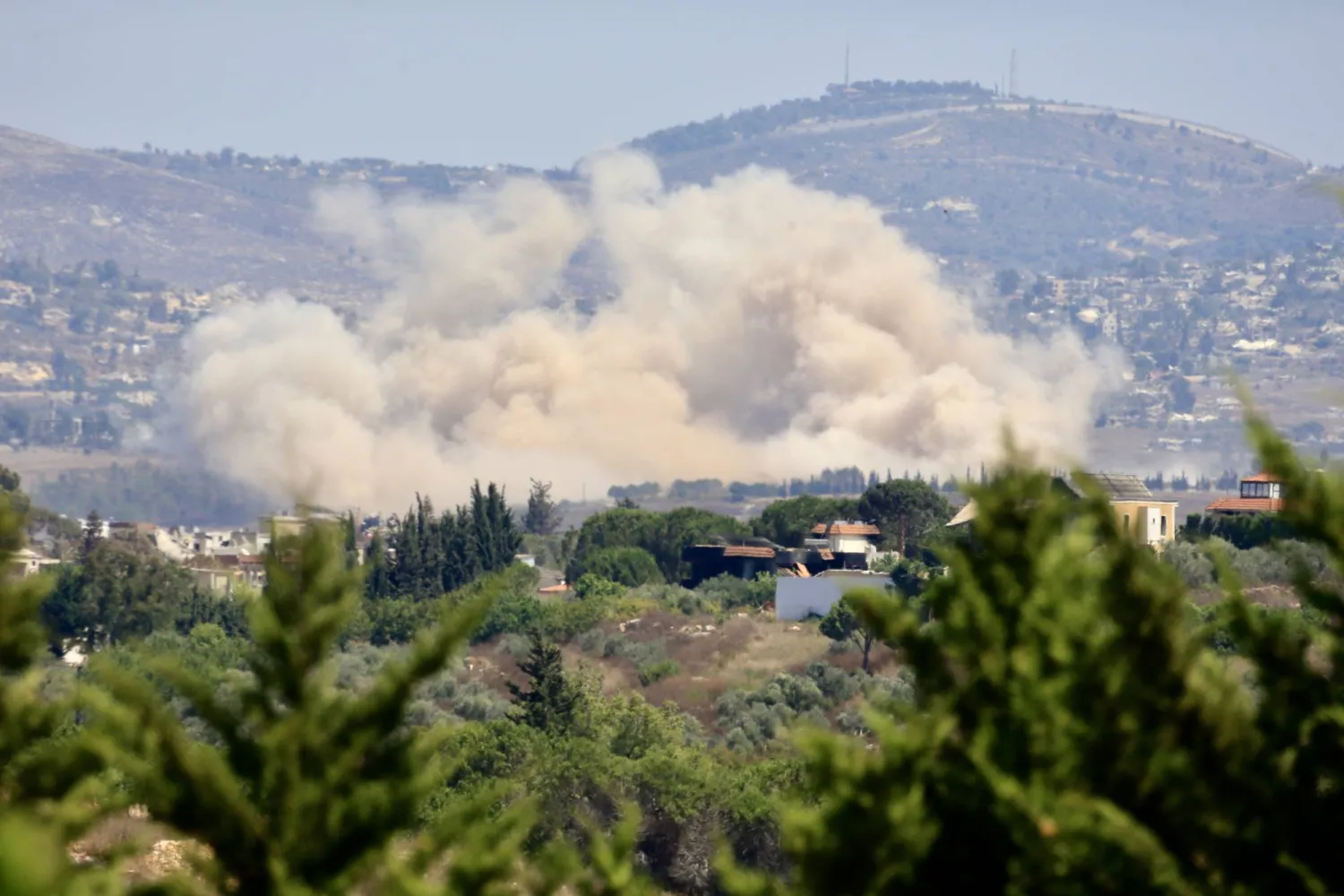
Israel's military on Wednesday issued a new evacuation warning for a dozen villages in southern Lebanon ahead of expected strikes, despite a truce with Lebanon intended to halt the fighting with Iran-backed Hezbollah.

"For your safety, you must evacuate your homes immediately and move away from the villages and towns by at least 1,000 meters into open areas," the military's Arabic-language spokesman Avichay Adraee posted on X, listing 12 villages.


US Wants 'Concrete Actions' on Iran from Next Iraqi PM

Members of Iraq's pro-Iran paramilitary group Kataeb Hezbollah mourn a comrade who was killed in a strike in Basra, during the funeral in Baghdad on April 8, 2026. AHMAD AL-RUBAYE / AFP/File
TT

US Wants 'Concrete Actions' on Iran from Next Iraqi PM

Members of Iraq's pro-Iran paramilitary group Kataeb Hezbollah mourn a comrade who was killed in a strike in Basra, during the funeral in Baghdad on April 8, 2026. AHMAD AL-RUBAYE / AFP/File

The United States is looking for "concrete actions" by Iraq's next prime minister to distance the state from pro-Iran armed groups before resuming financial shipments and security aid, a senior official said Tuesday.

Iraq's ruling coalition has put forward Ali al-Zaidi as the next leader and he quickly received a congratulatory call from President Donald Trump, who had threatened to end all US support if former frontrunner Nouri al-Maliki took office.

But a senior US State Department official, speaking on condition of anonymity, said Zaidi must address the "blurry line" between pro-Iran armed groups in the Shia-majority country and the state, AFP said.

Washington suspended cash payments for oil revenue, which have been handled from the Federal Reserve Bank of New York in an arrangement dating to the aftermath of the 2003 US invasion of Iraq, as well as security assistance over a spate of attacks on US interests.

Resuming full support "would start with expelling terrorist militias from any state institution, cutting off their support from the Iraqi budget (and) denying salary payments to these militia fighters," the official said.

"Those are the type of concrete actions that would give us confidence and say that there's a new mindset."

The official said US facilities in Iraq suffered more than 600 attacks after February 28, when the United States and Israel launched their war on Iran.

The attacks have come to a standstill since a shaky April 8 ceasefire between the United States and Iran, with the exception of Iranian strikes in Iraqi Kurdistan.

"I'm not underestimating the severity of the challenge or what it would take to disentangle these relationships. It could start with a clear and unambiguous statement of policy that the terrorist militias are not part of the Iraqi state," the official said.

"Certain elements of the Iraqi state have continued to provide political, financial and operational cover for these very terrorist militias," he added.

The United States piled pressure on Iraq after it appeared that Maliki would be the next prime minister. During his previous stint in office, relations deteriorated with Washington over accusations of being too close to Iran's Shia clerical government and fanning sectarian flames.

Attacks by armed groups in Iraq have struck the US embassy in Baghdad, its diplomatic and logistics facility at the capital's airport and oil fields operated by foreign companies.


Syria: Pending Issues, Including Arrests Delay SDF Integration

Protest by families of SDF detainees held by the Syrian government outside the Democratic Union Party building in Qamishli (Ronahi)
TT

Syria: Pending Issues, Including Arrests Delay SDF Integration

Protest by families of SDF detainees held by the Syrian government outside the Democratic Union Party building in Qamishli (Ronahi)

The exchange of prisoners and detainees between the Syrian government and the Syrian Democratic Forces (SDF) has stalled since mid-April after becoming tied to political issues, hampering efforts to integrate the SDF and implement an agreement reached last January.

Abdulkarim Omar, a senior official in the Kurdish Autonomous Administration, told Asharq Al-Awsat that several issues still require “further discussion and consensus.”

He said the top priority remains the detainees file and the return of displaced people, stressing that both the Autonomous Administration and the SDF are fully committed to the agreement.

The remarks came as families of SDF detainees held by the Syrian government staged a protest demanding the release of their sons, according to Kurdish media, amid reports of reciprocal arrest campaigns in Hasakah and Raqqa provinces.

Omar said the detainees and prisoners file was still receiving “careful attention and follow-up” from the SDF and the Autonomous Administration.

“This reflects our commitment to fully implementing the provisions of the Jan. 29 agreement, which represents an important framework for cooperation and understanding between the Autonomous Administration and the transitional government,” he said.

He said the Autonomous Administration and the SDF were committed to implementing all provisions of the agreement, including the integration of military, security and administrative institutions, while taking into account the particularity of Kurdish areas.

He said there was “full awareness that the integration process requires building trust and a genuine will from all parties, in addition to overcoming any rhetoric that could obstruct this path.”

According to the Kurdish news agency Hawar, families of SDF detainees held by the Syrian government complained that they had been prevented from seeing their sons in detention centers in Aleppo.

Families of detainees also staged protests in Hasakah city to demand their release. Video clips aired by Kurdish media showed a group of families demonstrating outside the Hasakah governorate building on Tuesday.

“We are seeking urgent solutions that ensure the release of all detainees in order to ease the suffering of their families,” Omar said.

He added that the return of displaced people to their original areas remained a top priority. About 1,400 families have so far returned to Afrin, while around 7,000 families in Jazira and Kobani are still waiting to return to their hometowns.

Work is also continuing to allow other families displaced from Ras al-Ain, Tal Abyad and other areas to return “with dignity and safety,” he said.

Outstanding Issues

Omar said several issues require further discussion and agreement. These include integrating the Women’s Protection Units into the Syrian Defense Ministry and developing mother-tongue education in Kurdish areas.

He added that other issues include accrediting certificates issued by Autonomous Administration institutions on par with other areas, as well as matters related to courthouses and other technical and administrative issues.

“We are confident that through shared will, continued and transparent dialogue and trust-building, tangible progress can be achieved on these files in a way that serves the interests of all Syrians and strengthens national stability,” he said.

He said progress on these files represented “a real opportunity to strengthen trust among all parties,” adding that commitment to agreements was the best path toward “solid national unity, lasting stability and a shared future marked by security and dignity for all Syrians.”

The prisoner and detainee exchange file had made notable progress in March and April under understandings aimed at “emptying prisons” and building confidence as part of the implementation of the agreement.

In the latest batch, around 400 SDF detainees were released in exchange for 91 detainees held by the Syrian government.

That followed earlier batches in March that saw 300 detainees released in exchange for 300 others, and before that, 159 detainees were released in exchange for 100.

Sipan Hamo, also known as Samir Oso, assistant defense minister in Syria’s interim government for eastern region affairs, described linking the detainees issues to political pressure as “immoral.”

In an interview with Hawar, he said the mechanism used in recent exchanges was “wrong,” adding that all prisoners should have been released on the day integration was announced, without batches.

Ahmed al-Hilali, spokesman for the presidential team tasked with overseeing the implementation of the Jan. 29 agreement, said in press remarks that the delay in taking over courthouses, especially in Qamishli, had negatively affected other files, most notably detainees.

He said the issue had shifted from an exchange approach to release procedures after the Syrian government took over prisons in Hasakah, but that the process was still facing delays.

Hilali said the integration track was linked to several overlapping issues, including the detainees, whom he described as “non-negotiable.”

But he said it was still affected by progress in implementing the agreement, while expressing optimism that a breakthrough could be achieved in the coming days.

Reciprocal arrests

In a parallel development, local media said SDF forces carried out an arrest campaign on Monday in Hasakah city and its surroundings.

The Hasakah Media Center said the campaign took place in the city’s Salihiya neighborhood and in the village of al-Fahd near Panorama roundabout, leading to the arrest of a young man in Hasakah and several residents of the village.

Syrian security forces had earlier arrested a number of people affiliated with the SDF in Raqqa. Asharq Al-Awsat sought details from government and Kurdish sources on the nature of those arrests but received no response.