


US Scientists Reveal Step Advancing Fusion Energy Quest 

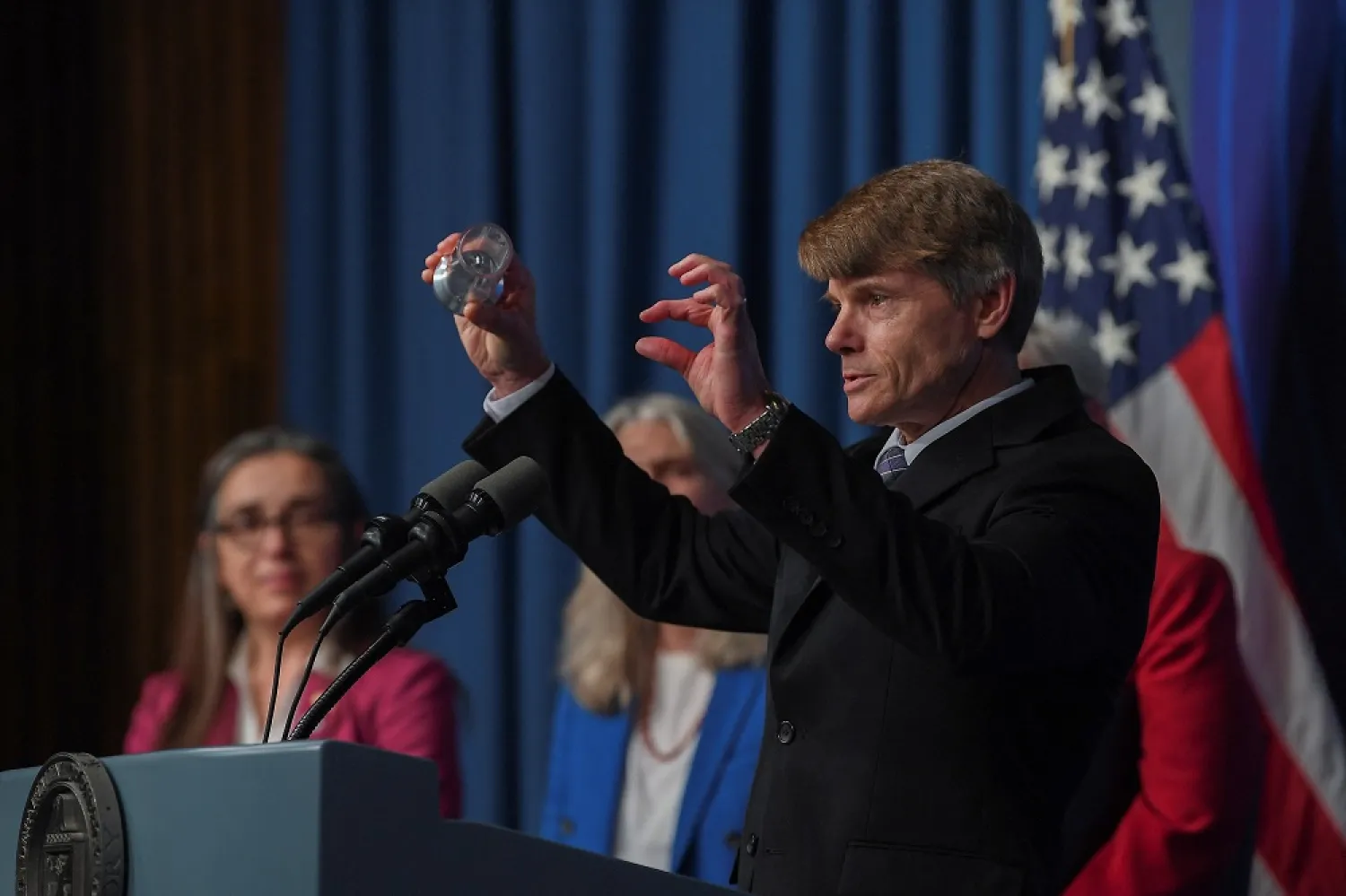
Dr. Marvin Adams, Deputy Administrator for Defense Programs of the Department of Energy’s National Nuclear Security Administration holds up a visual aid during a US Department of Energy news conference to announce that scientists at the Lawrence Livermore National Laboratory (LLNL) have made a breakthrough on fusion energy, the process that powers the sun and stars that one day could provide a cheap source of electricity in Washington, US, December 13, 2022. (Reuters)
TT

US Scientists Reveal Step Advancing Fusion Energy Quest 

Dr. Marvin Adams, Deputy Administrator for Defense Programs of the Department of Energy’s National Nuclear Security Administration holds up a visual aid during a US Department of Energy news conference to announce that scientists at the Lawrence Livermore National Laboratory (LLNL) have made a breakthrough on fusion energy, the process that powers the sun and stars that one day could provide a cheap source of electricity in Washington, US, December 13, 2022. (Reuters)

US scientists on Tuesday revealed a scientific advance on fusion energy which, if it can make the leap from labs to commercial generation of electricity in coming decades, could help the fight to curb climate change. 

Scientists at the Lawrence Livermore National Lab in California on Dec. 5 for the first time briefly achieved a net energy gain in a fusion experiment using lasers, the US Energy Department said. The scientists focused a laser on a target of fuel to fuse two light atoms into a denser one, releasing the energy. 

Arati Prabhakar, director of the White House Office of Sciences and Technology Policy, said the experiment represents a "tremendous example of what perseverance can achieve." 

Fusion powers the sun and scientists have pursued developing fusion on Earth for decades. 

Nuclear scientists outside the lab said the achievement will be a major stepping stone, but there is much more science to be done before fusion becomes commercially viable. 

Tony Roulstone, a nuclear energy expert at the University of Cambridge, estimated that the energy output of the experiment was only 0.5% of the energy that was needed to fire the lasers in the first place. 

"Therefore, we can say that this result ... is a success of the science – but still a long way from providing useful, abundant, clean energy," Roulstone said. 

The electricity industry cautiously welcomed the step, though emphasized that in order to carry out the energy transition, fusion should not slow down efforts on building out other alternatives like solar and wind power, battery storage and nuclear fission. 

"It's the first step that says 'Yes, this is not just fantasy, this can be done, in theory,'" said Andrew Sowder, a senior technology executive at EPRI, a nonprofit energy research and development group. 


ICAIRE Launches Global ‘AI Glossary Challenge’ to Promote Responsible Innovation

The initiative aims to promote the ethical use of modern technologies across international contexts
TT

ICAIRE Launches Global ‘AI Glossary Challenge’ to Promote Responsible Innovation

The initiative aims to promote the ethical use of modern technologies across international contexts

The International Center for AI Research and Ethics (ICAIRE), a Riyadh-based UNESCO affiliate, has launched the AI Glossary Challenge, inviting researchers, students, and practitioners to develop knowledge tools that support a responsible AI ecosystem.

By standardizing concepts and establishing a shared knowledge base, the initiative aims to promote the ethical use of modern technologies across international contexts.

The challenge comprises three specialized tracks: AI Glossary Tools for developing digital applications such as APIs and governance dashboards; Dataset Creation for building high-quality, bias-free cultural datasets; and Cultural Hallucinations Tools to detect and interpret contextual errors in large language models, enhancing their global adaptability.

Hosted on the Kaggle platform, the competition offers prizes to winning teams to foster a specialized community dedicated to AI ethics.


Florida Launches Criminal Probe into OpenAI and ChatGPT Over Deadly Shooting

This illustration photograph taken in Mulhouse, eastern France on February 11, 2025, shows the logo of OpenAI's artificial intelligence chatbot ChatGPT. (AFP)
TT

Florida Launches Criminal Probe into OpenAI and ChatGPT Over Deadly Shooting

This illustration photograph taken in Mulhouse, eastern France on February 11, 2025, shows the logo of OpenAI's artificial intelligence chatbot ChatGPT. (AFP)

Florida ‌Attorney General James Uthmeier said on Tuesday the state was launching a criminal probe into OpenAI and its artificial intelligence app ChatGPT over a deadly shooting last year that killed two people at Florida State University.

A gunman killed two people and wounded six others at Florida State University in April last year before he was shot by officers and hospitalized. The suspect was charged with multiple counts of murder and attempted ‌murder.

"The chatbot advised ‌the shooter on what type ‌of ⁠gun to use, on ⁠which ammo went with which gun, on whether or not a gun would be useful at short range," Uthmeier said in a press briefing.

"If it was a person on the other end of that screen, we would be charging them with murder."

Uthmeier's ⁠office said the investigation will determine whether "OpenAI ‌bears criminal responsibility for ‌ChatGPT's actions in the shooting."

The Office of Statewide Prosecution subpoenaed OpenAI ‌for some information and records, it added.

The rise ‌of AI has fed a host of concerns ranging from worries that electricity demand by data centers could raise power prices for consumers, to fears that the technology could cost ‌workers their jobs or be used to disrupt the democratic process, turbocharge fraud ⁠or help ⁠people plan criminal activities.

An OpenAI spokeswoman told US media that the shooting was a tragedy, but the company had no responsibility. The spokeswoman said that after learning of the incident, OpenAI identified a ChatGPT account believed to be associated with the suspect and "proactively shared this information with law enforcement."

"In this case, ChatGPT provided factual responses to questions with information that could be found broadly across public sources on the internet, and it did not encourage or promote illegal or harmful activity," the OpenAI spokeswoman said.


SK Hynix to Invest about $13 Bln in a New South Korea Plant to Meet AI Memory Demand

The SK Hynix logo appears in this illustration taken August 25, 2025. (Reuters)
TT

SK Hynix to Invest about $13 Bln in a New South Korea Plant to Meet AI Memory Demand

The SK Hynix logo appears in this illustration taken August 25, 2025. (Reuters)

SK Hynix said on Wednesday it plans to invest 19 trillion won ($12.85 billion) in a new manufacturing plant in South Korea for advanced packaging, to meet rising global demand ‌for AI ‌memory, with construction starting ‌this ⁠month.

The Nvidia supplier, ⁠one of the world's largest memory chipmakers, has been expanding production capacity to keep up with strong demand for ⁠artificial intelligence data centers.

The ‌South ‌Korean chipmaker said in a ‌statement that the new fab ‌plant will be dedicated to advanced packaging, a process essential for manufacturing AI ‌memory products such as high-bandwidth memory (HBM) chips.

Earlier this ⁠year, ⁠SK Hynix said it has accelerated capacity expansion, including bringing forward the opening of a new memory chip plant in South Korea, as it seeks to meet surging demand.
