

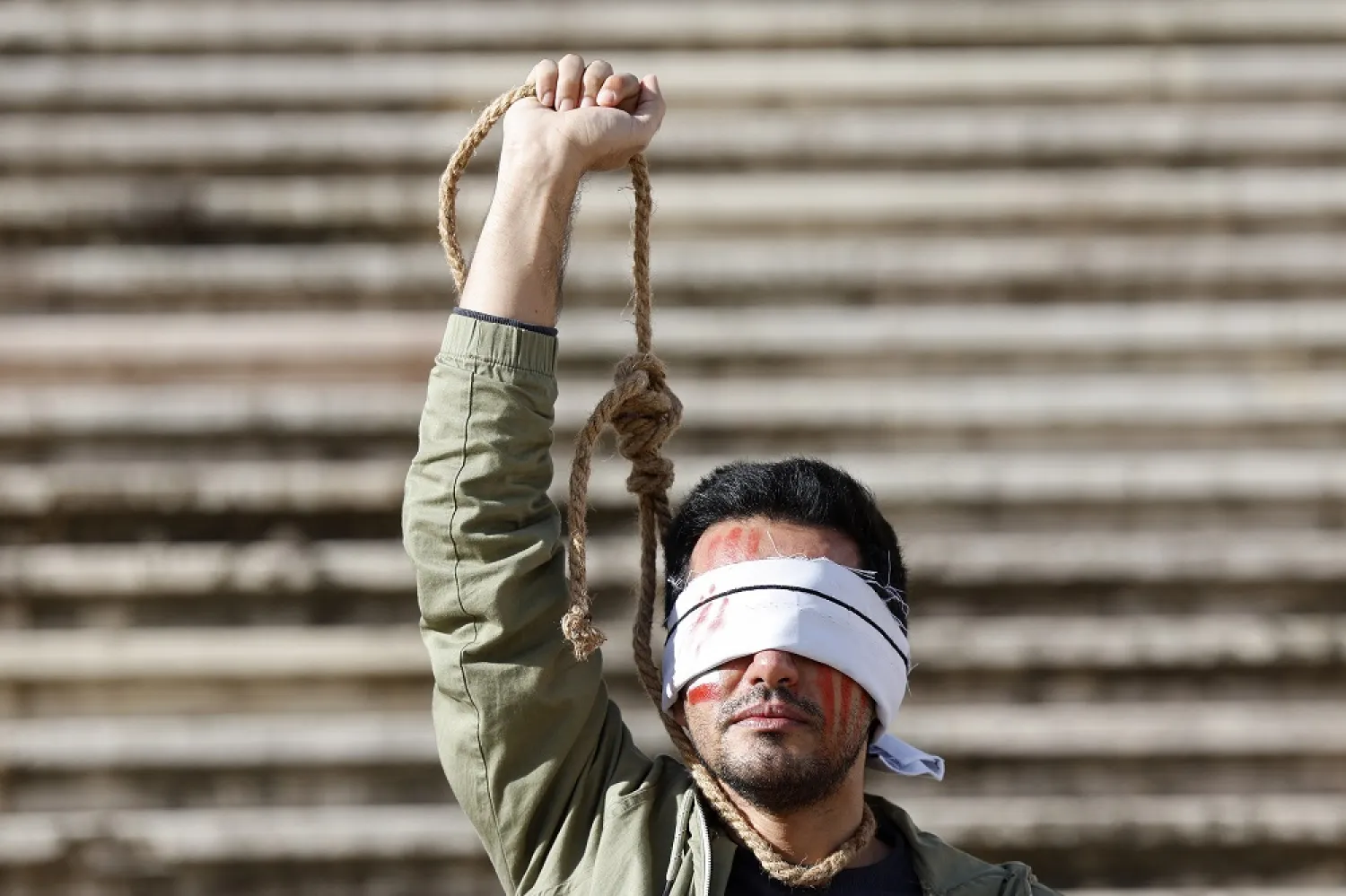

Prominent Iranian Cleric Urges Release of Protest Detainees 

A demonstrator from the Iranian Portuguese community protests in front of the Parliament building following Iran's sentencing to death and public execution of two young demonstrators, Mohsen Shekari and Majidreza Rahnavard, for participating in demonstrations against the regime, in Lisbon, Portugal, 16 December 2022. (EPA)
TT

Prominent Iranian Cleric Urges Release of Protest Detainees 

A demonstrator from the Iranian Portuguese community protests in front of the Parliament building following Iran's sentencing to death and public execution of two young demonstrators, Mohsen Shekari and Majidreza Rahnavard, for participating in demonstrations against the regime, in Lisbon, Portugal, 16 December 2022. (EPA)

A prominent dissident Sunni Muslim cleric urged Iranian authorities on Friday to free thousands of detained protesters and stop executions as the three-month-old unrest churned on with street marches in a restive southeastern province. 

Amnesty International said 26 people faced possible execution after Tehran hanged two people arrested over the protests that erupted after the death in police custody of young Kurdish Iranian woman Mahsa Amini on Sept. 16. 

The unrest, in which demonstrators from all walks of life have called for the fall of Iran's ruling theocracy, poses one of the biggest challenges to the Shiite -ruled republic since its 1979 revolution.  

"At least 26 people are at great risk of execution in connection with nationwide protests after Iranian authorities arbitrarily executed two individuals following grossly unfair sham trials in a bid to instill fear among the public and end protests," Amnesty International said in a statement. 

"Of the 26, at least 11 are sentenced to death and 15 are charged with capital offenses and awaiting or undergoing trials," it said. 

Molavi Abdolhamid, an outspoken Sunni cleric, criticized the death sentences, according to his website. 

"We compassionately recommend that you release the recent prisoners who were detained during these protests and not treat them harshly. Most of them are young and very young. Free the young men and women," Molavi Abdolhamid said. 

"Don't charge them with (capital offenses), and if they are, they should not be sentenced to death and put to death," the cleric said in a Friday prayers sermon. 

After the sermon, demonstrators took to the streets of Zahedan, capital of impoverished Sistan-Baluchistan province in the southeast. "This nation wants freedom, it wants a prosperous country!" they chanted, in videos posted on social media. Reuters could not immediately verify the footage. 

In continued unrest in other parts of Iran, unidentified attackers damaged a mosque in western Lorestan province early on Friday by throwing petrol bombs, state media reported. 

According to the activist HRANA news agency, 495 protesters have been killed as of Thursday, including 68 minors. Sixty-two members of the security forces have also been killed. It said more than 18,400 are estimated to have been arrested. 

On Wednesday, Iran was ousted from a United Nations women's group for policies contrary to the rights of women and girls, a move proposed by the United States over Tehran's violent crackdown on protests often led by women. 


Risk of ‘Escalation’ if Iran Attacked, Warns Deputy Foreign Minister

Iranians walk past shops selling food ahead of Iftar, the Ramadan fast-breaking meal, in northern Tehran on February 23, 2026. (AFP)
TT

Risk of ‘Escalation’ if Iran Attacked, Warns Deputy Foreign Minister

Iranians walk past shops selling food ahead of Iftar, the Ramadan fast-breaking meal, in northern Tehran on February 23, 2026. (AFP)

Iran's deputy foreign minister Kazem Gharibabadi warned of a wider escalation if his country was attacked, after US President Donald Trump raised the threat of strikes.

Trump has sent a major deployment of air and sea power to the Middle East and has threatened to strike Iran if it does not reach a deal on key concerns starting with its nuclear program.

"We call upon all nations committed to peace and justice to take meaningful steps to prevent further escalation," Gharibabadi said at the Conference on Disarmament in Geneva.

"The consequences of any renewed aggression wouldn't remain confined to one country -- and responsibility would rest with those who initiate or support such actions."

Iranian and US negotiators held indirect talks in Geneva last week on Tehran's nuclear program, hosted by Oman.

A fresh round of talks in the Swiss city this Thursday has been confirmed by Muscat, though not by Washington.

"Iran remains committed to diplomacy and dialogue as the most effective path towards de-escalation and sustainable security," Gharibabadi said.

"Recent diplomatic engagement here in Geneva, which will continue this Thursday, demonstrates that a new window of opportunity exists for negotiations to address differences and build confidence -- provided that they uphold mutual respect, equitable treatment and non-selective application of international norms.

"Any sustainable and credible negotiation must respect the legitimate rights of all states under international law, and deliver tangible security benefits without coercion, unilateral demands or threats of force."

- 'Chaos and change' -

The United States and Israel threatened new military action against Iran after mass protests in the regime, which the Iranian authorities crushed at a cost of thousands of lives.

After last week's indirect talks with Washington through Omani mediators in Geneva, Tehran said they had reached broad agreement on a set of guiding principles.

Gharibabadi said that while Tehran sought the path of diplomacy, it was prepared to defend its sovereignty, territory and people, insisting it would exercise its right to self-defense "if necessary".

He said meaningful progress in disarmament and non-proliferation could only be achieved through mutual, balanced and legally-binding commitments.

He called upon nuclear weapons states to engage constructively in talks towards a comprehensive nuclear weapons convention, plus offer legally-binding security assurances for countries without nuclear weapons.

Speaking just before, UN Secretary-General Antonio Guterres said the world was living through a period of "chaos and change", with international law being brazenly violated.

"The international order that defined security relations for nearly eight decades is shifting rapidly. The reckless use of force in many regions is fomenting mistrust," he warned.


Netanyahu Says Israel Facing ‘Challenging Days’ with Iran-US Tensions

Israeli Prime Minister Benjamin Netanyahu delivers a speech during a plenary session of the Knesset, the Israeli parliament, in Jerusalem, 23 February 2026. (EPA)
TT

Netanyahu Says Israel Facing ‘Challenging Days’ with Iran-US Tensions

Israeli Prime Minister Benjamin Netanyahu delivers a speech during a plenary session of the Knesset, the Israeli parliament, in Jerusalem, 23 February 2026. (EPA)

Prime Minister Benjamin Netanyahu said Monday that Israel was facing "complex and challenging days" as tensions escalate between the United States and Iran following President Donald Trump's threat of strikes should Tehran refuse to accept a new nuclear agreement.

"We are in very complex and challenging days," Netanyahu told lawmakers in a brief address to parliament. "We are keeping our eyes open and are prepared for any scenario."

He also reiterated a warning to Iran's leadership: "I have conveyed to the Iranian regime that if they make the gravest mistake in their history and attack the State of Israel, we will respond with a force they cannot even imagine."

The premier further highlighted Israel's close military cooperation with the US, as Washington continues to build up its military presence near Iran and in the Middle East.

"The alliance with the United States has never been closer," Netanyahu said.

"Between the Israel forces and the United States military, between our security agencies and their security services, there has never been anything like this," he added.

Arch-foes Israel and Iran faced each other in a first direct confrontation last June during a 12-day war in which the Israeli military targeted Tehran's nuclear facilities and ballistic missile arsenal.

Iran responded with drone and missile strikes on Israel. Later on in the war, the United States joined Israel in targeting Iran's underground nuclear facilities.


Iranian Students Protest for Third Day as US Pressure Mounts

Iranians drive along a street in Tehran, Iran, 23 February 2026. (EPA)
TT

Iranian Students Protest for Third Day as US Pressure Mounts

Iranians drive along a street in Tehran, Iran, 23 February 2026. (EPA)

Iranian students ‌defied authorities with protests for a third day on Monday, weeks after security forces crushed mass unrest with thousands killed and as the United States weighs possible air strikes against the country.

State media outlets reported students chanting anti-government slogans at Tehran University, burning flags at the all-women al-Zahra University, and scuffles at Amir Kabir University, all located in the capital.

Reuters also verified video showing students at al-Zahra University chanting slogans including "we'll reclaim Iran", but was not able ‌to confirm ‌when it was recorded.

In a new ‌sign ⁠of the mounting ⁠tension in the Middle East, the United States began pulling non-essential personnel and family members from the embassy in Beirut, a senior State Department official said.

US President Donald Trump has repeatedly threatened Iran since major nationwide protests across the country in January, saying on Thursday that "really bad things will ⁠happen" if talks between the countries fail ‌to produce a deal.

Washington wants ‌Iran to give up much of its nuclear program, which ‌it believes is aimed at building a bomb, limit the ‌range of its missiles to short distances and stop supporting groups it backs in the Middle East.

It has built up forces across the Middle East, putting increased pressure on Iran ‌as it weighs its response to US demands amid ongoing talks.

Iranian Supreme Leader Ali ⁠Khamenei ⁠already faces the gravest crisis of his 36-year tenure, with an economy struggling under the weight of international sanctions and growing unrest that broke out into major protests in January.

On Sunday Iranian President Masoud Pezeshkian said negotiations with the US had "yielded encouraging signals" even as a second US aircraft carrier headed towards the Middle East.

Trump has not laid out in detail his thinking on any possible Iran strike. A senior White House official told Reuters last week there was still no "unified support" within the administration to go ahead with an attack.
