


Ukraine President Back in Kyiv, Russia Keeps up Attacks

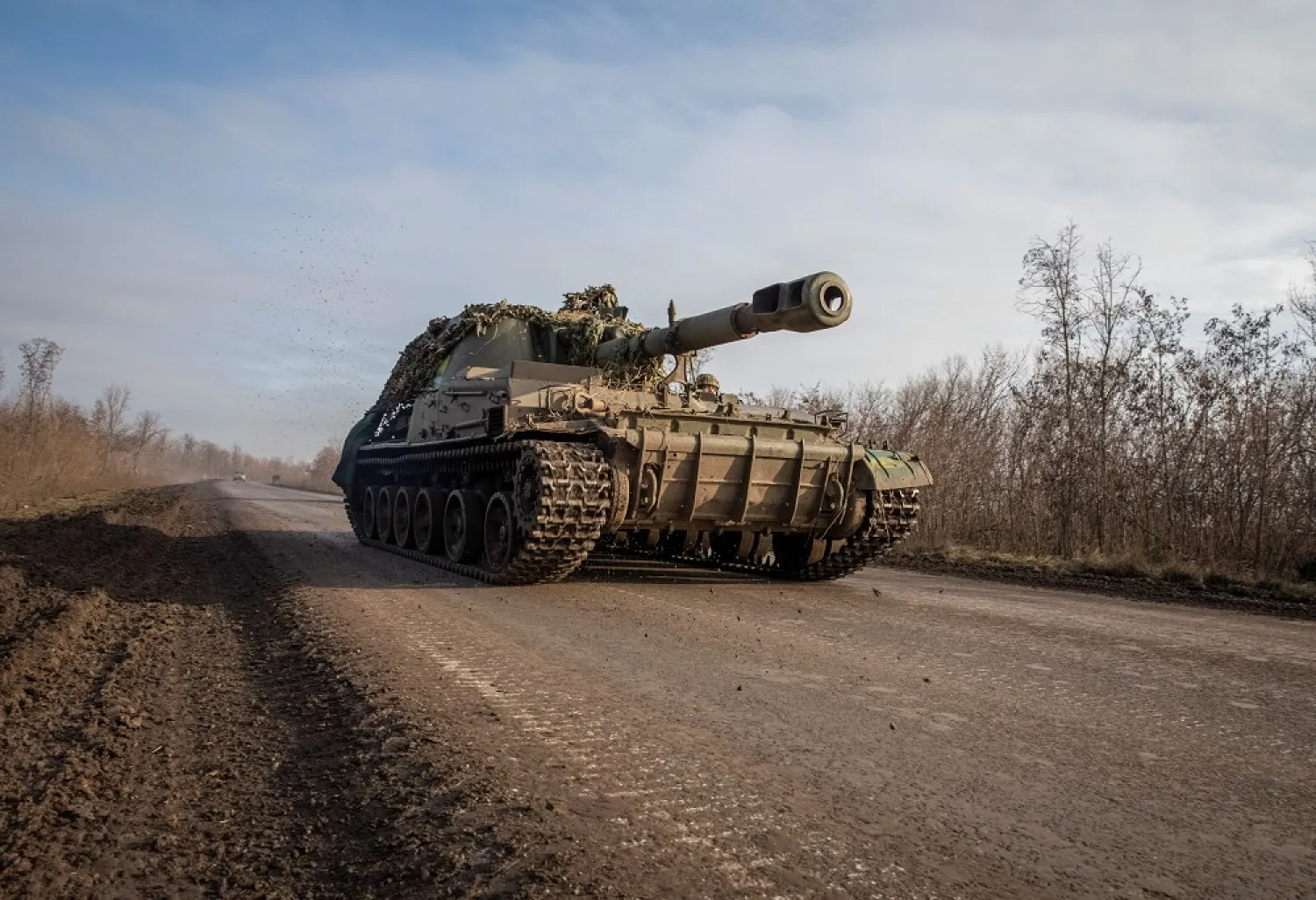
Ukrainian servicemen ride a self-propelled howitzer, amid Russia's attack on Ukraine, near Bakhmut, Ukraine December 23, 2022. (Reuters)
TT

Ukraine President Back in Kyiv, Russia Keeps up Attacks

Ukrainian servicemen ride a self-propelled howitzer, amid Russia's attack on Ukraine, near Bakhmut, Ukraine December 23, 2022. (Reuters)

Ukrainian President Volodymyr Zelenskyy sounded another defiant note on his return to his nation’s capital Friday following his wartime visit to the United States, saying his forces are “working toward victory” even as Russia warned that there would be no end to the war until it achieved its military aims. 

Zelenskyy posted on his Telegram account that he’s in his Kyiv office following his US trip that secured a new $1.8 billion military aid package, and pledged that “we’ll overcome everything.”  

Speaking to Ukrainian ambassadors later Friday, Zelenskyy suggested that US lawmakers were preparing another $45 billion financial package “for Ukraine and global security,” adding that strategic agreements with Washington would strengthen Kyiv's defense forces in the new year. 

He earlier thanked the Netherlands for pledging up to 2.5 billion euros ($2.65 billion) for 2023, to help pay for military equipment and rebuild critical infrastructure. 

Zelenksyy’s return comes amid relentless Russian artillery, rocket and mortar fire as well as airstrikes on the eastern and southern fronts and elsewhere in Ukraine. 

Kremlin spokesman Dmitry Peskov said the war would end at the negotiating table once the “special military operation” achieves “the goals that the Russian Federation has set,” adding that “a significant headway has been made on demilitarization of Ukraine.” 

The Kremlin spokesman said no reported Ukrainian peace plan can succeed without taking into account “the realities of today that can’t be ignored” — a reference to Moscow’s demand that Ukraine recognize Russia’s sovereignty over the Crimean Peninsula, which was annexed in 2014, as well as other territorial gains. 

At least six civilians were killed and 18 others were wounded in Russian attacks on eight regions in Ukraine's south and east in the past 24 hours, according to Ukrainian officials. 

In a regular Telegram update, the deputy head of Ukraine’s presidential office Kyrylo Tymoshenko said Russian missiles destroyed a boarding school in the eastern city of Kramatorsk, home of the Ukrainian army's local headquarters. 

The Ukrainian military said Russian forces fired multiple rocket launchers “more than 70 times” across Ukrainian territory overnight, while fierce battles raged around the city of Bakhmut in the eastern Donetsk region. 

The General Staff of the Ukrainian Armed Forces said Bakhmut and Lyman in the neighboring Luhansk region as well as the front line between the Luhansk and Kharkiv regions bore the brunt of the Russian strikes, but didn't specify to what degree. 

As many as 61 Russian rocket, artillery and mortar fire attacks were launched in the Kherson region over the past 24 hours. Kherson regional Gov. Yaroslav Yanushevych posted on Telegram that Russian forces attacked from dug-in positions on the right bank of the Dnieper river, hitting educational institutions, apartment blocks and private homes. Tymoshenko said renewed Russian shelling on Kherson city Friday killed another person. 

In the eastern Kharkiv and Dnipropetrovsk regions, Ukraine's military said Russia launched six missile strikes and as many air attacks on civilian targets, while Ukrainian forces repelled Russian ground attacks on or near 19 settlements in the north and east. 

Russian shelling overnight also struck a district hospital in the northeastern city of Volchansk, Kharkiv region, wounding five people, according to local Gov. Oleh Syniehubov. Syniehubov posted on Telegram that the four men and one woman were all in “moderate condition." 

Meanwhile, the Ukrainian military said several blasts tore through factory buildings housing Russian troops in the occupied city of Tokmak in the southern Zaporizhzhia region late on Thursday, sparking a fire. The Center for Strategic Communications of the Armed Forces of Ukraine didn't immediately report on casualties or who was behind the blasts. 

Earlier Friday, the Ukrainian mayor of the southern city of Melitopol said that a car used by Russian occupation forces exploded, although it's unclear if anyone was hurt. 

The reports came a day after a car bomb killed the Russia-appointed head of the village of Lyubymivka in the neighboring Kherson region, according to Russian and Ukrainian news reports. Ukrainian guerrillas have for months operated behind Russian lines in Ukraine’s occupied south and east, targeting Kremlin-installed officials, institutions and key infrastructure, such as roads and bridges. 

Separately, Russian President Vladimir Putin urged weapons industry executives on Friday to supply the country's soldiers “with all the necessary weapons, equipment, munitions and supplies” as well as upgrading weapons systems “in view of the combat experience” that arms designers and engineers have gleaned from the war in Ukraine. 

Putin had chaired the meeting with executives following a visit to an air defense and anti-tank weapons factory in Tula, about 150 kilometers (90 miles) south of Moscow. 

Amid the fighting, the funeral of a 33-year-old Ukrainian soldier killed during a Dec. 15 combat mission in the Donetsk region served as another poignant reminder of the human cost that the war has wrought. 

Shots were fired into the air in a final salute to Dmytro Georgiyovych Kyrychenko, whose Ukrainian flag-draped coffin was placed in a grave alongside other fallen comrades in his hometown of Bucha, on Kyiv's outskirts. 

“He was the best son,” Kyrychenko’s tearful mother Ryma said. “I don’t know how I’ll be living on.” 

The soldier's sister, Luba Kyrychenko, lamented that almost 10 months into the war, Ukrainian servicemen are still relying on donations from friends and relatives to buy basic protective gear and ammunition, adding that her brother lacked the necessary training and support for combat missions. 

“We have a black hole inside our souls. People shouldn’t forget. Europe, the whole world shouldn’t forget about this,” she said following the burial. 

Both Russia and Ukraine have kept any military casualty numbers a tightly guarded secret, but tens of thousands are believed to have died on both sides. 


Iran Summons French, German, Italian, UK Envoys Over Support for Protests

 Cars burn in a street during a protest over the collapse of the currency's value, in Tehran, Iran, January 8, 2026. Stringer/WANA (West Asia News Agency) via Reuters
Cars burn in a street during a protest over the collapse of the currency's value, in Tehran, Iran, January 8, 2026. Stringer/WANA (West Asia News Agency) via Reuters
TT

Iran Summons French, German, Italian, UK Envoys Over Support for Protests

 Cars burn in a street during a protest over the collapse of the currency's value, in Tehran, Iran, January 8, 2026. Stringer/WANA (West Asia News Agency) via Reuters
Cars burn in a street during a protest over the collapse of the currency's value, in Tehran, Iran, January 8, 2026. Stringer/WANA (West Asia News Agency) via Reuters

Iran on Monday summoned diplomats in Tehran representing France, Germany, Italy and the UK to object to what it described as support by those countries for the protests that have shaken the country, its foreign ministry said.

The diplomats were shown a video of the damage caused by "rioters" and told their governments should "withdraw official statements supporting the protesters", the ministry said in a statement quoted by state television.

In Paris, the French foreign ministry confirmed that "European ambassadors" had been summoned by Iran.


Iran’s Traders, Frustrated by Economic Losses, Turn Against Clerics

 Cars burn in a street during a protest over the collapse of the currency's value, in Tehran, Iran, January 8, 2026. Stringer/WANA (West Asia News Agency) via Reuters
Cars burn in a street during a protest over the collapse of the currency's value, in Tehran, Iran, January 8, 2026. Stringer/WANA (West Asia News Agency) via Reuters
TT

Iran’s Traders, Frustrated by Economic Losses, Turn Against Clerics

 Cars burn in a street during a protest over the collapse of the currency's value, in Tehran, Iran, January 8, 2026. Stringer/WANA (West Asia News Agency) via Reuters
Cars burn in a street during a protest over the collapse of the currency's value, in Tehran, Iran, January 8, 2026. Stringer/WANA (West Asia News Agency) via Reuters

Iran's bazaar merchants, the trader class who were the financial backbone of the 1979 revolution, have turned against the clerics they helped bring to power, fueling unrest over an economy that has morphed into full-blown anti-government protests.

Frustration among bazaar merchants, from small-scale shopkeepers to large wholesale traders, has grown as their political and economic clout in Iran has diminished over the decades while the elite Revolutionary Guards have tightened their grip on the economy, building sprawling and tightly held networks of power.

"We are struggling. We cannot import goods because of US sanctions and because only the Guards or those linked to them control the economy. They only think about their own benefits," said a trader at Tehran’s centuries-old Grand Bazaar, speaking on condition of anonymity.

The wave of protests that has engulfed the country, posing one of the toughest challenges ever to the clerical leadership, erupted in late December in Tehran's Grand Bazaar, where hundreds of shopkeepers denounced the sharp fall in the rial currency.

The demonstrations quickly swelled and turned political, challenging the Islamic Republic's legitimacy. Protesters burned images of Supreme Leader Ali Khamenei and chanted "Death ‌to the dictator" - ‌undeterred by security forces armed with tear gas, batons, and, in many cases, live ammunition.

Iran’s ‌rulers, ⁠while acknowledging economic difficulties, have ‌blamed their longtime foes the US and Israel for fomenting the unrest. They appear intent on holding onto power at any cost, backed by a security apparatus refined over decades of suppressing ethnic revolts, student movements, and protests over economic hardship and social freedoms.

A combination of international sanctions and the Guards' sprawling economic empire has limited the government's ability to ease the dire economic situation.

Tehran-based analyst Saeed Laylaz said the government has lost control over the situation.

"What is striking is that the unrest began in the bazaar. For merchants, the core issue isn’t inflation - it’s price volatility, which leaves them unable to decide whether to buy or sell," he said.

Economic disparities between ordinary Iranians and the clerical and security elite, along with economic mismanagement and state corruption - ⁠reported even by state media - have fanned discontent at a time when inflation is pushing the price of many goods beyond the means of most people.

Iran's rial currency has lost nearly ‌half its value against the dollar in 2025, with official inflation reaching 42.5% in December.

CONTROL ‍OF SECTORS FROM OIL TO CONSTRUCTION

Created by the republic's ‍late founder Khomeini, the Guards first secured an economic foothold after the Iran-Iraq war in the 1980s, when clerical rulers allowed them ‍to invest in leading Iranian industries.

Their influence expanded exponentially over decades, benefiting from Khamenei's full backing and from opportunities created by Western sanctions, which effectively excluded Iran from the global financial and trading system.

The Guards now control vast sectors of the economy, from oil to transportation, communications, and construction.

Another trader said the crisis was not over, as the Guards have long proved adept at defending their economic interests.

"The government wants to resolve the problem, but it lacks the means and power in this system. The economy is not controlled by the government," said the trader, a 62-year-old carpet seller in Tehran.

All aspects of the country's sanctions-hit oil business have come under the growing influence of the ⁠Guards - from the shadow fleet of tankers that secretly ship sanctioned crude, to logistics and front companies selling the oil, mostly to China.

"No one knows how much of the oil money that the Guards get from selling Iran’s oil returns to the country ... they are too powerful to be questioned about it,” said a senior Iranian official, who asked not to be named.

During his 2013–2021 presidency, pragmatist Hassan Rouhani repeatedly clashed with the Guards, accusing them publicly of resisting budget cuts, while his attempts to curb their commercial networks and assets were largely frustrated.

THE ESTABLISHMENT RELIES ON THE GUARDS TO END UNREST

Even as it has relinquished economic power, the clerical establishment has relied on its loyal forces - the Guards and its affiliated Basij paramilitary - to violently crush ethnic uprisings, student unrest, and protests over economic hardship, preserving the political order.

"Given the sensitive circumstances when the country faces foreign threats, Khamenei cannot upset the Guards by curbing their economic influence. The establishment needs them to quell the protests and confront foreign threats," said an insider, close to Rouhani.

US-based rights group HRANA said it had verified the deaths of 544 people - 496 protesters and 48 security personnel - with 10,681 people arrested since ‌the protests began on December 28 and spread around the country. Reuters was unable to independently verify the tallies.

The authorities have not given numbers of casualties, but officials say many members of the security forces have been killed by "terrorists and rioters" linked to foreign foes, including the US States and Israel.


Greenland Says It Should Be Defended by NATO, Rejects Any US Takeover

 A view of houses in Nuuk, Greenland, June 22, 2025. (AP)
A view of houses in Nuuk, Greenland, June 22, 2025. (AP)
TT

Greenland Says It Should Be Defended by NATO, Rejects Any US Takeover

 A view of houses in Nuuk, Greenland, June 22, 2025. (AP)
A view of houses in Nuuk, Greenland, June 22, 2025. (AP)

Greenland's government said on Monday it will increase efforts to ensure the defense of the Arctic territory takes place under the auspices of NATO and again rejected US President Donald Trump's ambition to take over the island.

Trump has said the United States must own Greenland, an autonomous part of the Kingdom of Denmark, to prevent Russia ‌or China occupying the ‌strategically located and minerals-rich territory ‌in ⁠the future.

"All ‌NATO member states, including the United States, have a common interest in the defense of Greenland," the island's coalition government said in a statement, adding that it can in no way accept a US takeover of Greenland.

"As part of ⁠the Danish commonwealth, Greenland is a member of NATO and ‌the defense of Greenland ‍must therefore be through NATO," ‍the government said.

The European Union Commissioner ‍for Defense and Space Andrius Kubilius said earlier on Monday that any US military takeover of Greenland would be the end of NATO.

Trump first floated the idea of a US takeover of Greenland in 2019 during his first term ⁠in office, although he faces opposition in Washington, including from within his own party.

While Denmark has ruled Greenland for centuries, the territory has gradually been moving towards independence since 1979, a goal shared by all political parties elected to the island's parliament.

"We are a democratic society that makes our own decisions. And our actions are based on international law," Greenland's Prime Minister ‌Jens-Frederik Nielsen wrote on LinkedIn.
