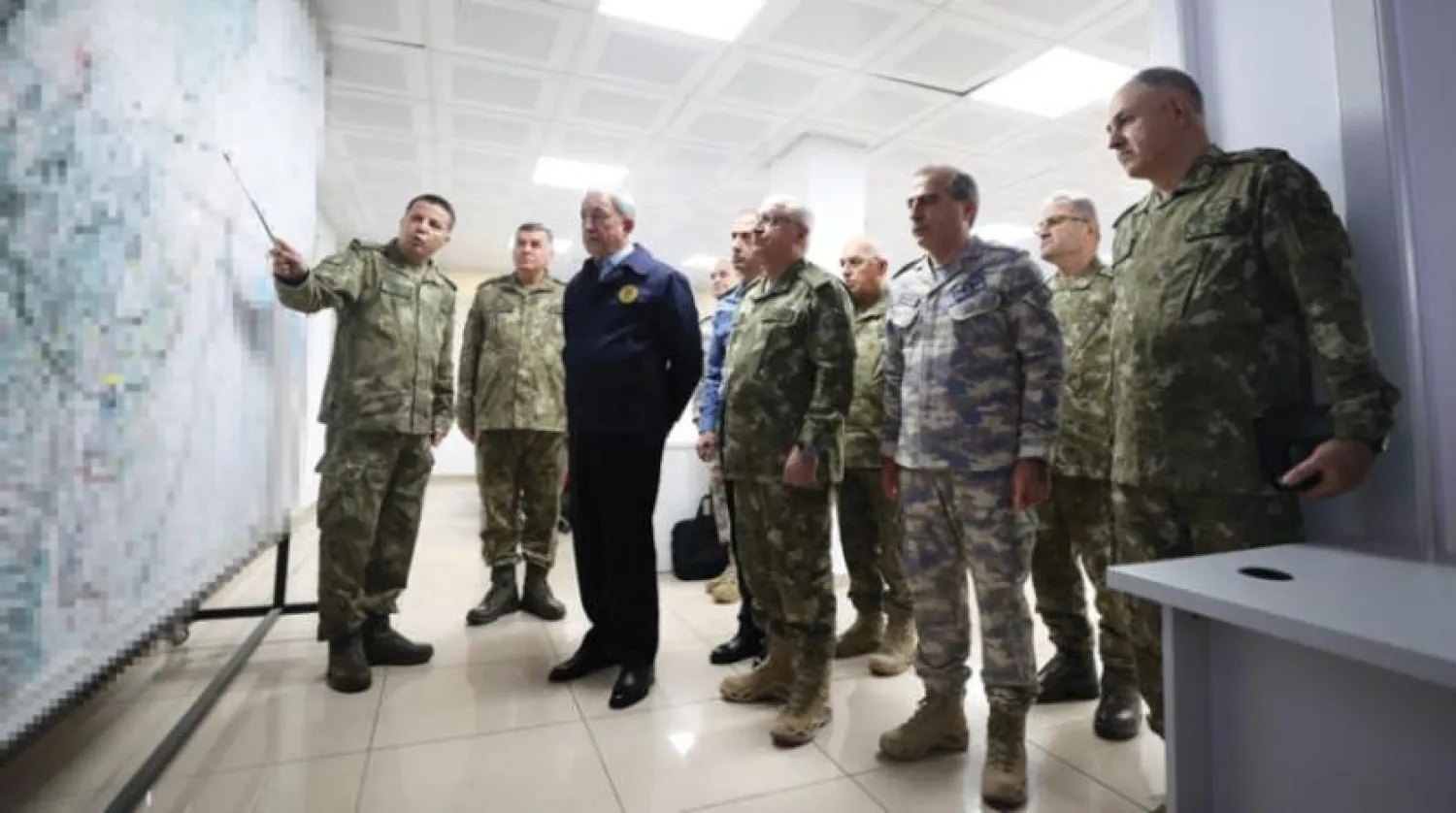
Turkish Defense Minister Visits Syrian Border, Stresses Dialogue

Turkish Minister of Defense Hulusi Akar and army leaders at the command center on the border with Syria. (Turkish Ministry of Defense)
TT

Turkish Defense Minister Visits Syrian Border, Stresses Dialogue

Turkish Minister of Defense Hulusi Akar and army leaders at the command center on the border with Syria. (Turkish Ministry of Defense)

Turkish Defense Minister Hulusi Akar visited Türkiye's command center on the border with Syria overnight on Saturday.  

According to the Ministry of Defense, the minister and accompanying army commanders were briefed about the situation on the border during a meeting with officers and soldiers at the Operation Spring Shield command center.  

Akar told reporters that Ankara was in talks with Moscow about the situation in northern Syria and using the Syrian airspace for a potential cross-border operation against the Syrian Democratic Forces (SDF). 

"We are in talks and discussing with Russia about all issues, including opening the airspace," he said. 

He added that Türkiye is sending the necessary messages to all parties concerned with the Syrian file and taking steps without allowing anyone to undermine its sovereignty, independence, rights and interests. 

Akar pointed out that the Euphrates Shield, Olive Branch, Peace Spring and Spring Shield operations were "carried out successfully" against what he called "terrorist targets" in northern Syria.  

He stressed that Türkiye is determined to protect its rights and never ignores peace, talks, and dialogue, reiterating that Ankara will try to resolve problems reasonably and rationally.  

Türkiye and Russia have held talks earlier this month. Moscow wanted to dissuade Ankara from resorting to a military operation that included a ground invasion of SDF positions in Manbij, Tal Rifaat and Ain al-Arab.  

The Russian plan included the withdrawal of the SDF forces and their weapons from Manbij and Ain al-Arab. They would be replaced by the Syrian regime forces, while the SDF would maintain the Asayish security forces that would be integrated into the regime's security forces, revealed sources. 

However, Türkiye demanded the withdrawal from Tal Rifaat and the return of the Syrian regime as an alternative to the SDF, including security forces and border guards.  

Russia, Iran, and Türkiye continue to pressure the SDF to hand over Ain al-Arab and Manbij to the regime.  

The SDF demanded guarantees regarding its future after handing over the areas, noting that the US had forced Türkiye to freeze the ground operation in northern Syria. 

Akar's visit to the border and the talks with Russia regarding a possible ground operation came amid the escalation of the Turkish forces and the factions of the so-called Syrian National Army against SDF areas in the east and west of the Euphrates. 


Israeli Elections Official: No Evidence Arab Parties 'Stole' Election

A Palestinian citizen of Israel casts her ballot in the country's general election at a polling station in Umm al-Fahm, Israel, Tuesday, Oct. 27, 2026. (AP Photo/Mahmoud Illean)
TT

Israeli Elections Official: No Evidence Arab Parties 'Stole' Election

A Palestinian citizen of Israel casts her ballot in the country's general election at a polling station in Umm al-Fahm, Israel, Tuesday, Oct. 27, 2026. (AP Photo/Mahmoud Illean)

Israel's Central Elections Committee has rejected allegations of electoral fraud following the strong showing by Arab parties in Tuesday's parliamentary elections, saying there is no evidence to support claims that Arab voters "stole" the election, according to dpa.

Dean Livne, acting director-general of the committee, told Israel's Kan public broadcaster there was no evidence that Arab parties had obtained votes illegally.

A senior police official also dismissed the allegations as propaganda tactics with no factual basis. The official told Haaretz that authorities had received fewer complaints of election irregularities than in previous elections.

Police Commissioner Daniel Levy said every election-related complaint would be examined and investigated thoroughly and impartially.

He added that if any criminal activity was suspected, police would act decisively to uncover the truth and bring those responsible to justice.

For his part, Mansour Abbas, leader of the United Arab List (Ra'am), denied that his party had any involvement in the alleged fraud, according to Israeli media reports.

Arab parties nearly doubled their representation compared with the 2022 elections, winning 19 seats in the 120-member Knesset.


Palestinian Authority, West Bank Palestinians Await Formation of Next Israeli Government

This combination of pictures created on October 28, 2026, shows Prime Minister Benjamin Netanyahu (L) speaking to the media after voting in Jerusalem on October 27, 2026, and Yashar party leader Gadi Eisenkot addressing his supporters at the election night rally in Tel Aviv early on October 28, 2026. (Photo by Jewel SAMAD and Maya LEVIN / various sources / AFP)
TT

Palestinian Authority, West Bank Palestinians Await Formation of Next Israeli Government

This combination of pictures created on October 28, 2026, shows Prime Minister Benjamin Netanyahu (L) speaking to the media after voting in Jerusalem on October 27, 2026, and Yashar party leader Gadi Eisenkot addressing his supporters at the election night rally in Tel Aviv early on October 28, 2026. (Photo by Jewel SAMAD and Maya LEVIN / various sources / AFP)

When Israeli Prime Minister Benjamin Netanyahu adopted his familiar campaign slogan, "The Right or Palestine," during the latest elections, he was seeking to turn voters against his rivals, Gadi Eisenkot, Naftali Bennett and Avigdor Lieberman, claiming that they would grant Palestinians a state if they won and bring disaster upon Israel.

Regardless of how many Israelis believed Netanyahu's claims, Palestinians were never convinced. They know better than anyone that none of Israel's political leaders, whether from the far right, center-right or left, are prepared to grant them statehood or even autonomy at this stage.

Despite this widespread understanding, Palestinians have followed the elections minute by minute and are awaiting the final results with unprecedented interest. The next Israeli prime minister and the ministers serving alongside him will largely determine what life looks like in the West Bank and Gaza Strip over the coming years.

An informed Palestinian source told Asharq Al-Awsat: "We realize that no government will launch a political process at this stage. It is difficult and complicated, and none of them intends to grant us the right to self-determination and statehood. But we will never abandon that right, and we will continue struggling for it through every available means."

The source added: "Many other critical issues are at stake: the future of the Palestinian Authority, the economic situation, the future of the West Bank, security conditions there, settler terrorism, the future of the Gaza Strip, reconstruction and governance in Gaza. All these issues depend on the coalition that comes to power in Israel."

"If Netanyahu's right-wing coalition remains in power, with ministers such as Itamar Ben-Gvir and Bezalel Smotrich, we will face a difficult and complicated situation with an uncertain future. But if Gadi Eisenkot forms a government, or even if a unity government emerges without Ben-Gvir and Smotrich, we could see some relief," the source said.

The Palestinian Authority

The Palestinian Authority is closely monitoring the electoral process and hoping for Eisenkot's success and Netanyahu's defeat.

It believes that improvements in security and economic conditions may be possible under any new Israeli government other than the current one.

A government willing to negotiate outstanding economic and security issues, release withheld Palestinian funds and resume regular financial transfers would be considered the lesser of two evils.

The Palestinian Authority has refrained from expressing this position publicly, maintaining silence and exercising considerable caution while describing the elections as an internal Israeli matter.

During the previous elections in 2022, the PA attempted to help defeat Netanyahu, prompting Israel's domestic security agency, Shin Bet, to issue an explicit "stern warning" against interfering in the electoral process.

The warning followed a meeting between Palestinian intelligence chief Majed Faraj and leaders of Arab political parties in Israel.

Israeli officials said the meeting was intended to persuade the Arab parties to unite, while the PA maintained that the elections had not been discussed.

Israeli reports at the time said the PA had expressed concern to Arab party leaders that low Arab voter turnout could return Netanyahu to power at the head of a hardline right-wing government.

The reports also claimed that the Palestinian official had gone as far as accusing Arab lawmakers of failing to do enough to prevent such an outcome.

This time, the PA made no attempt to meet Arab political leaders. Nevertheless, it undoubtedly maintained channels of communication with them through various means.

The PA is pleased with the number of Knesset seats won by Arab parties, which effectively prevents Netanyahu from securing an outright victory.

The "Erasure Project"

Netanyahu led a far-right government that escalated its measures against Palestinians in the West Bank on multiple fronts while waging a bloody war in the Gaza Strip.

During this period, his government worked to weaken the Palestinian Authority, withheld its revenues and gave settlers a free hand to kill, attack and seize land in the West Bank.

It also advanced plans to expand existing settlements and establish new ones, connecting them through contiguous settlement corridors.

The government established approximately 1,000 military checkpoints and gates across the West Bank in an attempt to confine Palestinians within Area A.

Netanyahu's government also annulled the Hebron Agreement governing the West Bank's largest city and introduced an electronic land registration and rights settlement system in the occupied Palestinian territories.

The move marked a dramatic step that could deepen the annexation of the West Bank, leaving the Palestinian Authority without sovereignty and Palestinians without legal protection.

Together, these policies served what has been described as a project to "erase" Palestinians as a people.

According to an extensive investigation by the Israeli human rights organization B'Tselem, this erasure project targets the Palestinian presence in the West Bank through an interconnected system of five measures: violence and intimidation, restrictions on movement, economic strangulation, political and social destruction, and ethnic cleansing and the seizure of territory.

"They Turned Our Lives into Hell"

Ahmed Taim, 50, from Ramallah in the West Bank, told Asharq Al-Awsat: "We don't expect any significant change from any government. They're all the same. But if people other than Netanyahu, Ben-Gvir and Smotrich come to power, things might improve when it comes to everyday life."

He added: "If they transfer the money to the Palestinian Authority, do more to restrain settlers, allow workers to return to their jobs in Israel, ease the pressure on the West Bank and reduce checkpoints and gates, that would make a huge difference to people's lives. That matters."

Palestinians in the West Bank are facing severe economic hardship, daily restrictions and delays at checkpoints, Israeli military operations and deadly settler attacks, making everyday life extremely difficult.

Mousa Awad, from Bethlehem, expressed hope that Arab parties would succeed in "sending Netanyahu, Ben-Gvir and Smotrich home."

"They have turned our lives into hell," he said.

The suffering has not been confined to Palestinians in the West Bank. It has also extended to prisoners in Israeli jails, where Ben-Gvir has deprived them of food, visits and privileges they previously enjoyed.

The mother of Palestinian prisoner Khaldoun Obeiyat said she prays every day for her son and for Ben-Gvir's departure.

"He has turned the prisons into graveyards. My heart burns for my son every time news reaches us from prison. God willing, he will leave and never return," she told Asharq Al-Awsat.

Palestinians will now have to wait weeks, perhaps longer, for Israel's political situation to be resolved. They may then face many more months of waiting before a new government, if one is formed, takes any significant measures affecting their lives.



Palestinian President Says Hopes for Peace Talks with New Israeli Government

President Mahmoud Abbas during the 32nd session of the Palestine Liberation Organization's Central Council in Ramallah, April 2025 (A.P.)
TT

Palestinian President Says Hopes for Peace Talks with New Israeli Government

President Mahmoud Abbas during the 32nd session of the Palestine Liberation Organization's Central Council in Ramallah, April 2025 (A.P.)

Palestinian president Mahmoud Abbas said on Thursday that he hoped the election of a new Israeli government would allow for the resumption of peace talks, AFP reported.

During a press conference in Cyprus, Abbas "expressed hope that the period following the formation of the new Israeli government would create an opportunity to resume serious political dialogue and advance peace", according to official Palestinian news agency Wafa.