



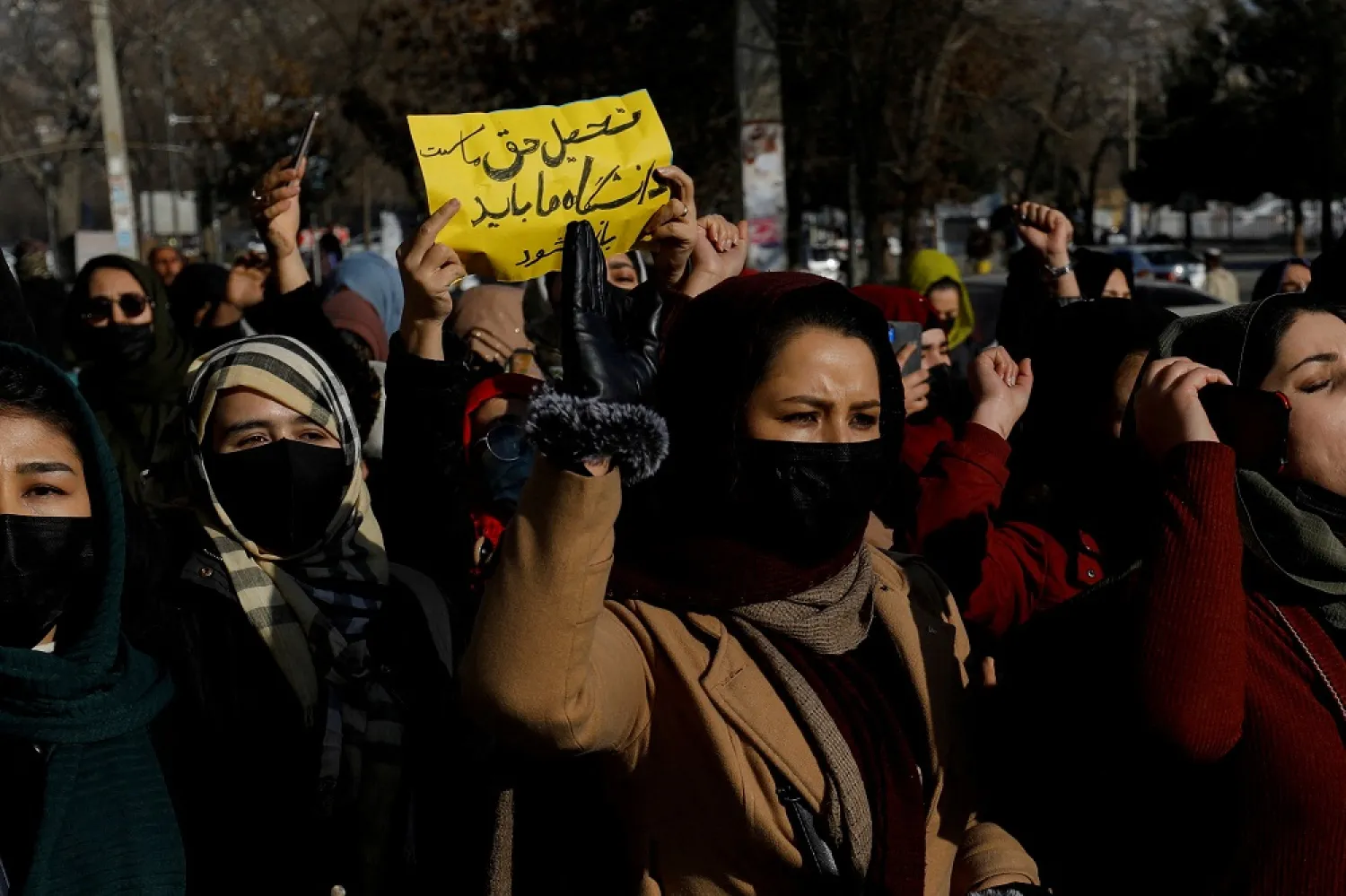

A strong majority of the UN Security Council urged Afghanistan’s Taliban rulers Friday to immediately reverse all “oppressive” restrictions on girls and women including the latest ban on women working for aid organizations which is exacerbating the already critical humanitarian crisis in the country.
The joint statement from 11 of the 15 council members said female aid workers are crucial to addressing Afghanistan’s “dire humanitarian situation” because they provide “critical life-saving support to women and girls” that men can’t reach. It reiterated the council’s demand for “unhindered access for humanitarian actors regardless of gender.”
Japanese Ambassador Kimihiro Ishikane, the current council president, delivered the statement to reporters before a closed council meeting, surrounded by diplomats from the 10 other countries -- Albania, Brazil, Ecuador, France, Gabon, Malta, Switzerland, Britain, United States and United Arab Emirates. The four council nations that didn’t support the statement were Russia, China, Ghana and Mozambique.
United Arab Emirates Ambassador Lana Nusseibeh, who called for the meeting with Japan, told reporters afterward that “the key takeaways” from the closed discussion were the unity from humanitarian actors that the work they are doing is essential -- and the unity in the Security Council to remain engaged, not only to express solidarity but practically “to try and help move the situation on the ground towards a better trajectory.”
Nusseibeh said another takeaway is that engagement with the Taliban has to continue, that there are different ministries mandated to regulate different sectors of humanitarian work.
Diplomats said that some countries are pushing for a Security Council resolution demanding the Taliban reverse all its edicts on women and girls, but it was too early to say if that would happen. Nusseibeh said council members are discussing next steps.
UN spokesman Stephane Dujarric said the UN special envoy for Afghanistan, Roza Otunbayeva, told the council in a video briefing that the Taliban’s restrictions on women and girls violate fundamental human rights and “contradict assurances that the Taliban gave prior to taking power about the role of women in their country.”
She outlined the potential negative impact of such decisions, including immediately on the delivery of humanitarian assistance, Dujarric said.
The 11 council members also urged the immediate reversal of the Taliban’s ban on girls attending secondary school and girls and women attending university as well as restrictions on women’s human rights and freedoms.
Britain’s UN ambassador, Barbara Woodward, tweeted that as a result of the ban on women working for humanitarian groups, as of Thursday, “15% of NGOs had paused all work in Afghanistan, 68% had significantly reduced operations.” She added: “Humanitarian aid can’t happen without women.”
David Miliband, CEO of the International Rescue Committee, a group that has worked in Afghanistan since 1988, said that last year its 8,000 staff, including 3,000 women, served 5.3 million Afghans across the country including 2.7 million women and girls.
But the group has been forced to pause most operations because of the decree banning female NGO staff from working, Miliband said in a prepared briefing to the council obtained by The Associated Press.
He outlined a twin-track approach for getting women back to work, saying: “We have a chance of preventing further calamity for the Afghan people, but only if the international community is decisive, practical and disciplined.”
On one track, he said, it must be made clear to the Taliban that there can be no business as usual without women workers. On another track, Miliband said, when Taliban decision-makers in ministries or localities support reopening services “we will quickly move to restart services and build momentum for a return to our operating model.”
The International Rescue Committee said in a statement Friday that earlier this week, “the Ministry of Public Health offered assurances that female health staff, and those working in office support roles, can resume working.” Based on this clarity, IRC said it has restarted health and nutrition services in four provinces.
Miliband called for “a united international response across the humanitarian movement, led by the UN, to re-establish the right of NGOs to employ women.”
The IRC urged the UN to remain engaged with the Taliban to restore the previous situation where male and female workers “can safely and effectively work” to help all needy Afghans.
In another prepared briefing, also obtained by AP, Catherine Russell, executive director of the UN children’s agency UNICEF, said the decree banning women from working for NGOs “is both wrong and dangerous” and “stands to deepen the country’s devastating humanitarian crisis.”
She said UNICEF projects that this year 13.5 million Afghan children will need humanitarian assistance and 20 million Afghans will be at crisis or emergency levels of needing food by March, including “upwards of 875,000 severely wasted children under 5.”


