


Study Envisages Connection between Innovation, Financing, Trade with Global Economy 

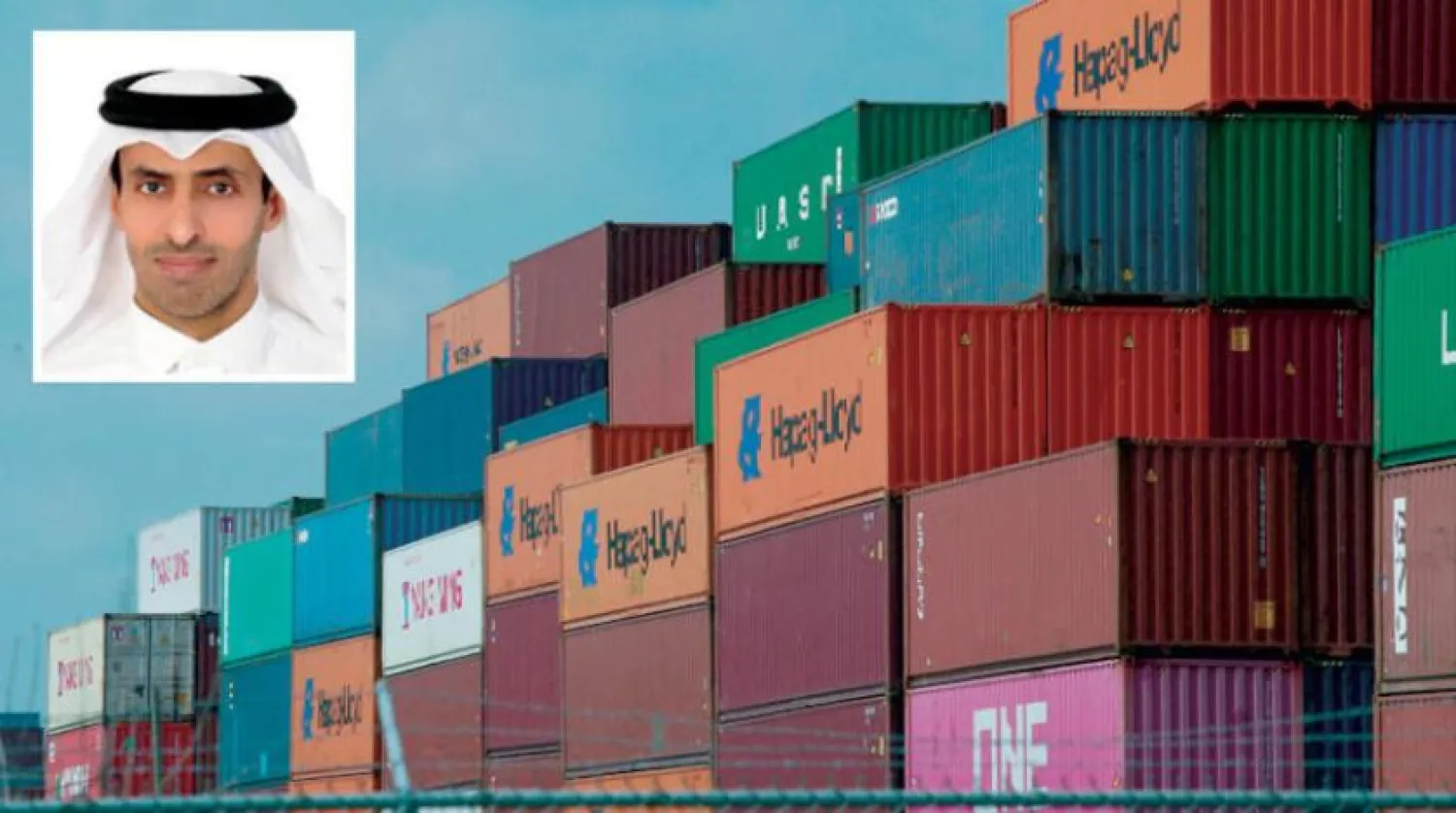
Containers are seen at Newark port in New Jersey and, in the frame, Chief Economic Advisor at the Saudi Ministry of Economy and Planning Dr. Raja Almarzoqi. (AFP)
TT

Study Envisages Connection between Innovation, Financing, Trade with Global Economy 

Containers are seen at Newark port in New Jersey and, in the frame, Chief Economic Advisor at the Saudi Ministry of Economy and Planning Dr. Raja Almarzoqi. (AFP)

Saudi researcher Dr. Raja Almarzoqi underscored the connection between innovation, international commerce movement, financing and economic growth that has become an enabler of global economy that crosses borders.

He called for the adoption of government policies and legislations that would benefit further from the relationship between research, development of innovation and economic growth to push them towards achieving sustainable development, especially amid the openness of the economy, movement of people and flow of investment.

Almarzoqi is a Chief Economic Advisor at the Saudi Ministry of Economy and Planning and a faculty member at the Institute of Diplomatic Studies. He is a previous Adjunct Professor at Thunderbird School of Global Management, Arizona State University, US and King Saud University, Saudi Arabia and former Advisor at the International Monetary Fund.

Along with John Mathis, he authored “Global Innovation, Finance, and International Commerce”, published by Routledge in December.

Mathis is an emeritus professor of global economics, banking and finance and the former director of the Global Financial Services Center at Thunderbird School of Global Management, Arizona State University, US.

Almarzoqi said the emergence of the economic importance of innovators rose with growing openness of the global economy and its interconnectedness through international trade, investments and individuals. This led to a growing attractiveness of innovation to global investment worldwide, crossing geographic borders of innovative countries, which helped them achieve high levels of growth.

Financing tools

Almarzoqi told Asharq Al-Awsat that the growth of bold investment funds played a clear and pivotal role alongside financial markets. He added that the invention of financial tools led to a drop in the risks and increase in the financing ability of businessmen and emerging companies, specifically technological countries where invention is key.

He noted that as finances became available and with the growth of the number of its tools, innovation also grew dramatically since 1750, the time of the first industrial revolution. The revolution helped increase global production that managed to keep up with the growth in demand caused by a rise in population growth and improvement in individual income across the globe.

This no doubt had a role in maintaining prices at an acceptable level, he added.

It also helped in supporting quality of life given that inventions introduced incredible change in means of transportation and communication and facilitated the flow of goods and movement of people at lower costs, Almarzoqi said.

Given the openness of the global economy and ease of the commerce movement, several inventions became accessible to all people, benefiting the producing and consumer countries alike, he noted.

Inventions, he stressed, are among the most important sources of sustainable economic growth, so financing and supporting them yields higher economic gains for the national economy that go beyond the costs the society has to incur as a result of this support.

Government role
Almarzoqi said his book also focuses on the fundamental role governments can play in innovation. He stressed the importance of economic policies and legislations that are adopted by governments to encourage research and development.

He added that the relationship between research, development and economic growth is positive as demonstrated in the theory of endogenous economic growth. Several studies have proven the positive relationship between economic growth and spending on research and development.

As a result of these theories, advanced countries have adopted an increase in spending on research and development at no less than 2 percent of GDP. Moreover, countries, such as South Korea, even went above the average and reached 3.5 percent. This helped transform the Korean economy to the situation it is now compared to the way it was in the 1960s and 70s.

Book chapters

Almarzoqi and Mathis’ book consists of 266 pages and is divided into nine chapters and three main sections. They tackle the industrial revolutions, and examine the environment and circumstances surrounding the inventors and explore their backgrounds to determine, why at a specific time, they identified a need that became the seed for invention and, what was their method of successfully commercializing their innovation.  

They focus on the financing of the inventor, the innovation, and the commercialization of the invention. They analyze the changes in finance during the shift from a labor-based production process to a more capital-intensive production process, and what new financial products or financial markets were created to facilitate this transition.  

They explore the impact of global commerce on the inventor country’s innovation environment and international competition impacting the innovation’s production, distribution, and sales, as well as, investigating any financial impact from the demand side and whether that impact was domestic or global in character.  

Furthermore, they consider if and how global finance and international commerce including the migration of people, together play a role in helping the disruptive invention satisfy a need in society, whether from a production or consumption perspective. Finally, they search for common elements that repeatedly inspired inventors and their disruptive innovations over time. 


India’s Modi Lauds Interim Trade Pact After US Tariff Rollback

Indian Prime Minister Narendra Modi addresses the media before the budget session of Parliament at Parliament House in New Delhi, India, 29 January 2026. (EPA)
TT

India’s Modi Lauds Interim Trade Pact After US Tariff Rollback

Indian Prime Minister Narendra Modi addresses the media before the budget session of Parliament at Parliament House in New Delhi, India, 29 January 2026. (EPA)

Indian Prime Minister Narendra Modi on Saturday hailed an interim trade agreement with the United States, saying it would bolster global growth and deepen economic ties between the two countries.

The pact cuts US "reciprocal" duties on Indian products to 18 percent from 25 percent, and commits India to large purchases of US energy and industrial goods.

US President Donald Trump, while announcing the deal Tuesday, had said Modi promised to stop buying Russian oil over the war in Ukraine.

The deal eases months of tensions over India's oil purchases -- which Washington says fund a conflict it is trying to end -- and restores the close ties between Trump and the man he describes as "one of my greatest friends."

"Great news for India and USA!" Modi said on X on Saturday, praising US President Donald Trump's "personal commitment" to strengthening bilateral ties.

The agreement, he said, reflected "the growing depth, trust and dynamism" of their partnership.

Modi's remarks came hours after Trump issued an executive order scrapping an additional 25 percent levy imposed over New Delhi's purchases of Russian oil, in a step to implement the trade deal announced this week.

Modi, who has faced criticism at home about opening access of Indian agricultural markets to the United States and terms on oil imports, did not mention Russian oil in his statement.

"This framework will also strengthen resilient and trusted supply chains and contribute to global growth," he said.

It would also create fresh opportunities for Indian farmers, entrepreneurs and fishermen under the "Make in India" initiative.

In a separate statement, Commerce Minister Piyush Goyal said the pact would "open a $30 trillion market for Indian exporters".

Goyal also said the deal protects India's sensitive agricultural and dairy products, including maize, wheat, rice, soya, poultry and milk.

Other terms of the agreement include the removal of tariffs on certain aircraft and parts, according to a separate joint statement released Friday by the White House.

The statement added that India intends to purchase $500 billion of US energy products, aircraft and parts, precious metals, tech products and coking coal over the next five years.

The shift marks a significant reduction in US tariffs on Indian products, down from a rate of 50 percent late last year.

Washington and New Delhi are expected to sign a formal trade deal in March.


Gold Bounces Back on Softer Dollar, US-Iran Concerns; Silver Rebounds

Gold and silver bars are stacked in the safe deposit boxes room of the Pro Aurum gold house in Munich, Germany, January 10, 2025. REUTERS/Angelika Warmuth
TT

Gold Bounces Back on Softer Dollar, US-Iran Concerns; Silver Rebounds

Gold and silver bars are stacked in the safe deposit boxes room of the Pro Aurum gold house in Munich, Germany, January 10, 2025. REUTERS/Angelika Warmuth

Gold rebounded on Friday and was set for a weekly gain, helped by bargain hunting, a slightly weaker dollar and lingering concerns over US-Iran talks in Oman, while silver recovered from a 1-1/2-month low.

Spot gold rose 3.1% to $4,916.98 per ounce by 09:31 a.m. ET (1431 GMT), recouping losses posted during a volatile Asia session that followed a fall of 3.9% on Thursday. Bullion was headed for a weekly gain of about 1.3%.

US gold futures for April delivery gained 1% to $4,939.70 per ounce.

The US dollar index fell 0.3%, making greenback-priced bullion cheaper for the overseas buyers.

"The gold market is seeing perceived bargain hunting from bullish traders," said Jim Wyckoff, senior analyst at Kitco Metals.

Iran and the US started high-stakes negotiations via Omani mediation on Friday to try to overcome sharp differences over Tehran's nuclear program.

Wyckoff said gold's rebound lacks momentum and the metal is unlikely to break records without a major geopolitical trigger.

Gold, a traditional safe haven, does well in times of geopolitical and economic uncertainty.

Spot silver rose 5.3% to $74.98 an ounce after dipping below $65 earlier, but was still headed for its biggest weekly drop since 2011, down over 10.6%, following steep losses last week as well.

"What we're seeing in silver is huge speculation on the long side," said Wyckoff, adding that after years in a boom cycle, gold and silver now appear to be entering a typical commodity bust phase.

CME Group raised margin requirements for gold and silver futures for a third time in two weeks on Thursday to curb risks from heightened market volatility.

Spot platinum added 3.2% to $2,052 per ounce, while palladium gained 4.9% to $1,695.18. Both were down for the week.


Europe, Türkiye Agree to Work Toward Updating Customs Union

European Union (R) and Turkish flags fly at the business and financial district of Levent in Istanbul, Türkiye September 4, 2017. REUTERS/Osman Orsal
TT

Europe, Türkiye Agree to Work Toward Updating Customs Union

European Union (R) and Turkish flags fly at the business and financial district of Levent in Istanbul, Türkiye September 4, 2017. REUTERS/Osman Orsal

The European enlargement chief and the Turkish foreign minister said on Friday they had agreed to continue work toward modernizing the EU-Türkiye customs union and to improve its implementation, Reuters reported.

European Commissioner for Enlargement Marta Kos met Turkish Foreign Minister Hakan Fidan in the capital Ankara on Friday.

"They shared a willingness to work for paving the way for the modernization of the Customs Union and to achieve its full potential in order to support competitiveness, and economic security and resilience for both sides," they said in a joint statement afterward.

The sides also welcomed the gradual resumption of European Investment Bank (EIB) operations in Türkiye and said they intended to support projects across the country and neighbouring regions in cooperation with the bank.
