


Saudi Arabia, Syria Sign Joint Airline and Telecoms Deals

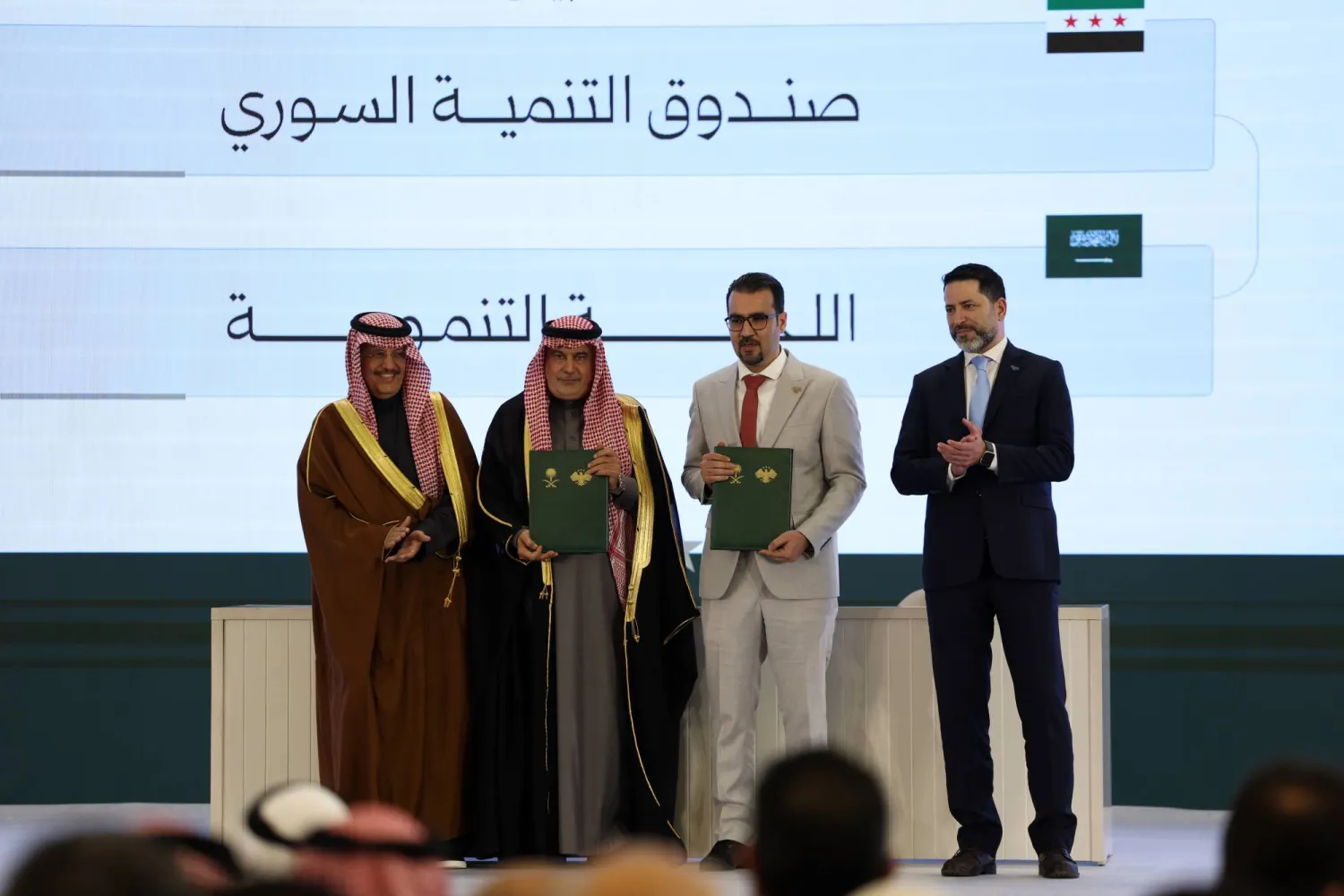
Officials pose after signing a framework agreement for developmental cooperation and the launch of 45 development initiatives between the Syrian Development Fund and Saudi Arabia's Development Committee at the People's Palace in Damascus, Syria, Saturday, Feb. 7, 2026. (AP)
TT

Saudi Arabia, Syria Sign Joint Airline and Telecoms Deals

Officials pose after signing a framework agreement for developmental cooperation and the launch of 45 development initiatives between the Syrian Development Fund and Saudi Arabia's Development Committee at the People's Palace in Damascus, Syria, Saturday, Feb. 7, 2026. (AP)

Syria and Saudi Arabia signed deals Saturday that include a joint airline and a $1-billion project to develop telecommunications, officials said, as Syria seeks to rebuild after years of war.

The new authorities in Damascus have worked to attract investment and have signed major agreements with several companies and governments.

Syrian Investment Authority chief Talal al-Hilali announced a series of deals including "a low-cost Syrian-Saudi airline aimed at strengthening regional and international air links".

The agreement also includes the development of a new international airport in the northern city of Aleppo, and redeveloping the existing facility.

Hilali also announced an agreement for a project called SilkLink to develop Syria's "telecommunications infrastructure and digital connectivity".

Syrian Telecommunications Minister Abdulsalam Haykal told the signing ceremony that the project would be implemented "with an investment of around $1 billion".

For decades, Syria was unable to secure significant investments because of Assad-era sanctions.

But the United States fully removed its remaining sanctions on Damascus late last year, paving the way for the full return of investments.

Syria and Saudi Arabia also inked an agreement on water desalination and development cooperation on Saturday.

At the ceremony, Saudi Investment Minister Khalid Al-Falih announced the launch of an investment fund for "major projects in Syria with the participation of the (Saudi) private sector".

The deals are part of "building a strategic partnership" between the two countries, he said.

Syria's Hilali said the agreements targeted "vital sectors that impact people's lives and form essential pillars for rebuilding the Syrian economy".

Syria has begun the mammoth task of trying to rebuild its shattered infrastructure and economy.

In July last year, Riyadh signed investment and partnership deals with Damascus valued at $6.4 billion to help rebuild the country's infrastructure, telecommunications and other major sectors.

A month later, Syria signed agreements worth more than $14 billion, including investments in Damascus airport and other transport and real estate projects.

This week, Syria signed a preliminary deal with US energy giant Chevron and Qatari firm Power International to explore for oil and gas offshore.

Egypt Raises Fuel Prices by up to 30 Percent

A gas station in the Egyptian capital, Cairo. (Reuters)
TT

Egypt Raises Fuel Prices by up to 30 Percent

A gas station in the Egyptian capital, Cairo. (Reuters)

Egypt raised domestic fuel prices by up to 30 percent on Tuesday, blaming "exceptional" global energy pressures caused by the Middle East war, which has disrupted oil supplies and shipping routes.

The increases, announced by the petroleum ministry, apply to gasoline, diesel and natural gas used in vehicles.

In a statement, the ministry said the adjustments were driven by "disruptions in supply chains, rising risk levels and higher maritime shipping and insurance costs", which have pushed petroleum product prices to "levels not seen in years".

Oil prices briefly surged above $119 a barrel on Monday before plunging to around $84 after US President Donald Trump said the US-Israel war with Iran would end soon.

Diesel, one of Egypt's most widely used fuels, rose by three Egyptian pounds, or about 17.1 percent, to 20.50 pounds ($0.38) per liter, up from 17.50 pounds.

Prices for 80-octane gasoline rose by about 16.9 percent, to 20.75 pounds per liter, while 92-octane gasoline increased by roughly 15.6 percent to 22.25 pounds.

Prices for 95-octane climbed by about 14.3 percent to 24 pounds, the ministry said.

Natural gas used for vehicles saw the largest hike, jumping 30 percent to 13 pounds per cubic meter.

Egypt has raised fuel prices four times over the past two years under an $8 billion loan program from the International Monetary Fund.

An October increase of up to 13 percent was expected to be the last under the plan.


Oil Falls as Trump Predicts Middle East De-escalation

Wells at the San Ardo Oil Field in San Ardo, Calif., Monday, March 9, 2026. (AP Photo/Nic Coury)
TT

Oil Falls as Trump Predicts Middle East De-escalation

Wells at the San Ardo Oil Field in San Ardo, Calif., Monday, March 9, 2026. (AP Photo/Nic Coury)

Oil prices fell on Tuesday after hitting a more than three-year high in the previous session as US President Donald Trump predicted the war in the Middle East could end soon, easing concerns about prolonged disruptions to global oil supplies.

Brent futures fell $6.28, or 6.3%, to $92.68 a barrel at 0715 GMT, while US West Texas Intermediate (WTI) crude was down $6.19, or 6.5%, to $88.58 a barrel, reported Reuters.

Both contracts fell as much as 11% earlier before paring some losses. Oil surged past $100 a barrel on Monday to the highest since mid-2022, as ‌supply cuts ‌by Saudi Arabia and other producers during the expanding US-Israeli war ‌on ⁠Iran stoked fears ⁠of major disruptions to global supplies.

Prices later retreated after Russian President Vladimir Putin held a call with Trump and shared proposals aimed at a quick settlement to the war, according to a Kremlin aide, easing concerns about supply.

Trump said on Monday in a CBS News interview that he thought the war against Iran was "very complete" and Washington was "very far ahead" of his initial four- to five-week estimated time frame.

"Clearly Trump's comments about a short-lived war have calmed ⁠markets. While there was an overreaction to the upside yesterday, we ‌think there is an overreaction to the downside today," ‌said Suvro Sarkar, energy sector team lead at DBS Bank, adding that the market was ‌underappreciating risks at these levels for Brent.

"Murban and Dubai grades are still well above $100 ‌per barrel, so practically nothing much has changed in terms of ground realities," he added, referring to benchmark Middle Eastern oil grades.

In response to Trump, Iran's Revolutionary Guards Corps (IRGC) said they would "determine the end of the war," and Tehran would not allow "one liter of oil" to be exported ‌from the region if US and Israeli attacks continued, state media reported on Tuesday, citing the IRGC's spokesperson.

Prices, however, remain under ⁠pressure as Trump ⁠considers easing oil sanctions on Russia and releasing emergency crude stockpiles as part of a package of options aimed at curbing spiking global oil prices, according to multiple sources.

"Discussions around easing sanctions on Russian oil, comments from Donald Trump hinting that the conflict could eventually de-escalate, and the possibility of G7 countries tapping strategic oil reserves all pointed to the same message - that oil barrels will somehow continue to reach the market," Priyanka Sachdeva, a Phillip Nova analyst, said in a note on Tuesday.

"Once traders sensed that supply routes could still be maintained, the initial 'panic premium' that had pushed prices above the $100 mark yesterday started to fade, and oil prices quickly pulled back."

G7 nations had said on Monday they were prepared to implement "necessary measures" in response to surging global oil prices but stopped short of committing to the release of emergency reserves.


Gold Gains on Weaker Dollar, Easing Inflation Concerns

AFP- A saleswoman adjusts gold jewelry for sale at a shop in Lianyungang_ in China's eastern Jiangsu province
TT

Gold Gains on Weaker Dollar, Easing Inflation Concerns

AFP- A saleswoman adjusts gold jewelry for sale at a shop in Lianyungang_ in China's eastern Jiangsu province

Gold prices rose on Tuesday, supported by a weaker US dollar and easing energy costs after US President Donald Trump suggested that the war in the Middle East could end soon.

Respite from a potential war-driven surge in inflation would likely reduce the chances of central banks raising interest rates, a positive for non-yielding gold, Reuters said.

Spot gold rose 0.7% ‌to $5,174.49 per ounce, ‌as of 0631 GMT. US gold futures ‌for ⁠April delivery rose ⁠1.6% to $5,184.

The dollar fell 0.4%, making greenback-priced bullion cheaper for holders of other currencies.

Gold prices rose "due to the news flow from US President Trump himself, stating that there is a potential for de-escalation ... So what we could see is that potential inflation expectation starts to tone down given this dramatic fall in ⁠oil price," said Kelvin Wong, a senior ‌market analyst at OANDA.

Oil prices ‌fell by more than 5% following Trump's comments.

But, the US president ‌also warned that US attacks could rise sharply if ‌Iran sought to block tanker traffic through the Strait of Hormuz, which handles one-fifth of the world's oil supply.

The war has effectively shut the strait, stranding tankers for over a week and forcing ‌producers to halt output as storage fills up, sending energy prices soaring.

Gold prices fell by ⁠as much ⁠as 2% on Monday as higher energy costs fanned inflation concerns and further dimmed the prospects for a near-term cut in interest rates by the US Federal Reserve.

Investors expect the Fed to keep rates steady at the end of its two-day meeting on March 18, per CME Group's FedWatch tool.

Markets are now awaiting the US consumer price index for February, due on Wednesday, and Personal Consumption Expenditures (PCE) index - the Fed's preferred inflation gauge - on Friday.

Spot silver rose 2% to $88.73 per ounce. Spot platinum gained 0.7% at $2,196.35, while palladium lost 0.3% to $1,685.01.
