


Palestinian Teen Wounds 2, Day after 7 Killed in Jerusalem

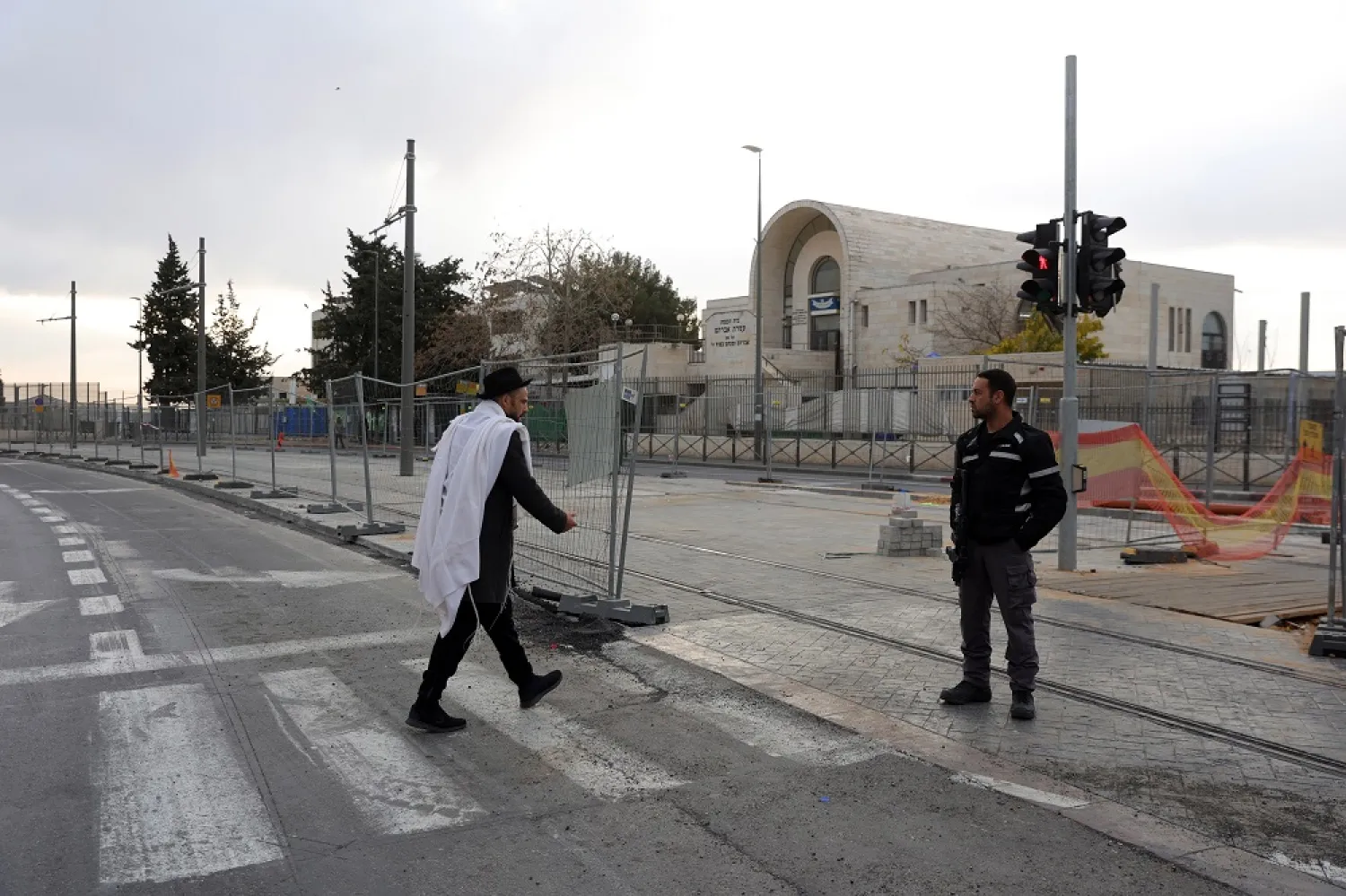
A Police officer (R) outside the Ataret Avraham Synagogue in the Neve Yaakov neighborhood after a fatal shooting attack in Jerusalem, 28 January 2023. (EPA)
TT

Palestinian Teen Wounds 2, Day after 7 Killed in Jerusalem

A Police officer (R) outside the Ataret Avraham Synagogue in the Neve Yaakov neighborhood after a fatal shooting attack in Jerusalem, 28 January 2023. (EPA)

A 13-year-old Palestinian opened fire in east Jerusalem on Saturday, wounding two Israelis, officials said, a day after another attacker killed seven outside a synagogue in the deadliest attack in the city since 2008.

The shooting in the Palestinian neighborhood of Silwan in east Jerusalem, near the historic Old City, wounded a father and son, ages 47 and 23, paramedics said. Both were fully conscious and in moderate to serious condition in the hospital, the medics added.

As police rushed to the scene, two passers-by with licensed weapons shot and overpowered the 13-year-old attacker, police said. Police confiscated his handgun and took the wounded teen to a hospital. Video showed police escorting a wounded teen, wearing nothing but underwear, away from the scene and onto a stretcher, his hands cuffed behind his back. Authorities taped off the street, emergency vehicles and security forces swarmed the area and helicopters whirled overhead.

“He waited to ambush civilians on the holy Sabbath day,” Israeli police spokesman Dean Elsdunne told The Associated Press, adding that the teenager opened fire on a group of five civilians. Security footage showed the victims to be observant Jews, wearing skullcaps and tzitzit, or knotted ritual tassels.

Saturday's events — on the eve of US Secretary of State Antony Blinken's arrival in the region — raised the possibility of even greater conflagration in one of the bloodiest months in Israel and the occupied West Bank in several years. On Friday, a Palestinian gunman killed at least seven people, including a 70-year-old woman, in a Jewish settlement in east Jerusalem, an area captured by Israel in 1967 and later annexed in a move not internationally recognized.

The attacks pose pivotal test for Israel’s new far-right government. Its firebrand minister of national security, Itamar Ben-Gvir, has presented himself as an enforcer of law and order and grabbed headlines for his promises to take even stronger action against the Palestinians.

Speaking to reporters at a hospital where victims were being treated, Ben-Gvir said he wants homes of Palestinian attackers sealed off immediately as a punitive measure, lashing out at Israel's attorney general for delaying his order.

She “is not allowing us to seal the house. In my opinion this is awful. In my opinion, it can’t be like that,” he said of the top prosecutor.

He also called for demolishing dozens of Palestinian homes that Israel says were illegally built in east Jerusalem, granting more gun licenses to Israelis, and applying the death penalty on Palestinians convicted of killing Israelis.

Overhauling the justice system in the country, including the attorney general's, has been on the top agenda of the new government, which says judges have overwhelming powers. The divisive issue helped fuel weekly protests by Israelis who say the sweeping proposed changes would weaken the Supreme Court and undermine democracy.

The Israeli army said it had deployed another battalion to the West Bank on Saturday, adding hundreds more troops to a presence already on heightened alert in the occupied territory.

Prime Minister Netanyahu said he would convene his Security Cabinet later, after the Sabbath, which ends at sundown, to discuss a further response to the attack near the synagogue.

Security forces launched a crackdown in east Jerusalem, fanning out into the neighborhood of the 21-year-old Palestinian gunman, who was shot and killed at the scene. Police arrested 42 of his family members and neighbors for questioning in the At-Tur neighborhood.

The Palestinian leadership, meanwhile, upheld its decision to halt security coordination with Israel that was taken Thursday following the deadly raid in Jenin. After a meeting headed by President Mahmoud Abbas in Ramallah, the Palestinian Authority called on international community and the US administration to oblige Israel into stopping its raids and operations in the West Bank.

Police Chief Kobi Shabtai permanently moved a force, similar to a S.W.A.T. team, in the city and beefed up forces, instructing police to work 12-hour shifts. He urged the public to call a hotline if they see anything suspicious.

The earlier Friday attack came a day after an Israeli military raid killed nine Palestinians in the flashpoint Jenin refugee camp in the West Bank that prompted a rocket barrage from Gaza and retaliatory Israeli airstrikes.

Although calm had appeared to take hold after the limited exchange of fire between Israel and Gaza fighters, tensions were running high in Jerusalem and the West Bank.

Thursday's raid, deadliest single incursion in the West Bank since 2002, followed a particularly bloody month that saw at least 30 Palestinians — gunmen and civilians — killed in in confrontations with Israelis in the West Bank, according to a tally by the AP.

Last year, as the Israeli military intensified its arrest raids following a string of deadly Palestinian attacks within Israel, at least 150 Palestinians were killed in the occupied West Bank and east Jerusalem. It was the highest annual death toll for more than a decade and a half. Thirty people were killed in Palestinian attacks against Israelis last year.

Israel says most of the dead were gunmen. But youths protesting the incursions and others not involved in the confrontations also have been killed.

The Israeli military contends its raids are meant to dismantle militant networks and thwart attacks. But Palestinians say they further entrench Israel’s 55-year, open-ended occupation of the West Bank, captured along with east Jerusalem and the Gaza Strip in the 1967 Mideast war. The Palestinians demand east Jerusalem as the capital of a future independent state, and much of the world considers it illegally occupied. Israel claims as its united, sovereign capital. Palestinians also say the building of Jewish settlements in those territories threatens the prospect of a viable, contiguous future state.

Home to the shrines of all three major monotheistic religions, the contested capital been the centerpiece of spiking tensions between Israelis and Palestinians for years.

Both Palestinian attackers behind the shootings on Friday and Saturday came from east Jerusalem. Palestinian residents of east Jerusalem hold permanent residency status, allowing them to work and move freely throughout Israel, but they are not allowed to vote in national elections. Residency rights can be stripped if a Palestinian is found to live outside the city for an extended period or in certain security cases.

Although their standard of living is generally better than in the West Bank and Gaza, Palestinian residents of the city receive a fraction of the services that Jewish residents do. They also complain of home demolitions and the near impossibility of obtaining Israeli building permits.



Will STC Keep its Gains in Yemen or Prepare for a Major Confrontation?

A supporter of the Southern Transitional Council (STC) stands in the back of a pickup truck in the Khor Maksar district of the second city of Aden on August 29, 2019. (AFP file)
TT

Will STC Keep its Gains in Yemen or Prepare for a Major Confrontation?

A supporter of the Southern Transitional Council (STC) stands in the back of a pickup truck in the Khor Maksar district of the second city of Aden on August 29, 2019. (AFP file)

Yemen's eastern provinces of Hadhramaut and Al-Mahra are passing through a critical phase amid the unprecedented unilateral military escalation carried out by the Southern Transitional Council (STC) that has been met with widespread regional and international condemnation.

Observers have said the STC cannot be allowed to impose a new status quo through the use of force no matter its justifications or claims.

They said the situation is not a passing development that can be ignored by the Saudi-led Arab coalition to restore legitimacy in Yemen and its supporters. Rather, this is a multifaceted political and security test where southern interests, the war against the Houthis and regional peace collide.

At the moment, the STC is opting to maneuver under pressure instead of leading the challenge head-on. In its recent statements, the council has resorted to political claims to justify its actions on the ground, speaking of "coordination" and "understanding concerns", reflecting a growing realization that its room to maneuver is shrinking and that it must take the right decision.

Saudi Arabia has made clear warnings over the situation, starting with a political warning, followed by an airstrike on Hadhramaut. The stern response means that a firm decision has been taken to prevent Hadhramaut and Al-Mahra from being dragged into an internal conflict or becoming an arena where agendas are imposed by force.

The STC is aware that ignoring the warnings puts it in a direct confrontation with a regional heavyweight - Saudi Arabia. The council does not have the political or military means to come out on top, so it has been advised to seriously deal with the warnings and avoid resorting to stalling tactics if it is considering taking the option of minimal losses to the gains it has amassed over the years.

Failing to heed the warning will mean it will have to come to heel through force, which will end in its major defeat.

The observers said the STC has landed itself in an unprecedented crisis. The council has justified its unilateral military actions as aimed at "protecting the southern cause" and that it was meeting the demands of the people. It also claimed that it sought to block Houthi smuggling routes and fight terrorist groups.

Despite everything, it is not too late for the STC to salvage the situation, as stated by Saudi Defense Minister Prince Khalid bin Salman on Saturday. The STC can still end the crisis while taking minimal losses by immediately withdrawing its forces from Hadhramaut and Al-Mahra.

Should it stand its ground, the STC does not have the means to consolidate its presence in the two provinces, especially amid wide popular opposition, notably in Hadhramaut. Moreover, the STC lacks regional cover and international support that is a main condition for creating any security changes in critical areas.

So, it would seem that the best and easiest scenario would be for the STC to withdraw its forces, under such pretexts of "redeployment" or "security arrangements", to minimize its political losses, said the observers.

Should it ignore the warnings and choose to continue to escalate the situation, then the STC will lose its partnership with the legitimate Yemeni authorities, transforming into an obstacle in efforts to restore stability in the country. International sanctions may even be imposed on its leaders.

On the military level, the Arab coalition was clear in stating that it will not allow a new status quo to be imposed by force in eastern Yemen. Any escalation may be met with direct deterrence, meaning casualties on the ground that the STC cannot justify.

On the ground, the STC does not enjoy the support of the people in Hadhramaut and Al-Mahra and the continued escalation will deepen opposition to it in the south. The southern cause will transform from an issue that enjoys consensus to one that causes division.


Syrian Army Enters Latakia, Tartus after Attacks by Regime Remnants

Syrian Security forces stand atop a military vehicle in the city of Latakia, Syria, 28 December 2025. (EPA)
TT

Syrian Army Enters Latakia, Tartus after Attacks by Regime Remnants

Syrian Security forces stand atop a military vehicle in the city of Latakia, Syria, 28 December 2025. (EPA)

The Syrian Defense Ministry announced on Sunday the deployment of military forces in the coastal cities of Latakia and Tartus in wake of an armed attack against security forces and civilians during recent protests.

Syrian television said the deployment was happening after "outlawed groups" carried out attacks against security forces and the people.

The military will work on preserving security and restoring calm in cooperation with the internal security forces, it added.

Earlier, local media reported that three people were killed and 48 wounded when gunmen affiliated with the ousted regime opened fire at civilians and security forces during protests in Latakia and Tartus.

State television said a member of the security forces was killed and others were injured while they were protecting protests in Latakia.

Head of the security forces in the Latakia province Abdulaziz al-Ahmed said the attack was carried out by terrorist members of the former regime.

The protests in Latakia were called for by Ghazal Ghazal.

Al-Ahmed added that masked gunmen were spotted at the protests and they were identified as members of Coastal Shield Brigade and Al-Jawad Brigade terrorist groups, reported the official SANA news agency.

The groups were responsible for bombings on the M1 highway and extrajudicial killings, it added.

A member of the groups was arrested in the Jableh countryside during a security operation, announced the Interior Ministry. Three other members were killed, while explosives and various weapons and ammunition were seized during the operation.

The Al-Jawad Brigade is affiliated with Suheil al-Hassan, a notorious former Syrian military officer.

In a statement, the Interior Ministry said the group was involved in assassinations, bombings and attacks against the Interior Ministry forces and the army.

It was planning attacks on New Year celebrations, it revealed. The detainee also revealed the locations of weapons caches used by the group.


Hezbollah Chief Accuses Lebanese Authorities of Working ‘in the Interest of What Israel Wants’

Hezbollah leader Naim Qassem
TT

Hezbollah Chief Accuses Lebanese Authorities of Working ‘in the Interest of What Israel Wants’

Hezbollah leader Naim Qassem

Hezbollah leader Naim Qassem on Sunday said moves to disarm the group in Lebanon are an "Israeli-American plan,” accusing Israel of failing to abide by a ceasefire agreement sealed last year.

Under heavy US pressure and fears of expanded Israeli strikes, the Lebanese military is expected to complete Hezbollah's disarmament south of the Litani River -- located about 30 kilometers from the border with Israel -- by the end of the year.

It will then tackle disarming the Iran-backed movement in the rest of the country.

"Disarmament is an Israeli-American plan," Qassem said.

"To demand exclusive arms control while Israel is committing aggression and America is imposing its will on Lebanon, stripping it of its power, means that you are not working in Lebanon's interest, but rather in the interest of what Israel wants."

Despite a November 2024 ceasefire that was supposed to end more than a year of hostilities between Israel and Hezbollah, Israel has kept up strikes on Lebanon and has maintained troops in five areas it deems strategic.

According to the agreement, Hezbollah was required to pull its forces north of the Litani River and have its military infrastructure in the vacated area dismantled.

Israel has questioned the Lebanese military's effectiveness and has accused Hezbollah of rearming, while the group itself has rejected calls to surrender its weapons.

"The deployment of the Lebanese army south of the Litani River was required only if Israel had adhered to its commitments... to halting the aggression, withdrawing, releasing prisoners, and having reconstruction commence," Qassem said in a televised address.

"With the Israeli enemy not implementing any of the steps of the agreement... Lebanon is no longer required to take any action on any level before the Israelis commit to what they are obligated to do."

Lebanese army chief Rodolphe Haykal told a military meeting on Tuesday "the army is in the process of finishing the first phase of its plan.”

He said the army is carefully planning "for the subsequent phases" of disarmament.