


Wide Arab, Int’l Solidarity with Earthquake Victims in Türkiye, Syria

A child rescued from under the rubble in Türkiye (AP)
TT

Wide Arab, Int’l Solidarity with Earthquake Victims in Türkiye, Syria

A child rescued from under the rubble in Türkiye (AP)

Arab and foreign countries have voiced their solidarity with Türkiye and Syria following a devastating earthquake on Monday that killed hundreds and injured thousands.

Saudi Arabia’s Crown Prince Mohammed bin Salman called Turkish President Recep Tayyip Erdogan and offered his condolences over the deadly 7.8-magnitude earthquake that struck Türkiye.

During the phone call, the Crown Prince “extended his deepest condolences to [Erdogan] and to the Turkish people and the families of the earthquake victims, and his wishes for the speedy recovery of the injured.”

The Crown Prince also reaffirmed Saudi Arabia’s stand in solidarity with Türkiye to overcome the aftermath of the natural disaster.

For his part, Erdogan “expressed his thanks and appreciation to the Crown Prince for the noble and fraternal feelings he expressed, appreciating the Kingdom standing by Türkiye’s side during this difficult time.”

Separately, the Saudi Foreign Ministry released a statement expressing the Kingdom’s solidarity with Türkiye and Syria.

“The Kingdom is following up closely on the unfortunate events in Türkiye and Syria,” the ministry said.

“The Kingdom expresses its solidarity with the Turkish and Syrian people and offers its condolences, wishing the injured a quick recovery,” it added.

Among the regional bodies that also followed suit in offering their condolences to the families of victims of the earthquake were the Muslim World League (MWL), the Organization of Islamic Cooperation (OIC) and the Gulf Cooperation Council (GCC).

Saudi Arabia’s embassy in Türkiye said it was working with the Turkish authorities to confirm whether any Saudi citizens have died in the earthquake that hit the nation early on Monday.

The United Arab Emirates, the United States, France, Germany, Italy, Norway, Greece, Poland, Sweden, the UK, and several other Gulf, Arab and foreign states, also expressed their condolences.

The quake – which was felt in Lebanon, Jordan, Egypt, Cyprus, and several other neighboring countries – has killed hundreds of people in southeast Türkiye and northern Syria.

Saudi Arabia was not affected by the earthquake, according to the Saudi Geological Survey (SGS).

Official Spokesman of the SGS Tariq Abalkhail said that the earthquake was caused by the active tectonic movement of the Anatolian Fault, in southeastern Türkiye.

This fault is a seismically active crack due to the tectonic pressures resulting from the collision of the Arabian plate with the Eurasian plate in the Taurus Mountains region of Türkiye.
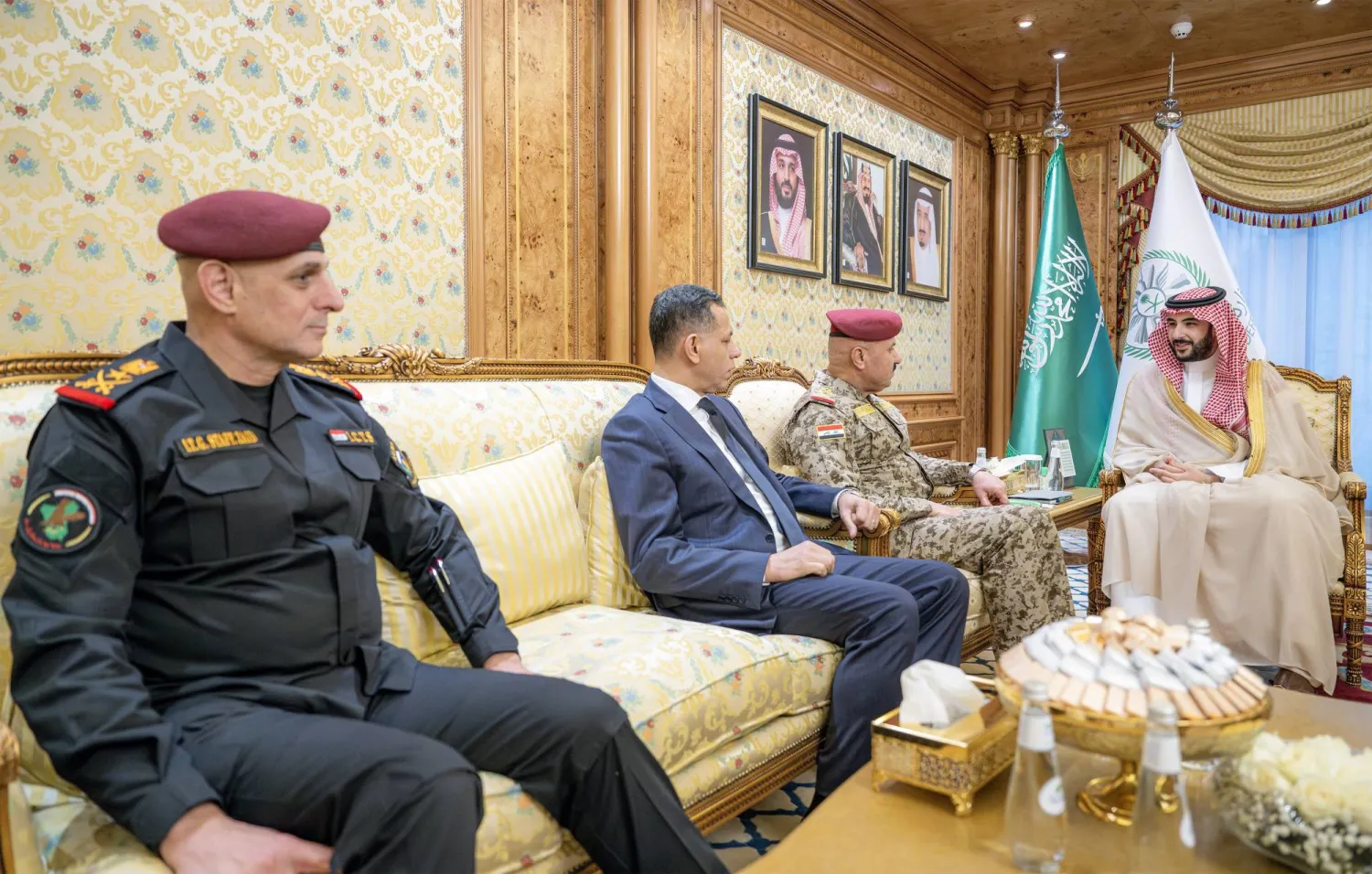



Saudi Arabia, Iraq Underscore their Continued Security Coordination

Saudi Defense Minister Prince Khalid bin Salman and Iraqi Armed Forces Commander General Abdul Amir al-Shammari meet in Riyadh on Thursday. (Saudi Defense Ministry)
TT

Saudi Arabia, Iraq Underscore their Continued Security Coordination

Saudi Defense Minister Prince Khalid bin Salman and Iraqi Armed Forces Commander General Abdul Amir al-Shammari meet in Riyadh on Thursday. (Saudi Defense Ministry)

Saudi Defense Minister Prince Khalid bin Salman held talks in Riyadh on Thursday with Iraqi Armed Forces Commander General Abdul Amir al-Shammari.

They discussed bilateral relations between their countries in the military and defense fields. They also tackled regional developments.

“We underscored the importance of continuing coordination and cooperation between our countries to serve common interests and achieve regional security and stability,” Prince Khalid said in a post on the X platform.

“Iraq will remain a dear neighbor,” he added, saying: “We share fraternal bonds with its government and people.”

Saudi Arabia will always stand by Iraq to support its security, stability, development and prosperity, he declared.

Al-Shammari had arrived in the Kingdom earlier on Thursday to discuss security files and issues of common interest.


Egypt, UAE Urge US and Iran to Restore Calm

Egyptian Foreign Minister Dr. Badr Abdelatty and UAE Deputy Prime Minister and Minister of Foreign Affairs Sheikh Abdullah bin Zayed Al Nahyan during a previous meeting in Abu Dhabi. (Egyptian Foreign Ministry)
TT

Egypt, UAE Urge US and Iran to Restore Calm

Egyptian Foreign Minister Dr. Badr Abdelatty and UAE Deputy Prime Minister and Minister of Foreign Affairs Sheikh Abdullah bin Zayed Al Nahyan during a previous meeting in Abu Dhabi. (Egyptian Foreign Ministry)

Egypt and the United Arab Emirates have called for a return to compliance with the Memorandum of Understanding between the United States and Iran, in order to pave the way for resuming political and diplomatic tracks and to prevent the expansion of the conflict.

This came during a phone call on Thursday between Egyptian Foreign Minister Dr. Badr Abdelatty and UAE Deputy Prime Minister and Minister of Foreign Affairs Sheikh Abdullah bin Zayed Al Nahyan, according to a statement by the Egyptian Ministry of Foreign Affairs.

The statement said that the call "comes within the framework of ongoing consultation and coordination between the two brotherly countries regarding bilateral relations and regional developments."

The ministers exchanged views on the latest developments in the region, and stressed "the importance of intensifying efforts aimed at de-escalation and containing tensions."

They underscored "the importance of respecting the rules of international law and safeguarding the security, safety, and freedom of international navigation."

The call also addressed developments in the Gaza Strip and the West Bank amid ongoing escalatory measures and Israeli violations. The FMs affirmed "the importance of completing the implementation of all obligations of the first phase of US President Donald Trump’s peace plan in Gaza, in accordance with the announced roadmap, to contribute to stabilizing the situation and preparing conditions for transitioning to the next phases of the plan."

According to the Egyptian Foreign Ministry statement, they stressed the need for halting Israeli escalatory measures and practices in the West Bank.

They rejected "any actions that would undermine the chances of achieving peace and the two-state solution, emphasizing the importance of preserving the territorial unity of the Palestinian territories in Gaza and the West Bank."

They covered developments in Sudan, where the ministers exchanged views on the latest updates of the crisis and the regional and international efforts being made to handle it. They stressed "the importance of continued coordination and consultation to contribute to supporting the security and stability of Sudan and alleviating the humanitarian suffering of the Sudanese people."

The ministers agreed to continue close coordination and consultation during the coming period on various issues of common interest, contributing to the support of regional security and stability.

On the level of bilateral relations, the FMs praised the depth and distinctiveness of the brotherly and strategic relations binding their two countries, and the continuous development they are witnessing across various fields.

They underlined "a shared keenness to continue strengthening the frameworks of bilateral cooperation and building upon the existing momentum in relations to achieve the interests of both countries and their brotherly peoples."


Saudi Arabia: Royal Orders Reconstitute Cabinet Under Crown Prince Mohammed bin Salman

Joint photo of King Salman bin Abdulaziz Al-Saud and Saudi Crown Prince Mohammed bin Salman bin Abdulaziz Al-Saud - File Photo
TT

Saudi Arabia: Royal Orders Reconstitute Cabinet Under Crown Prince Mohammed bin Salman

Joint photo of King Salman bin Abdulaziz Al-Saud and Saudi Crown Prince Mohammed bin Salman bin Abdulaziz Al-Saud - File Photo

Custodian of the Two Holy Mosques King Salman bin Abdulaziz Al Saud issued three royal orders on Thursday, including the reconstitution of the Cabinet under the chairmanship of Crown Prince and Prime Minister Mohammed bin Salman bin Abdulaziz Al Saud, with its current members.

The orders follow two previous royal orders concerning the formation of the Cabinet, as well as related royal orders, and Article 9 of the Council of Ministers Law, which stipulates that the term of the Cabinet shall not exceed four years, during which it shall be reconstituted by royal order.

The new royal orders included relieving Bandar Alkhorayef of his position as Chairman of the Board of Directors of the Local Content and Government Procurement Authority and appointing Prince Abdulaziz bin Salman bin Abdulaziz as Chairman of the Board.

They also included relieving Mohammed ElKuwaiz of his position as Chairman of the Capital Market Authority and appointing Mazen Al-Sudairi as his successor, with the rank of minister.