
Israel Steps Up Jerusalem Home Demolitions as Violence Rises

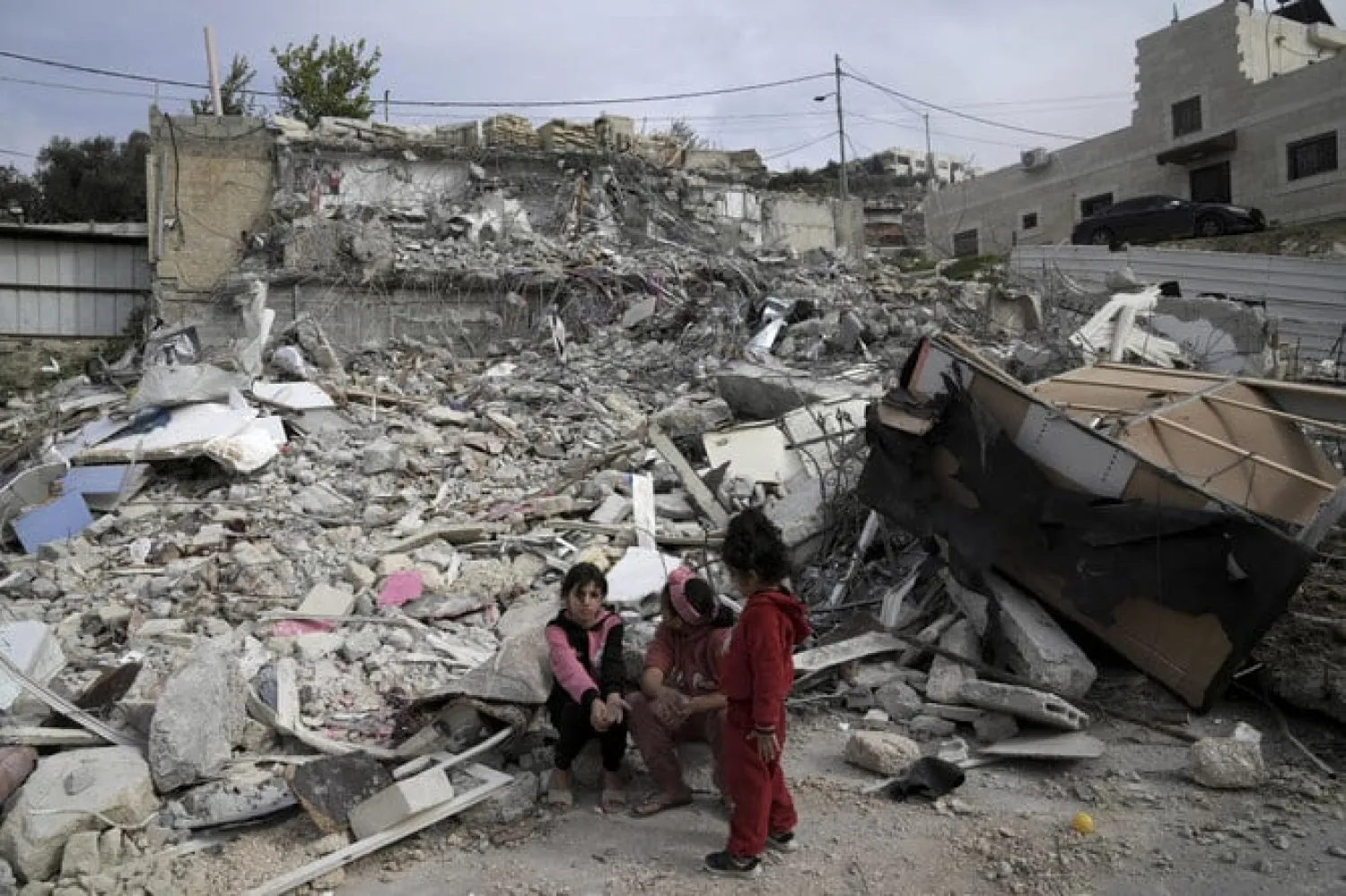
Girls from the Matar family sit near the rubble of their home that housed 11 people before it was demolished by Israeli authorities in the Jabal Mukaber neighborhood of east Jerusalem (AP)
TT

Israel Steps Up Jerusalem Home Demolitions as Violence Rises

Girls from the Matar family sit near the rubble of their home that housed 11 people before it was demolished by Israeli authorities in the Jabal Mukaber neighborhood of east Jerusalem (AP)

Ratib Matar’s family was growing. They needed more space.

Before his granddaughters, now 4 and 5, were born, he built three apartments on an eastern slope overlooking Jerusalem’s ancient landscape. The 50-year-old construction contractor moved in with his brother, son, divorced daughter and their young kids — 11 people in all, plus a few geese.

But Matar was never at ease. At any moment, the Israeli code-enforcement officers could knock on his door and take everything away, The Associated Press said.

That moment came on Jan. 29, days after a Palestinian gunman killed seven people in east Jerusalem, the deadliest attack in the contested capital since 2008. Israel’s new far-right National Security Minister Itamar Ben-Gvir called not only for the sealing of the assailant's family home, but also the immediate demolition of dozens of Palestinian homes built without permits in east Jerusalem, among other punitive steps.

Mere hours after Ben-Gvir's comments, the first bulldozers rumbled into Matar's neighborhood of Jabal Mukaber.

For many Palestinians, the gathering pace of home demolitions is part of the new ultranationalist government's broader battle for control of east Jerusalem, captured by Israel in the 1967 Mideast war and claimed by the Palestinians as the capital of a future independent state.

The battle is waged with building permits and demolition orders — and it is one the Palestinians feel they cannot win. Israel says it is simply enforcing building regulations.

“Our construction is under siege from Israel,” Matar said. His brothers and sons lingered beside the ruins of their home, drinking bitter coffee and receiving visitors as though in mourning. “We try really hard to build, but in vain," he said.

Last month, Israel demolished 39 Palestinian homes, structures and businesses in east Jerusalem, displacing over 50 people, according to the United Nations. That was more than a quarter of the total number of demolitions in 2022. Ben-Gvir posted a photo on Twitter of the bulldozers clawing at Matar's home.

“We will fight terrorism with all the means at our disposal,” he wrote, though Matar's home had nothing to do with the Palestinian shooting attacks.

Most Palestinian apartments in east Jerusalem were built without hard-to-get permits. A 2017 study by the UN described it as “virtually impossible" to secure them.

The Israeli municipality allocates scant land for Palestinian development, the report said, while facilitating the expansion of Israeli settlements. Little Palestinian property was registered before Israel annexed east Jerusalem in 1967, a move not internationally recognized.

Matar said the city rejected his building permit application twice because his area is not zoned for residential development. He's now trying a third time.

The penalty for unauthorized building is often demolition. If families don't tear their houses down themselves, the government charges them for the job. Matar is dreading his bill — he knows neighbors who paid over $20,000 to have their houses razed.

Now homeless, Matar and his family are staying with relatives. He vows to build again on land he inherited from his grandparents, though he has no faith in the Israeli legal system.

“They don't want a single Palestinian in all of Jerusalem,” Matar said. Uphill, in the heart of his neighborhood, Israeli flags fluttered from dozens of apartments recently built for religious Jews.

Since 1967, the government has built 58,000 homes for Israelis in the eastern part of the city, and fewer than 600 for Palestinians, said Daniel Seidemann, an Israeli lawyer specializing in the geopolitics of Jerusalem, citing the government’s statistics bureau and his own analysis. In that time, the city’s Palestinian population has soared by 400%.

“The planning regime is dictated by the calculus of national struggle,” Seidemann said.

Israel's city plans show state parks encircling the Old City, with some 60% of Jabal Mukaber zoned as green space, off-limits to Palestinian development. At least 20,000 Palestinian homes in east Jerusalem are now slated for demolition, watchdogs say.

Matar and his neighbors face an agonizing choice: Build illegally and live under constant threat of demolition, or leave their birthplace for the occupied West Bank, sacrificing Jerusalem residency rights that allow them to work and travel relatively freely throughout Israel.

While there are no reliable figures for permit approvals, the Israeli municipality set aside just over 7% of its 21,000 housing plans for Palestinian homes in 2019, reported Ir Amim, an anti-settlement advocacy group. Palestinians are nearly 40% of the city's roughly 1 million people.

“This is the purpose of this policy,” said Aviv Tatarsky, a researcher at Ir Amim. “Palestinians are forced to leave Jerusalem."

Arieh King, a Jerusalem deputy mayor and settler leader, acknowledged that demolitions help Israel entrench control over east Jerusalem, home to the city's most important religious sites.

“It’s part of enforcing sovereignty," King said. “I'm happy that at last we have a minister that understands," he added, referring to Ben-Gvir.

Ben-Gvir is now pushing for the destruction of an apartment tower housing 100 people. Trying to lower tensions, Prime Minister Benjamin Netanyahu delayed the eviction that was planned for Tuesday, Israeli media reported.

King contended it was possible for Palestinians to secure permits and accused them of building without authorization to avoid an expensive bureaucracy.

When the al-Abasi family in east Jerusalem found a demolition order plastered on their new breeze-block home last month, they contemplated their options. The government had knocked down their last apartment, built on the same lot, eight years ago. This time, Jaafar al-Abasi decided, he would tear it down himself.

Al-Abasi hired a tractor and invited his relatives and neighbors to join. The destruction took three days, with breaks for hummus and soda. His three sons borrowed pickaxes and jackhammers, angrily hacking away at the walls they had decorated with colored plates just last month.

“This place is like a ticking time bomb,” said his brother in law, 48-year-old Mustafa Samhouri, who helped them out.

Protests over the demolitions have roiled east Jerusalem in recent days. Two weekends ago, Samhouri said, the family's 13-year-old cousin opened fire at Jewish settlers in the neighborhood of Silwan just across the valley, wounding two people before being shot and arrested.

“The pressure just grows more and more,” Samhouri said. “And at last, boom."


Will STC Keep its Gains in Yemen or Prepare for a Major Confrontation?

A supporter of the Southern Transitional Council (STC) stands in the back of a pickup truck in the Khor Maksar district of the second city of Aden on August 29, 2019. (AFP file)
TT

Will STC Keep its Gains in Yemen or Prepare for a Major Confrontation?

A supporter of the Southern Transitional Council (STC) stands in the back of a pickup truck in the Khor Maksar district of the second city of Aden on August 29, 2019. (AFP file)

Yemen's eastern provinces of Hadhramaut and Al-Mahra are passing through a critical phase amid the unprecedented unilateral military escalation carried out by the Southern Transitional Council (STC) that has been met with widespread regional and international condemnation.

Observers have said the STC cannot be allowed to impose a new status quo through the use of force no matter its justifications or claims.

They said the situation is not a passing development that can be ignored by the Saudi-led Arab coalition to restore legitimacy in Yemen and its supporters. Rather, this is a multifaceted political and security test where southern interests, the war against the Houthis and regional peace collide.

At the moment, the STC is opting to maneuver under pressure instead of leading the challenge head-on. In its recent statements, the council has resorted to political claims to justify its actions on the ground, speaking of "coordination" and "understanding concerns", reflecting a growing realization that its room to maneuver is shrinking and that it must take the right decision.

Saudi Arabia has made clear warnings over the situation, starting with a political warning, followed by an airstrike on Hadhramaut. The stern response means that a firm decision has been taken to prevent Hadhramaut and Al-Mahra from being dragged into an internal conflict or becoming an arena where agendas are imposed by force.

The STC is aware that ignoring the warnings puts it in a direct confrontation with a regional heavyweight - Saudi Arabia. The council does not have the political or military means to come out on top, so it has been advised to seriously deal with the warnings and avoid resorting to stalling tactics if it is considering taking the option of minimal losses to the gains it has amassed over the years.

Failing to heed the warning will mean it will have to come to heel through force, which will end in its major defeat.

The observers said the STC has landed itself in an unprecedented crisis. The council has justified its unilateral military actions as aimed at "protecting the southern cause" and that it was meeting the demands of the people. It also claimed that it sought to block Houthi smuggling routes and fight terrorist groups.

Despite everything, it is not too late for the STC to salvage the situation, as stated by Saudi Defense Minister Prince Khalid bin Salman on Saturday. The STC can still end the crisis while taking minimal losses by immediately withdrawing its forces from Hadhramaut and Al-Mahra.

Should it stand its ground, the STC does not have the means to consolidate its presence in the two provinces, especially amid wide popular opposition, notably in Hadhramaut. Moreover, the STC lacks regional cover and international support that is a main condition for creating any security changes in critical areas.

So, it would seem that the best and easiest scenario would be for the STC to withdraw its forces, under such pretexts of "redeployment" or "security arrangements", to minimize its political losses, said the observers.

Should it ignore the warnings and choose to continue to escalate the situation, then the STC will lose its partnership with the legitimate Yemeni authorities, transforming into an obstacle in efforts to restore stability in the country. International sanctions may even be imposed on its leaders.

On the military level, the Arab coalition was clear in stating that it will not allow a new status quo to be imposed by force in eastern Yemen. Any escalation may be met with direct deterrence, meaning casualties on the ground that the STC cannot justify.

On the ground, the STC does not enjoy the support of the people in Hadhramaut and Al-Mahra and the continued escalation will deepen opposition to it in the south. The southern cause will transform from an issue that enjoys consensus to one that causes division.


Syrian Army Enters Latakia, Tartus after Attacks by Regime Remnants

Syrian Security forces stand atop a military vehicle in the city of Latakia, Syria, 28 December 2025. (EPA)
TT

Syrian Army Enters Latakia, Tartus after Attacks by Regime Remnants

Syrian Security forces stand atop a military vehicle in the city of Latakia, Syria, 28 December 2025. (EPA)

The Syrian Defense Ministry announced on Sunday the deployment of military forces in the coastal cities of Latakia and Tartus in wake of an armed attack against security forces and civilians during recent protests.

Syrian television said the deployment was happening after "outlawed groups" carried out attacks against security forces and the people.

The military will work on preserving security and restoring calm in cooperation with the internal security forces, it added.

Earlier, local media reported that three people were killed and 48 wounded when gunmen affiliated with the ousted regime opened fire at civilians and security forces during protests in Latakia and Tartus.

State television said a member of the security forces was killed and others were injured while they were protecting protests in Latakia.

Head of the security forces in the Latakia province Abdulaziz al-Ahmed said the attack was carried out by terrorist members of the former regime.

The protests in Latakia were called for by Ghazal Ghazal.

Al-Ahmed added that masked gunmen were spotted at the protests and they were identified as members of Coastal Shield Brigade and Al-Jawad Brigade terrorist groups, reported the official SANA news agency.

The groups were responsible for bombings on the M1 highway and extrajudicial killings, it added.

A member of the groups was arrested in the Jableh countryside during a security operation, announced the Interior Ministry. Three other members were killed, while explosives and various weapons and ammunition were seized during the operation.

The Al-Jawad Brigade is affiliated with Suheil al-Hassan, a notorious former Syrian military officer.

In a statement, the Interior Ministry said the group was involved in assassinations, bombings and attacks against the Interior Ministry forces and the army.

It was planning attacks on New Year celebrations, it revealed. The detainee also revealed the locations of weapons caches used by the group.


Hezbollah Chief Accuses Lebanese Authorities of Working ‘in the Interest of What Israel Wants’

Hezbollah leader Naim Qassem
TT

Hezbollah Chief Accuses Lebanese Authorities of Working ‘in the Interest of What Israel Wants’

Hezbollah leader Naim Qassem

Hezbollah leader Naim Qassem on Sunday said moves to disarm the group in Lebanon are an "Israeli-American plan,” accusing Israel of failing to abide by a ceasefire agreement sealed last year.

Under heavy US pressure and fears of expanded Israeli strikes, the Lebanese military is expected to complete Hezbollah's disarmament south of the Litani River -- located about 30 kilometers from the border with Israel -- by the end of the year.

It will then tackle disarming the Iran-backed movement in the rest of the country.

"Disarmament is an Israeli-American plan," Qassem said.

"To demand exclusive arms control while Israel is committing aggression and America is imposing its will on Lebanon, stripping it of its power, means that you are not working in Lebanon's interest, but rather in the interest of what Israel wants."

Despite a November 2024 ceasefire that was supposed to end more than a year of hostilities between Israel and Hezbollah, Israel has kept up strikes on Lebanon and has maintained troops in five areas it deems strategic.

According to the agreement, Hezbollah was required to pull its forces north of the Litani River and have its military infrastructure in the vacated area dismantled.

Israel has questioned the Lebanese military's effectiveness and has accused Hezbollah of rearming, while the group itself has rejected calls to surrender its weapons.

"The deployment of the Lebanese army south of the Litani River was required only if Israel had adhered to its commitments... to halting the aggression, withdrawing, releasing prisoners, and having reconstruction commence," Qassem said in a televised address.

"With the Israeli enemy not implementing any of the steps of the agreement... Lebanon is no longer required to take any action on any level before the Israelis commit to what they are obligated to do."

Lebanese army chief Rodolphe Haykal told a military meeting on Tuesday "the army is in the process of finishing the first phase of its plan.”

He said the army is carefully planning "for the subsequent phases" of disarmament.