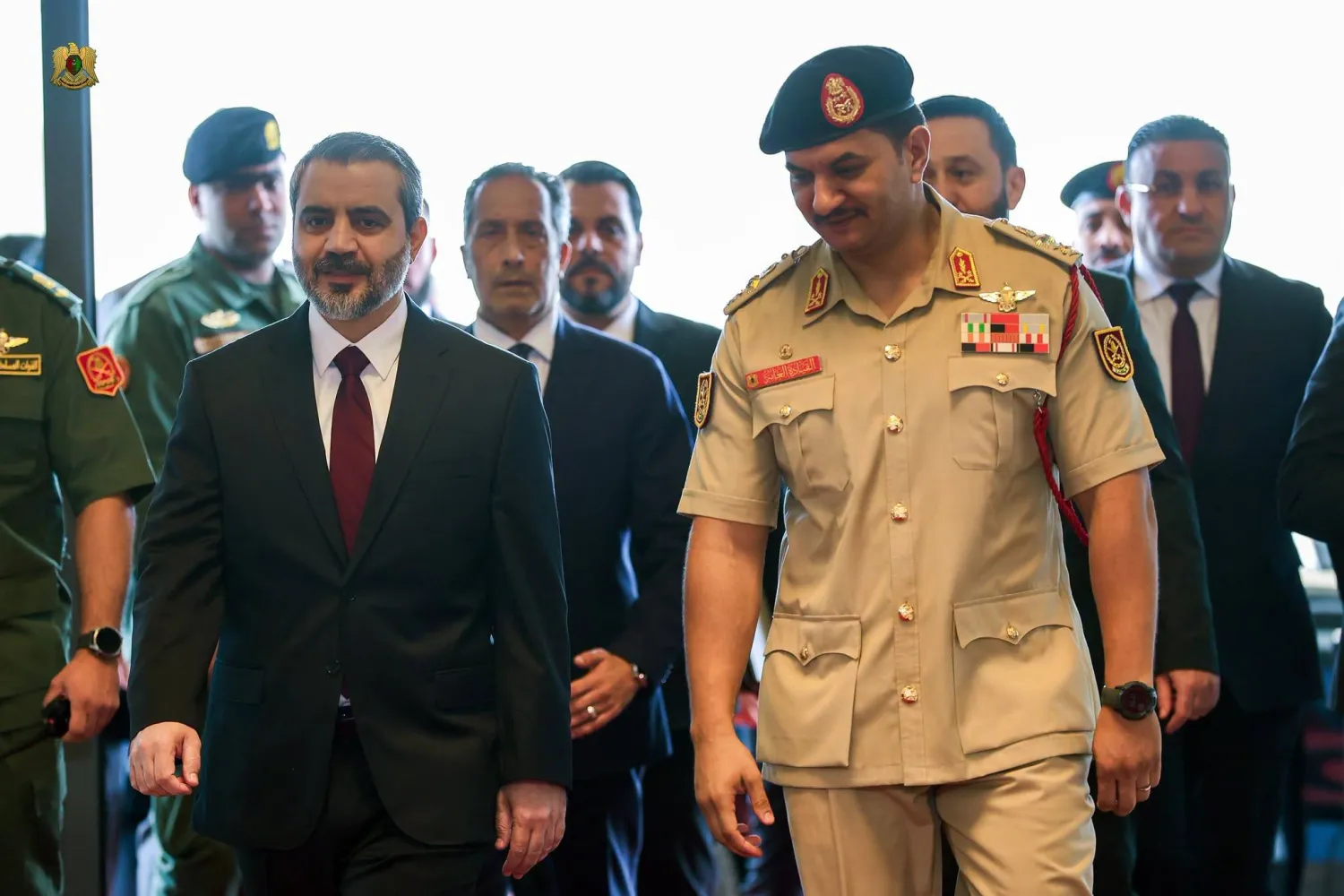
Chairman of Yemen’s Presidential Leadership Council (PLC) Dr. Rashad al-Alimi said the country’s political problems can be summed up in two words: exclusion and marginalization, while they can be resolved through consensus and partnership.
In an exclusive interview to Asharq Al-Awsat, he underscored his support to the Saudi mediation with the Iran-backed Houthi militias with Oman’s participation. He confirmed that the Yemeni government is receiving constant updates from the Saudis about the progress of the talks, adding that ultimately, any final agreement will take place between the government and Houthis.
Alimi is currently in Brussels, the first leg of a European tour.
Saudi mediation with Houthis
Asked about the progress in the Saudi mediation with the Houthis, he remarked that this was not the first time that the Kingdom had sought to contact the militias. He cited the Dhahran al-Janub understandings and how the militias reneged on them. He noted that channels of communication had also been open when he was aide to former President Abdrabbuh Mansur Hadi.
“We believe that the discussions and communication are positive because they will serve the peace process and stability in Yemen,” Alimi remarks.
Moreover, he revealed that the “brothers in the Kingdom explained that there won’t be a Saudi-Houthi agreement, but that should a deal be struck, it will take place between the Yemeni government and the coupists.”
Any agreement on a roadmap, which begins with the extension of the nationwide truce, a ceasefire, kicking off comprehensive consultations on political, security and military affairs, will take place between the government and Houthis, he added.
“We support and encourage the Saudi efforts because we are seeking peace and stability in Yemen and ending the war,” he stressed.
Ties between the govt and coalition
The relationship between the Yemeni government and Saudi-led Arab coalition had been criticized and some figures had addressed the issue, both directly and indirectly, during the 2022 consultations in Riyadh.
Alimi noted that the coalition was formed at the behest of the former president to restore the Yemeni state and constitution from the Houthis.
He said some of the criticism has said that eight years of joint work between the coalition and government has not yielded the desired result of reclaiming the state. “On the contrary, were it not for this intervention, the Houthis would now be in control of the whole of Yemen. Iran would now be in control of the Bab al-Mandeb and Arabian Sea straits,” stated Alimi.
“Everyone seems to forget this fact,” he continued. “A large part of Yemen has been safeguarded, so has the legitimacy of the state, which is national interest.”
“Why is it a national interest?” he asked. “Take a look of Somalia. For 30 years, it remained without an identity and its citizens did not have passports or a government. At least the Yemenis today have passports and international recognition.”
“Hypothetically, if the Houthis had taken over the whole of Yemen, I am certain that the international and regional communities would not have recognized their government. The suffering of the Yemeni people would probably have been worse than it is now if it weren't for the intervention of the coalition,” stressed Alimi.
“Setting aside the negatives, one of the greatest achievements [of the coalition] was preventing the Houthis from taking over the entire country. The Yemeni government is still in control of the straits and the identity of the Yemeni nation has been preserved,” he added.
He did, however, acknowledge errors that have been committed by the government and coalition. “Mistakes happen during work. Everyone recognized the errors and made them right.”
Moreover, Alimi praised the financial and development support provided by the members of the coalition to Yemen, the latest of which was Saudi Arabia’s deposit of one billion dollars this week in the country’s central bank.
He thanked the Kingdom, saying its gesture was an “example of solidarity and a reflection of the Kingdom’s responsible vision of Yemen, its identity and people.”
Political process
Alimi believes that the root of Yemen’s problems is the obstruction of the political process. Its economic problems, war, internal conflicts, deep poverty and unprecedented humanitarian disaster can all be traced to the obstruction of the political process.
He revealed that he met with Belgium’s King Philippe and explained to him the crisis in his country, starting from 2011. He detailed to him the Gulf initiative that sought to end the tensions between the Yemenis that could have devolved into war. He spoke of the national dialogue that the Houthis were a part of, the constitutional committee and efforts to hold a constitutional referendum.
“We were on the verge of electing a new president and parliament when the Houthi coup took place” in 2014, he added. “This is the sum of the situation. The war, humanitarian crisis, and everything else happened as a result of the halt of the political process.”
Yemen’s main problem can be summed up in two words: exclusion and marginalization. They can be resolved through consensus and partnership, stated Alimi.
Houthis and political maturity
The Houthis, lamented Alimi, have “violated all the values the Yemeni people have known throughout their history.” The Houthi actions have struck at the core of the Yemeni social fabric, he went on to say. He believes that should United Nations-sponsored elections be held in Yemen, the Houthis would not win a single vote, citing how back in the 1990s, they had only ever won one seat in parliament.
In 2018, then American Ambassador to Yemen Matthew Toller told Asharq Al-Awsat that a political solution can only be achieved when the Houthis reach “political maturity”.
Asharq Al-Awsat asked Alimi: “When will the Houthis become politically mature?”
“Perhaps after 40,” he quipped, referring to the leader of the Houthis who is under 40 years of age.
More seriously, however, the Houthis may begin to mature politically once they stop sanctifying religious rulers, he said. The Yemenis themselves have always opposed this and some Houthi figures have also criticized this concept.
The other condition is for them to abandon the Iranian-Persian expansionist agenda in the region. The Iranians want to strip Islam of its true values and teachings to further their political goals, Alimi said.
Iran and the European position
Observers have noted that Iran’s providing of Russia of drones in the war on Ukraine has opened the discussion over the dangers of Tehran’s aircraft. Yemen and the entire region have complained about the Iranian drones and agenda in the region.
Alimi said: “We have spoken about this before and none of those countries had listened. But now that the drones have reached Ukraine, the West and Americans have started to think about this problem because their main interests have been harmed.”
“I believe that the European position has changed. This could be a blessing in disguise. We do not support war anywhere in the world, but perhaps this could be a message to the western and international community to sense the dangers that we had previously warned of,” he added.
“Who would have ever thought that European countries would one day demand the terrorist designation of the Iranian Revolutionary Guards?” he asked.
He revealed that Yemeni officials had held talks in Brussels to that end. Alimi said he had spoken to head of the European Union and praised him on the bloc’s “progressive stance.”
“We are being harmed by the Guards, which are the source of all problems in our region,” he stressed. “There is one command center that is running the situation in Lebanon, Syria, Iraq, Yemen and perhaps other regions.”
Truce
Yemen enjoyed a nationwide ceasefire between the government forces and Houthis from April to October 2022. The Houthis refused to extend the truce for another six months in spite of the efforts of United Nations envoy Hans Grundberg.
The truce called for a ceasefire, reopening Sanaa airport and routes to Houthi-besieged Taiz and allowing the import of fuel through Houthi-held Hodeidah.
The government committed to all articles of the truce and offered several concessions when it could have just as easily impeded it, but it prioritized the people’s interests. The Houthis, on the other hand, did not commit to any articles related to Taiz and the ceasefire was widely violated by the militias on a nearly daily basis, as documented by the government and local organizations.
Even though the truce may have ended, the government still remains committed to the ceasefire and has not stopped Sanaa flights or the flow of fuel into Hodeidah. The Houthis, meanwhile have committed numerous violations, including attacks on oil ports that the UN Security Council, EU and United States have described as terrorist.
Asharq Al-Awsat asked Alimi why the government has continued to allow Sanaa flights because they appear to be a political gain for the Houthis. His reply was surprising, saying that it was not a gain for the Houthis, but rather the government. Moreover, he said he was not thinking about who was gaining what, but was more concerned with the interests of the people.
“Our goal is not the Houthis, but tending to our people because we are a government for all Yemenis. This is not a gain for the Houthis, but one for the government, and more importantly, for all Yemenis,” he stressed.
“We want the people to have an outlet from the Houthi pressure, oppression, and great prison they are held in,” he remarked.
National shield
The formation of the “National Shield Forces” was announced in January, sparking a heated debate over its purpose. Alimi explained that the force was supposed to be formed even before the establishment of his Presidential Leadership Council in April 2022.
As part of the PLC, “we were considering our next military plan and the need for a reserve force that would be aligned to the state,” he explained. There have been thousands of martyrs on various fronts, such as al-Jawf, Lahj, Saada, Marib, Taiz, Shabwa, Hodeidah and others.
“There was a need for new blood and the National Shield Forces was that,” he noted. “It is a reserve force that will not replace any other one, such as the republican or presidential guards, rather, it will carry out any mission tasked to it by the PLC,” he added.
Yearning for Sanaa
“Have you missed Sanaa?” Asharq Al-Awsat asked Alimi. He replied: “Of course. Several people have told me that my house has now been seized by the Houthis, to which I respond that once the nation is reclaimed, then houses will be returned to their owners.”
“Several people who have taken an ambiguous stance towards the legitimacy and the Houthis have done so out of their fear over their families and properties,” he went on to say. “I once asked someone if it was possible for them to return to their home in Sanaa and live in freedom and enjoy a normal life, to which they replied that it was not.”
“I told him, of course it wasn’t because the country has been abducted, not the homes. When the nation is restored, so will the homes, which are nothing but piles of rocks that have no value when compared to freedom, equality, rights and justice,” Alimi stressed.