


OIC Foreign Ministers Meeting Praises Saudi-Iranian Agreement

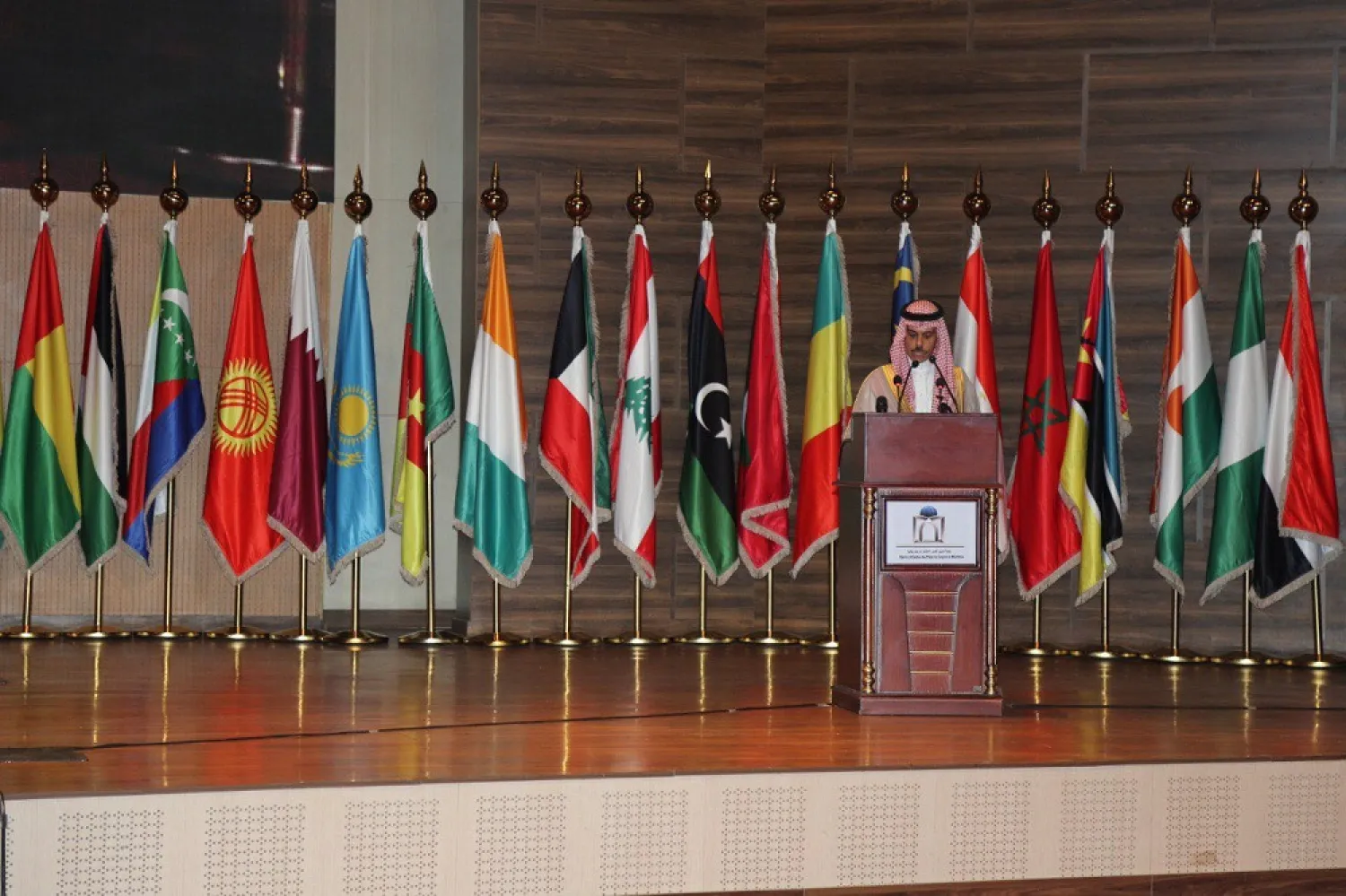
Saudi Foreign Minister Prince Faisal bin Farhan bin Abdullah addresses the OIC meeting in Nouakchott on Thursday. (OIC)
TT

OIC Foreign Ministers Meeting Praises Saudi-Iranian Agreement

Saudi Foreign Minister Prince Faisal bin Farhan bin Abdullah addresses the OIC meeting in Nouakchott on Thursday. (OIC)

The foreign ministers of the member states of the Organization of Islamic Cooperation met in Nouakchott on Thursday to discuss security, terrorism and Islamophobia.

The 49th session of the council of OIC foreign ministers, “Moderation is the Key to Security and Stability,” also tackled efforts to develop relations between Islamic nations, while hailing the Saudi-Iranian agreement to restore diplomatic ties that was announced last week.

During the opening of the meeting, Saudi Foreign Minister Prince Faisal bin Farhan bin Abdullah said the Kingdom is hoping that the agreement would bolster Gulf and Arab security and stability and support collective Islamic work.

“Saudi Arabia believes in the importance of the religious and neighborly ties that bind us. It always extends its hand to dialogue and resolving disputes through peaceful means,” he added.

This is why it held “for over two years, several rounds of dialogue with its brothers in Iran, in each of Baghdad, Muscat and then, Beijing,” he remarked.

The agreement, which was sponsored by China at an initiative by its President Xi Jinping, was announced from Beijing.

These efforts were capped by the agreement to re-establish diplomatic relations based on respecting the United Nations Charter, OIC and the sovereignty of nations, refraining from meddling in the internal affairs of others, and resolving disputes through dialogue, continued Prince Faisal.

“We hope the agreement will bolster our security and stability and collective Islamic work,” he stated.

Moreover, he noted that the OIC meeting was being held as the world marked International Day to Combat Islamophobia on March 15.

He cited the attempts to desecrate holy sites, the burning of the holy Quran and incitement against Muslim minorities. “This demands that we underscore the need to respect values of moderation, respect for others and coexistence with them,” he stressed.

Turning to the Palestinian Territories, Prince Faisal called on the international community to assume its responsibilities in putting a stop to the violations committed by Israeli forces against the Palestinian people.

These violations are undermining opportunities to revive the peace process, he warned.

Mauritanian President Mohamed Ould Ghazouani urged Islamic nations to resolve differences between them so that they can achieve sustainable development and growth, while hailing the Saudi-Iranian agreement.

He called for reaching “immediate peaceful and sustainable solutions to all disputes in the Islamic world, such as the conflicts in Yemen, Syria and Libya.”

He added: “We encourage all negotiations and dialogue aimed at overcoming disputes and bridging divides between Islamic countries and peoples.”

OIC Secretary-General Hissein Brahim Taha welcomed the agreement between Saudi Arabia and Iran, hoping it would help consolidate peace, security and stability in the region and give a new push for cooperation between members of the OIC.



MWL Condemns Terrorist Bombing in Afghanistan’s Capital

The Muslim World League (MWL) logo
TT

MWL Condemns Terrorist Bombing in Afghanistan’s Capital

The Muslim World League (MWL) logo

The Muslim World League (MWL) condemned on Thursday the terrorist bombing at a restaurant in Afghanistan’s capital, Kabul that left several killed and wounded, the Saudi Press Agency reported.

In a statement issued by the General Secretariat, MWL Secretary-General and Organization of Muslim Scholars Chairman Sheikh Dr. Mohammed bin Abdulkarim Al-Issa reaffirmed the MWL’s firm stance rejecting violence and terrorism in all forms and under any pretext.

He expressed solidarity with Afghanistan in confronting all threats to its security, stability, and the safety of its people.

Al-Issa expressed the MWL’s sincere condolences to the Afghan people and the families of the victims.


Saudi Foreign Minister Meets with British, French Counterparts

Saudi Foreign Minister Prince Faisal bin Farhan (Middle East)
TT

Saudi Foreign Minister Meets with British, French Counterparts

Saudi Foreign Minister Prince Faisal bin Farhan (Middle East)

Saudi Minister of Foreign Affairs Prince Faisal bin Farhan bin Abdullah held separate meetings with his counterparts from the UK and France on the sidelines of the World Economic Forum annual meeting in Davos, Switzerland, the Saudi Press Agency reported Wednesday.

He met with Yvette Cooper, the United Kingdom Secretary of State for Foreign, Commonwealth and Development Affairs where they reviewed bilateral relations and the latest regional developments, as well as joint efforts to address them.

The Saudi minister also held talks with French Minister for Europe and Foreign Affairs Jean-Noël Barrot. Discussions highlighted the latest regional developments and joint efforts aimed at achieving security and stability in the region.


Al-Wali to Asharq Al-Awsat: Riyadh Talks a Pivotal Moment for Yemen’s Southern Cause

Former Yemeni minister and veteran southern politician Abdel Nasser Al-Wali speaks to Asharq Al-Awsat.
TT

Al-Wali to Asharq Al-Awsat: Riyadh Talks a Pivotal Moment for Yemen’s Southern Cause

Former Yemeni minister and veteran southern politician Abdel Nasser Al-Wali speaks to Asharq Al-Awsat.

Former Yemeni minister and veteran southern politician Abdel Nasser Al-Wali described the meeting of Yemen’s southern leaders in Riyadh for consultations and dialogue on their cause on Sunday as a pivotal moment in its history, calling for the opening created by Saudi Arabia to be channeled into a political process that delivers lasting peace.

Speaking on the Asharq Al-Awsat podcast with Gulf affairs editor Badr Al-Qahtani, Al-Wali said Riyadh was not merely a diplomatic stop, but a place close to the heart of the Arab and Islamic worlds, offering a chance to correct past shortcomings in conveying the southern voice.

The veteran Yemeni politician said southerners now faced a “huge opportunity” under Saudi sponsorship, noting that Riyadh had taken the initiative to invite discussions on the issue and “left the matter in our hands.”

He pointed to Saudi Arabia’s role in bringing the parties together without imposing guardianship and in supporting whatever they agree upon without interference.

He said Saudi assurances had been explicit: “The opinion is yours, the decision is yours. We are sponsors and will not impose anything on you. Raise your ceiling to the sky.”

Al-Wali said a message from Saudi Defense Minister Prince Khalid bin Salman was clear and direct.

“The southern cause is just, with historical and social dimensions, and the Kingdom will not abandon the people of the south and will stand with their will,” he remarked.

“It is enough for the southern voice to reach Saudi Arabia, and for it to understand the justice of the pain that has accumulated since unification,” he stressed.

On preparations for the Riyadh Conference for Yemeni southern dialogue, Al-Wali said discussions would address the shape of the state and its system “with an open ceiling,” to be decided by consensus without exclusion.

The focus was on restoring the state as a path toward dignity, security, stability, development, and prosperity for people, he went on to say.

“The South has room for everyone. There are no intentions of marginalization or exclusion. Any other projects are not sidelined, but discussed,” he assured.

Al-Wali addressed a message to the southern people, saying: “Trust us. We represent in Riyadh those who authorized us,” in a reference to not compromising the cause or taking decisions that contradict popular will.

In another message, he said: “The Saudis will find from the southerners only what pleases God and pleases them, while preserving the bonds of neighborhood, blood, kinship, and shared interests.”

Turning to the roots of the issue, Al-Wali said Yemeni unity had not been an “invasion” or imposed by force, but a voluntary move toward Sanaa “with open hearts,” in the hope of a larger state, a broader economy, and deeper development.

He said that if the price of stability, calm, and development were Yemen’s return to two states, then it would be better, in his view, to have two neighboring states bound by affection, with flexible and smooth economic and social relations and strong fraternal ties, rather than antagonism that “paralyzed both peoples.”

Outlining his vision for a future state, Al-Wali presented the contours of a “federal southern state” that would grant governorates room to contribute to development, investment, and wealth, with equality in rights and duties and fairness in the distribution of resources so that they reach all who deserve them.

He reiterated the centrality of Saudi Arabia’s role, saying the Kingdom’s weight was “very balanced” regionally and globally, and that its engagement represented a historic opportunity to achieve peace “without it being followed by war.”

Asked how he found Riyadh, Al-Wali replied: “As I have always known it. A country of security and stability. Calm and serenity. Love and peace. You come to it, your soul settles, and you feel reassured.”

“Their promises are sincere and are not broken,” he stressed.