Iraq Halts Northern Crude Exports after Winning Arbitration Case against Türkiye https://english.aawsat.com/home/article/4233111/iraq-halts-northern-crude-exports-after-winning-arbitration-case-against
Iraq Halts Northern Crude Exports after Winning Arbitration Case against Türkiye
The Nihran Bin Omar oil field flare stacks burn north of Basra, Iraq, Wednesday, March 22, 2023. (AP)
Iraq halted crude exports from the semi-autonomous Kurdistan region and northern Kirkuk fields on Saturday, an oil official told Reuters, after the country won a longstanding arbitration case against Türkiye.
The decision to stop shipments of 450,000 barrels per day (bpd) of crude relates to a case from 2014, when Baghdad claimed that Türkiye violated a joint agreement by allowing the Kurdistan Regional Government (KRG) to export oil through a pipeline to the Turkish port of Ceyhan.
Baghdad deems KRG exports via Turkish Ceyhan port as illegal.
The International Chamber of Commerce ruled in favor of Iraq on Thursday, Iraq's oil ministry confirmed on Saturday.
Türkiye has informed Iraq that it will respect the arbitration ruling, a source said.
Turkish shipping officials told Iraqi employees at Türkiye’s Ceyhan oil export hub that no ship will be allowed to load Kurdish crude without the approval of the Iraqi government, according to a document seen by Reuters.
Türkiye subsequently halted the pumping of Iraqi crude from the pipeline that leads to Ceyhan, a separate document seen by Reuters showed.
On Saturday, Iraq stopped pumping oil through its side of the pipeline which runs from its northern Kirkuk oil fields, one of the officials told Reuters.
Iraq had been pumping 370,000 bpd of KRG crude and 75,000 bpd of federal crude through the pipeline before it was halted, according to a source familiar with pipeline operations.
"A delegation from the oil ministry will travel to Türkiye soon to meet energy officials to agree on new mechanism to export Iraq's northern crude oil in line with the arbitration ruling," a second oil ministry official said.
Iraq will discuss with the relevant authorities ways to ensure the continuation of oil exports through the port of Ceyhan and state-owned SOMO's obligations with oil companies, Iraq's oil ministry said in a statement.
The ruling, in which Türkiye has been ordered to pay Iraq around $1.5 billion before interest, covers the 2014-2018 period, according to a source familiar with the case who spoke on condition of anonymity because they were not authorized to speak with the media.
A second arbitration case, which the source expects to take around two years, will cover the period from 2018 onwards.
Turkish government officials did not immediately respond to requests for comment.
Production risk
The final hearing on the arbitration case was held in Paris in July 2022, but it took months for the arbitrators, the secretariat of the arbitration court and the International Chamber of Commerce to approve the verdict, the source familiar with the process said.
The impact on the KRG's oil production depends heavily on the duration of the Iraqi Turkish Pipeline (ITP) closure, sources said, adding this would cause significant uncertainty to oil firms operating in the Kurdistan Region in Iraq (KRI).
A cessation of exports through the pipeline would trigger a collapse of the KRI economy, according to a letter last year to US representatives from Dallas-based HKN Energy, which operates in the region.
Türkiye would need to source more crude from Iran and Russia to make up for the loss of northern Iraqi oil, the letter said.
Analysts have warned that companies could withdraw from the region unless the environment improved.
Foreign oil firms, including HKN Energy and Gulf Keystone, have linked their investment plans this year to the reliability of KRG payments, which face months of delays.
Saudi Money Market Funds Face Investment Reshuffle
The Saudi Capital Market Authority’s headquarters in Riyadh (Asharq Al-Awsat)
Saudi money market funds are entering a new phase of liquidity management and portfolio restructuring as new rules cap foreign investments at 5% of net asset value.
Fund managers will have to balance returns, liquidity and risk more carefully.
The rules do not require funds to exit existing foreign investments immediately. The Capital Market Authority has given managers transition periods to bring portfolios into compliance. This allows deposits and murabaha transactions to mature before funds are reallocated, avoiding early exits that could hurt returns or disrupt liquidity management.
The measures also require foreign counterparties to hold investment-grade credit ratings, strengthening protection against overseas exposure risks.
Financial analysts say the main impact may not be an immediate shift in capital flows. Instead, the rules are likely to reshape money market fund portfolios and how managers allocate liquidity between domestic and foreign instruments, based on returns, liquidity and credit quality.
As investment options in the Saudi market expand, the restructuring could direct greater attention toward domestic liquidity instruments. The transition periods will allow managers to adjust gradually, retain flexibility over existing investments and reduce the risks of rapid reinvestment.
Investor protection
Financial analyst Abdullah Al-Jabali told Asharq Al-Awsat that the move was part of the Capital Market Authority’s efforts to regulate higher-risk investments and strengthen investor protection, particularly amid global market shifts and continued uncertainty over interest rates.
The decision seeks to reduce Saudi money market funds’ exposure to foreign investments and limit the impact of related volatility, he said. The timing and scale of interest-rate cuts in the coming years remain unclear.
Al-Jabali said the measures go beyond imposing a cap on foreign investments. They also tighten requirements governing the entities through which funds may invest, taking into account credit ratings, solvency and reliability. This would help reduce risk and safeguard investors’ money.
The rules also seek to prevent money market funds from concentrating investments in instruments or entities that could be difficult to exit when needed. This would strengthen liquidity and improve funds’ ability to respond to market changes, he said.
Al-Jabali expected further regulations to follow, potentially covering other foreign investments such as real estate funds, financing funds and foreign sukuk. The measures could also extend to funds’ private-equity investments outside the kingdom.
He said the changes reflected the authority’s efforts to reduce risks linked to some investment practices, strengthen the investment environment and protect investors in the Saudi market.
Financial analyst Tariq Al-Atiq told Asharq Al-Awsat that the decision was primarily intended to reduce risk, strengthen investor protection and impose greater discipline on the placement of liquidity outside the kingdom.
Money market funds typically invest in deposits, murabaha transactions and short-term sukuk. Financial companies affiliated with banks manage a large proportion of these funds, he said.
A fund valued in Saudi riyals does not necessarily hold all its investments inside the kingdom, Al-Atiq said. Some liquidity may be placed with Gulf or foreign banks in search of higher returns. The decision would reduce that exposure and return some liquidity to the domestic market.
Giving funds up to two years to comply takes into account the fixed maturities of deposits and murabaha transactions, he said. Early exits could hurt fund performance, while allowing foreign deposits to expire without renewal would support a gradual, orderly transition.
Gradual compliance
The Saudi Capital Market Authority has capped foreign investments by public money market funds at 5% of net asset value and given managers transition periods to bring existing holdings into compliance.
Under a circular sent to capital market institutions, managers of public money market funds whose foreign investments exceed 5% must comply with the cap within two years of the circular’s date.
The requirement also affects transactions made during the transition. Until compliance is achieved, managers must not make an investment or enter into or renew any transaction that would breach the limit.
Funds with foreign investments exceeding 20% of net asset value face a shorter deadline. Their managers must reduce that exposure to below 20% within six months of the circular’s date.
They must then continue reducing foreign investments until they reach the final 5% cap within the timeframe set by the circular.
The rules therefore set different paths based on the level of foreign exposure. Funds above the 5% cap have up to two years to comply, while those above 20% must first bring their exposure below 20% within six months.
The authority also required all foreign investments by public money market funds to be made with counterparties holding investment-grade credit ratings issued by licensed credit-rating agencies.
Managers whose funds hold foreign investments that do not meet this requirement must bring them into compliance within two years of the circular’s date.
The Capital Market Authority stressed that capital market institutions must comply with the circular, the Capital Market Law and its implementing regulations. It designated the Collective Investment Schemes Compliance Department to answer questions about the new requirements.
Saudi Tourism Minister Announces Launch of Second Edition of TOURISE Forum in Marchhttps://english.aawsat.com/business/5319151-saudi-tourism-minister-announces-launch-second-edition-tourise-forum-march
Saudi Tourism Minister Announces Launch of Second Edition of TOURISE Forum in March
Tourists are seen at Saudi Arabia's AlUla. (SPA)
Saudi Minister of Tourism and Chairman of the TOURISE Forum Board Ahmed Al-Khateeb announced on Wednesday the launch of the second edition of the “TOURISE 2027” Forum, under the theme “Alliances That Move the World,” to be held in Riyadh from March 23 to 25, 2027.
The forum, held under the patronage of Prince Mohammed bin Salman bin Abdulaziz Al Saud, Crown Prince and Prime Minister, brings together leading figures from the tourism, technology, investment, sustainability, culture and transport sectors from around the world to discuss the key opportunities and challenges facing these sectors and help shape the next phase of global tourism.
The forum comes as Saudi Arabia presents a prominent example of what can be achieved in the tourism sector as an integrated economic ecosystem. The Kingdom surpassed its initial target of welcoming 100 million visitors annually in 2023, seven years ahead of schedule, and raised its ambition to 150 million visitors annually by 2030.
The TOURISE Forum serves as an attractive platform for investment. Its inaugural edition last year succeeded in catalyzing investments worth $113 billion, spanning destinations, hotels, retail, talent development and AI-powered platforms, demonstrating how cross-sector collaboration can turn ambition into investment and practical action.
The theme of the forum’s second edition, “Alliances That Move the World,” underscores the importance of forging alliances that transcend sectors, borders and business fields, connecting tourism with capital, technology and infrastructure to unlock investment opportunities, accelerate innovation and facilitate the traveler experience, supporting a more growing, sustainable and inclusive global tourism economy.
Minister Al-Khateeb said: “No single destination, company or organization will shape the future of tourism. Rather, it will be determined by the strength of the alliances we build together. Saudi Arabia has witnessed first-hand what can be achieved when ambitions, investments and strategic partnerships come together.”
“Through the second edition of the TOURISE Forum, we are inviting the world to Riyadh to build the alliances that will shape the next 50 years of the tourism sector,” he added.
The Ministry of Tourism announced the first group of speakers for the 2027 edition, comprising leading figures from the tourism, hospitality, technology and destination development sectors. They will showcase their organizations’ contributions to facilitating travel, tourism and mobility, as well as the most promising areas for investment in the global tourism sector.
Riyadh Opens the Way for Driverless Parcel Deliveryhttps://english.aawsat.com/business/5319088-riyadh-opens-way-driverless-parcel-delivery
Riyadh Opens the Way for Driverless Parcel Delivery
One of the autonomous trucks (Asharq Al-Awsat)
As the mobility landscape within Saudi cities continues to evolve, Riyadh is preparing to embark on a new experience in which no driver sits behind the wheel and the success of a journey does not depend on a driver's ability to navigate the road. By mid-November, 24 autonomous trucks are expected to begin trial operations on the capital's roads, opening the door for the technology to move from passenger transport into parcel and freight delivery.
The move follows the General Transport Authority's sponsorship in May of a memorandum of understanding between Abdul Latif Jameel Motors and China's Zeelos Technology, a company specializing in autonomous driving technologies, with the aim of adopting and enabling autonomous mobility solutions in the Kingdom.
The trucks expected to operate in Riyadh represent one of the practical applications of this cooperation. The first phase will focus on testing the ability of autonomous vehicles to transport parcels within the capital, paving the way for an assessment of their performance and efficiency before moving to broader stages of operation.
Ammar Baterdok, General Manager of Mobility Solutions Projects at Abdul Latif Jameel Motors, told Asharq Al-Awsat that the pilot operation will begin after the completion of geospatial mapping and the training of autonomous driving systems on local roads.
He explained that the fleet allocated to the first phase comprises 24 trucks of different sizes and models. Four have already arrived in the Kingdom, while another 20 are currently in transit, amid logistical challenges affecting shipments from China due to developments in the region.
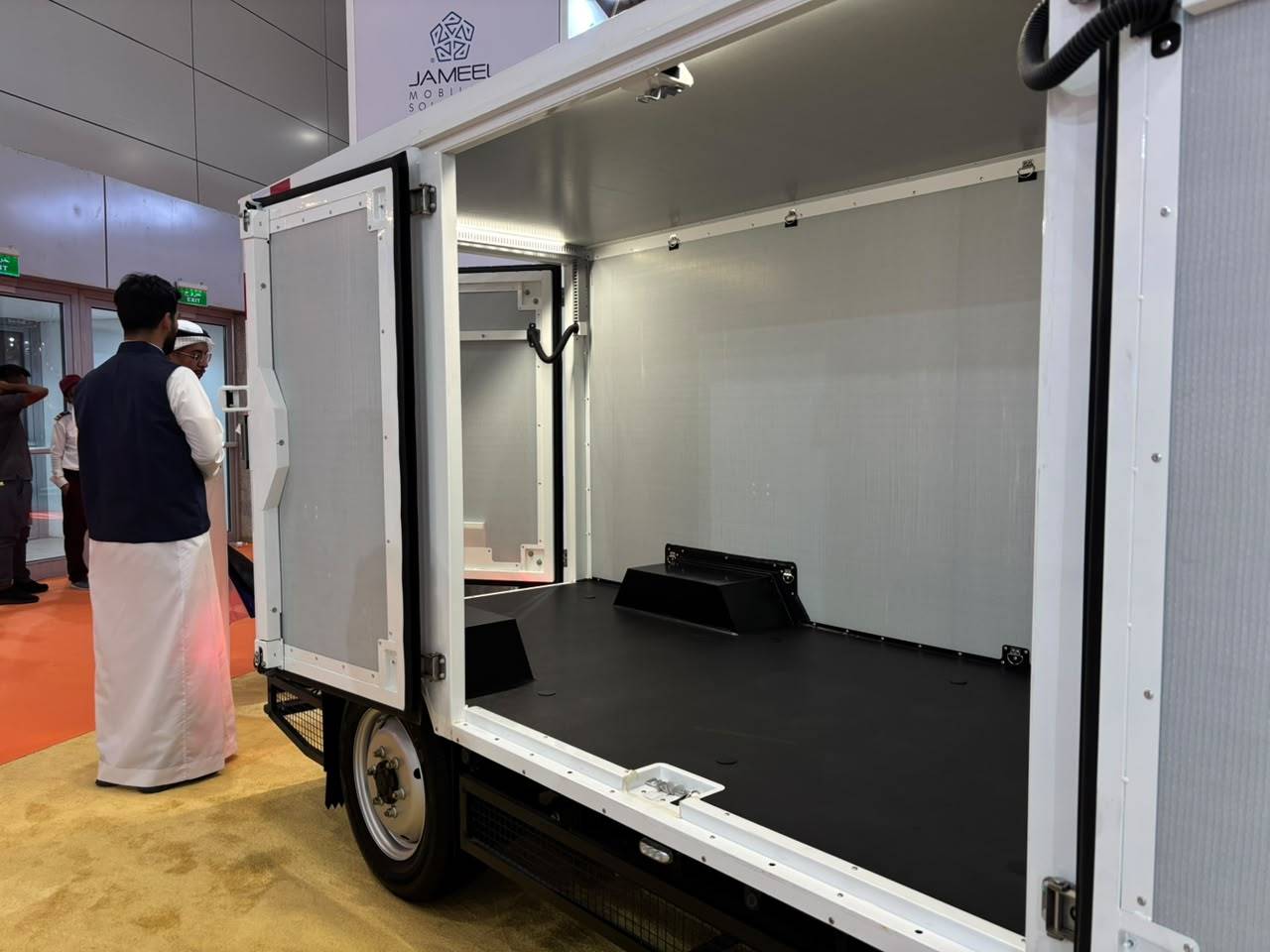
The trucks have payload capacities of 0.5 tons, 1.5 tons, and 2.5 tons. The fleet includes refrigerated and non-refrigerated models, with the remaining batches expected to arrive successively during October and November.
Free Trials with SPL
Abdul Latif Jameel Motors is carrying out the pilot phase in cooperation with Saudi Post | SPL to transport parcels from the main center to neighborhood centers in Riyadh. The service will be provided free of charge throughout the trial period.
Baterdok said the company is prepared to extend the pilot period for several months if necessary in order to collect sufficient operational and investment data to assess the fleet's performance and economic viability before making a decision on commercial expansion.
The phase will allow the company to test the vehicles under actual driving conditions within the capital, including their ability to navigate local roads and traffic, while also measuring their performance during different operating hours.
Millions Invested to Test Viability
The cost of the pilot phase amounts to millions of riyals, according to Baterdok, covering the purchase of vehicles, customs clearance, fees, and taxes. He explained that the investment is not intended to generate a direct financial return, but rather to test the technology's economic and technical viability and collect the data needed before decisions are made regarding commercial expansion and the size of the future fleet.
Illustrative photo of the inside of the truck (Asharq Al-Awsat)
Operating Savings Could Exceed Truck Costs
The company is banking on autonomous trucks being able to reduce operating costs compared with conventional vehicles. Baterdok explained that the price of an autonomous truck is approximately half that of a conventional fuel-powered truck, whether gasoline or diesel.
The cost gap becomes wider during operation due to lower labor and maintenance expenses, in addition to the possibility of operating the trucks around the clock, except for the periods required for recharging.
In an analysis, logistics expert Hassan Al Halil told Asharq Al-Awsat that the most significant economic impact would come from reducing operating costs and improving supply-chain efficiency. He noted that autonomous trucks could increase fleet utilization, improve route planning, and allow for longer operating periods, particularly on repetitive and defined routes.
Al Halil added that it is too early to establish a fixed percentage for reductions in logistics costs in Saudi Arabia, given that savings vary depending on the type of shipment, distance, and operating model. He said that "the greatest opportunities for savings lie in operating labor costs, increasing truck utilization, reducing waiting times, improving fuel consumption, and maintenance," adding that "the economic value will come from increasing fleet productivity and completing more trips efficiently."
Baterdok, meanwhile, said the absence of a driver allows supply and delivery operations to be shifted to nighttime hours, increasing the efficiency of fleet utilization in major cities such as Riyadh by taking advantage of periods when road traffic is less dense.
According to company estimates, electricity costs account for only about 20 percent of the cost of conventional fuel, while maintenance expenses decline due to the absence of conventional engines and transmissions. Routine servicing therefore focuses to a greater extent on components such as brakes and tires.
The trucks rely on sensors and radar systems for autonomous driving, enabling them to operate in nighttime driving conditions without relying on human vision.
Road Readiness Determines the Path to Expansion
Despite these advantages, Al Halil believes that large-scale operation of autonomous trucks in Riyadh requires more than well-maintained roads. It requires highly accurate maps that are continuously updated, reliable communications systems, smart infrastructure, and coordination among the relevant authorities.
He pointed out that the main challenges within cities include congestion, sudden changes in routes, roadworks, unexpected behavior by some vehicles, dusty conditions, and the handling of loading and unloading points. He said that "the most realistic starting point will be defined, repetitive roads and logistics routes before moving to more complex urban operations."
From Passenger Transport to Parcel Delivery
The truck trial comes as Saudi Arabia expands its testing of autonomous mobility applications, as the technology moves from passenger transport into freight and delivery.
Last year, Saudi Arabia launched autonomous passenger vehicles and is currently operating more than five routes, including the Roshn area, Princess Nourah bint Abdulrahman University, and the route connecting Riyadh Gallery and Hayat Mall.
The service has transported more than 3,100 passengers across 1,600 trips under the supervision of the General Transport Authority, as part of efforts to test autonomous driving technologies in the Saudi urban environment.
The expansion of these applications into the freight sector opens a new field for testing the impact of autonomous driving on the efficiency of delivery operations within cities, at a time when e-commerce is expanding and supply chains are seeing growing demand for more efficient and flexible solutions.
From Roads to the Sky
Abdul Latif Jameel Motors' plans do not stop at ground transportation. The company has begun studying the market for drone-based goods delivery in preparation for entering the field once the necessary regulatory frameworks are in place.
Baterdok expects the process of developing regulations governing goods delivery by drones to take between one and a half and three years. He noted that the company is in discussions with global suppliers of trucks and drones designed to transport goods and individuals.
In evaluating these solutions, the company is focusing on technical readiness, range, speed, the ability of vehicles and aircraft to operate under different weather conditions, and resistance to wind, with the aim of achieving operational readiness as soon as official licenses are issued.
Accordingly, Abdul Latif Jameel Motors' plan is not limited to testing autonomous trucks in Riyadh. It extends to developing a broader system of autonomous mobility solutions, beginning with ground transportation and eventually reaching air-based goods delivery, while testing the technical and economic viability of each solution before moving from trials to commercial expansion.
لم تشترك بعد
انشئ حساباً خاصاً بك لتحصل على أخبار مخصصة لك ولتتمتع بخاصية حفظ المقالات وتتلقى نشراتنا البريدية المتنوعة