


Child Casualties from Houthi Landmines Increase Eight-Fold in Yemen

Houthi landmines that have been removed by Saudi Arabia's Masam project in Yemen. (Masam)
TT

Child Casualties from Houthi Landmines Increase Eight-Fold in Yemen

Houthi landmines that have been removed by Saudi Arabia's Masam project in Yemen. (Masam)

Children remain the greatest casualties of mines planted arbitrarily by the Iran-backed Houthi militias in residential areas in Yemen.

A child is wounded or killed by a landmine once every two days, found a recent study by Save the Children. The number of victims has risen eight-fold from 2018 to 2022.

Despite a year of calm in Yemen, the research said child casualties from Houthi landmines increased during the April to October 2022 truce in the country.

“One child has been killed or injured on average every three days for the past five years by landmines and other explosive devices,” it said, adding that during last year’s truce, one child was killed or injured on average every two days by landmines or other explosive devices, the highest rate in five years.

Titled “Watching Our Every Step,” the study analyzed data from January 2018 to November 2022 and found that children in Yemen are facing the highest risk in five years of encountering landmines and unexploded ordnance (UXO), such as artillery shells, grenades, mortars, rockets and bombs.

Save the Children said child casualties from landmines or unexploded ordnance rose to 199 in 2022 – or 55% of overall children casualties – compared to 68 in 2018 which was 7% of overall child casualties, rising as families returned home during a six-month UN-brokered truce to contaminated land.

In its study, the non-government operated organization found that children in Yemen are at risk of encountering landmines and explosive remnants of war while engaging in everyday activities such as playing, collecting firewood and water, and tending to livestock and they may lack the experience to identify or avoid them.

It said almost half of all landmine and explosive remnants of war incidents involving children were deadly.

The report also found the proportion of child injuries and deaths caused by these explosive devices increased during the six-month UN-brokered truce last year as people returned home to areas that had been battlefields.

Save the Children Deputy Country Director for Yemen Ashfaq Ahmad said: “As the country enters its ninth year of conflict, this report is a stark reminder of the devastating impact the war is having on children, Yemen's most vulnerable population.”

He added that the fact that more and more children are being killed and injured by landmines and other explosive remnants of war.

“We cannot continue to stand by and watch as children's lives are torn apart by these horrific weapons,” Ahmad stressed. “The situation in Yemen is truly horrific. All parties to the conflict must prioritize the protection of children and ensure that they are no longer exposed to the risks posed by landmines and other explosive devices.”

The study also found that with the health system on the verge of collapse and few qualified rehabilitation specialists in Yemen, children injured by explosives do not have access to the long-term care needed to recover their mobility, return to school, and reintegrate into community life.

It warned that children living in displacement camps are more at risk of getting hurt by explosive devices due to a lack of mine risk education and being in areas at high risk of floods.

Most common child injuries treated by Save the Children included amputation of upper or lower limbs and hands, as well as loss of sight and hearing. In some cases, incidents led to permanent disability due to shrapnel and injuries to the spine.

Syria Imposes Night Curfew on Port City of Latakia

People watch as Syrian Security forces are deployed after clashes erupted during a protest in the city of Latakia, Syria, 28 December 2025. EPA/AHMAD FALLAHA
TT

Syria Imposes Night Curfew on Port City of Latakia

People watch as Syrian Security forces are deployed after clashes erupted during a protest in the city of Latakia, Syria, 28 December 2025. EPA/AHMAD FALLAHA

Syrian authorities imposed an overnight curfew in the coastal city of Latakia on Tuesday.

Authorities announced a "curfew in Latakia city, effective from 5:00pm (1400 GMT) on Tuesday, December 30, 2025, until 6:00am (0300 GMT) on Wednesday, December 31, 2025".


Jailed Turkish Kurd Leader Calls on Government to Broker Deal for Syrian Kurds

(FILES) Supporters display a poster depicting jailed leader of the Kurdistan Workers' Party (PKK) Abdullah Ocalan, after he called on the Kurdistan Workers' Party (PKK) to disarm and dissolve itself in Diyarbakir, southeastern Türkiye, on February 27, 2025. (Photo by Yasin AKGUL / AFP)
TT

Jailed Turkish Kurd Leader Calls on Government to Broker Deal for Syrian Kurds

(FILES) Supporters display a poster depicting jailed leader of the Kurdistan Workers' Party (PKK) Abdullah Ocalan, after he called on the Kurdistan Workers' Party (PKK) to disarm and dissolve itself in Diyarbakir, southeastern Türkiye, on February 27, 2025. (Photo by Yasin AKGUL / AFP)

Jailed Turkish Kurd leader Abdullah Ocalan said Tuesday that it was "crucial" for Türkiye’s government to broker a peace deal between the Kurdish-led Syrian Democratic Forces (SDF) and the Damascus government.

Clashes between Syrian forces and the SDF have cast doubt over a deal to integrate the group's fighters into the army, which was due to take effect by the end of the year, reported AFP.

Ocalan, founder of the Kurdistan Workers' Party (PKK) group, called on Türkiye to help ensure implementation of the deal announced in March between the SDF and the Syrian government.

"It is essential for Türkiye to play a role of facilitator, constructively and aimed at dialogue," he said in a message released by Türkiye's pro-Kurdish DEM party.

"This is crucial for both regional peace and to strengthen its own internal peace," Ocalan, who has been jailed for 26 years, added.

"The fundamental demand made in the agreement signed on March 10 between the SDF and the government in Damascus is for a democratic political model permitting (Syria's) peoples to govern together," he added.

"This approach also includes the principle of democratic integration, negotiable with the central authorities. The implementation of the March 10 agreement will facilitate and accelerate that process."

The backbone of the US-backed SDF is the YPG, a Kurdish group seen by Türkiye as an extension of the PKK.

Türkiye and Syria both face long-running unrest in their Kurdish-majority regions, which span their shared border.

In Türkiye, the PKK agreed this year at Ocalan's urging to end its four-decade armed struggle.

In Syria, Sharaa has agreed to merge the Kurds' semi-autonomous administration into the central government, but deadly clashes and a series of differences have held up implementation of the deal.

The SDF is calling for a decentralized government, which Sharaa rejects.

Turkish Foreign Minister Hakan Fidan, whose country sees Kurdish fighters across the border as a threat, urged the SDF last week not to be an "obstacle" to stability.

Syrian Kurdish leader Mazloum Abdi said Thursday that "all efforts" were being made to prevent the collapse of talks.


Yemen's PLC Imposes No Fly-Zone, Sea and Ground Blockade on All Ports and Crossings

Chairman of Yemen's Presidential Leadership Council Dr. Rashad al-Alimi. (Saba)
TT

Yemen's PLC Imposes No Fly-Zone, Sea and Ground Blockade on All Ports and Crossings

Chairman of Yemen's Presidential Leadership Council Dr. Rashad al-Alimi. (Saba)

Chairman of Yemen's Presidential Leadership Council Dr. Rashad al-Alimi declared on Tuesday a state of emergency throughout the country in wake of the "internal strife caused by the military rebellion in eastern provinces aimed at dividing the republic."

He called for all military formations and forces in the Hadhramaut and Al-Mahra governorates to coordinate completely with the Coalition to Restore Legitimacy in Yemen, represented by Saudi Arabia, and to immediately return to their original positions without a fight. They should cede their positions in the two governorates to the National Shield forces.

Al-Alimi said the state of emergency will last 90 days, which can be extended. He also imposed a no fly-zone, sea and ground blockade on all ports and crossings for 72 hours.

The move also stems from "the commitment to the unity of Yemen, its sovereignty, independence, and territorial integrity and the need to confront the Houthi coup that has been ongoing since 2014," he stressed.

Moreover, al-Alimi called on "all United Arab Emirates forces to leave the country within 24 hours."

"We will firmly deal with any rebellion against state institutions," he warned.

He called on the Southern Transitional Council to "return to reason and quickly and unconditionally withdraw its forces from Hadhramaut and Al-Mahra."

Al-Alimi announced the state of emergency shortly after the Saudi-led Arab coalition carried out a "limited" airstrike targeting a military shipment that had arrived in Yemen's Al-Mukalla port.

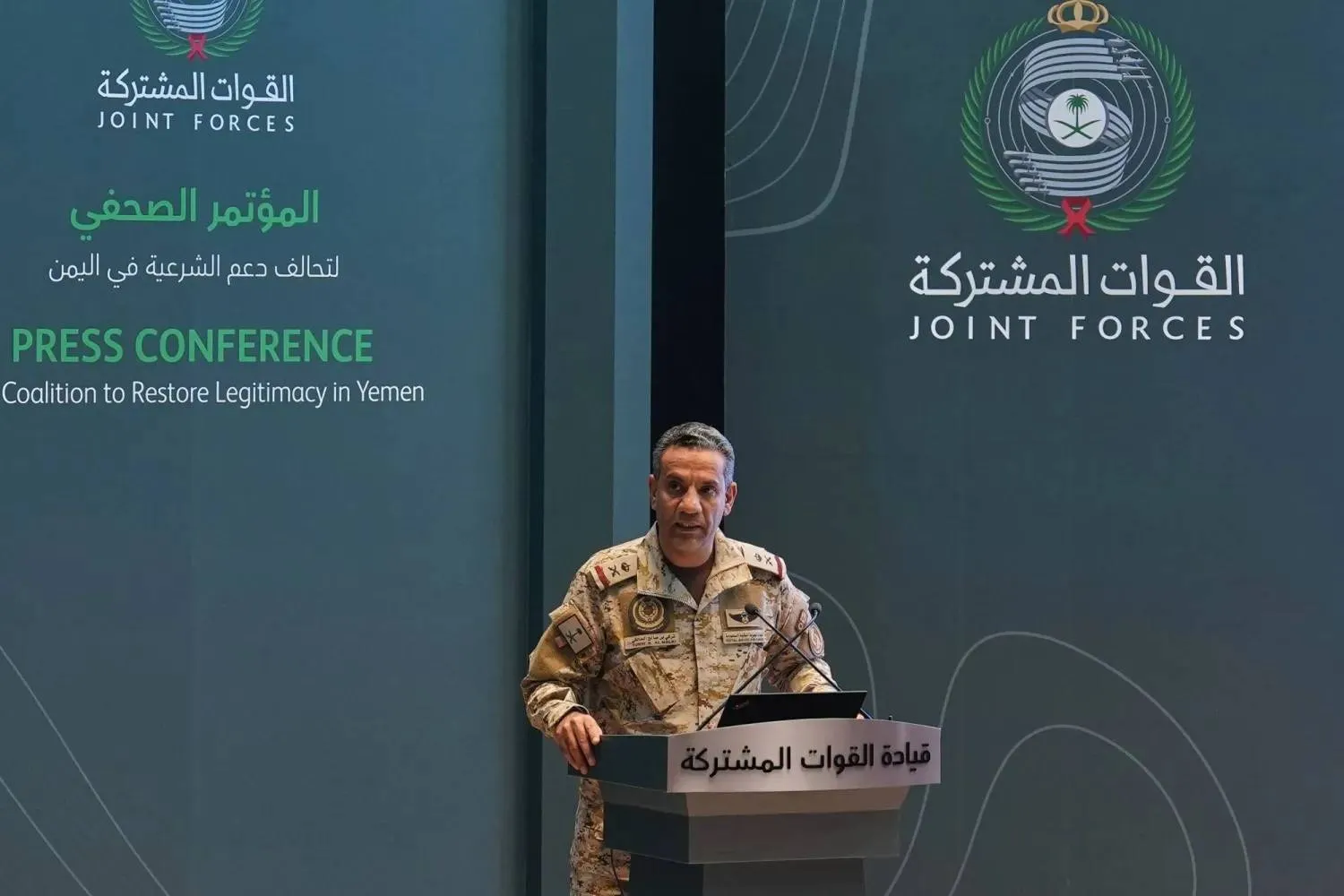
In a statement, coalition spokesman Major General Turki al-Malki said the forces detected on Saturday and Sunday the arrival of two vessels from the Port of Fujairah to Mukalla without obtaining any permits from the Joint Forces Command.

Saudi Arabia expressed on Tuesday its disappointment in the United Arab Emirates for pressuring the STC to carry out military operations on the Kingdom's southern borders in Hadhramaut and Al-Mahra.

A Saudi Foreign Ministry statement said: "The steps taken by the UAE are considered highly dangerous, inconsistent with the principles upon which the Coalition to Restore Legitimacy in Yemen was established, and do not serve the coalition's purpose of achieving security and stability for Yemen."

"The Kingdom stresses that any threat to its national security is a red line, and the Kingdom will not hesitate to take all necessary steps and measures to confront and neutralize any such threat," it declared.