


Türkiye and Syria Agree to Improve Ties after Talks in Moscow

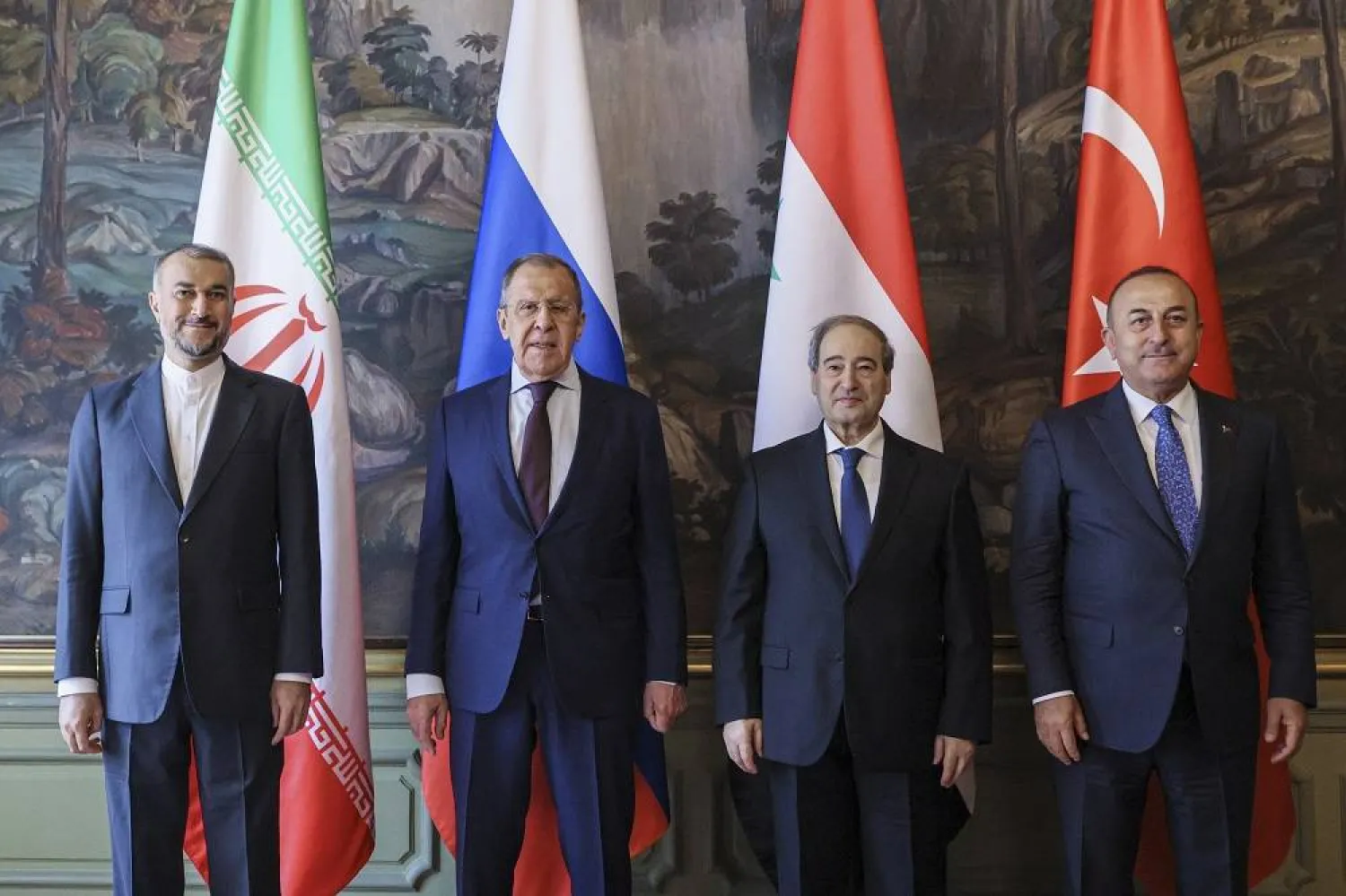
A handout picture made available by Russian Foreign ministry press service shows (L-R) Iranian Foreign Minister Hossein Amir Abdollahian, Russian Foreign Minister Sergei Lavrov, Syrian Foreign Minister Faisal Mekdad and Turkish Foreign Minister Mevlut Cavusoglu posing for a family photo during a meeting in Moscow, Russia, 10 May 2023. (EPA / Russian Foreign ministry press service)
TT

Türkiye and Syria Agree to Improve Ties after Talks in Moscow

A handout picture made available by Russian Foreign ministry press service shows (L-R) Iranian Foreign Minister Hossein Amir Abdollahian, Russian Foreign Minister Sergei Lavrov, Syrian Foreign Minister Faisal Mekdad and Turkish Foreign Minister Mevlut Cavusoglu posing for a family photo during a meeting in Moscow, Russia, 10 May 2023. (EPA / Russian Foreign ministry press service)

Syria and Türkiye agreed Wednesday to set up a “roadmap” to improve strained ties, following talks alongside Russia and Iran in Moscow.

The agreement comes a week after Syria and Arab governments meeting in Jordan agreed to establish a roadmap of their own to resolve Syria's lengthy civil war and bolster ties. Syria has been returning to the Arab fold and slowly restoring ties with its neighbors.

The Arab League also readmitted Syria's membership after a 12-year suspension in the onset of the conflict on Sunday, before Saudi Arabia delivered a formal invitation earlier Wednesday to President Bashar al-Assad to attend the upcoming summit in Jeddah.

Throughout the 12-year conflict, Türkiye has backed armed opposition groups in the country's northwest seeking to remove Assad from power. The Syrian government has frequently denounced Ankara’s hold over parts of a northwest enclave previously seized by Assad’s opponents. Türkiye captured the territory through several military incursions since 2016 against US-backed Kurdish forces.

Russia on the other hand intervened militarily in Syria starting in September 2015, and alongside Iran played a pivotal role in keeping Assad in power and to reclaim much of the country back. Moscow has maintained a military presence in the Mideast country even as the bulk of its forces are busy fighting in Ukraine.

Moscow has spent years trying to help Assad rebuild ties with Türkiye and other countries that were fractured in the war, which has killed nearly 500,000 people and displaced half of Syria’s prewar population of 23 million.

Russia’s foreign minister on Wednesday hosted his counterparts from Türkiye, Syria and Iran for talks that marked the highest-level contact between Ankara and Damascus since the start of the Syrian war over a decade ago.

Talks to establish a plan to improve relations between Türkiye and Syria would be done in coordination with ongoing communication between the four countries' defense ministries.

“The ministers noted the positive and constructive atmosphere of the exchange of views and agreed to continue high-level contacts and technical talks in the quadripartite format in the coming period,” a statement from the Russian Foreign Ministry after the talks read.

The statement added that they called for more international aid to Syria, not only to help the country's struggling population but also “in the interests of voluntary, safe, and dignified” refugee returns and post-war reconstruction.

The efforts toward a Turkish-Syrian reconciliation come as Turkish President Recep Tayyip Erdogan is under intense pressure at home to send Syrian refugees back amid a steep economic downturn and increasing anti-refugee sentiment. He is seeking reelection on Sunday, when Türkiye holds both presidential and parliamentary elections.

Syrian state media quoted Syrian Foreign Minister Faisal Mekdad as saying during Wednesday's meeting that Syria and Türkiye “share goals and common interests.”  

He said that “despite all the negatives over the past years,” Damascus saw the talks as an opportunity “for both governments to cooperate with the help and support of our friends Russia and Iran.”

Yet Mekdad added that the Syrian government’s “main goal” was to end all “illegal” military presences in the country, including that of Turkish forces.

“We will continue to demand and insist on the subject of withdrawal,” he was quoted as saying.

Following a deadly earthquake in February that killed tens of thousands of people in Syria and Türkiye, regional normalization with Damascus began to accelerate.  

In April, Moscow hosted the defense ministers of Türkiye, Syria and Iran for talks that it said focused on “practical steps to strengthen security in the Syrian Arab Republic and to normalize Syrian-Turkish relations.”


Hamas Revives Momentum for Political Bureau Chief Election

Hamas leaders, from right: Rawhi Mushtaha, Saleh al-Arouri and Ismail Haniyeh, all of whom were assassinated, and Khaled Meshaal and Khalil al-Hayya (file photo, Hamas media)
TT

Hamas Revives Momentum for Political Bureau Chief Election

Hamas leaders, from right: Rawhi Mushtaha, Saleh al-Arouri and Ismail Haniyeh, all of whom were assassinated, and Khaled Meshaal and Khalil al-Hayya (file photo, Hamas media)

Two sources in the Palestinian group Hamas said on Wednesday that the movement has resumed the process of electing a new head of its political bureau, pending the full selection of its members.

The move restores momentum to the leadership race after it stalled at least twice in January and February.

A source inside Gaza told Asharq Al-Awsat that “conditions that had been hindering the elections have been resolved,” opening the way for the process to restart.

He said some of those conditions were linked to internal organizational disputes in the enclave, adding that once settled, the decision was made to resume the process, alongside external political and security factors and ongoing negotiations.

Hamas faces its most severe crisis since its founding in 1987, after Israeli strikes launched in response to the Oct. 7, 2023, attack hit multiple wings and levels of the group, triggering organizational and financial strains.

Estimates suggest Khaled Meshaal, head of the political bureau abroad, and Khalil al-Hayya, head of the political bureau in Gaza, are the leading contenders.

Observers and figures inside and outside Hamas say al-Hayya is backed by members in Gaza and the Qassam Brigades, while Meshaal has stronger support in the West Bank and abroad.

A source outside Gaza said the vote will take place across all accessible arenas, inside Gaza, the West Bank and abroad, depending on conditions, with a decision expected soon.

For about a year and a half, a leadership council has been managing Hamas affairs.

At the start of this year, a new push began to elect a leader for the remainder of the current political bureau’s term, originally due to end in 2025 and extended by one year, pending broader elections expected at the end of this year or early next year.

An attempt to hold the vote in mid-February was disrupted by the US-Israeli war on Iran, sources said at the time.

The vote will be limited to selecting a new political bureau chief to lead Hamas inside and outside the territories. Full elections for the bureau are not expected before the end of this year or early 2027.

The current leadership council, which includes Hamas leaders in Gaza, the West Bank and abroad, along with the movement’s secretary-general, and is headed by Shura Council chief Mohammed Darwish, will become an advisory body overseeing the group’s internal and external affairs.


Hamas Angered by Continued Violations, Prepares Amendments to New Mediator Plan

Mourners weep beside the body of a child at a hospital in Gaza City (AFP)
TT

Hamas Angered by Continued Violations, Prepares Amendments to New Mediator Plan

Mourners weep beside the body of a child at a hospital in Gaza City (AFP)

Three Hamas sources said the movement has expressed anger to mediators over the continued Israeli violations in the Gaza Strip, most recently the assassination of Iyad al-Shanbari, a senior commander in the Qassam Brigades, the movement’s armed wing.

The three sources, speaking to Asharq Al-Awsat, said Hamas considers these violations, particularly the assassination of security leaders, a blow to mediation efforts aimed at establishing a clear agreement that obliges Israel to carry out its commitments.

It called on mediators to intervene in a “serious and firm” manner to halt these operations, which have led to the killing of about 1,000 Palestinians since the ceasefire entered into force on October 10, 2025. The sources said mediators confirmed they are continuing their efforts to put an end to the Israeli violations.

A Palestinian source in contact with the Gaza Administration Committee told Asharq Al-Awsat that Nickolay Mladenov, the highest representative for Gaza in the Peace Council, “requested on Monday that Israel halt airstrikes in the Gaza Strip for 48 hours to give the Cairo negotiations a chance to succeed, but received no response.” Hamas sources said they had no knowledge of this request.

A day after a new proposal was presented by mediators and the Peace Council regarding Gaza and advancing the implementation of the ceasefire agreement, Hamas sources said the movement is preparing a response containing remarks and requested amendments to be submitted by its negotiating delegation to Mladenov and the mediators.

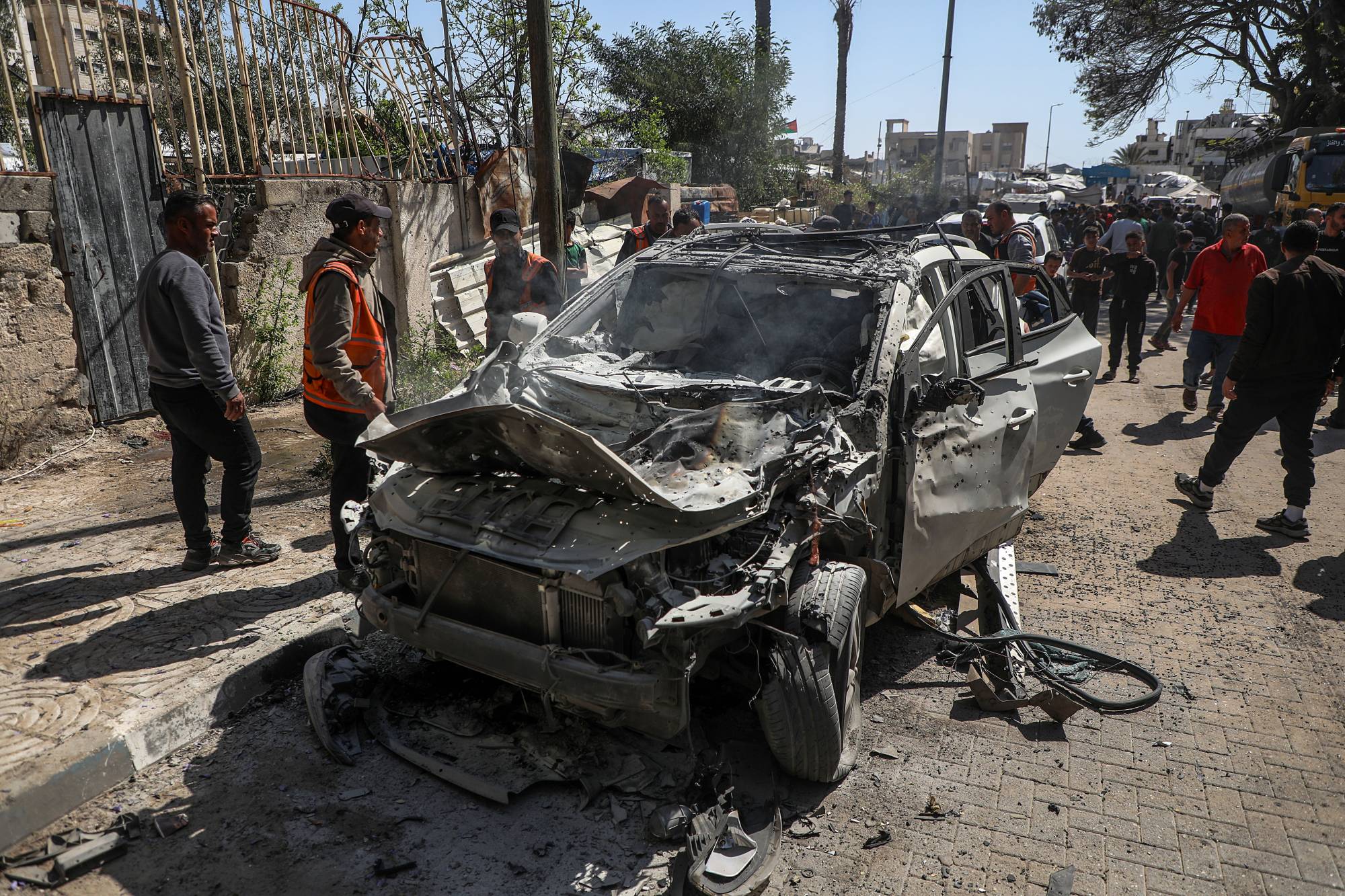
Members of the Palestinian Civil Defense and local residents inspect a damaged vehicle following an Israeli airstrike in the west of Gaza City, Gaza Strip, 28 April 2026. EPA/MOHAMMED SABER

Asharq Al-Awsat had obtained details of the proposal drafted by representatives of the Peace Council and mediators from Egypt, Qatar and Türkiye, along with the United States, concerning the Gaza Strip, particularly its disarmament.

The document, titled “Roadmap” to complete implementation of US President Donald Trump’s comprehensive Gaza peace plan, outlines 15 provisions addressing the implementation of the second phase of the ceasefire agreement between Israel and Hamas.

The response will focus, according to the sources, on demands for a clear timetable for Israeli withdrawal, the establishment of clear international mechanisms and guarantees to oblige Israel, rejecting any linkage between reconstruction and the confinement and disarmament issue, and affirming the right of factions to fully exercise their political role without restrictions.

The new paper indicates the formation of a body named the “Implementation Verification Committee,” to be established by the highest representative for Gaza, comprising guarantor states, an international stabilization force and the Peace Council, to ensure that the parties fulfill their obligations, supported by an enhanced monitoring mechanism.

In its first provisions, the document stresses the importance of full commitment by all parties to implement UN Security Council Resolution 2803 and Trump’s comprehensive plan, as an agreed international framework that will guide the implementation of this process, in a way that ensures achieving the primary objective of restoring civilian life, enabling Palestinian governance, reconstruction, security and economic recovery, and creating the conditions for a credible path toward self-determination and a Palestinian state in line with the Security Council resolution.


Lebanon President Says Israel Must 'Fully Implement Ceasefire' before Talks

 Smoke rises following an Israeli airstrike in a southern Lebanese village, as seen from the Upper Galilee 29 April 2026, amid a ceasefire between Israel and Lebanon.  EPA/ATEF SAFADI
Smoke rises following an Israeli airstrike in a southern Lebanese village, as seen from the Upper Galilee 29 April 2026, amid a ceasefire between Israel and Lebanon. EPA/ATEF SAFADI
TT

Lebanon President Says Israel Must 'Fully Implement Ceasefire' before Talks

 Smoke rises following an Israeli airstrike in a southern Lebanese village, as seen from the Upper Galilee 29 April 2026, amid a ceasefire between Israel and Lebanon.  EPA/ATEF SAFADI
Smoke rises following an Israeli airstrike in a southern Lebanese village, as seen from the Upper Galilee 29 April 2026, amid a ceasefire between Israel and Lebanon. EPA/ATEF SAFADI

Lebanese President Joseph Aoun said Wednesday that Israel must "fully implement" the ceasefire between the two countries before beginning direct negotiations, adding that Beirut was waiting for Washington to set a date for the talks, AFP reported.

Israel "must first fully implement the ceasefire in order to move on to negotiations... Israeli attacks cannot continue as they are," Aoun said in a statement shared by the presidency.

"We are now waiting for the United States to set a date to begin direct negotiations" with Israel.

Despite the ceasefire, Israel and Iran-backed Lebanese militant group Hezbollah have both engaged in fighting, trading blame over violations of the fragile truce.
