Oil Slips as Economic Worries Take Focus Off Tighter Supplies

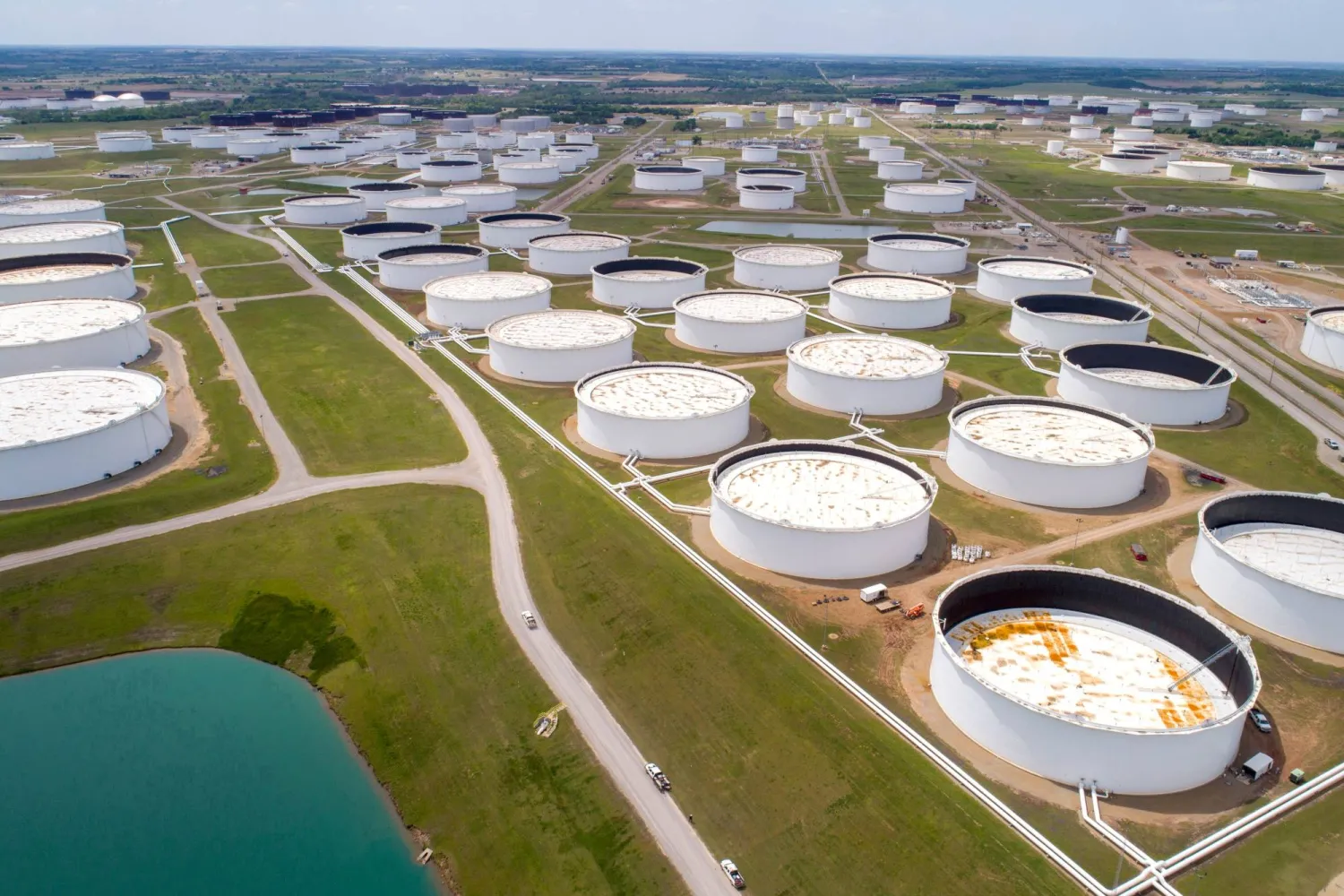
Crude oil storage tanks are seen in Oklahoma, US. Reuters
TT

Oil Slips as Economic Worries Take Focus Off Tighter Supplies

Crude oil storage tanks are seen in Oklahoma, US. Reuters

Oil prices fell on Monday as concerns about fuel demand in the top global oil consumers, the United States and China, offset bullish sentiment about tightening supplies from OPEC+ cuts and a resumption in US buying for reserves.

Brent crude futures fell 26 cents, or 0.35%, to $73.91 a barrel by 0638 GMT, while US West Texas Intermediate crude was at $69.34 a barrel, down 20 cents, or 0.29%, Reuters reported.

Last week, both benchmarks fell for a fourth consecutive week, the longest streak of weekly declines since September 2022, over concerns the United States could enter a recession on "significant risk" of a historic default within the first two weeks of June.

Investors sought safe havens such as the US dollar, strengthening the currency and making dollar-denominated commodities more expensive for holders of other currencies.

"Oil prices are still under pressure on sluggish demand outlooks as China's economic reopening progress seems bumpy," CMC Markets analyst Tina Teng said, adding that the US banking rout has also caused market jitters.

Investors will scour China's slew of economic data on industrial output, fixed assets investment and retail sales in the week ahead for signs of oil demand improvement, she said.

"With the uneven re-opening in China and concerns that the US is facing a growth slowdown at a time when the X-date for the debt ceiling is rapidly approaching, topped off by a rally in the US dollar, market sentiment towards crude oil will remain tepid at best," IG analyst Tony Sycamore said.

Still, global crude supplies could tighten in the second half as the OPEC+ grouping, the Organization of the Petroleum Exporting Countries and its allies, including Russia, is making additional output cuts that are reducing sour crude availability.
The group announced in April that some members would cut output further by around 1.16 million barrels per day, bringing the total volume of cuts to 3.66 million bpd, according to Reuters calculations.

The US could start repurchasing oil for the Strategic Petroleum Reserve (SPR) after completing a congressionally mandated sale in June, Energy Secretary Jennifer Granholm told lawmakers on Thursday.

This announcement was followed by a weekly report by energy services firm Baker Hughes Co that showed the number of US oil rigs fell by two to 586 this week, their lowest since June 2022, while the number of gas rigs plunged by 16 to 141.

Meanwhile, leaders of the Group of Seven (G7) nations could announce new measures at their May 19-21 meetings that target sanctions evasion involving third countries, said officials with direct knowledge of the discussions.

The tightening of sanctions will also seek to undermine Russia's future energy production and curb trade that supports the Russian military, the people said.

India and China, the world's No. 3 and No. 1 crude importers, respectively, have been the key buyers of Russian crude since the European Union embargo started in December.


Iraq’s Oil Hub Slows to a Crawl as Strait of Hormuz Shutdown Strangles Exports

01 April 2026, Iraq, Erbil: Smoke rises from a motor oil depot on the outskirts of Erbil, after it was hit by a drone attack. Photo: Ismael Adnan/dpa
TT

Iraq’s Oil Hub Slows to a Crawl as Strait of Hormuz Shutdown Strangles Exports

01 April 2026, Iraq, Erbil: Smoke rises from a motor oil depot on the outskirts of Erbil, after it was hit by a drone attack. Photo: Ismael Adnan/dpa

Iraqi oil fields once alive with the buzz of workers are nearly deserted. Ports that pulsed with the churn of cargo have fallen still, the din of commerce replaced by the soft rhythm of waves.

A month after the war in Iran started, workers at ports and oil fields in the province of Basra, where almost all of Iraq's crude is produced and exported, have grown accustomed to rockets streaking across the sky, aimed at US air bases and other strategic facilities, The Associated Press said.

The war, which began with US-Israeli strikes, is dealing a heavy blow to Iraq's economy. Iraq relies on oil revenues for roughly 90% of its budget, and most of its oil is exported through the Strait of Hormuz, the narrow mouth of the Arabian Gulf where Iran has effectively stopped cargo traffic during the conflict. The war also has led to a sharp reduction in the volume of imported goods reaching southern Iraq's ports, while attacks have halted traffic at the border it shares with Iran.

Unlike other countries in the Middle East touched by the war, Iraq hosts both entrenched Iran-aligned forces and significant US interests, leaving it exposed to attacks from both sides. Since the war started, oil production in southern Iraq, where Basra is located, has fallen by more than 70% and the volume of imported goods reaching the country's ports has been cut in half. Drone and missile attacks have targeted American companies and military bases. Iran's allied Iraqi militias also have struck oil fields and energy infrastructure. Many foreign workers have left.

The Iraqi government should have enough funds to get through mid-May without new oil sales, according to experts, but then it will have to borrow money.

“After that, the government would resort to issuing bonds,” said Ahmed Tabaqchali, an expert in Iraq’s economy. “But not without consequences.”

Oil production suspended

Across southern Iraq, the closure of the Strait of Hormuz has prompted oil fields to scale back production and focus on domestic needs, while oil prices around the globe have risen. Basra’s Zubair oil field, once producing around 400,000 barrels per day, has seen output drop to roughly 250,000, officials said.

Iran has offered assurances that Iraqi crude can safely transit the strait, said Bassem Abdul Karim, the head of the state-run Basra Oil Company, which oversees production in the province. However, because Iraq lacks its own tanker fleet and depends on chartered vessels, shipments ultimately hinge on whether tanker owners are willing to accept the heightened risks of making the journey. Most are not.

At a degassing station in Zubair, where crude is processed, production has also slowed dramatically. “It’s quiet now because of the reductions,” said chief engineer Ammar Hashim. “Of course we are worried.”

The downturn in Zubair reflects a broader decline in Basra. Output has dropped from 3.1 million barrels per day to roughly 900,000 across the province, according to Abdul Karim.

“Exports are currently completely halted. At the moment, we are considering alternative loading areas, but none are fully operational,” he told The Associated Press.

That morning, a drone crashed in the Majnoon oil field north of Basra without detonating. A security official said it's an increasingly common occurrence, adding that the drone was likely headed toward US bases in Kuwait. Production at the field has been suspended due to the frequency of these events. The official spoke on condition of anonymity because he was not permitted to speak to news media.

Hundreds of employees from American, British, Italian, French and other international oil companies have left Iraq due to the war. The departures accelerated after a March 6 drone strike hit the Burjisiya complex in Basra, a key logistics hub for Iraq’s oil industry used by numerous companies. The attack targeted US oil services company KBR, striking its chemical storage facility.

Another drone struck the British-Petroleum operated Rumaila oil field, prompting some foreign workers there to leave, said Abdul Karim. The field is still operating, he said. On Wednesday, multiple drones attacked a fuel warehouse linked to BP in northern Iraq.

Efforts to reroute Iraq's oil face major constraints: The country doesn't have the capacity to boost exports via its northern pipeline, and trucking through Jordan and Syria is costly and inefficient, said Abdul Karim.

Shipping lanes closed Umm Qasr, Iraq’s primary deep-water port, was once so noisy with imported cargo that it could give you a headache, workers there said.

Now, with the Strait of Hormuz closed, large mother ships bringing shipments to Iraq can no longer get to the port. Instead, they dock in the United Arab Emirates, where the cargo is carried by trucks and then smaller ships to get to Umm Qasr, a costly workaround.

The port’s jetties are running well below their former capacity, with volumes halved by the war, according to port director Mohammed Tahir Fadhil.

When the AP visited, just one cargo ship from the U.A.E. had docked.

The threat to shipping lanes escalated after Iran destroyed two tankers on March 11 in Iraqi waters, the Marshall Islands-flagged Safesea Vishnu and the Malta-flagged Zefyros.

“Today, our only gateway for goods is the United Arab Emirates,” said Farhan Fartousi, director of the Iraqi Ports Company.

Trade disrupted

On Sunday morning, Haidar Abdul-Samad, deputy director of Basra’s Shalamcha border crossing with Iran, was on the phone with an Iranian official, complaining about electricity cuts that had halted trade, urging a quick resolution. The power cuts followed an airstrike that hit the Iranian side of the crossing.

Such disruptions, local officials say, have become routine.

Before the war, the crossing saw constant movement, reflecting strong familial and commercial ties between Iranians and Iraqis in the area. It is also a key transit point for traders and pilgrims heading to Shiite holy sites in central Iraq.

That morning, trucks were backed up for miles.

“Priority is given to food supplies to prevent price increases,” Abdul-Samad said. “Passenger movement is not at the same level as before; activity has declined due to the war in Iran.”

Once electricity was restored, 30-year-old Iranian trader Atefa Al-Fatlawi arrived with her husband and young son. She buys goods at lower prices in Basra to sell back home.

“We are scared because of the bombings,” she said. “Shalamcha was targeted. Today, there were no transport vehicles at the garage because of the attack.”



Gold Prices Retreat as Trump Threatens Further Attacks on Iran

An Indian woman displays a gold jewelry piece at a jewelry store in Bangalore (AFP)
TT

Gold Prices Retreat as Trump Threatens Further Attacks on Iran

An Indian woman displays a gold jewelry piece at a jewelry store in Bangalore (AFP)

Gold retreated from two-week highs on Thursday after US President Donald Trump said that Washington would continue its military campaign in Iran in the coming weeks, pushing crude prices sharply higher and dampening hopes of interest rate cuts.

Spot gold was down 2% at $4,664.39 per ounce, as of 0439 GMT, snapping a four-day winning streak, while US ‌gold futures slid 2.5% ‌to $4,691.10.

The pullback followed bullion's climb to ‌its ⁠highest level since March ⁠19, prior to Trump's remarks, said Reuters.

In a prime-time address to the nation late on Wednesday, Trump said the United States would carry out aggressive strikes on Iran over the next two to three weeks and was nearing "completion of its main strategic objectives" in the conflict.

"Gold is pulling back after two superb days, as ⁠President Trump was quite bellicose in his tone, referring ‌to aggressive plans over the coming ‌weeks... it suggests the optimism of the last few days was exuberant ‌and there will be some retracement ahead of the long ‌weekend," independent metals trader Tai Wong said.

Markets reacted swiftly: the 10-year US Treasury yield and the dollar index both advanced, pressuring dollar-denominated gold.

Meanwhile, Brent crude surged more than 6% after Trump indicated continued targeting of Iran's energy ‌infrastructure, raising supply concerns.

Gold had already been under pressure, dropping 11% in March, its worst monthly performance ⁠since 2008, ⁠following the outbreak of the Iran conflict on February 28. The surge in oil prices has fueled inflation concerns, complicating the Federal Reserve's monetary policy outlook.

Expectations for U.S. rate cuts remain low through most of 2026. Bets for a December reduction have fallen to just 12%, down from around 25% before Trump's latest comments.

While gold typically benefits during periods of inflationary pressure and geopolitical tension, higher interest rates reduce its appeal by increasing the opportunity cost of holding the non-yielding asset.

In other metals, spot silver fell 4.6% to $71.67, platinum dropped 2.5% to $1,914.61 and palladium shed 1.4% to $1,451.92.


Oil Rallies, Stocks Tumble as Trump Says US to Hammer Iran Further

Oil prices surged and stocks sank after Donald Trump's address to the nation. Alex Brandon / POOL/AFP
TT

Oil Rallies, Stocks Tumble as Trump Says US to Hammer Iran Further

Oil prices surged and stocks sank after Donald Trump's address to the nation. Alex Brandon / POOL/AFP

Oil prices spiked and stocks sank on Thursday after Donald Trump reiterated that US forces would hammer Iran for another two to three weeks but offered no solution to the closure of the Strait of Hormuz that has crippled global markets.

Investors appeared to be unimpressed with the US president's much-anticipated address to the nation, in which he again called on countries that rely on the waterway for their energy supplies to reopen it themselves, AFP said.

The comments came amid growing fears about the economic impact of the crisis, which has seen governments introduce support measures, with the World Bank saying it was "extremely concerned".

In a speech lasting less than 20 minutes, Trump added little to what he has said in the past, warning that "over the next two to three weeks, we are going to bring them back to the Stone Ages, where they belong".

He also told the nation that US forces would meet all their battlefield goals "very, very shortly".

The address dented a nascent recovery in world markets that had come after Trump said earlier this week that the war would be ending "very soon", while his Iranian counterpart said his country had the "necessary will" to end it.

Brent crude, which had fallen back below $100 a barrel Wednesday, surged as much as five percent to hit $106.29, while West Texas Intermediate jumped more than four percent to as high as $104.29.

Trump "spoke of objectives met, but not of resolution. Of continued strikes, not withdrawal. Of optional escalation, not closure", wrote Stephen Innes at SPI Asset Management.

"The message was not one of panic, but it was unmistakably one of unfinished business. And in markets, unfinished business is oxygen for volatility.

"So oil did what oil always does when the illusion cracks. It surged, not because the war suddenly worsened, but because the market had prematurely priced in the expectation that it would end."

The reaction among equity traders was no better, with Seoul -- which soared more than eight percent Wednesday -- losing three percent. Tokyo, Hong Kong, Shanghai, Singapore, Taipei and Sydney were also well down.

The speech "did not contain what the market had hoped for -- namely, indications of an end to the fighting", Jumpei Tanaka, of Pictet Asset Management, said. "Instead, he suggested a potential escalation of the situation, which is a clear negative for stocks."

Markets have endured huge volatility since the US-Israeli war on Iran was launched on February 28, with the president frequently U-turning after making policy statements, particularly with regards to foreign relations and military operations.

His announcements that Washington and Tehran were in peace talks have often been denied by the Iranian republic, while its Revolutionary Guards insisted the strait will remain closed to the country's "enemies".

Trump's repeated demand that countries that rely on energy through the Strait of Hormuz "get your own oil" comes as Britain prepares to host a meeting of about 35 nations Thursday to discuss how to reopen the waterway.

The meeting will "assess all viable diplomatic and political measures that we can take to restore freedom of navigation, guarantee the safety of trapped ships and seafarers and resume the movement of vital commodities", UK Prime Minister Keir Starmer said.

Meanwhile, the World Bank Managing Director Paschal Donohoe said he was fearful about the global economic impact of the crisis.

"We are extremely concerned regarding the effect that this will have on inflation, on jobs and on food security," he told AFP as the Bank announced a new partnership with the International Monetary Fund and International Energy Agency to coordinate aid responses.