
In First, Kyiv Says it Shoots Down Volley of Russian Hypersonic Missiles

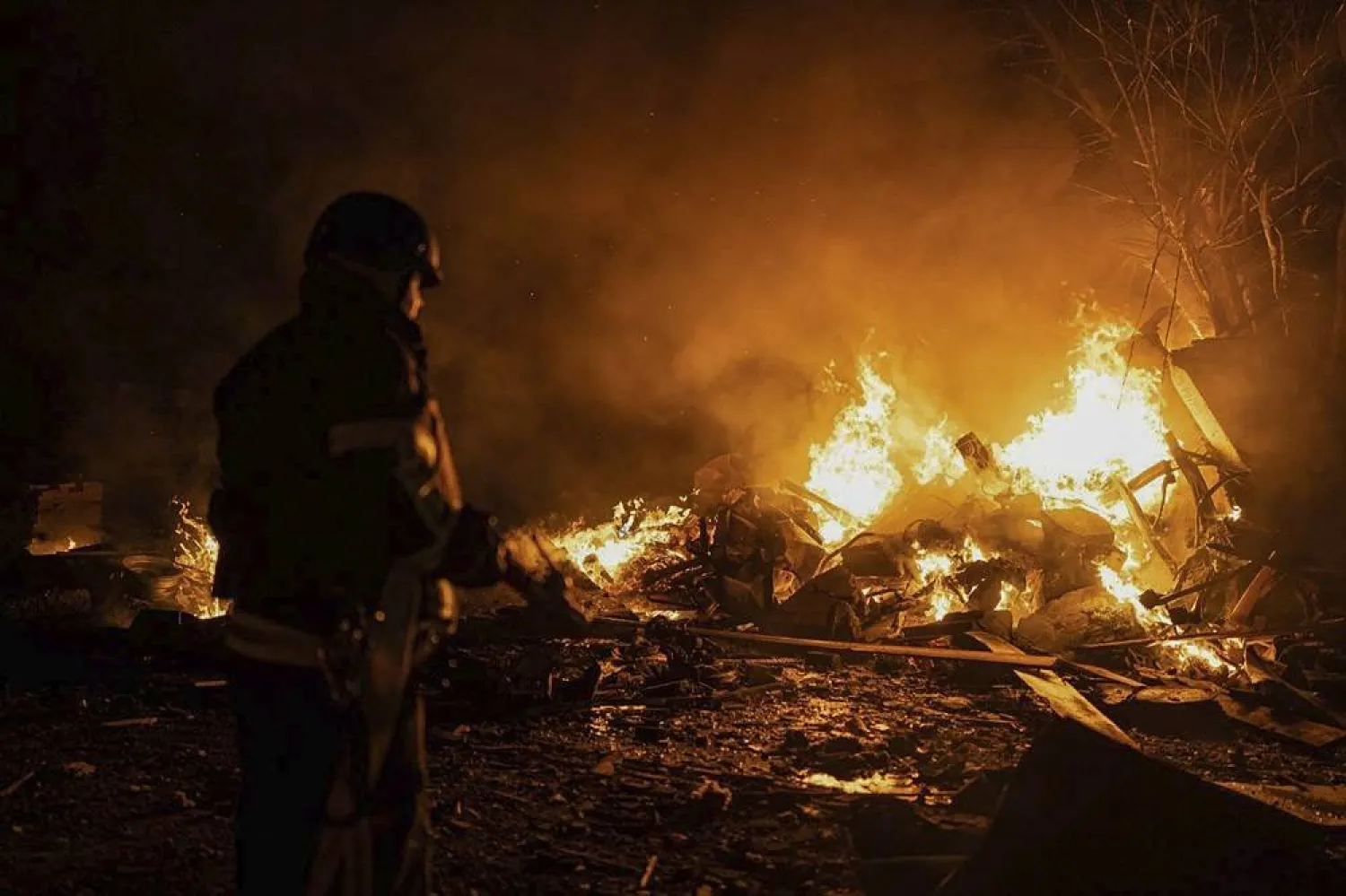
In this photo provided by the Ukrainian Emergency Situations Ministry, firefighters put out fire caused by fragments of a Russian rocket after it was shot down by air defense system during the night Russian rocket attack in Kyiv, Ukraine, early Tuesday, May 16, 2023. (Ukrainian Emergency Situations Ministry via AP)
TT

In First, Kyiv Says it Shoots Down Volley of Russian Hypersonic Missiles

In this photo provided by the Ukrainian Emergency Situations Ministry, firefighters put out fire caused by fragments of a Russian rocket after it was shot down by air defense system during the night Russian rocket attack in Kyiv, Ukraine, early Tuesday, May 16, 2023. (Ukrainian Emergency Situations Ministry via AP)

Ukraine said on Tuesday it had shot down six Russian hypersonic Kinzhal missiles in a single night, thwarting a superweapon Moscow had previously touted as all but unstoppable. 

It was the first time Ukraine had claimed to have struck an entire volley of multiple hypersonic missiles, and if confirmed would be a dramatic demonstration of the effectiveness of newly deployed Western air defenses. 

The six Kinzhals, ballistic missiles which travel at up to 10 times the speed of sound, were among a volley of 18 missiles Russia launched at Ukraine overnight, lighting up Kyiv with flashes and raining debris after they were blasted from the sky. 

The commander-in-chief of Ukraine's armed forces, Valeriy Zaluzhnyi said all had been successfully intercepted. There was no immediate comment from Russia. 

City authorities in the Ukrainian capital said three people were wounded by falling debris. 

"It was exceptional in its density - the maximum number of attack missiles in the shortest period of time," Serhiy Popko, head of Kyiv's city military administration, said on the Telegram messaging app. 

Zaluzhnyi said his forces had intercepted the six Kinzhals launched from aircraft, as well as nine Kalibr cruise missiles from ships in the Black Sea and three Iskanders fired from land. 

Earlier this month, Ukraine claimed to have shot down a single Kinzhal missile over Kyiv for the first time, using a newly deployed US Patriot air defense system. 

Previously, the ability of Patriots to intercept Kinzhal missiles was only theoretical. Hitting six at once would suggest it could be a reliable defense, rather than a lucky shot. 

President Vladimir Putin, who unveiled the Kinzhal as one of six "next generation" weapons in 2018, has frequently touted it as proof of world-beating Russian military hardware, capable of taking on NATO. 

The Kinzhal, whose name means dagger, can carry conventional or nuclear warheads up to 2,000 km. Russia used them in warfare for the first time in Ukraine last year and has only acknowledged firing them on a few occasions. 

With Ukrainian forces preparing to go on the offensive for the first time in six months, Russia is now launching long-range air strikes at the highest frequency of the war. 

It has launched eight drone and missile volleys so far this month, compared to weekly during the winter and a lull in March and April. Kyiv says it has been shooting most down. 

‘Under control’ 

Early on Tuesday, air raid sirens blared across nearly all of Ukraine, and were heard over Kyiv and its region for more than three hours. 

"The enemy's mission is to sow panic and create chaos. However, in the northern operational zone (including Kyiv), everything is under complete control," General Serhiy Naev, Commander of the Joint Forces of the Armed Forces, said. 

The past week has seen Ukraine make its biggest gains on the battlefield since last November, recapturing several square kilometers of territory on the northern and southern outskirts of the battlefield city of Bakhmut. Moscow has acknowledged that some of its troops have retreated but denies that its battle lines are crumbling on the city's flanks. 

Kyiv says those advances are localized and do not yet represent the full force of its upcoming counteroffensive, planned to take advantage of hundreds of modern tanks and armored vehicles sent by the West this year. 

A Ukrainian counteroffensive would bring the next major phase of the war, after a huge Russian winter offensive that failed to capture significant new territory despite the bloodiest ground combat in Europe since World War Two. 

Moscow launched its full-scale invasion of Ukraine in February last year and now claims to have annexed around a sixth of its neighbor's territory. Ukraine turned back Russian troops from the outskirts of Kyiv early in the war and recaptured territory in two major counteroffensives in the second half of 2022, but has kept its forces on the defensive since November. 

Russia says its invasion was necessary to counter a threat to its security posed by Kyiv's close ties to the West. Ukraine and its allies call it an unprovoked and unlawful war of conquest, and Kyiv says it will not stop fighting until all Russian troops leave its land. 


Nigeria's President to Make a Sate Visit to the UK in March

Nigeria’s President Bola Tinubu gives a joint statement with Brazil’s President Luiz Inacio Lula da Silva, at the Planalto presidential palace, in Brasilia, Brazil, Aug. 25, 2025. (AP Photo/Eraldo Peres, File)
TT

Nigeria's President to Make a Sate Visit to the UK in March

Nigeria’s President Bola Tinubu gives a joint statement with Brazil’s President Luiz Inacio Lula da Silva, at the Planalto presidential palace, in Brasilia, Brazil, Aug. 25, 2025. (AP Photo/Eraldo Peres, File)

Nigeria’s president is set to make a state visit to the UK in March, the first such trip by a Nigerian leader in almost four decades, Britain’s Buckingham Palace said Sunday.

Officials said President Bola Tinubu and first lady Oluremi Tinubu will travel to the UK on March 18 and 19, The AP news reported.

King Charles III and Queen Camilla will host them at Windsor Castle. Full details of the visit are expected at a later date.

Charles visited Nigeria, a Commonwealth country, four times from 1990 to 2018 before he became king. He previously received Tinubu at Buckingham Palace in September 2024.m

Previous state visits by a Nigerian leader took place in 1973, 1981 and 1989.

A state visit usually starts with an official reception hosted by the king and includes a carriage procession and a state banquet.

Last year Charles hosted state visits for world leaders including US President Donald Trump, French President Emmanuel Macron and German President Frank-Walter Steinmeier.


Iran Strikes Hard Line on US Talks, Saying Tehran's Power Comes From Saying 'No'

Traffic moves through a street in Tehran on February 7, 2026. (Photo by ATTA KENARE / AFP)
TT

Iran Strikes Hard Line on US Talks, Saying Tehran's Power Comes From Saying 'No'

Traffic moves through a street in Tehran on February 7, 2026. (Photo by ATTA KENARE / AFP)

Iran's top diplomat insisted Sunday that Tehran's strength came from its ability to “say no to the great powers," striking a maximalist position just after negotiations with the United States over its nuclear program and in the wake of nationwide protests.

Foreign Minister Abbas Araghchi, speaking to diplomats at a summit in Tehran, signaled that Iran would stick to its position that it must be able to enrich uranium — a major point of contention with President Donald Trump, who bombed Iranian atomic sites in June during the 12-day Iran-Israel war.

Iran will never surrender the right to enrich uranium, even if war "is imposed on us,” he noted.

"Iran has paid a very heavy price for its peaceful nuclear program and for uranium enrichment." 

Israeli Prime Minister Benjamin Netanyahu is expected to travel to Washington this week, with Iran expected to be the major subject of discussion, his office said.

While Iranian President Masoud Pezeshkian praised the talks Friday in Oman with the Americans as “a step forward,” Araghchi's remarks show the challenge ahead. Already, the US moved the aircraft carrier USS Abraham Lincoln, ships and warplanes to the Middle East to pressure Iran into an agreement and have the firepower necessary to strike the Islamic Republic should Trump choose to do so, according to The AP news.

“I believe the secret of the Islamic Republic of Iran’s power lies in its ability to stand against bullying, domination and pressures from others," Araghchi said.

"They fear our atomic bomb, while we are not pursuing an atomic bomb. Our atomic bomb is the power to say no to the great powers. The secret of the Islamic Republic’s power is in the power to say no to the powers.”

‘Atomic bomb’ as rhetorical device Araghchi's choice to explicitly use an “atomic bomb” as a rhetorical device likely wasn't accidental. While Iran has long maintained its nuclear program is peaceful, the West and the International Atomic Energy Agency say Tehran had an organized military program to seek the bomb up until 2003.

Iran had been enriching uranium up to 60% purity, a short, technical step to weapons-grade levels of 90%, the only non-weapons state to do so. Iranian officials in recent years had also been increasingly threatening that Tehran could seek the bomb, even while its diplomats have pointed to Iranian Supreme Leader Ali Khamenei’s preachings as a binding fatwa, or religious edict, that Iran wouldn’t build one.

Pezeshkian, who ordered Araghchi to pursue talks with the Americans after likely getting Khamenei's blessing, also wrote on X on Sunday about the talks.

“The Iran-US talks, held through the follow-up efforts of friendly governments in the region, were a step forward,” the president wrote. “Dialogue has always been our strategy for peaceful resolution. ... The Iranian nation has always responded to respect with respect, but it does not tolerate the language of force.”

It remains unclear when and where, or if, there will be a second round of talks. Trump, after the talks Friday, offered few details but said: “Iran looks like they want to make a deal very badly — as they should.”

Aircraft carrier in the Arabian Sea During Friday's talks, US Navy Adm. Brad Cooper, the head of the American military's Central Command, was in Oman. Cooper's presence was apparently an intentional reminder to Iran about US military power in the region. Cooper later accompanied US special envoy Steve Witkoff and Jared Kushner, Trump's son-in-law, to the Lincoln out in the Arabian Sea after the indirect negotiations.

Araghchi appeared to be taking the threat of an American military strike seriously, as many worried Iranians have in recent weeks. He noted that after multiple rounds of talks last year, the US “attacked us in the midst of negotiations."

“If you take a step back (in negotiations), it is not clear up to where it will go,” Araghchi said.


Russia: Man Suspected of Shooting Top General Detained in Dubai

An investigator works outside a residential building where the assassination attempt on Russian Lieutenant General Vladimir Alexeyev took place in Moscow, Russia February 6, 2026. REUTERS/Anastasia Barashkova
TT

Russia: Man Suspected of Shooting Top General Detained in Dubai

An investigator works outside a residential building where the assassination attempt on Russian Lieutenant General Vladimir Alexeyev took place in Moscow, Russia February 6, 2026. REUTERS/Anastasia Barashkova

Russia's Federal Security Service (FSB) said on Sunday that the man suspected of shooting top Russian military intelligence officer Vladimir Alexeyev in Moscow has been detained in Dubai and handed over to Russia.

Lieutenant General Vladimir Alexeyev, deputy head of the GRU, ⁠Russia's military intelligence arm, was shot several times in an apartment block in Moscow on Friday, investigators said. He underwent surgery after the shooting, Russian media ⁠said.

The FSB said a Russian citizen named Lyubomir Korba was detained in Dubai on suspicion of carrying out the shooting.

Russian Foreign Minister Sergei Lavrov accused Ukraine of being behind the assassination attempt, which he said was designed to sabotage peace talks. ⁠Ukraine said it had nothing to do with the shooting.

Alexeyev's boss, Admiral Igor Kostyukov, the head of the GRU, has been leading Russia's delegation in negotiations with Ukraine in Abu Dhabi on security-related aspects of a potential peace deal.