Last Emperor of China’s Watch Sells for Record $6.2 Mln in Hong Kong Auctionhttps://english.aawsat.com/culture/4343621-last-emperor-china%E2%80%99s-watch-sells-record-62-mln-hong-kong-auction
Last Emperor of China’s Watch Sells for Record $6.2 Mln in Hong Kong Auction
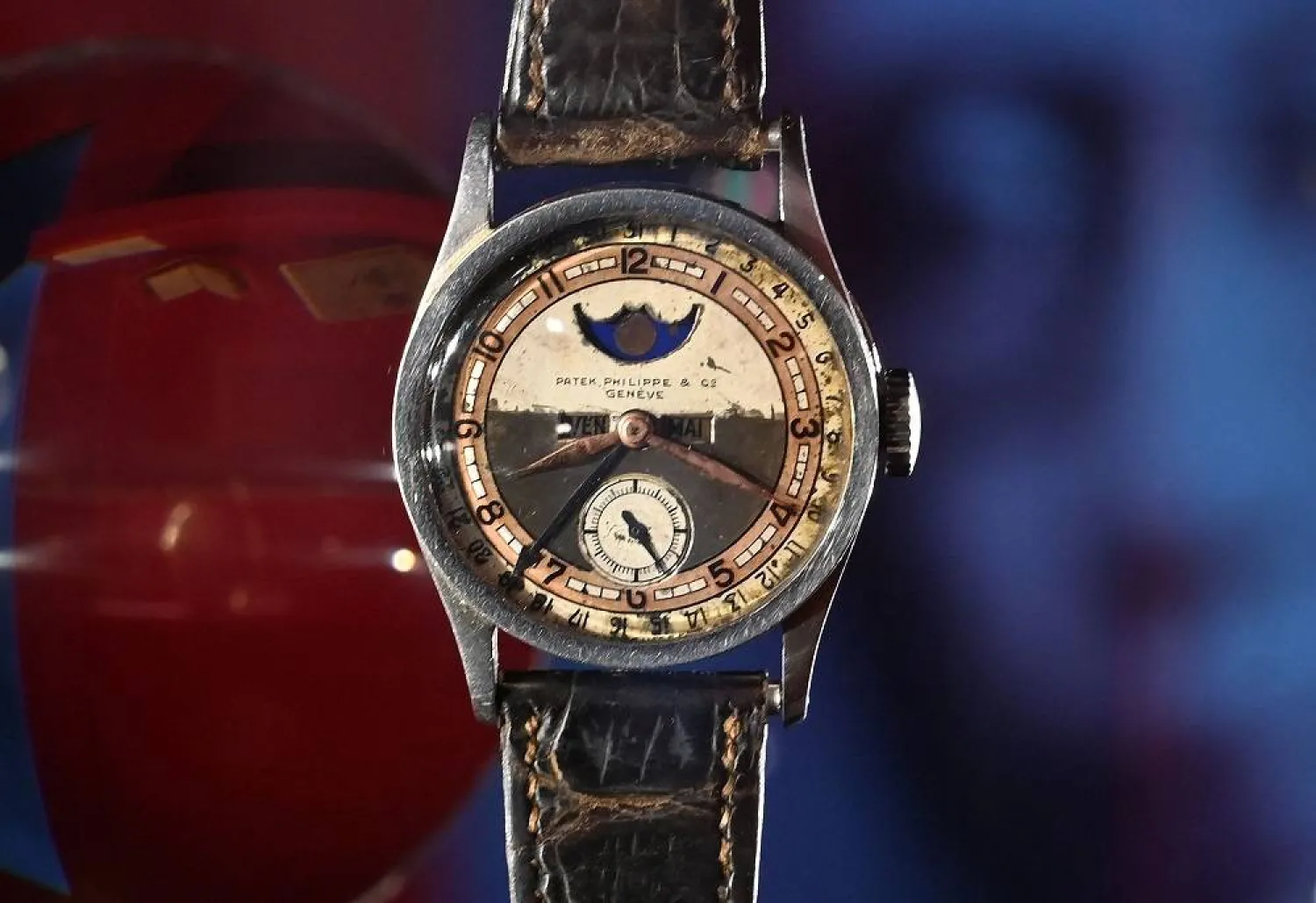
The Patek Philippe Ref 96 Quantieme Lune timepiece once owned by Aisin-Gioro Puyi, the Chinese Qing dynasty’s last emperor (R), is seen on display in Hong Kong on May 23, 2023 ahead of its auction in the territory on the same day. (AFP)
TT
TT
Last Emperor of China’s Watch Sells for Record $6.2 Mln in Hong Kong Auction
The Patek Philippe Ref 96 Quantieme Lune timepiece once owned by Aisin-Gioro Puyi, the Chinese Qing dynasty’s last emperor (R), is seen on display in Hong Kong on May 23, 2023 ahead of its auction in the territory on the same day. (AFP)
A watch that was once owned by the last emperor of China's Qing Dynasty, whose life formed the basis of the Oscar-winning film "The Last Emperor," sold for a record HK$49 million ($6.2 million) at a Hong Kong auction on Tuesday.
An Asian collector residing in Hong Kong calling on the phone bought the rare Patek Philippe watch that had belonged to Aisin-Gioro Puyi, according to the auction house.
The hammer price, which excludes the buyer's premium fee, was HK$40 million ($5.1 million).
Thomas Perazzi, head of watches at auction house Phillips Asia, told Reuters that it is "the highest result" for any wristwatch that once belonged to an emperor.
It was one of only eight known Patek Philippe Reference 96 Quantieme Lune timepieces and was gifted by Puyi to his Russian interpreter when he was imprisoned by the Soviet Union, the auction house said. It easily beat a pre-sale estimate of $3 million.
Other watches owned by emperors and sold at auction include a Patek Philippe timepiece that belonged to the last Ethiopian emperor, Haile Selassie, which sold for $2.9 million in 2017.
A Rolex watch that belonged to the last emperor of Vietnam, Bao Dai, fetched $5 million at an auction in 2017.
Born in 1906, Puyi was the last emperor of China's Qing dynasty, who began his reign at two years old.
After Japan’s defeat in World War II in 1945, Puyi was captured at China's Shenyang Airport by the Soviet Red Army. He was detained as a war prisoner and incarcerated in a detention camp in Khabarovsk, Russia, for five years.
The auction house said it spent three years collaborating with watch specialists, historians, journalists, and scientists to research the watch's history and verify its provenance.
Perazzi told Reuters that the watch was the finest Patek made at the time.
Journalist Russell Working, who interviewed Puyi's interpreter Georgy Permyakov in 2001, said he gave the watch to Permyakov on his last day in the Soviet Union, shortly before he was extradited back to China.
“These were the kind of things he sometimes did to people that were very special to him,” Working said.
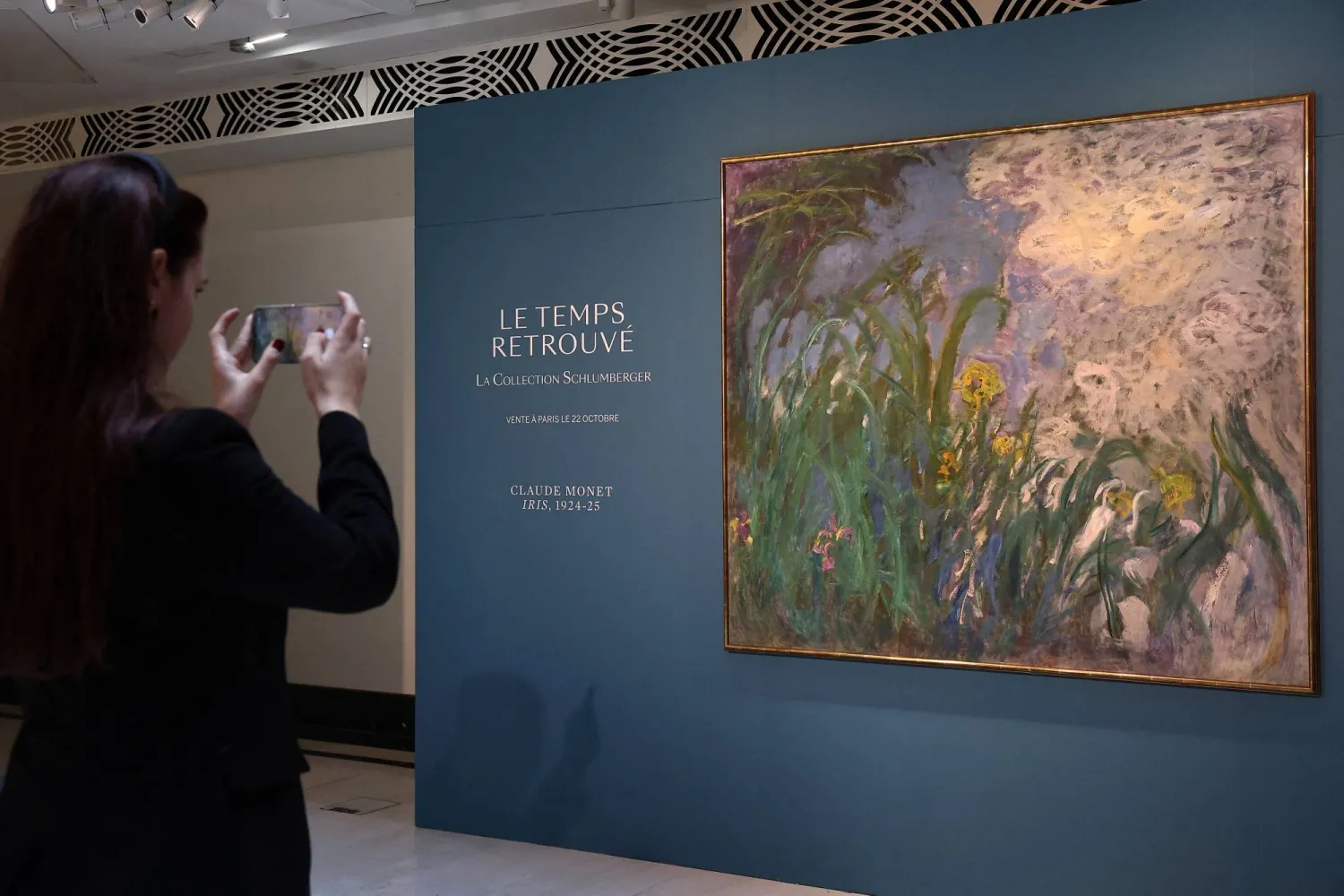
A visitor takes a picture of the painting "Iris, 1924-1925" by French painter Claude Monet (1840-1926) during the presentation of 28 art works from the Schlumberger Collection ahead of the auction at Sotheby's auction house in Paris, France, September 17, 2026. REUTERS/Abdul Saboor
A visitor takes a picture of the painting "Iris, 1924-1925" by French painter Claude Monet (1840-1926) during the presentation of 28 art works from the Schlumberger Collection ahead of the auction at Sotheby's auction house in Paris, France, September 17, 2026. REUTERS/Abdul Saboor
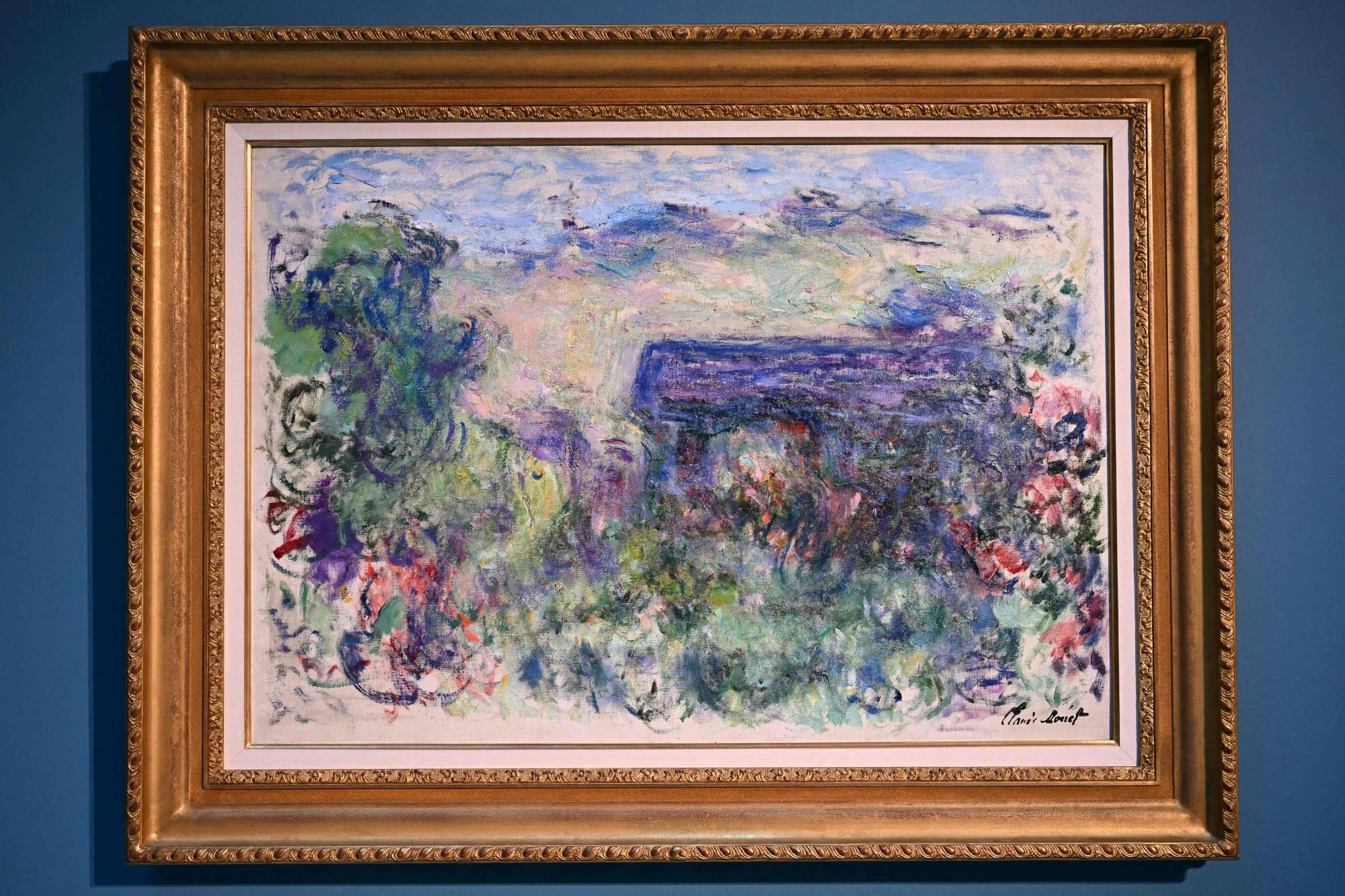
Two paintings by the Impressionist master Claude Monet that have never been shown in public are to be sold in Paris next month by the Schlumberger family of France, auction house Sotheby's said Thursday.
"Iris", a large painting Monet completed toward the end of his life, has been valued at 22 million to 30 million euros ($25-34 million), which represents "the highest estimate ever given for a painting offered at auction in France", Sotheby's said as it unveiled the sale at its Paris headquarters.
It has never left the Schlumberger family's home in Paris after being acquired by Jeanne Schlumberger (1889-1983), who was described as "a brilliant art collector" by Sotheby's art department co-head Thomas Bompard, AFP reported.
Alongside "Iris", three other canvases by Monet are included in the sale on October 22, among them "Saule Pleureur" (Weeping Willow), valued at 9-12 million euros.
This photograph shows French painter Claude Monet's La maison a travers les roses (The House Seen Through the Roses), during a preview of 28 Impressionist works from the Schlumberger Collection, unveiled ahead of the October 22, 2026, sale at Sotheby's auction house in Paris on September 17, 2026. (Photo by LOU BENOIST / AFP)
The sale comes in the year marking the centenary of Monet's death on December 5, 1926, which is being commemorated by two Paris exhibitions opening in late September: "Monet, Painting Time" and "Stories of Landscapes, from Monet to Hockney."
The Schlumberger collection, which will be shown in Hong Kong and New York before the sale, also includes three works by Paul Cezanne, among them "La Ferme" (The Farm), "the largest work by the artist ever to be offered at auction," estimated at 600,000 to 800,000 euros.
Culinary Arts Commission, China Discuss Sector Cooperationhttps://english.aawsat.com/culture/5319501-culinary-arts-commission-china-discuss-sector-cooperation
Culinary Arts Commission, China Discuss Sector Cooperation
The two sides discussed expanding professional ties between Saudi and Chinese - SPA
Culinary Arts Commission CEO Mayada Badr met today at the commission's headquarters in Riyadh with Counselor at the Chinese Embassy to Saudi Arabia Ma Jian to discuss cooperation between the two countries in food products, professional development, and culinary exchange.
The meeting reviewed ongoing cooperation between Saudi Arabia and China in the dairy and fisheries sectors. It also examined ways to facilitate the export of Saudi agricultural products to Chinese markets in coordination with relevant stakeholders, SPA reported.
The two sides discussed expanding professional ties between Saudi and Chinese chefs, focusing on skills development, specialized preparation techniques, and the use of ingredients to create innovative culinary experiences inspired by both cultures.
The talks also explored potential partnerships with Chinese manufacturers to benefit from their production expertise in the culinary sector.
They also discussed establishing institutional communication channels to assess joint commercial opportunities aligned with the commission's strategic priorities for sector growth.
China’s Porcelain City Carries Centuries-old Heritage to New Generationhttps://english.aawsat.com/culture/5319308-china%E2%80%99s-porcelain-city-carries-centuries-old-heritage-new-generation
Chinese porcelain artist Chen Qing holds up two cups after painting them in Jingdezhen, known as China's "Porcelain Capital," in eastern China's Jiangxi province, Tuesday, Sept. 1, 2026. (AP Photo/Achmad Ibrahim)
China’s Porcelain City Carries Centuries-old Heritage to New Generation
Chinese porcelain artist Chen Qing holds up two cups after painting them in Jingdezhen, known as China's "Porcelain Capital," in eastern China's Jiangxi province, Tuesday, Sept. 1, 2026. (AP Photo/Achmad Ibrahim)
Chinese porcelain artist Chen Qing has a vivid memory of her grandfather. It was the only time he wrote down the formula for her family’s distinctive red pigment.
He asked her mother to memorize it and burned the paper minutes later. The secret has since been passed down orally from one generation to the next.
“My mother did not reveal the formula to me until I was over 30,” Chen said.
Her family has practiced the craft since around 1860 in Jingdezhen, known as China’s “Porcelain Capital.” It is located in Jiangxi province, about 1,180 kilometers (735 miles) southeast of Beijing.
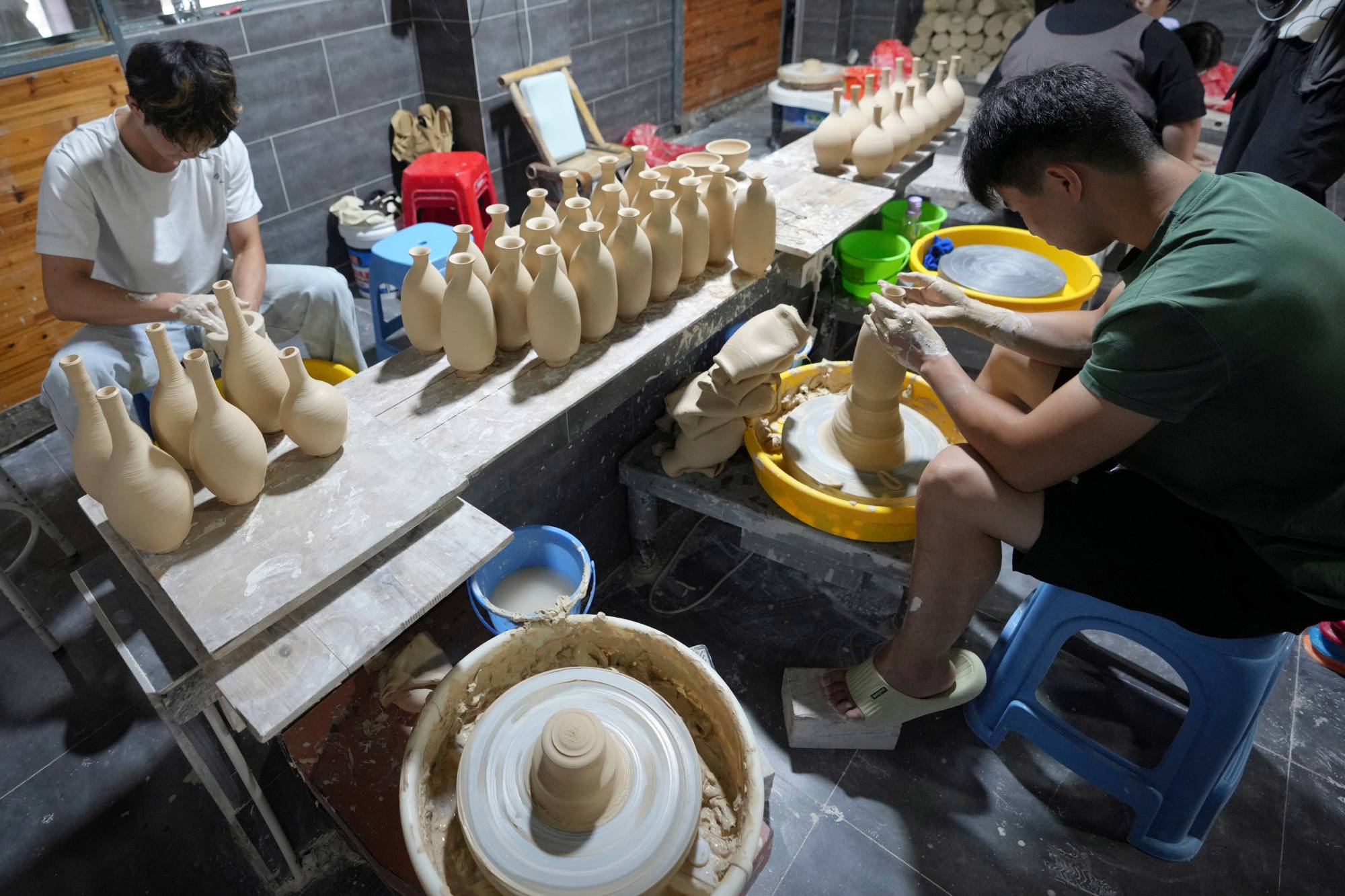
Students practice traditional ceramic craftsmanship at Zhan Shao Ceramic Arts Practice Base in Jingdezhen, known as China's "Porcelain Capital," in eastern China's Jiangxi province, Tuesday, Sept. 1, 2026. (AP Photo/Achmad Ibrahim)
Jingdezhen’s pottery-making history spans more than 2,000 years. It began during the Han Dynasty, and its porcelain sites were inscribed on UNESCO’s World Heritage List in 2026.
Small details take years to master Jingdezhen’s craftsmen have kept alive techniques once used to produce porcelain for the imperial court. That knowledge later spread to private artisans.
Chen’s ancestors adopted some of those traditions after the fall of the Qing Dynasty in 1912.
“The craft is very difficult for an outsider to master,” The Associated Press quoted Chen as saying. “A family might spend nearly a century developing a single technique.”
Two tables in her studio are covered with brushes, unfinished pieces and pigments. She works in silence, a lamp lighting her strokes.
Chen’s fingers never touch the porcelain’s surface. She steadies her hand against its outer edge, holding the brush firmly as she paints delicate, precise strokes.
Painting a porcelain teacup can take days to complete. A single particle of dust or sweat could ruin the piece and require her to start from scratch.
Landscapes are the most difficult scenes to paint because their boundaries are not clear. A mountain summit might be emerald green, gradually shifting to brown and other warmer colors farther down the slope.
“Mastering a craft is a lifelong process,” Chen said. “Few people are willing to spend more than 10 years learning such a painstaking craft.”
Fragments of porcelain reveal a spiritual past Artists like Chen work alongside archaeological sites and museums to preserve China’s porcelain heritage.
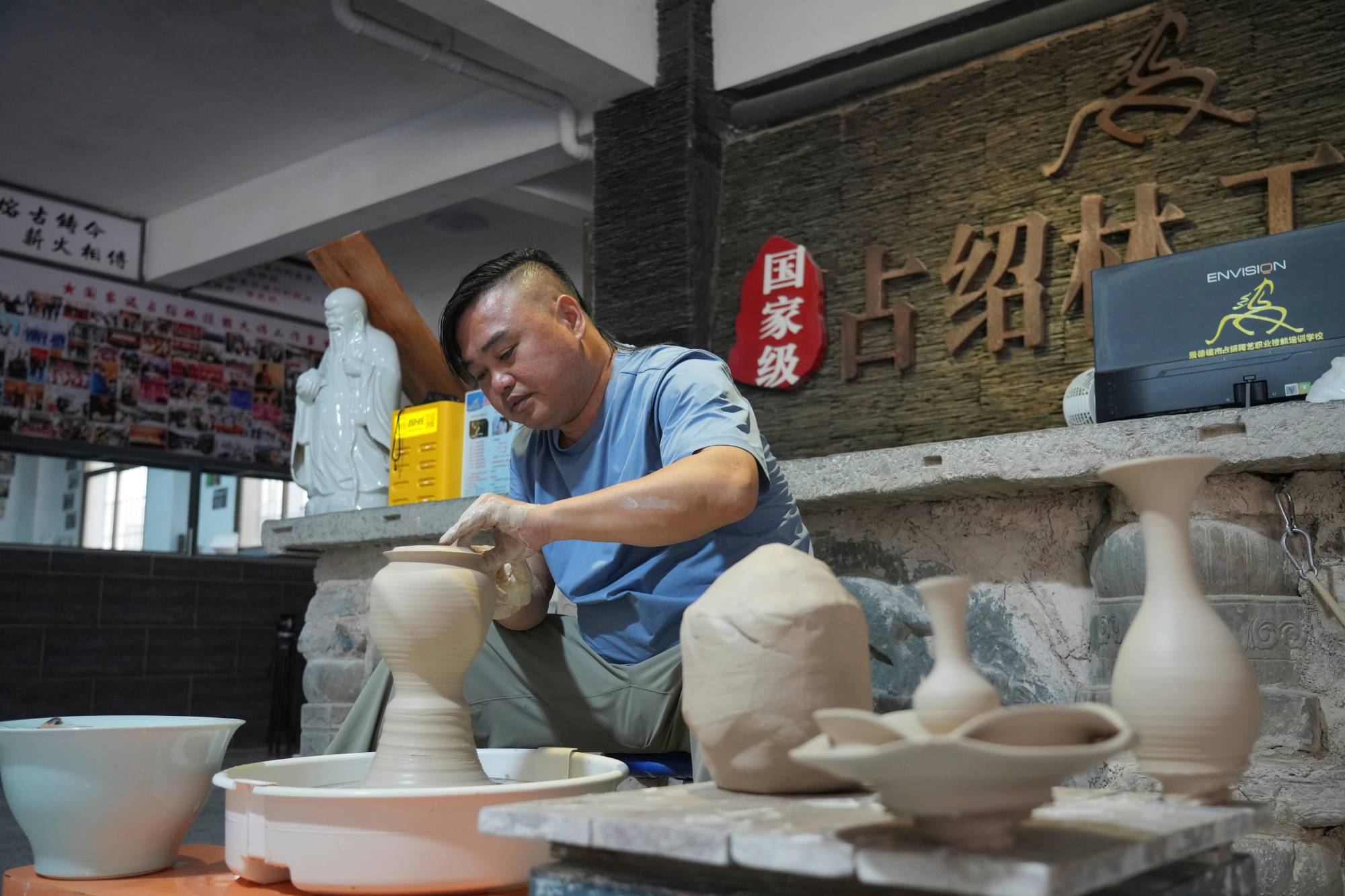
Chinese ceramic wheel-throwing artist Zhan Shaolin demonstrates his craft in Jingdezhen, known as China's "Porcelain Capital," in eastern China's Jiangxi province, Tuesday, Sept. 1, 2026. (AP Photo/Achmad Ibrahim)
Jingdezhen’s Imperial Kiln Institute researches and restores ceramics excavated from an adjacent complex, where pieces for emperors were crafted in kilns whose remains are still visible today.
The institute is incorporating new technologies into its work, including artificial intelligence, to help match and reconstruct ancient porcelain fragments.
“By the establishment of our ceramic gene bank, we can collect all kinds of information,” said the institute’s president, Weng Yanjun. “We hope that we can retrieve ancient technology with modern science.”
That research can also shed light on the culture and beliefs that surrounded porcelain-making centuries ago.
Among the tiles made at Jingdezhen’s imperial kilns were those used in the Bao’en Pagoda.
It was part of a Buddhist temple complex that was destroyed during a 19th-century rebellion in the city of Nanjing. Its exterior walls were covered with porcelain tiles, each bearing an image of the Buddha.
Traces of other religious traditions can also be found in porcelain studied by the institute, Weng said.
“Islam, Buddhism, Taoism and, later on, European Catholic Christianity harmoniously blend into the porcelain decorations,” he added.
Porcelain-making was surrounded by its own beliefs Within Jingdezhen’s imperial kiln complex stands a shrine commemorating Tong Bin, the protective spirit of ceramics.
Known as the “Immortal Master of Wind and Fire” or “Kiln God,” Tong was revered during the Qing dynasty for sacrificing himself in protest against the abuse of kiln workers, according to local tradition.
The shrine remains open today, with a statue honoring Tong inside alongside figures representing other traditional roles in porcelain-making.
“In ancient times, the technology was not as advanced as it is today, so, in many cases, people had to rely on their beliefs — their gods — to help bring good luck and better results,” Weng said.
How artisans today honor their craft varies widely Some Jingdezhen craftsmen say they hold no particular beliefs associated with porcelain-making. Others display figures of Budai — or the laughing Buddha — in their workshops as symbols of good fortune and prosperity.
For artisans like master Sun Lixin, however, the work retains a spiritual dimension. He is a fourth-generation practitioner who learned the trade from his father at age 13.
“Some traditional rituals have faded considerably,” Sun said. “Yet in the hearts of craftspeople, that reverence remains.”
Every time he paints or fires a piece, Sun is mindful of the hundreds of millions of years of geological history the white clay has undergone before reaching his hands.
He does not visit Jingdezhen’s shrine, but has a practice of his own. Sun instinctively bows to the Kiln God before a firing, wishing for it to be successful and for fine porcelain to emerge.
“If we do not care for it, paint it with devotion and treasure it, how could we possibly do it justice?” Sun said.
Artists from China and abroad find their way to Jingdezhen While Jingdezhen’s pottery-making continues to be passed down within families, universities and residency programs host new generations of Chinese and international practitioners.
Paola Masi is an Italian ceramic artist in a residency program through October.
She said Song dynasty porcelain shaped her early training. So coming to Jingdezhen feels like going back to the roots of her own path as an artist.
Chinese artist Huang Qi graduated from Jingdezhen Ceramic University in 2015 and left the city to work elsewhere. She eventually decided to come back and is also now an artist-in-residence.
“Jingdezhen is where my dream began,” Huang said. “More and more people are coming and the city is attracting growing attention.”
Encountering fellow craftspeople has allowed her to learn new techniques, while Jingdezhen’s inscription on UNESCO’s World Heritage List makes her optimistic about the future.
“It gives us confidence,” Huang said. “Things will continue to get better.”
لم تشترك بعد
انشئ حساباً خاصاً بك لتحصل على أخبار مخصصة لك ولتتمتع بخاصية حفظ المقالات وتتلقى نشراتنا البريدية المتنوعة