

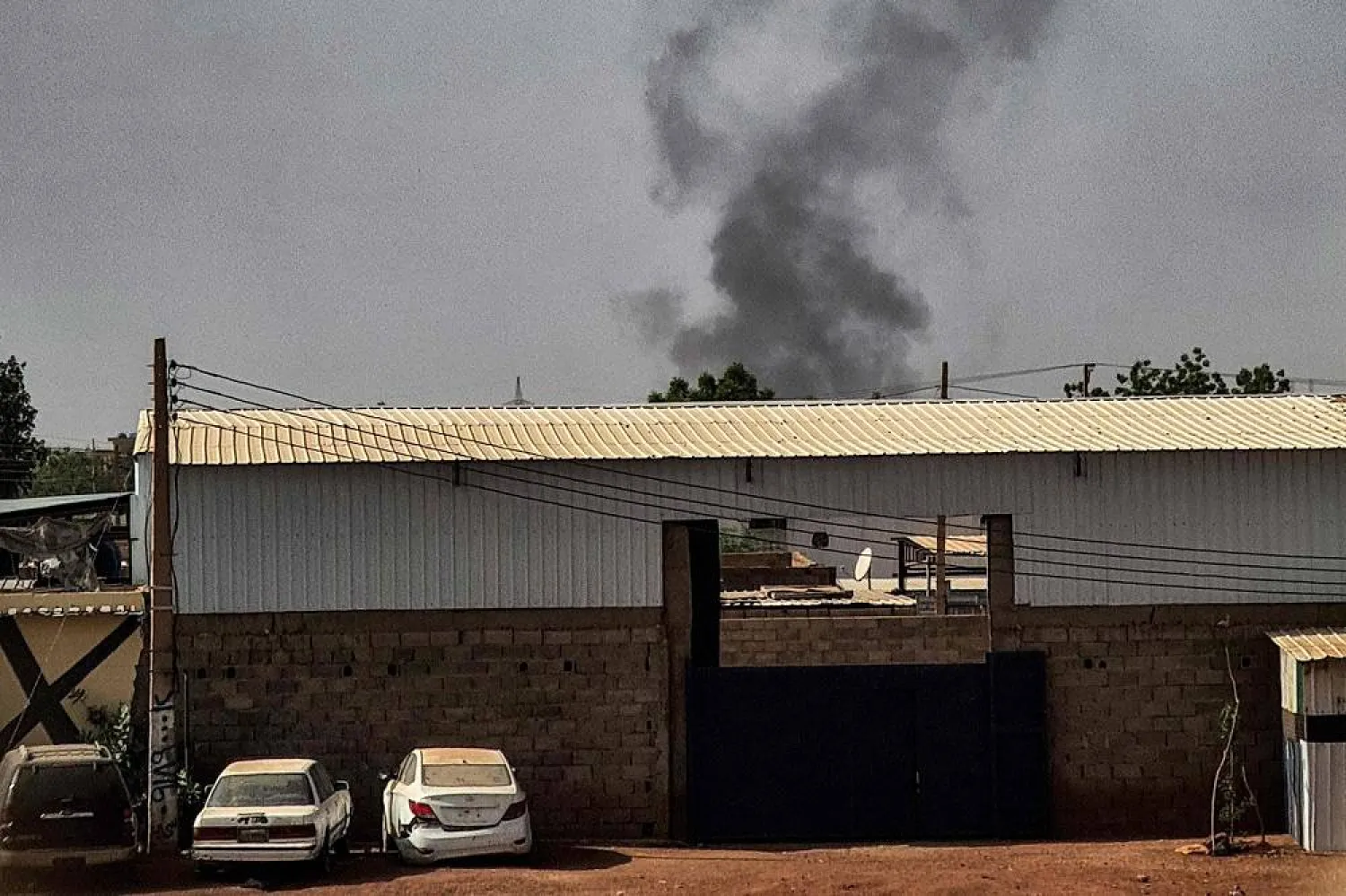

Sudan’s Warring Parties Trade Blame over Truce Breach

Smoke billows from a fire in a building in the center of Khartoum on May 25, 2023. (AFP)
TT

Sudan’s Warring Parties Trade Blame over Truce Breach

Smoke billows from a fire in a building in the center of Khartoum on May 25, 2023. (AFP)

Sudan's warring sides accused each other on Thursday of being behind breaches of the latest ceasefire that was negotiated by the US and Saudi Arabia, now in its third day.

The one-week truce was violated only minutes after it came into effect on Monday night, with residents of the capital Khartoum reporting air strikes and artillery fire shaking the city.

There have since been further breaches of the ceasefire agreement, which is meant to allow for much-needed humanitarian aid to reach war-ravaged parts of the north African country.

It is the latest in a series of truces that have all been systematically violated.

Since April 15, Sudan's capital and other parts of the country have been gripped by brutal urban warfare between the regular army, the Sudanese Armed Forces (SAF), and the paramilitary Rapid Support Forces (RSF).

But though the current ceasefire has been violated, it has allowed for a lull in fighting that has seen frightened residents cautiously venture out of their homes, some for the first time in weeks.

Many have gone out for supplies of food and water or to seek much-needed medical attention after nearly six weeks of fighting that has sharply depleted vital supplies and pushed the healthcare system to the brink of collapse.

In a statement issued late Wednesday, the RSF, which is led by Mohammed Hamdan Daglo, sought to place the blame for ceasefire breaches on the army led by Sudan's de facto leader Abdel Fattah al-Burhan.

The army "launched a series of unwarranted attacks today", the RSF said, adding that "our forces decisively repelled these assaults".

"Our forces successfully shot down a SAF MiG jet fighter," it said, reiterating however that it remained "committed to the humanitarian truce" and called on the "aggressors to respect the ceasefire".

The army responded Thursday morning, saying it had "countered an attack on armored vehicles by the militias of the Rapid Support Forces in a clear violation of the truce".

The United States and Saudi Arabia, which brokered the ceasefire, on Wednesday pointed to reports "indicating that both sides violated the agreement" but said "fighting in Khartoum appeared to be less intense".

The UN envoy for the Horn of Africa, Hanna Tetteh, expressed concern that fighting was still continuing despite the truce. "It's unacceptable and it must stop," she said.

Over a million displaced

Desperately needed aid has yet to reach the capital despite the brief lull.

The conflict has so far killed more than 1,800 people, according to the latest figures from the Armed Conflict Location and Event Data Project.

More than a million Sudanese people have been displaced, in addition to 300,000 who have fled to neighboring countries, according to the United Nations.

Conditions have been particularly alarming in the western region of Darfur, already ravaged by a conflict that erupted in 2003.

The UN's refugee coordinator in Sudan, Toby Harward, said the town of Zalengei in Central Darfur state "has been under siege by armed militias for the last days".

Numerous facilities "have been attacked and looted, civilians are unable to seek medical care as healthcare facilities are targeted, and gangs on motorcycles intimidate government workers and restrict civilian movements", he added.

Representatives of the warring Sudanese generals have since early May been involved in negotiations in the Saudi city of Jeddah on the Red Sea.

But analysts have repeatedly warned that the two generals are likely prepared for a prolonged conflict.

Burhan and Daglo had in 2021 staged a coup that unseated a civilian transitional government but later fell out in a bitter power struggle.



Iran Mobilizes Remnants of Fourth Division to Stoke Syria Unrest

 Circulating images of Syria’s Fourth Division
Circulating images of Syria’s Fourth Division
TT

Iran Mobilizes Remnants of Fourth Division to Stoke Syria Unrest

 Circulating images of Syria’s Fourth Division
Circulating images of Syria’s Fourth Division

The Syria TV website said Iran has been working since early December to mobilize remnants of the Fourth Division, which was linked to Iran and previously overseen by Maher al-Assad, the brother of fugitive President Bashar al-Assad, to inflame the situation in Syria.

Citing regional security sources, the website reported that Iran is utilizing Ghiyath Dalla, the former commander of the Fourth Division, along with Maj. Gen. Kamal Hassan, a former head of military intelligence, and Maj. Gen. Ghassan Bilal, who previously served in the Fourth Division’s command.

According to the sources, Iran’s Islamic Revolutionary Guard Corps, which has over recent months kept dozens of officers from the Fourth Division and military intelligence in camps it controls along the Iraqi border, in Lebanon’s Hermel area, and in areas under the control of formations linked to the Kurdistan Workers Party in eastern Syria, is pushing for their return to Syrian territory and the mobilization of former Assad regime elements for a new wave of security operations.

The New York Times recently published a report based on interviews with participants in those moves and a review of correspondence between them, showing that the former leadership figures are determined to reassert their influence in Syria, which remains gripped by tensions more than 13 years after the outbreak of civil war.

The newspaper said it had received credible information that some former figures in the Assad regime are working to build an armed insurgent movement from exile.

One of them is backing a lobbying campaign in Washington, estimated to cost millions of dollars, in the hope of securing control over Syria’s coastal region, the stronghold of the Alawite sect to which Assad and many of his senior military and security commanders belong.

Returning to the information cited by Syria TV, Iran has several objectives in fueling tensions in Syria. Chief among them is easing US pressure on Iran in the Iraqi arena along the Iranian border, where the US envoy to Baghdad is pressing Iraqi factions to disband.

Escalation in Syria would serve as a distraction and diversion from those efforts.

The report said pressure is also expected to intensify on Lebanon’s Hezbollah to complete the process of disarming, with the possibility that it could face new military operations, alongside a potential new Israeli attack on Iran.

Mobilizing remnants of the Assad regime and extending their presence in Syria would give Tehran and Hezbollah greater room to maneuver, rather than remaining confined to a defensive posture.

They could also be used in intelligence operations to track future Israeli movements preemptively.


Somali President to Visit Türkiye After Israeli Recognition of Somaliland

 Somalia's President Hassan Sheikh Mohamud delivers a joint press conference with the German Chancellor after talks at the Chancellery in Berlin, on November 5, 2024. (AFP)
Somalia's President Hassan Sheikh Mohamud delivers a joint press conference with the German Chancellor after talks at the Chancellery in Berlin, on November 5, 2024. (AFP)
TT

Somali President to Visit Türkiye After Israeli Recognition of Somaliland

 Somalia's President Hassan Sheikh Mohamud delivers a joint press conference with the German Chancellor after talks at the Chancellery in Berlin, on November 5, 2024. (AFP)
Somalia's President Hassan Sheikh Mohamud delivers a joint press conference with the German Chancellor after talks at the Chancellery in Berlin, on November 5, 2024. (AFP)

Somalia's president is to visit Türkiye on Tuesday following Israel's recognition of the breakaway territory of Somaliland, Türkiye’s presidency said.

Somali President Hassan Sheikh Mohamud will hold talks "on the current situation in Somalia in the fight against terrorism, measures taken by the federal Somali government towards national unity and regional developments", Burhanettin Duran, head of the Turkish presidency's communications directorate, said on X.

Türkiye on Friday denounced Israel's recognition of Somaliland, a self-proclaimed republic, calling it "overt interference in Somalia's domestic affairs".

Somaliland declared independence in 1991.

The region has operated autonomously since then and possesses its own currency, army and police force.

It has generally experienced greater stability than Somalia, where Al-Shabaab militants periodically mount attacks in the capital Mogadishu.

Diplomatic isolation has been the norm -- until Israel's move to recognize it as a sovereign nation, which has been criticized by the African Union, Egypt, the six-nation Gulf Cooperation Council and the Saudi-based Organization of Islamic Cooperation.

The European Union has insisted Somalia's sovereignty should be respected.

The recognition is the latest move by Israel that has angered Türkiye, with relations souring between the two countries in recent years.

Ankara has strongly condemned Israel's offensive in the Gaza Strip, and Israel has opposed Türkiye’s participation in a future stabilization force in the Palestinian territory.


Iraq's Parliament Elects Al-Halbousi as Its New Speaker

 The new speaker of parliament Haibet Al-Halbousi, center, looks on before the start of their first legislative session in Baghdad, Iraq, Monday, Dec. 29, 2025. (AP Photo/Hadi Mizban)
The new speaker of parliament Haibet Al-Halbousi, center, looks on before the start of their first legislative session in Baghdad, Iraq, Monday, Dec. 29, 2025. (AP Photo/Hadi Mizban)
TT

Iraq's Parliament Elects Al-Halbousi as Its New Speaker

 The new speaker of parliament Haibet Al-Halbousi, center, looks on before the start of their first legislative session in Baghdad, Iraq, Monday, Dec. 29, 2025. (AP Photo/Hadi Mizban)
The new speaker of parliament Haibet Al-Halbousi, center, looks on before the start of their first legislative session in Baghdad, Iraq, Monday, Dec. 29, 2025. (AP Photo/Hadi Mizban)

Iraq's parliament on Monday elected a new speaker following overnight talks to break a political deadlock.

Haibet Al-Halbousi received 208 votes from the 309 legislators who attended, according to The AP news. He is a member of the Takadum, or Progress, party led by ousted speaker and relative Mohammed al-Halbousi. Twenty legislators did not attend the session.

Iraq held parliamentary elections in November but didn’t produce a bloc with a decisive majority. By convention, Iraq’s president is always Kurdish, while the more powerful prime minister is Shiite and the parliamentary speaker is Sunni.

The new speaker must address a much-debated bill that would have the Hashd al-Shaabi, or Popular Mobilization Units become a formal security institution under the state. Iran-backed armed groups have growing political influence.

Al-Halbousi also must tackle Iraq’s mounting public debt of tens of billions of dollars as well as widespread corruption.

Babel Governor Adnan Feyhan was elected first deputy speaker with 177 votes, a development that might concern Washington. Feyhan is a member of the Asaib Ahl al-Haq, or League of the Righteous, a US-sanctioned, Iran-backed group with an armed wing led by Qais al-Khazali, also sanctioned by Washington.