


US Defense Chief Tells China Talks Essential to Avoid Crisis

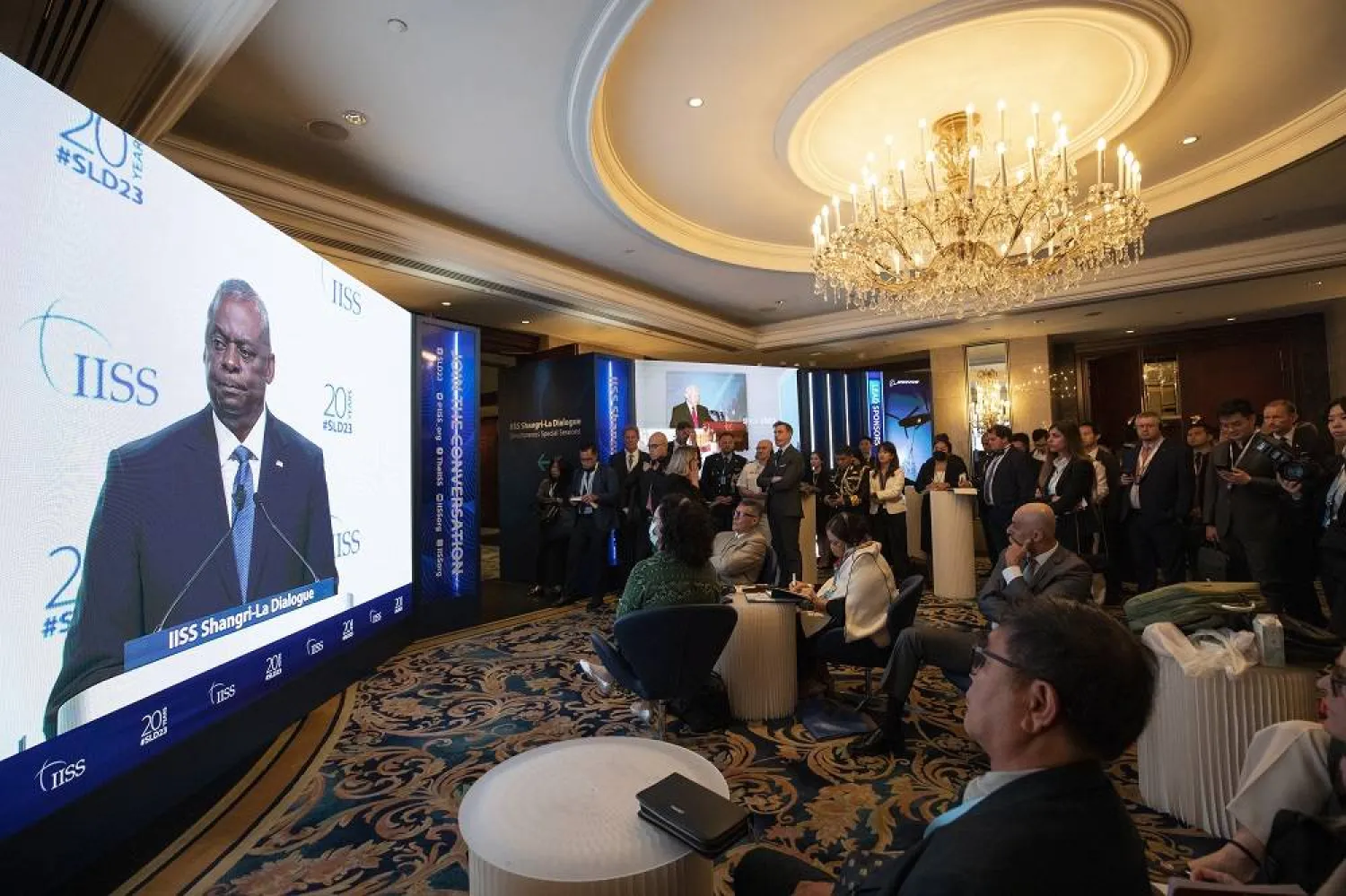
Attendees watch a livestream of US Secretary of Defense Lloyd Austin speaking during a plenary session on a screen outside the main hall during the International Institute for Strategic Studies (IISS) Shangri-La Dialogue at the Shangri-La hotel in Singapore, 03 June 2023. (EPA)
TT

US Defense Chief Tells China Talks Essential to Avoid Crisis

Attendees watch a livestream of US Secretary of Defense Lloyd Austin speaking during a plenary session on a screen outside the main hall during the International Institute for Strategic Studies (IISS) Shangri-La Dialogue at the Shangri-La hotel in Singapore, 03 June 2023. (EPA)

United States Secretary of Defense Lloyd Austin said on Saturday he was deeply concerned by China's unwillingness to engage on military crisis management, warning that talks are key to avoiding conflict.

The relationship between the United States and China is at its lowest point in decades, as they remain deeply divided over everything from the sovereignty of Taiwan to espionage and territorial disputes in the South China Sea.

Speaking at the Shangri-La Dialogue, Asia's top security summit, Austin said that open lines of communication between US and Chinese defense and military leaders were essential to avoid conflict and bolster stability in the Asia-Pacific.

"I am deeply concerned that the PRC (People's Republic of China) has been unwilling to engage more seriously on better mechanisms for crisis management between our two militaries," Austin told the meeting in Singapore.

"The more that we talk, the more that we can avoid the misunderstandings and miscalculations that could lead to crisis or conflict."

China's Minister of National Defence Li Shangfu had this week declined an invitation to meet Austin at the security summit. Li, a general who has been sanctioned by the US, delivers his own speech on Sunday.

On Friday, the two shook hands on the sidelines of the conference but did not hold detailed talks, the Pentagon said.

"A cordial handshake over dinner is no substitute for a substantive engagement," Austin said.

Dialogue between the two countries has stalled since

US Secretary of State Antony Blinken cancelled a visit to China

in February after a suspected Chinese spy balloon was tracked flying across the United States.

Liu Pengyu, spokesperson at the Chinese embassy in Washington, said on Friday in an emailed statement that communication between China and the US was conducive to a greater mutual understanding.

"However, now the US says it wants to speak to the Chinese side while seeking to suppress China through all possible means and continue imposing sanctions on Chinese officials, institutions and companies," the statement said.

China will have bilateral talks with defense chiefs from a dozen countries at the summit, Lieutenant General He Lei, former vice president of the Academy of Military Sciences, said in comments published by state-backed Chinese newspaper the Global Times on Saturday.

Taiwan tensions

One of the thorniest security issues between the two superpowers is over the future of Taiwan, a democratically governed territory which Beijing wants to bring under its rule.

There are increasing concerns that China could invade Taiwan with the US drawn into any conflict.

Austin pointed to Russia's invasion of Ukraine as an example of "how dangerous our world would become if big countries could just invade their peaceful neighbors with impunity".

He said the US was "deeply committed" to preserving the status quo in Taiwan and opposes unilateral changes from either side.

"Conflict is neither imminent nor inevitable. Deterrence is strong today and it’s our job to keep it that way," Austin said.

Chinese Senior Colonel Zhao Xiaozhuo told reporters on the sidelines of the meeting that Austin's comments risk creating confrontation in the Asia-Pacific region, including over Taiwan.

"It (US) wants instability in Taiwan so that it can bring its soldiers to Taiwan, and earn money from selling military weapons to Taiwan," said Zhao, a researcher at China's Academy of Military Sciences.

US military officials have previously said that Chinese President Xi Jinping has called on his armed forces to develop the capabilities for a possible invasion of Taiwan by 2027.

"It doesn't mean that he's made a decision to do that," Austin said in response to a question about Xi's plans.

Under President Joe Biden, the US has been strengthening its ties with allies in Asia, including Australia, Japan, India, the Philippines and Taiwan.

Beijing has criticized a deal announced by Australia in March to buy US nuclear-powered submarines.

Australia is set to spend A$368 billion ($250 billion) over three decades on the submarine program, part of a broader security pact with the US and Britain known as AUKUS.

"(AUKUS) promotes greater stability and security," Austin said.


Top Trump Iran Negotiator Says Visits US Aircraft Carrier in Middle East

US Special Envoy Steve Witkoff delivers a press conference upon the signing of the declaration on deploying post-ceasefire force in Ukraine, during the so-called "Coalition of the Willing" summit, at the Elysee Palace in Paris, France, January 6, 2026. (Reuters)
TT

Top Trump Iran Negotiator Says Visits US Aircraft Carrier in Middle East

US Special Envoy Steve Witkoff delivers a press conference upon the signing of the declaration on deploying post-ceasefire force in Ukraine, during the so-called "Coalition of the Willing" summit, at the Elysee Palace in Paris, France, January 6, 2026. (Reuters)

US President Donald Trump's lead Iran negotiator Steve Witkoff on Saturday said he visited the USS Abraham Lincoln aircraft carrier currently in the Arabian Sea, with Washington and Tehran due to hold further talks soon.

"Today, Adm. Brad Cooper, Commander of US Naval Forces Central Command, Jared Kushner, and I met with the brave sailors and Marines aboard the USS Abraham Lincoln, her strike group, and Carrier Air Wing 9 who are keeping us safe and upholding President Trump's message of peace through strength," said Witkoff in a social media post.

Iranian Foreign Minister Abbas Araghchi said on Saturday he hoped talks with the United States would resume soon, while reiterating Tehran's red lines and warning against any American attack.


Israel’s Netanyahu Expected to Meet Trump in US on Wednesday and Discuss Iran

Israeli Prime Minister Benjamin Netanyahu delivers a speech during a special session to mark the 77th anniversary of the Knesset's establishment and the 60th anniversary of the dedication of the current building at the Knesset, the Israeli parliament, in Jerusalem, 02 February 2026. (EPA)
TT

Israel’s Netanyahu Expected to Meet Trump in US on Wednesday and Discuss Iran

Israeli Prime Minister Benjamin Netanyahu delivers a speech during a special session to mark the 77th anniversary of the Knesset's establishment and the 60th anniversary of the dedication of the current building at the Knesset, the Israeli parliament, in Jerusalem, 02 February 2026. (EPA)

Israeli Prime Minister Benjamin Netanyahu is expected to meet US President Donald Trump on Wednesday in Washington, where they will discuss negotiations with Iran, Netanyahu's office said on Saturday.

Iranian and US officials held indirect nuclear ‌talks in the ‌Omani capital ‌Muscat ⁠on Friday. ‌Both sides said more talks were expected to be held again soon.

A regional diplomat briefed by Tehran on the talks told Reuters Iran insisted ⁠on its "right to enrich uranium" ‌during the negotiations with ‍the US, ‍and that Tehran's missile capabilities ‍were not raised in the discussions.

Iranian officials have ruled out putting Iran's missiles - one of the largest such arsenals in the region - up ⁠for discussion, and have said Tehran wants recognition of its right to enrich uranium.

"The Prime Minister believes that any negotiations must include limiting ballistic missiles and halting support for the Iranian axis," Netanyahu's office said in a ‌statement.


Italy FM Rules Out Joining Trump’s ‘Board of Peace’

Italy's Minister for Foreign Affairs Antonio Tajani speaks to the press during the EPP Leaders’ meeting, in Zagreb, Croatia, 30 January 2026. (EPA)
TT

Italy FM Rules Out Joining Trump’s ‘Board of Peace’

Italy's Minister for Foreign Affairs Antonio Tajani speaks to the press during the EPP Leaders’ meeting, in Zagreb, Croatia, 30 January 2026. (EPA)

Italy will not take part in US President Donald Trump's "Board of Peace", Italian Foreign Minister Antonio Tajani said Saturday, citing "insurmountable" constitutional issues.

Trump launched his "Board of Peace" at the World Economic Forum in Davos in January and some 19 countries have signed its founding charter.

But Italy's constitution bars the country from joining an organization led by a single foreign leader.

Prime Minister Giorgia Meloni, a Trump ally, last month noted "constitutional problems" with joining, but suggested Trump could perhaps reopen the framework "to meet the needs not only of Italy, but also of other European countries".

Tajani appeared Saturday to rule that out.

"We cannot participate in the Board of Peace because there is a constitutional limit," he told the ANSA news agency.

"This is insurmountable from a legal standpoint," he said, the day after meeting US Secretary of State Marco Rubio and US Vice President JD Vance at the Olympics in Milan.

Although originally meant to oversee Gaza's rebuilding, the board's charter does not limit its role to the Palestinian territory and appears to want to rival the United Nations.
