


Cairo Talks: Hamas, Jihad Open to 'Technocrat Cabinet'

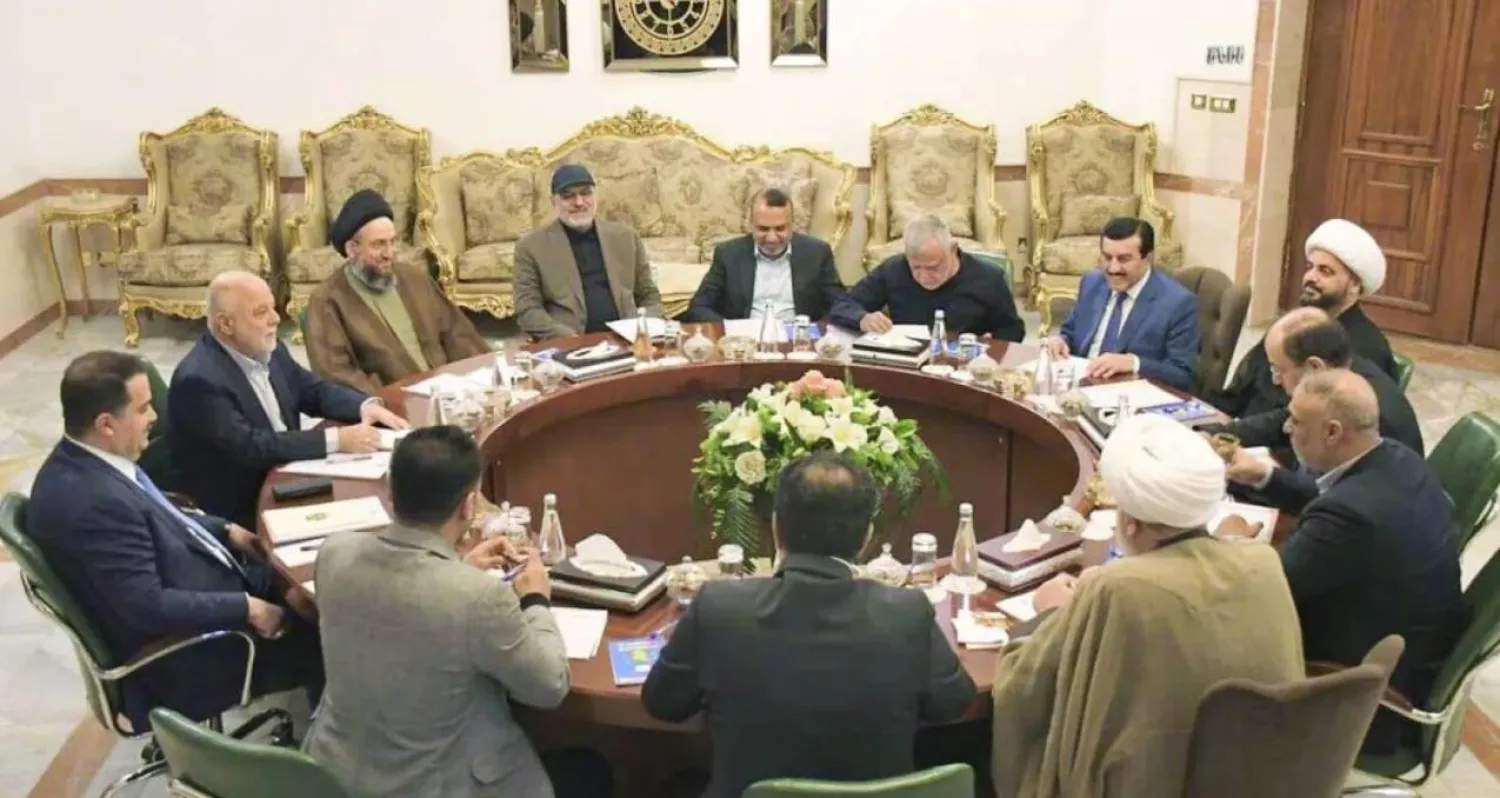
Hamas and Jihad officials during the meeting in Cairo (Hamas Movement)
TT

Cairo Talks: Hamas, Jihad Open to 'Technocrat Cabinet'

Hamas and Jihad officials during the meeting in Cairo (Hamas Movement)

Hamas and Islamic Jihad movements continued their talks in Cairo with Egyptian security officials to discuss several issues focusing on establishing "long-term calm" in Gaza and improving the humanitarian and economic situation in the Strip.

Hamas announced an expanded meeting began in Cairo between the head of the politburo, Ismail Haniyeh, and the Secretary-General of the Jihad movement, Ziad al-Nakhala.

They discussed ways to strengthen their strategic relationship "to serve issues of the resistance and the Palestinian people." They also highlighted the attacks on the Palestinian people in Jerusalem, al-Aqsa Mosque, and the West Bank.

A Palestinian source familiar with the consultations said the meeting between the coalitions took place separately from the discussions that the leaders of each faction held separately with Egyptian security officials.

The leaders also met with a delegation representing the Democratic Reform Bloc, led by Palestinian leader Mohammed Dahlan.

The source, who spoke to Asharq Al-Awsat on condition of anonymity, explained that the consultations between the factions and the Egyptian side focused on "seeking a long-term calm in Gaza" and "improving the humanitarian and economic situation in the Strip."

He pointed out that the officials lauded Egypt's role in maintaining calm in the sector and renewed the affirmation of their response to these efforts to spare the enclave from any Israeli escalation.

The source referred to a proposal to form a Palestinian "technocratic government" that would supervise, within a year, the parliamentary and presidential elections in the West Bank and Gaza Strip.

Hamas and Jihad initially approved the proposal, but they expressed to the Egyptian side their fear that the Palestinian Authority (PA) might obstruct the move.

The source pointed out that the Hamas movement feared President Mahmoud Abbas might hinder the proposal, citing his decision to appoint a new constitutional court.

Hamas does not recognize the legitimacy of the constitutional court and considers it a mere tool to circumvent the Palestinian President's decision to dissolve the elected parliament, confirming that Abbas does not intend to move forward with holding the elections.

On Thursday, four judges of the Supreme Constitutional Court took the oath before the President in Ramallah after Abbas issued a decision in May appointing new judges, following his previous decision to retire seven.

In 2018, the President dissolved the Palestinian Legislative Council, controlled by Hamas. The movement rejected the decision saying it "has no constitutional or legal value."

The last elections for the Legislative Council were held in 2006.

- Commodity entry

The source pointed out that the talks also addressed ways to facilitate the entry of goods and merchandise into the Gaza Strip in coordination with Egypt.

He indicated that the PA required supervision of the crossings to collect customs, which Hamas also rejected.

Egypt had invited the Hamas and Jihad leaders to a new round of consultations, which began last Saturday, after the arrival of the members of the delegations of the two movements, whether from the Gaza Strip or abroad.

The consultations mainly aim to maintain calm in the Gaza Strip and ensure that the security situation does not lead to another confrontation with Israel.



Syria to Start Currency Swap on January 1st, Central Bank Governor Says

Syrian pounds are pictured inside an exchange currency shop in Azaz, Syria February 3, 2020. Picture taken February 3, 2020. REUTERS/Khalil Ashawi/File Photo
TT

Syria to Start Currency Swap on January 1st, Central Bank Governor Says

Syrian pounds are pictured inside an exchange currency shop in Azaz, Syria February 3, 2020. Picture taken February 3, 2020. REUTERS/Khalil Ashawi/File Photo

Syria will start swapping old banknotes for new ones under a ​plan to replace Assad-era notes starting from January 1, 2026, Central Bank Governor Abdelkader Husrieh said on Thursday.

Husrieh announced the introduction of the new Syrian currency, saying the decree "sets January ‌1, 2026, ‌as the start date ‌for ⁠the ​exchange ‌process". Sources familiar with the matter told Reuters in August that the country will issue new banknotes, removing two zeros from its currency in an attempt to restore ⁠public confidence in the severely devalued pound.

The ‌step is intended ‍to strengthen ‍the Syrian pound after its purchasing ‍power collapsed to record lows following a 14-year conflict that ended with President Bashar al-Assad's ouster in December.

Husrieh ​said the operation will take place through a smooth and orderly ⁠swap - a move bankers hope will ease fears that the new currency could fuel inflation and further erode the purchasing power of Syrians already reeling from high prices.

He added that a press conference will soon outline the exact regulations and mechanisms.


Türkiye Begins Black Box Analysis of Jet Crash That Killed Libyan Military Chief and 7 Others

Libyan national flags fly at half-mast in Tripoli on December 24, 2025, after the head of Libya's armed forces and his four aides died in a plane crash in Türkiye. (AFP)
TT

Türkiye Begins Black Box Analysis of Jet Crash That Killed Libyan Military Chief and 7 Others

Libyan national flags fly at half-mast in Tripoli on December 24, 2025, after the head of Libya's armed forces and his four aides died in a plane crash in Türkiye. (AFP)

The technical analysis of the recovered black boxes from a jet crash that killed eight people, including western Libya’s military chief, began as the investigation proceeded in cooperation with Libyan authorities, the Turkish Ministry of Defense said Thursday.

The private jet with Gen. Muhammad Ali Ahmad al-Haddad, four other military officials and three crew members crashed on Tuesday after taking off from Türkiye’s capital, Ankara, killing everyone on board. Libyan officials said the cause of the crash was a technical malfunction on the plane.

The high-level Libyan delegation was on its way back to Tripoli after holding defense talks in Ankara aimed at boosting military cooperation between the two countries.

The wreckage was scattered across an area covering 3 square kilometers (more than a square mile), complicating recovery efforts, according to the Turkish Interior Minister Ali Yerlikaya.

A 22-person delegation, including five family members, arrived from Libya early on Wednesday to assist in the investigation.


Lebanese President: We are Determined to Hold Parliamentary Elections on Time

President Joseph Aoun between Prime Minister Nawaf Salam and Speaker Nabih Berri (Lebanese Presidency file photo)
TT

Lebanese President: We are Determined to Hold Parliamentary Elections on Time

President Joseph Aoun between Prime Minister Nawaf Salam and Speaker Nabih Berri (Lebanese Presidency file photo)

Lebanese President Joseph Aoun reiterated on Thursday that the country’s parliamentary elections are a constitutional obligation that must be carried out on time.

Lebanon’s state-run National News Agency quoted Aoun as saying that he, alongside Prime Minister Nawaf Salam and Parliament Speaker Nabih Berri, is determined to hold the elections on schedule.

Aoun also emphasized that diplomatic efforts have continued unabated to keep the specter of war at bay, noting that "things are heading in a positive direction".

The agency also cited Berri reaffirming that the elections will take place as planned, with "no delays, no extensions".

The Lebanese parliamentary elections are scheduled for May next year.