
With Record Heat and Drought-stricken Woods, Spain’s Catalonia Faces Perfect Wildfire Conditions

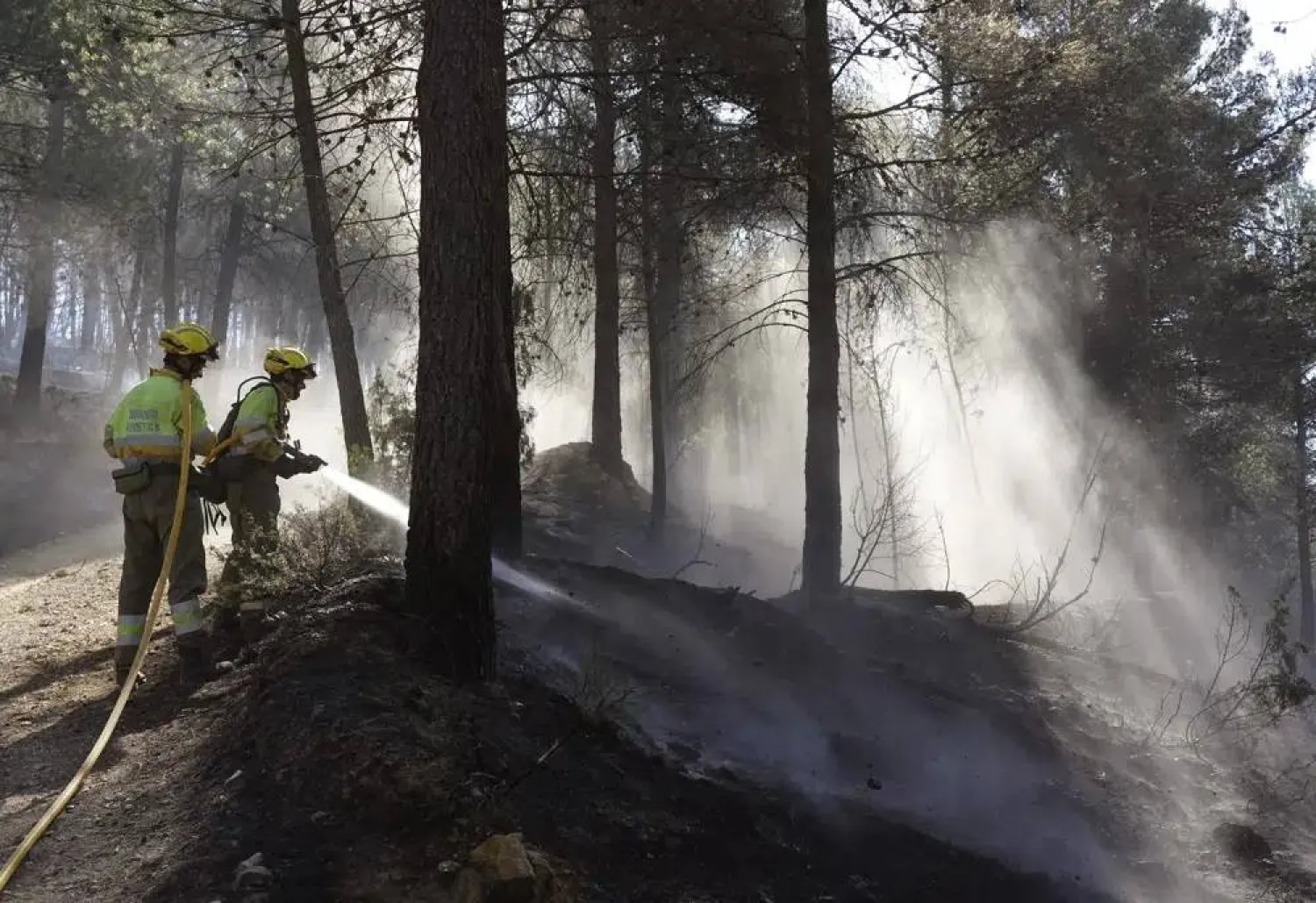
FILE - Firefighters try to extinguish a forest fire in Fuente la Reina, Castellon de la Plana, Spain, March 29, 2023. (AP Photo/Alberto Saiz, File)
TT

With Record Heat and Drought-stricken Woods, Spain’s Catalonia Faces Perfect Wildfire Conditions

FILE - Firefighters try to extinguish a forest fire in Fuente la Reina, Castellon de la Plana, Spain, March 29, 2023. (AP Photo/Alberto Saiz, File)

Surveying the hills covered with near bone-dry pines stretching to the Pyrenees in the distance, Asier Larrañaga has reason to be on guard.

This part of northeast Spain is, like large swaths of the Mediterranean country, braced for wildfires due to the lethal combination of a prolonged drought, record-high temperatures, and increasingly dense woods unable to adapt to a fast-changing climate, The Associated Press said.

Larrañaga is one of the top fire analysts for the firefighters of Catalonia charged with safeguarding the region's homes and landscapes. While grateful that some desperately needed rain has finally fallen in recent weeks, he is ready for the worst — unless July and August buck Spain’s historic trend of being the hottest and driest months of the year.

“If we have a normal summer ... and conditions of low humidity combined with high temperatures, then we will see fires that quickly expand beyond our extinction capacity. And for areas where it has not rained in May and this month, we could see these types of fires as early as next week,” Larrañaga told The Associated Press in the rural town of Solsona, some two hours north of Barcelona.

Spain suffered the biggest losses from wildfires of any European Union country last year amid a record-hot 2022. Four people, including one firefighter, died in blazes that consumed 306,000 hectares. And with Spain sweltering under a record-hot spring, it is again leading the continent in 2023 with 66,000 hectares turned to ashes. Now firefighters like Larrañaga across Spain are preparing for a potential scorcher of a summer.

The fires coincide with Catalonia and a large part of Spain’s south bearing the brunt of a drought that started last year and has only recently been somewhat alleviated by rain. The central reservoirs for Catalonia, which provide water for some six million people including Barcelona, are still only at 29% of capacity and water restrictions remain in place.

Climate change is playing a direct role in propagating these fires, experts agree. The increasing temperatures have made the plants that are used to more mild weather vulnerable to both plagues and fire. Spain, like the rest of the Mediterranean, is forecast to heat up faster than the global average. Spain saw fires that showed the virulence of a summer outbreak break out as early as March. Northern Europe is also battling blazes spurred by drought.

The 52-year-old Larrañaga is a member of Catalonia’s GRAF, its elite wildfire-fighting unit. Members of the Catalan firefighters are currently helping in Canada as part of a Spanish contingent sent to combat the massive fires that have sent smoke over the United States and as far as Europe.

Larrañaga was in Solsona to oversee a training session by the local fire brigade. Practice included simulating a last-resort protection maneuver used in cases when firefighters are trapped by the flames. They clear an area of vegetation and take refuge in their truck, which is equipped with sprinklers. The firefighters said that they hope it is a maneuver they will never have to use.

The Solsonès county, home to Solsona and its 9,000 residents, does not normally have large fires thanks to storms generated by the Pyrenees. But the downside is that its forests build up vegetation, or “fuel” for potential fires, that become vulnerable to a lightning strike, a spark from farm machinery, or arson. In 1998 a fire consumed 27,000 hectares in the country. Now Larrañaga is concerned that the landscape is primed to ignite again.

“The fires in these conditions can be very intense like the enormous ones we are seeing in Canada," he said. Larrañaga added that his worst-case scenario is "a situation where you have people, in a panic, trying to flee, who put themselves in danger because the access roads cross wooded areas,” stirring up memories of a tragedy in neighboring Portugal when over 60 people perished in a fire disaster in 2017.

Catalonia’s firefighters were tested last year by fires that erupted just when the official fire season started in mid-July.

That close call, fire chief David Borrell said, motivated their decision to increase the fire campaign to four months from three and start it a month earlier. That means more manpower and more aircraft for a longer period.

Borrell said that this new generation of more powerful fires has led to two changes in how they are fought. First, it is no longer possible to just “attack” a fire, firefighters have to wait for it, and if need be, sacrifice unfavorable terrain – whether due to its position related to the wind, access, or vegetation – if it means keeping the firefighters from wearing themselves out or even risking their lives.

“The second change is how to deal with simultaneous fires without getting overwhelmed,” Borrell told the AP at the Catalan firefighters' high-tech headquarters near Barcelona. “If you go all out against a fire, then you won’t be able to handle a second one, and with a third fire, you collapse. So to avoid that, we consider everything in one process. That is a potent strategy change we began last year. And for me, it is a game changer.”

The challenge, however, is still daunting with summer now here.

In addition to turning the terrain into a tinderbox, drought is complicating the firefighters' ability to work: some of Catalonia’s reservoirs have been ruled unusable for water-dumping aircraft due to the lack of their low levels of water.

“If we hadn’t had the rain we saw in May, we would now already be in a campaign of large fires,” Jordi Pagès, a wildfire expert for the Pau Costa Foundation, a Barcelona-based nonprofit organization for fire awareness.

"But we still had a spring with below average rainfall, so we can expect an intense summer.”


US Astronaut to Take her 3-year-old's Cuddly Rabbit Into Space

FILE PHOTO: An evening launch of a SpaceX Falcon 9 rocket carrying 20 Starlink V2 Mini satellites, from Space Launch Complex at Vandenberg Space Force Base is seen over the Pacific Ocean from Encinitas, California, US, June 23, 2024. REUTERS/Mike Blake/File Photo
TT

US Astronaut to Take her 3-year-old's Cuddly Rabbit Into Space

FILE PHOTO: An evening launch of a SpaceX Falcon 9 rocket carrying 20 Starlink V2 Mini satellites, from Space Launch Complex at Vandenberg Space Force Base is seen over the Pacific Ocean from Encinitas, California, US, June 23, 2024. REUTERS/Mike Blake/File Photo

When the next mission to the International Space Station blasts off from Florida next week, a special keepsake will be hitching a ride: a small stuffed rabbit.

American astronaut and mother, Jessica Meir, one of the four-member crew, revealed Sunday that she'll take with her the cuddly toy that belongs to her three-year-old daughter.

It's customary for astronauts to go to the ISS, which orbits 250 miles (400 kilometers) above Earth, to take small personal items to keep close during their months-long stint in space.

"I do have a small stuffed rabbit that belongs to my three-year-old daughter, and she actually has two of these because one was given as a gift," Meir, 48, told an online news conference.

"So one will stay down here with her, and one will be there with us, having adventures all the time, so that we'll keep sending those photos back and forth to my family," AFP quoted her as saying.

US space agency NASA says SpaceX Crew-12 will lift off on a SpaceX Falcon 9 rocket from Cape Canaveral in Florida to the orbiting scientific laboratory early Wednesday.

The mission will be replacing Crew-11, which returned to Earth in January, a month earlier than planned, during the first medical evacuation in the space station's history.

Meir, a marine biologist and physiologist, served as flight engineer on a 2019-2020 expedition to the space station and participated in the first all-female spacewalks.

Since then, she's given birth to her daughter. She reflected Sunday on the challenges of being a parent and what is due to be an eight-month separation from her child.

"It does make it a lot difficult in preparing to leave and thinking about being away from her for that long, especially when she's so young, it's really a large chunk of her life," Meir said.

"But I hope that one day, she will really realize that this absence was a meaningful one, because it was an adventure that she got to share into and that she'll have memories about, and hopefully it will inspire her and other people around the world," Meir added.

When the astronauts finally get on board the ISS, they will be one of the last crews to live on board the football field-sized space station.

Continuously inhabited for the last quarter century, the aging ISS is scheduled to be pushed into Earth's orbit before crashing into an isolated spot in the Pacific Ocean in 2030.

The other Crew-12 astronauts are Jack Hathaway of NASA, European Space Agency astronaut Sophie Adenot, and Russian cosmonaut Andrey Fedyaev.


iRead Marathon Records over 6.5 Million Pages Read

Participants agreed that the number of pages read was not merely a numerical milestone - SPA
TT

iRead Marathon Records over 6.5 Million Pages Read

Participants agreed that the number of pages read was not merely a numerical milestone - SPA

The fifth edition of the iRead Marathon achieved a remarkable milestone, surpassing 6.5 million pages read over three consecutive days, in a cultural setting that reaffirmed reading as a collective practice with impact beyond the moment.

Hosted at the Library of the King Abdulaziz Center for World Culture (Ithra) and held in parallel with 52 libraries across 13 Arab countries, including digital libraries participating for the first time, the marathon reflected the transformation of libraries into open, inclusive spaces that transcend physical boundaries and accommodate diverse readers and formats.

Participants agreed that the number of pages read was not merely a numerical milestone, but a reflection of growing engagement and a deepening belief in reading as a daily, shared activity accessible to all, free from elitism or narrow specialization.

Pages were read in multiple languages and formats, united by a common conviction that reading remains a powerful way to build genuine connections and foster knowledge-based bonds across geographically distant yet intellectually aligned communities, SPA reported.

The marathon also underscored its humanitarian and environmental dimension, as every 100 pages read is linked to the planting of one tree, translating this edition’s outcome into a pledge of more than 65,000 trees. This simple equation connects knowledge with sustainability, turning reading into a tangible, real-world contribution.

The involvement of digital libraries marked a notable development, expanding access, strengthening engagement, and reinforcing the library’s ability to adapt to technological change without compromising its cultural role. Integrating print and digital reading added a contemporary dimension to the marathon while preserving its core spirit of gathering around the book.

With the conclusion of the iRead Marathon, the experience proved to be more than a temporary event, becoming a cultural moment that raised fundamental questions about reading’s role in shaping awareness and the capacity of cultural initiatives to create lasting impact. Three days confirmed that reading, when practiced collectively, can serve as a meeting point and the start of a longer cultural journey.


Imam Turki bin Abdullah Royal Reserve Launches Fifth Beekeeping Season

Jazan’s Annual Honey Festival - File Photo/SPA
TT

Imam Turki bin Abdullah Royal Reserve Launches Fifth Beekeeping Season

Jazan’s Annual Honey Festival - File Photo/SPA

The Imam Turki bin Abdullah Royal Nature Reserve Development Authority launched the fifth annual beekeeping season for 2026 as part of its programs to empower the local community and regulate beekeeping activities within the reserve.

The launch aligns with the authority's objectives of biodiversity conservation, the promotion of sustainable environmental practices, and the generation of economic returns for beekeepers, SPA reported.

The authority explained that this year’s beekeeping season comprises three main periods associated with spring flowers, acacia, and Sidr, with the start date of each period serving as the official deadline for submitting participation applications.

The authority encouraged all interested beekeepers to review the season details and attend the scheduled virtual meetings to ensure organized participation in accordance with the approved regulations and the specified dates for each season.