

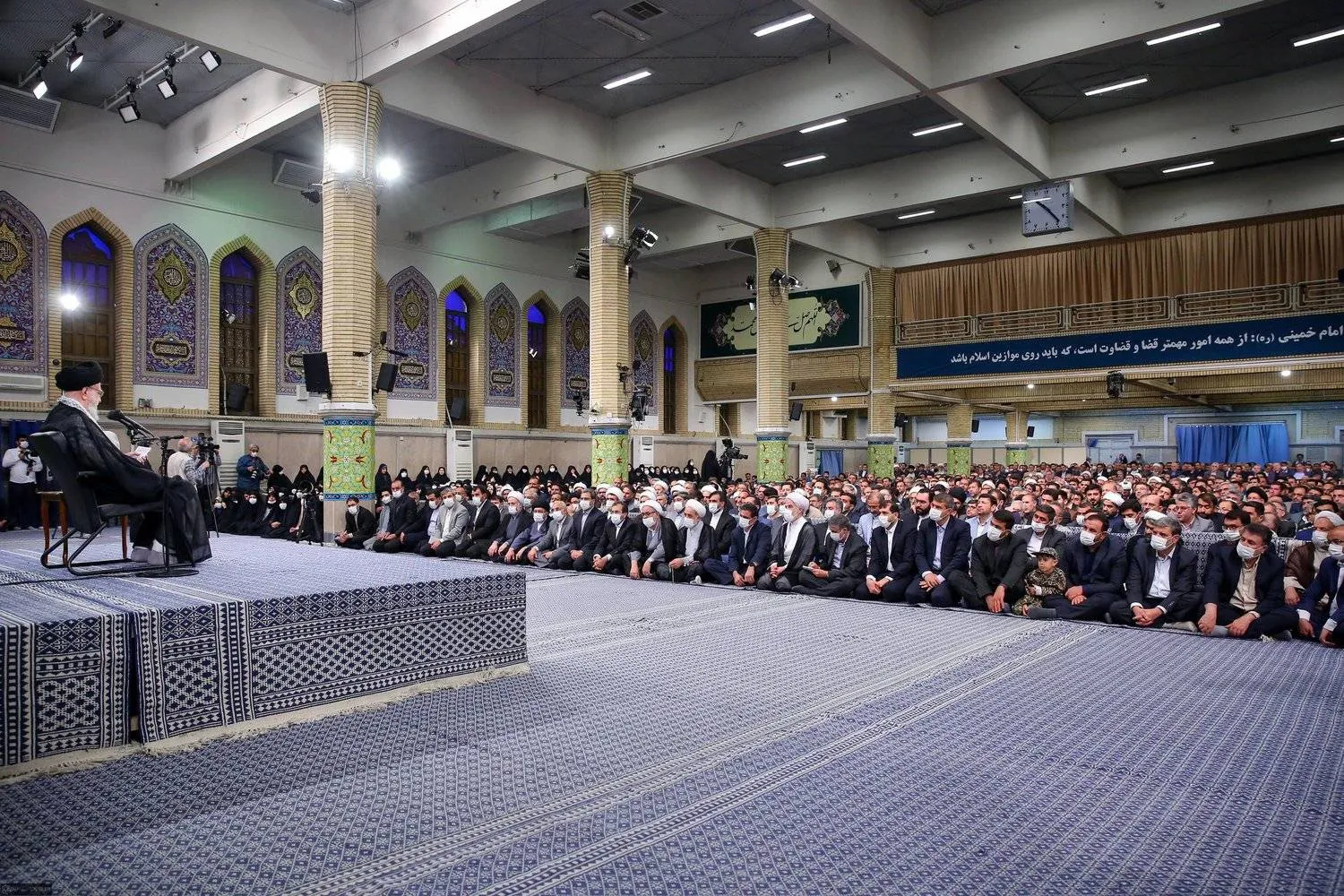

Khamenei Urges Iran’s Judiciary to Tighten Control over Cyberspace

Iranian Supreme Leader Ali Khamenei in a meeting with the head and officials of Iran’s Judiciary Branch on Tuesday (Supreme Leader official website)
TT

Khamenei Urges Iran’s Judiciary to Tighten Control over Cyberspace

Iranian Supreme Leader Ali Khamenei in a meeting with the head and officials of Iran’s Judiciary Branch on Tuesday (Supreme Leader official website)

Iran's Supreme Leader Ali Khamenei has called on the judiciary to take serious steps to control social networks and tighten control over cyberspace.

"The prevention of startling and disrupting the mental security of people in the real world and the world of cyberspace is one of the manifestations of securing public rights. The judicial system must attend well to this difficult task with planning, discipline, and rules,” Khamenei told a group of officials and judiciary members.

Khamenei also considered it essential to ensure that people have lawful freedoms.

"According to the precise interpretation of the constitution, all the freedoms allowed by the Sharia law must be provided to the people. The institutions usually oppose these freedoms, and the judiciary must fulfill its duties."

Khamenei criticized the judiciary's image in the media and recommended taking measures to improve it.

He accused the media of tarnishing the judiciary's image, noting that media and advertisements were not effectively utilized to showcase and inform the public about its extensive work.

During the months that followed the "Woman, Life, Freedom" protests after the death of the young Kurdish woman, Mahsa Amini, last September, the Supreme Leader increased his criticism of the management of the Internet and social networks.

Earlier this month, Khamenei accused Western powers, led by the US, of "engineering" the riots.

He accused dissidents of organizing the riots, saying: "The comprehensive planning of these riots was carried out in the think tanks of Western countries."

Khamenei indicated its implementation was accompanied by extensive financial, arms, and media support of "Western security institutions, traitors and mercenaries who turned their backs on their country and agents of hostile policies against Iran."

The authorities eased some of their constraints on communications after the Internet was cut off on a large scale, starting last February, but they kept the basic restrictions, especially WhatsApp and Instagram.

Rights groups say more than 500 people have been killed during the authorities' violent crackdown to quell the protests. The violence also claimed the lives of about 70 members of the security services.

The number of detainees is estimated at 20,000, but the authorities did not provide official statistics on the number of the dead or arrested.

In the first official confirmation of the estimates of human rights organizations, the head of the judiciary, Gholam-Hossein Mohseni-Ejei, said during the annual conference of judicial officials that there are 20,000 judicial files in connection with the recent riots.

Last March, Mohseni-Ejei said that the authorities released 80,000 Iranian prisoners, including some of those arrested during the protests, following Khamenei's pardon.



France Accuses Iran of ‘Repression’ in Sentence for Nobel Laureate

People cross an intersection in downtown Tehran, Iran, Monday, Feb. 9, 2026. (AP)
TT

France Accuses Iran of ‘Repression’ in Sentence for Nobel Laureate

People cross an intersection in downtown Tehran, Iran, Monday, Feb. 9, 2026. (AP)

France accused Iran on Monday of "repression and intimidation" after a court handed Nobel Peace Prize laureate Narges Mohammadi a new six-year prison sentence on charges of harming national security.

Mohammadi, sentenced Saturday, was also handed a one-and-a-half-year prison sentence for "propaganda" against Iran's system, according to her foundation.

"With this sentence, the Iranian regime has, once again, chosen repression and intimidation," the French foreign ministry said in a statement, describing the 53-year-old as a "tireless defender" of human rights.

Paris is calling for the release of the activist, who was arrested before protests erupted nationwide in December after speaking out against the government at a funeral ceremony.

The movement peaked in January as authorities launched a crackdown that activists say has left thousands dead.

Over the past quarter-century, Mohammadi has been repeatedly tried and jailed for her vocal campaigning against Iran's use of capital punishment and the mandatory dress code for women.

Mohammadi has spent much of the past decade behind bars and has not seen her twin children, who live in Paris, since 2015.

Iranian authorities have arrested more than 50,000 people as part of their crackdown on protests, according to US-based Human Rights Activists News Agency (HRANA).


Iran's Supreme Leader Urges Iranians to Show 'Resolve' against Foreign Pressure

Iran's supreme leader Ali Khamenei on (File Photo/Supreme Leader's website).
TT

Iran's Supreme Leader Urges Iranians to Show 'Resolve' against Foreign Pressure

Iran's supreme leader Ali Khamenei on (File Photo/Supreme Leader's website).

Iran's supreme leader Ali Khamenei on Monday called on his compatriots to show "resolve" ahead of the anniversary of the 1979 Islamic revolution this week.

Since the revolution, "foreign powers have always sought to restore the previous situation", Ali Khamenei said, referring to the period when Iran was under the rule of shah Reza Pahlavi and dependent on the United States, AFP reported.

"National power is less about missiles and aircraft and more about the will and steadfastness of the people," the leader said, adding: "Show it again and frustrate the enemy."


UK PM's Communications Director Quits

British Prime Minister Keir Starmer delivers a speech at Horntye Park Sports Complex in St Leonards, Britain, February 05, 2026. Peter Nicholls/Pool via REUTERS
TT

UK PM's Communications Director Quits

British Prime Minister Keir Starmer delivers a speech at Horntye Park Sports Complex in St Leonards, Britain, February 05, 2026. Peter Nicholls/Pool via REUTERS

British Prime Minister Keir Starmer's director of communications Tim Allan resigned on Monday, a day after Starmer's top aide Morgan McSweeney quit over his role in backing Peter Mandelson over his known links to Jeffrey Epstein.

The loss of two senior aides ⁠in quick succession comes as Starmer tries to draw a line under the crisis in his government resulting from his appointment of Mandelson as ambassador to the ⁠US.

"I have decided to stand down to allow a new No10 team to be built. I wish the PM and his team every success," Allan said in a statement on Monday.

Allan served as an adviser to Tony Blair from ⁠1992 to 1998 and went on to found and lead one of the country’s foremost public affairs consultancies in 2001. In September 2025, he was appointed executive director of communications at Downing Street.