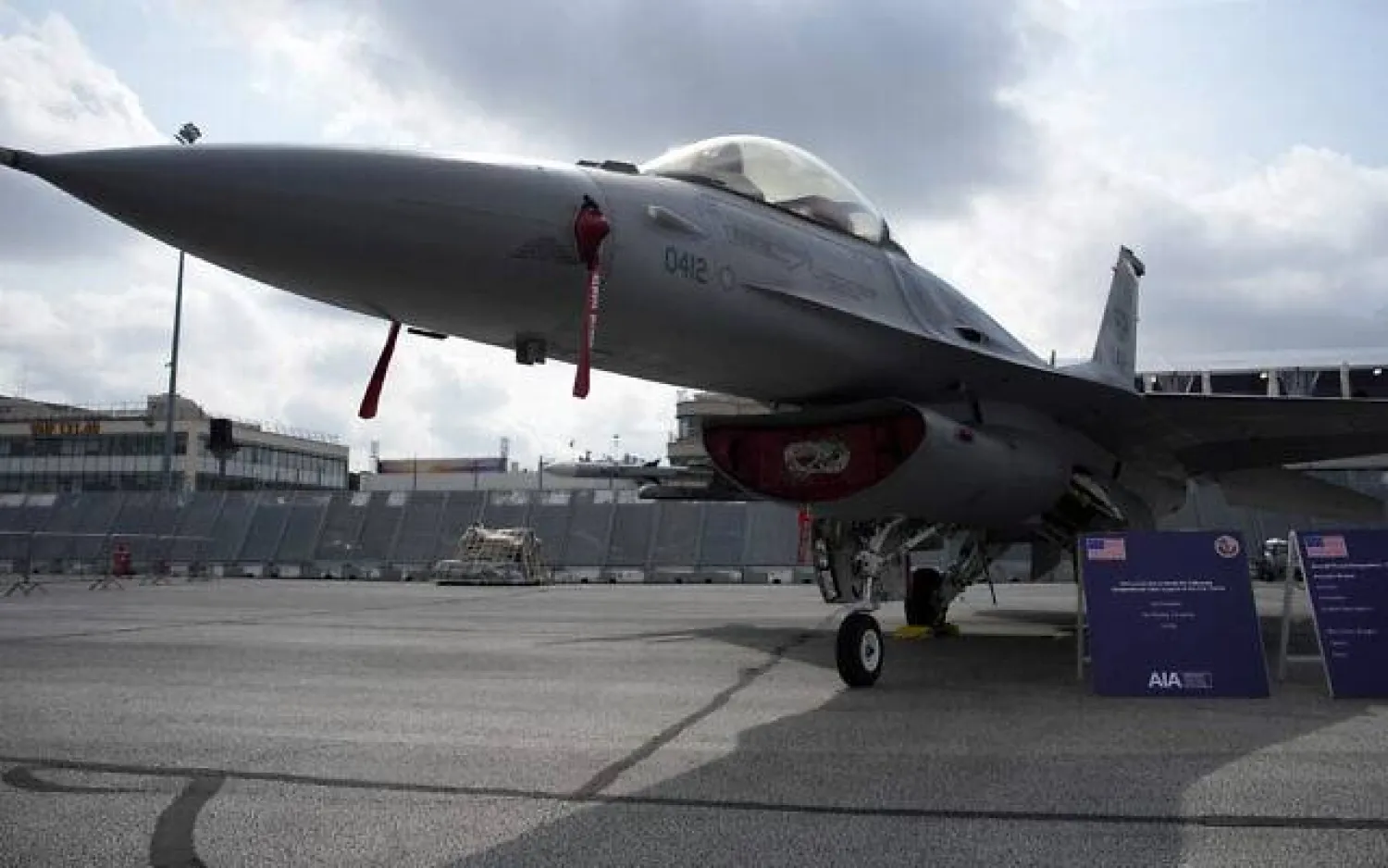
US Sending F-16 Fighter Jets to Protect Ships from Iranian Seizures in Gulf Region

US Air Force F-16 fighter jet is on display during the Paris Air Show in Le Bourget, north of Paris, France, Monday, June 19, 2023 (AP Photo/Lewis Joly, File)
TT

US Sending F-16 Fighter Jets to Protect Ships from Iranian Seizures in Gulf Region

US Air Force F-16 fighter jet is on display during the Paris Air Show in Le Bourget, north of Paris, France, Monday, June 19, 2023 (AP Photo/Lewis Joly, File)

The US is beefing up its use of fighter jets around the strategic Strait of Hormuz to protect ships from Iranian seizures, a senior defense official said Friday, adding that the US is increasingly concerned about the growing ties between Iran, Russia and Syria across the Middle East.
Speaking to Pentagon reporters, the official said the US will send F-16 fighter jets to the Gulf region this weekend to augment the A-10 attack aircraft that have been patrolling there for more than a week. The move comes after Iran tried to seize two oil tankers near the strait last week, opening fire on one of them, The Associated Press said.
The defense official, who spoke on condition of anonymity to provide details of military operations in the region, said the F-16s will give air cover to the ships moving through the waterway and increase the military's visibility in the area, as a deterrent to Iran.
The US Navy said in both instances the Iranian naval vessels backed off when the USS McFaul, a guided-missile destroyer, arrived on the scene.
In addition, the defense official told reporters the US is considering a number of military options to address increasing Russian aggression in the skies over Syria, which complicated efforts to strike an ISIS group leader last weekend. The official declined to detail the options, but said the US will not cede any territory and will continue to fly in the western part of the country on anti-ISIS missions.
The Russian military activity, which has increased in frequency and aggression since March, stems from growing cooperation and coordination between Moscow, Tehran and the Syrian government to try to pressure the US to leave Syria, the official said.
The official said Russia is beholden to Iran for its support in the war in Ukraine, and Tehran wants the US out of Syria so it can more easily move lethal aid to Lebanese Hezbollah and threaten Israel. The US has seen more cooperation, collaboration, planning and intelligence sharing, largely between mid-level Russian and Iranian Quds force leaders in Syria, to pressure the US to remove troops from Syria, the official added.
There are about 900 US forces in the country, and others move in and out to conduct missions targeting ISIS group militants.
The US does not believe Russian aircraft plan to drop bombs on US troops or shoot down manned aircraft. But there are concerns that Russian pilots will knock a Reaper drone out of the sky and that Moscow believes that type of action would not get a strong US military response, the official said.
As an example, in March, a Russian warplane poured jet fuel on a US surveillance drone and then struck its propeller, forcing the US military to ditch the MQ-9 Reaper into the Black Sea. The incident spiked tensions between the two countries and triggered a call between their defense chiefs, but led to no direct military response.
Last week, Rear Adm. Oleg Gurinov, head of the Russian Reconciliation Center for Syria, said the Russian and Syrian militaries have been doing joint training. In comments carried by Syrian state media, he said Moscow is concerned about drone flights by the US-led coalition over northern Syria, calling them “systematic violations of protocols” designed to avoid clashes between the two militaries.
US and Russian military commanders routinely communicate over a deconfliction phone line that has been in place for several years to avoid unintended clashes in Syria, where both sides have troops on the ground and in the air.
There are often many calls a day, and at times result in angry threats as commanders argue over an ongoing operation, said the US official. Describing a conversation, the official said the Russians will often declare an area of space a restricted operating zone and say they are doing military exercises there.
The US sees no exercises, and tells Russia that American forces are on a counterterror mission against the ISIS group and plan to fly in that area. The Russians then say they can't guarantee US aircraft safety if they go there. And once the mission begins, and the aircraft move into the zone, “it sometimes gets very heated,” said the official, as both sides loudly protest and reject the other's assertions.
The most recent incident was Friday morning, when a Russia aircraft flew repeatedly over the at-Tanf garrison in eastern Syria, where US forces are training Syrian allies and monitoring ISIS militant activity. The official said the Russian An-30 aircraft was collecting intelligence on the base.
The US did not have fighter aircraft in the area and took no direct action against the Russian flight.



Netanyahu Skeptical of an Iran Breakthrough

Israel's Prime Minister Benjamin Netanyahu leaves after a meeting with US President Donald Trump at the White House February 11, 2026, in Washington, DC. (Photo by Brendan Smialowski / AFP)
TT

Netanyahu Skeptical of an Iran Breakthrough

Israel's Prime Minister Benjamin Netanyahu leaves after a meeting with US President Donald Trump at the White House February 11, 2026, in Washington, DC. (Photo by Brendan Smialowski / AFP)

Israeli Prime Minister Benjamin Netanyahu said he was skeptical that US nuclear talks with Iran will lead to a breakthrough but described his meeting with US President Donald Trump at the White House as “excellent.”

Speaking to reporters Thursday in Washington before boarding a plane to return to Israel, Netanyahu said Trump’s terms and Iran’s “understanding that they made a mistake the last time when they did not reach an agreement, may lead them to agree to conditions that will enable a good agreement to be reached.”

While he said he did “not hide my general skepticism” about any deal, he stressed that any agreement must include concessions about Iran’s ballistic missiles program and support for militant proxies.

He added that the conversation Wednesday with Trump, which lasted more than two hours, included a number of other subjects, including Gaza and regional developments but focused on the negotiations with Iran.


German Court Rejects Palestinian's Claim over Weapons Exports

A view shows the front of the Reichstag building, the seat of the German parliament, the Bundestag, in Berlin, Germany March 5, 2025. REUTERS/Annegret Hilse/File Photo
TT

German Court Rejects Palestinian's Claim over Weapons Exports

A view shows the front of the Reichstag building, the seat of the German parliament, the Bundestag, in Berlin, Germany March 5, 2025. REUTERS/Annegret Hilse/File Photo

Germany's highest court on Thursday threw out a case brought by a Palestinian civilian from Gaza seeking to sue the German government over its weapons exports to Israel.

The complainant, supported by the European Center for Constitutional and Human Rights (ECCHR), had been seeking to challenge export licences for German parts used in Israeli tanks deployed in Gaza.

After his case was rejected by lower courts in 2024 and 2025, he had appealed to the Federal Constitutional Court.

But the court in Karlsruhe dismissed the case, stating that "the complainant has not sufficiently substantiated that the specialized courts misjudged or arbitrarily denied a possible duty to protect him", AFP reported.

While Germany is obliged to protect human rights and respect international humanitarian law, this does not mean the state is necessarily obliged to take specific action on behalf of individuals, the court said.

"It is fundamentally the responsibility of the state authorities themselves to decide how they fulfil their general duty of protection," it added.

The ECCHR called the decision "a setback for civilian access to justice".

"The court acknowledges the duty to protect but only in the abstract and refuses to ensure its practical enforcement," said Alexander Schwarz, co-director of the NGO's International Crimes and Legal Accountability program.

"For people whose lives are endangered by the consequences of German arms exports, access to justice remains effectively closed," he said.

The ECCHR had been hoping for a successful appeal after the Constitutional Court ruled last year that Germany had "a general duty to protect fundamental human rights and the core norms of international humanitarian law, even in cases involving foreign countries".

In that case, two Yemenis had been seeking to sue Berlin over the role of the US Ramstein airbase in a 2012 drone attack.

The complainant was one of five Palestinians who initially brought their case against the German government in 2024.


2 Israelis Charged with Using Classified Military Information to Place Bets

The Israeli Iron Dome air defense system intercepts missiles during an Iranian attack on Tel Aviv, Israel, June 18, 2025. (AP Photo/Leo Correa, File)
TT

2 Israelis Charged with Using Classified Military Information to Place Bets

The Israeli Iron Dome air defense system intercepts missiles during an Iranian attack on Tel Aviv, Israel, June 18, 2025. (AP Photo/Leo Correa, File)

Two Israelis have been charged with using classified military information to place bets on how future events will unfold, Israeli authorities said Thursday, accusing the individuals of “serious security offenses.”

A joint statement by the Israeli Ministry of Defense, domestic security service Shin Bet and police said that a civilian and a reservist are suspected of placing bets on the US-based prediction market Polymarket on future military operations based on information that the reservist had access to, The AP news reported.

Israel’s Attorney General’s Office decided to prosecute the two individuals following a joint investigation by police, military intelligence and other security agencies that resulted in several arrests. The two face charges including bribery and obstruction of justice.

Authorities offered no details on the identity of the two individuals or the reservist's rank or position in the Israeli military but warned that such actions posed a “real security risk” for the military and the Israeli state.

Israel’s public broadcaster Kan had reported earlier that the bets were placed in June ahead of Israel’s war with Iran and that the winnings were roughly $150,000.

Israel's military and security services “view the acts attributed to the defendants very seriously and will act resolutely to thwart and bring to justice any person involved in the activity of using classified information illegally,” the statement said.

The accused will remain in custody until the end of legal proceedings against them, the Prosecutor's Office said.

Prediction markets are comprised of typically yes-or-no questions called event contracts, with the prices connected to what traders are willing to pay, which theoretically indicates the perceived probability of an event occurring.

Their use has skyrocketed in recent years, but despite some eye-catching windfalls, traders still lose money everyday. In the US, the trades are categorized differently than traditional forms of gambling, raising questions about transparency and risk.