


Europe's Sweltering Summer Could Send Tourists to Cooler Climes

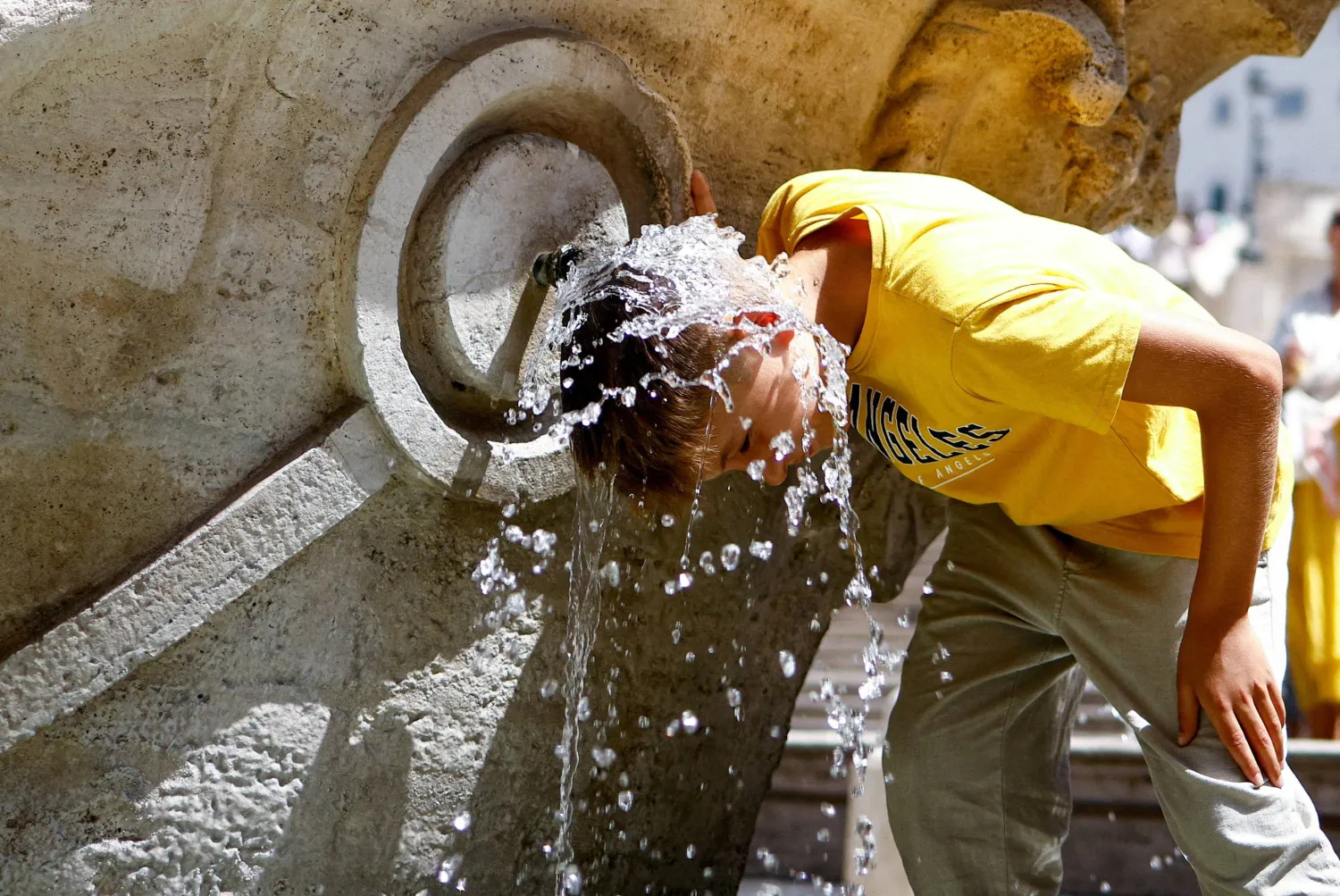
FILE PHOTO: A boy cools off at Fontana della Barcaccia at the Spanish Steps during a heat wave across Italy as temperatures are expected to rise further in the coming days, in Rome, Italy July 17, 2023. REUTERS/Guglielmo Mangiapane
TT

Europe's Sweltering Summer Could Send Tourists to Cooler Climes

FILE PHOTO: A boy cools off at Fontana della Barcaccia at the Spanish Steps during a heat wave across Italy as temperatures are expected to rise further in the coming days, in Rome, Italy July 17, 2023. REUTERS/Guglielmo Mangiapane

Soaring summer temperatures across southern Europe could prompt a lasting shift in tourist habits, with more travellers choosing cooler destinations or taking their holidays in spring or autumn to dodge the extreme heat, tourism bodies and experts predict.

European Travel Commission (ETC) data shows the number of people hoping to travel to the Mediterranean region in June to November has already fallen 10% compared to last year, when scorching weather led to droughts and wildfires.

Destinations like the Czech Republic, Denmark, Ireland and Bulgaria have meanwhile seen a spike in interest.

"We anticipate that unpredictable weather conditions in the future will have a greater impact on travelers' choices in Europe," Reuters quoted Miguel Sanz, the head of the ETC, as saying.

A report by the trade body also shows 7.6% of travelers now see extreme weather events as a major concern for trips between June and November.

Among them are Anita Elshoy and her husband, who returned home to Norway from their favorite vacation spot of Vasanello, a village north of Rome, a week earlier than planned this month as temperatures reached around 35C.

"(I) got a lot of pain in the head, legs and (my) fingers swelled up and I became more and more dizzy," Elshoy said of her heat-related symptoms. "We were supposed to be there for two weeks, but we couldn't (stay) because of the heat."

NO CANCELLATIONS YET

Demand for travel has soared again this summer as tourists leave behind years of pandemic restrictions, and travel companies say the heat hasn't caused many cancellations - yet.

Britons in particular have booked fewer holidays at home and more in the Mediterranean, often many months in advance, as they continue to crave post-lockdown beach escapes, said Sean Tipton of British travel agent group ABTA.

But that balance could shift as heatwaves are set to become more grueling. Scientists have long warned that climate change, caused by CO2 emissions from burning fossil fuels, will make weather events more frequent, severe and deadly.

Meteorologists predict that temperatures in the coming week may surpass Europe's current record of 48.8 degrees Celsius (119.84 Fahrenheit), set in Sicily in August 2021, raising fears of a repetition of last year's heat deaths.

Stories of tourists being airlifted off Italian beaches or ferried away in ambulances from Athens' Acropolis have flooded European media in recent weeks.

"Our recent research indicates a decline in the number of people interested in travelling in August, the peak month, while more Europeans are considering autumn trips," Sanz said.

SHIFTS IN SOUTHERN EUROPE

Tourists in Rome told Reuters they would think twice about booking a trip there again in July as they struggled to drink enough water, stay cool and find air-conditioned spots to rest.

"I would come when it's colder. Only June, April," said Dalphna Niebuhr, an American tourist on holiday with her husband in Rome this week, who said the heat was making her visit "miserable."

That's bad news for Italy's economy, which thrives on busy summer traffic.

Italy's Environment Ministry warned in a report this year that foreign tourists would in future travel more in the spring and autumn and choose cooler destinations.

"The balance will be negative, also because part of the Italian tourists will contribute to the flow of international tourism to less hot countries," the report said.

Some hope that the change will simply be a shift in traffic, not a reduction.

In Greece, where international air arrivals were up 87.5% year-on-year between January and March, overcrowding in the summer has plagued tourist hot spots like the island of Mykonos.

Increased travel in the winter, spring and autumn months could ease that problem and make up for a potential summer slowdown, according to the Greek environment ministry.

Greek authorities closed Athens' ancient Acropolis during the hottest part of the day on Friday to protect tourists.

In Spain, high vacation demand is expected in coastal destinations in the north of the country and on Spanish tourist islands, where summer temperatures tend to be cooler, according to a report from national tourism association Exceltur.

Spaniards Daniel Otero and Rebeca Vazquez, who were visiting Bilbao, said they might move their holiday to June next year, when it would be cooler and more comfortable.

For Elshoy, summers in southern Europe may be a thing of the past.

She said she will consider holidaying in her home country of Norway instead, adding: "I don't want to have a holiday where I have a headache and am dizzy again."



'Extremely Exciting': The Ice Cores that Could Help Save Glaciers

A researcher cuts a slice from an ice core sample taken from a glacier in the Pamir mountain range in Tajikistan, at the Hokkaido University Institute of Low Temperature Science, in Sapporo, in northern Japan's Hokkaido prefecture on December 9, 2025. (Photo by GREG BAKER / AFP)
TT

'Extremely Exciting': The Ice Cores that Could Help Save Glaciers

A researcher cuts a slice from an ice core sample taken from a glacier in the Pamir mountain range in Tajikistan, at the Hokkaido University Institute of Low Temperature Science, in Sapporo, in northern Japan's Hokkaido prefecture on December 9, 2025. (Photo by GREG BAKER / AFP)

Dressed in an orange puffer jacket, Japanese scientist Yoshinori Iizuka stepped into a storage freezer to retrieve an ice core he hopes will help experts protect the world's disappearing glaciers.

The fist-sized sample drilled from a mountaintop is part of an ambitious international effort to understand why glaciers in Tajikistan have resisted the rapid melting seen almost everywhere else.

"If we could learn the mechanism behind the increased volume of ice there, then we may be able to apply that to all the other glaciers around the world," potentially even helping revive them, said Iizuka, a professor at Hokkaido University.

"That may be too ambitious a statement. But I hope our study will ultimately help people," he said.

Thousands of glaciers will vanish each year in the coming decades, leaving only a fraction standing by the end of the century unless global warming is curbed, a study published in the journal Nature Climate Change showed Monday.

Earlier this year, AFP exclusively accompanied Iizuka and other scientists through harsh conditions to a site at an altitude of 5,810 meters (about 19,000 feet) on the Kon-Chukurbashi ice cap in the Pamir Mountains.

The area is the only mountainous region on the planet where glaciers have not only resisted melting, but even slightly grown, a phenomenon called the "Pamir-Karakoram anomaly.”

The team drilled two ice columns approximately 105 meters (328 feet) long out of the glacier.

One is being stored in an underground sanctuary in Antarctica belonging to the Ice Memory Foundation, which supported the Tajikistan expedition along with the Swiss Polar Institute.

The other was shipped to Iizuka's facility, the Institute of Low Temperature Science at Hokkaido University in Sapporo, where the team is hunting clues on why precipitation in the region increased over the last century, and how the glacier has resisted melting.

Some link the anomaly to the area's cold climate or even increased use of agricultural water in Pakistan that creates more vapor.

But the ice cores are the first opportunity to examine the anomaly scientifically.
"Information from the past is crucial," said Iizuka.

"By understanding the causes behind the continuous build-up of snow from the past to the present, we can clarify what will happen going forward and why the ice has grown."

Since the samples arrived in November, his team has worked in freezing storage facilities to log the density, alignment of snow grains, and the structure of ice layers.

In December, when AFP visited, the scientists were kitted out like polar explorers to cut and shave ice samples in the comparatively balmy minus 20C of their lab.

The samples can tell stories about weather conditions going back decades, or even centuries.

A layer of clear ice indicates a warm period when the glacier melted and then refroze, while a low-density layer suggests packed snow, rather than ice, which can help estimate precipitation.

Brittle samples with cracks, meanwhile, indicate snowfall on half-melted layers that then refroze.

And other clues can reveal more information -- volcanic materials like sulfate ions can serve as time markers, while water isotopes can reveal temperatures.

The scientists hope that the samples contain material dating back 10,000 years or more, though much of the glacier melted during a warm spell around 6,000 years ago.

Ancient ice would help scientists answer questions such as "what kind of snow was falling in this region 10,000 years ago? What was in it?" Iizuka said.

"We can study how many and what kinds of fine particles were suspended in the atmosphere during that ice age," he added.

"I really hope there is ancient ice."

For now, the work proceeds slowly and carefully, with team members like graduate student Sora Yaginuma carefully slicing samples apart.

"An ice core is an extremely valuable sample and unique," said Yaginuma.

"From that single ice core, we perform a variety of analyses, both chemical and physical."

The team hopes to publish its first findings next year and will be doing "lots of trial-and-error" work to reconstruct past climate conditions, Iizuka said.

The analysis in Hokkaido will uncover only some of what the ice has to share, and with the other samples preserved in Antarctica, there will be opportunities for more research.

For example, he said, scientists could look for clues about how mining in the region historically affected the area's air quality, temperature and precipitation.

"We can learn how the Earth's environment has changed in response to human activities," Iizuka said.

With so many secrets yet to learn, the work is "extremely exciting," he added.


Jane Austen Fans Celebrate the Author’s 250th Birthday in Britain and Beyond

One of the new British 10 pound notes is posed for photographs outside the Bank of England in the City of London, Thursday, Sept. 14, 2017. (AP)
TT

Jane Austen Fans Celebrate the Author’s 250th Birthday in Britain and Beyond

One of the new British 10 pound notes is posed for photographs outside the Bank of England in the City of London, Thursday, Sept. 14, 2017. (AP)

Fans of Jane Austen celebrated the acclaimed author's 250th birthday on Tuesday with a church service in her home village, festive visits to her house — and a virtual party for those paying tribute from afar.

Thousands of enthusiasts around the world have already taken part in a yearlong celebration of one of English literature’s greats, who penned “Pride and Prejudice," “Sense and Sensibility” and other beloved novels.

On Tuesday — to mark 250 years since she was born on Dec. 16, 1775 — Jane Austen’s House, in the southern English village of Chawton, hosted talks, tours and performances for dozens of visitors, with celebrations concluding with an online party for fans from all over the world.

“Regency dress strongly encouraged,” organizers said, adding that more than 500 people had signed up for the Zoom party.

The cottage, now a museum with Austen artifacts, was where the author lived for the last years of her life and where she wrote all six of her novels.

A church service featuring music and readings is held in Steventon, the rural village where she was born.

Fans, who call themselves “Janeites," have marked the anniversary year with Regency balls and festivals staged in the UK, US and beyond.

At the weekend, the city of Bath, where Austen lived for five years, hosted the Yuletide Jane Austen Birthday Ball, the finale of many grand costumed events held there this year.


Thousands of Dinosaur Footprints Found on Alpine Cliffs Near Winter Olympics Site

The Director of the Stelvio Park, Franco Claretti, poses next to a reproduction of a dinosaur prior to a press conference in Milan, Italy, Tuesday, Dec. 16, 2025, on a discovery of thousands of dinosaur tracks at the Stelvio Park. (AP)
TT

Thousands of Dinosaur Footprints Found on Alpine Cliffs Near Winter Olympics Site

The Director of the Stelvio Park, Franco Claretti, poses next to a reproduction of a dinosaur prior to a press conference in Milan, Italy, Tuesday, Dec. 16, 2025, on a discovery of thousands of dinosaur tracks at the Stelvio Park. (AP)

Italian paleontologists have uncovered thousands of dinosaur footprints on a near-vertical rock face more than 2,000 meters above sea level in the Stelvio National Park, a discovery they say is among the world's richest sites for the Triassic period.

The tracks, some up to 40 cm wide and showing claw marks, stretch for about five kilometers in the high-altitude glacial Valle di Fraele near Bormio, one of the venues for the 2026 Winter Olympics in the northern region of Lombardy.

"This is one of the largest and oldest footprint sites in Italy, and among the most spectacular I've seen in 35 years," said Cristiano Dal Sasso, paleontologist at Milan's Natural History Museum in a press conference on Tuesday at the headquarters of the Lombardy Region.

Experts believe the prints were left by herds of long-necked herbivores, likely plateosaurs, more than 200 million years ago when the area was a warm lagoon, ideal for dinosaurs to roam along beaches, leaving tracks in the mud near the water.

"The footprints were impressed when the sediments were still soft, on the wide tidal flats that surrounded the Tethys Ocean," said Fabio Massimo Petti, ichnologist at MUSE museum of Trento, attending the same conference.

"The muds, now turned to rock, have allowed the preservation of remarkable anatomical details of the feet, such as impressions of the toes and even the claws," Petti added.

As the African plate gradually moved north, closing and drying up the Tethys Ocean, sedimentary rocks that formed the seabed were folded, creating the Alps.

The fossilized dinosaur footprints shifted from a horizontal position to the vertical one on a mountain slope spotted by a wildlife photographer in September while chasing deer and bearded vultures, experts said.

"The natural sciences deliver to the Milan-Cortina 2026 Games an unexpected and precious gift from remote eras," Giovanni Malagò, President of the Milano Cortina 2026 Organizing Committee told journalists.

The area cannot be reached by trails, so drones and remote sensing technologies will have to be used to study it.