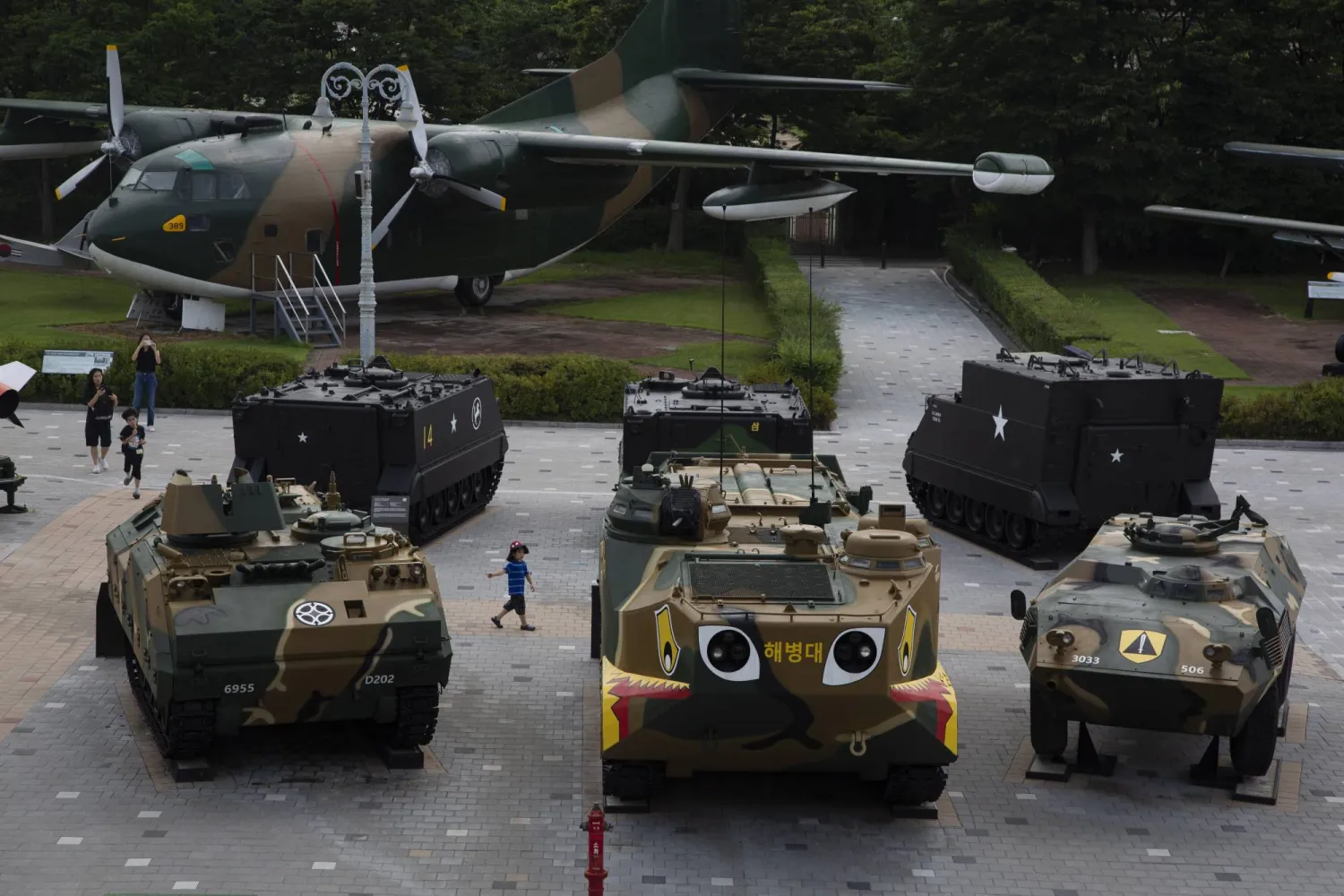
Rival Koreas Mark Armistice Anniversary in Two Different Ways that Highlight Rising Tensions

People visit the War Memorial Museum in Seoul, South Korea, 25 July 2023, ahead of the 70th anniversary of the Korean War Armistice Agreement, on 27 July 2023.  EPA/JEON HEON-KYUN
People visit the War Memorial Museum in Seoul, South Korea, 25 July 2023, ahead of the 70th anniversary of the Korean War Armistice Agreement, on 27 July 2023. EPA/JEON HEON-KYUN
TT

Rival Koreas Mark Armistice Anniversary in Two Different Ways that Highlight Rising Tensions

People visit the War Memorial Museum in Seoul, South Korea, 25 July 2023, ahead of the 70th anniversary of the Korean War Armistice Agreement, on 27 July 2023.  EPA/JEON HEON-KYUN
People visit the War Memorial Museum in Seoul, South Korea, 25 July 2023, ahead of the 70th anniversary of the Korean War Armistice Agreement, on 27 July 2023. EPA/JEON HEON-KYUN

The truce that stopped the bloodshed in the Korean War turns 70 years old on Thursday and the two Koreas are marking the anniversary in starkly different ways, underscoring their deepening nuclear tensions.
North Korea has invited delegations from China and Russia as it prepares to stage huge celebrations with thousands of citizens who have rehearsed for months to commemorate the armistice it sees as a victory in the “Grand Fatherland Liberation War.” The festivities are likely to be capped by a giant military parade in the capital, Pyongyang, where leader Kim Jong Un could showcase his most powerful, nuclear-capable missiles designed to target neighboring rivals and the US mainland.
The mood is more somber in South Korea, where President Yoon Suk Yeol has invited dozens of foreign war veterans to honor the fallen soldiers of the 1950-53 conflict, which killed and injured millions and set the stage for decades of animosity among the Koreas and the United States, The Associated Press said.
Yoon, a conservative condemned by Pyongyang as a “traitor,” will likely use this week's events to highlight the North’s growing threat and double down on his goals of strengthening the South’s defense and its alliance with the US
Tensions between the rivals are at their highest point in years, as the pace of North Korean missile tests and US-South Korean joint military exercises has intensified in a tit-for-tat cycle. The dueling military activities have been punctuated by verbal threats, including North Korean talk of preemptive nuclear strikes and US vows to “end” Kim’s regime in the event of such an attack.
The frictions provide a renewed reminder that the armistice has left the Korean Peninsula in a technical state of war. Through their 70 years of diplomatic ups and downs, the Koreas have consistently seen each other as existential threats, which is essentially why the armistice was never replaced by a peace treaty as originally intended.
Managing tensions is now more complicated than ever as Kim continues to reject dialogue with the US while aggressively expanding a nuclear arsenal he sees as his strongest guarantee of survival.
Kim is also pushing for deeper cooperation with authoritarian allies China and Russia, which are locked in their own confrontations with Washington over regional influence and the war in Ukraine, as he aims to counter US efforts to tighten trilateral security cooperation with Seoul and Tokyo.
North Korean state media on Wednesday highlighted the arrival of a Russian delegation led by Defense Minister Sergei Shoigu, who was greeted at Pyongyang’s airport by senior North Korean officials including Defense Minister Kang Sun Nam. China’s ruling Communist Party is also sending a mid-level official, Li Hongzhong, in hopes of further facilitating bilateral exchanges.
For Kim, bringing Shoigu and Li to his balcony at Pyongyang’s main square to watch a massive parade featuring goose-stepping soldiers, tanks and missiles would be the biggest accomplishment he could show to his domestic audience for the anniversary, said Park Won Gon, a professor at Seoul’s Ewha University.
Kim already displayed his most powerful missiles during a previous parade in February and there might not be meaningful new hardware to show after the North failed in its first attempt to launch a military spy satellite into orbit in May. Economic achievements have been scarce after pandemic-related border closures decimated an economy already crippled by decades of mismanagement and US-led sanctions over Kim’s nuclear ambitions.
Park said the invitations of the Chinese and Russian delegations could also reflect Kim’s unease about the strengthening security cooperation between the US and South Korea, which have included larger joint military exercises, increased deployments of strategic US military assets and new rounds of nuclear contingency planning meetings.
Thursday’s anniversary comes after North Korea conducted three separate rounds of ballistic and cruise missile firings since last week, apparently to protest the US sending major naval assets to the South in a show of force. They include the USS Kentucky, which last week became the first US nuclear-armed submarine to dock in South Korea since the 1980s.
“The strengthening of nuclear deterrence strategies between South Korea, the United States and Japan and military moves like the docking of the ballistic-missile submarine (in South Korea) are a huge burden and threat for North Korea,” Park said. “Since North Korea has limited ability to deal with these moves on its own, emphasizing cooperation with Moscow and Beijing for a combined response would be important (for Kim).”
Moscow and Beijing have already thwarted US-led efforts since last year to strengthen UN Security Council sanctions on Pyongyang over its intensified missile testing activity, underscoring a divide between the council’s permanent members deepened over Russia’s war on Ukraine.
When asked about the visits, US State Department deputy spokesperson Vedant Patel urged Beijing and Moscow to play a more constructive role in defusing tensions and to bring Pyongyang back to dialogue.
The Korean War was triggered by a North Korean sneak attack on the South. The North was backed by forces from the newly created People’s Republic of China, which was aided by the then-Soviet air force. South Korea, the US and troops from various countries under the direction of the United Nations fought to push back the invasion.
For South Koreans, the major outcome of the 1953 armistice was the subsequent signing of the US-South Korea Mutual Defense Treaty, which was mainly aimed at calming South Korean security jitters about the truce and continues to serve as the foundation for the countries’ military alliance. Facing growing nuclear threats, Yoon is now seeking stronger US assurances that it would swiftly and decisively use its nuclear weapons to defend the South in the event of a North Korean nuclear attack.
Thousands of people are expected to attend an armistice ceremony Thursday in South Korea's southern port city of Busan, which is the location of a cemetery honoring the UN soldiers killed during the war.
While there have been several skirmishes between the Koreas along their border in past years, the armistice has prevented a return to large-scale hostilities. A recent border incident involving an American soldier who bolted into the North through the truce village of Panmunjom — named after a town where the armistice was signed — has highlighted how the agreement could serve as a safety valve when relations are strained.
The US-led UN Command, which was created to fight the war and then remained in the South to supervise the armistice’s implementation, says it is using the armistice’s communications mechanisms to negotiate the release of Pvt. Travis King. It’s likely referring to the so-called pink phone, a telephone line between the command and the North Korean People’s Army at Panmunjom.
“Despite innumerable provocations, challenges, misunderstandings and even deaths that resulted since the signing of the armistice agreement, it has in general withstood the test of 70 years,” Andrew Harrison, a British lieutenant general who is the deputy commander at the UN Command, said during a news conference Monday.



Netanyahu Coalition Pushes Contentious Oct. 7 Attack Probe, Families Call for Justice

The bereaved families of the 7 October attack hold pictures of their loved ones and shout slogans towards Knesset members during a debate on the bill for a state commission of inquiry into the events of 7 October at the Knesset, the Israeli parliament, in Jerusalem, 24 December 2025. (EPA)
TT

Netanyahu Coalition Pushes Contentious Oct. 7 Attack Probe, Families Call for Justice

The bereaved families of the 7 October attack hold pictures of their loved ones and shout slogans towards Knesset members during a debate on the bill for a state commission of inquiry into the events of 7 October at the Knesset, the Israeli parliament, in Jerusalem, 24 December 2025. (EPA)

Israel's parliament gave the initial go-ahead on Wednesday for a government-empowered inquiry into the surprise October 7, 2023 attack by Hamas on southern Israel rather than the expected independent investigation demanded by families of the victims.

Prime Minister Benjamin Netanyahu has resisted calls to establish a state commission to investigate Israel's failures in the run-up to its deadliest day and has taken no responsibility for the attack that sparked the two-year Gaza war.

His ruling coalition voted on Wednesday to advance a bill which grants parliament members the authority to pick panel members for an inquiry and gives Netanyahu's cabinet the power to set its mandate.

Critics ‌say the move ‌circumvents Israel's 1968 Commissions of Inquiry Law, under which ‌the ⁠president of ‌the Supreme Court appoints an independent panel to investigate major state failures such as those which preceded the 1973 Yom Kippur war.

Survivors and relatives of those hurt in the Hamas attack have launched a campaign against the proposed probe, saying only a state commission can bring those accountable to justice.

"This is a day of disaster for us all," said Eyal Eshel, who lost his daughter when Hamas fighters overran the army base where she served. "Justice ⁠must be done and justice will be done," he said at the Knesset, before the vote.

Surveys have shown ‌wide public support for the establishment of a state ‍commission into the country's biggest security ‍lapse in decades.

Netanyahu said on Monday that a panel appointed in line with the ‍new bill, by elected officials from both the opposition and the coalition, would be independent and win broad public trust.

But Israel's opposition has already said it will not cooperate with what it describes as an attempt by Netanyahu's coalition to cover up the truth rather than reveal it, arguing that the investigation would ultimately be controlled by Netanyahu and his coalition.

The new bill says that if the politicians fail to ⁠agree on the panel, its make-up will be decided by the head of parliament, who is allied with Netanyahu and is a member of his Likud party.

Jon Polin, whose son Hersh Goldberg-Polin was taken hostage and found slain by his captors with five other hostages in a Hamas tunnel in August 2024, said only a trusted commission could restore security and unite a nation still traumatized.

"I support a state commission, not to see anyone punished and not because it will bring back my only son, no. I support a state commission so that nothing like what happened to my son, can ever happen to your son, or your daughter, or your parents," Polin said on Sunday at a news ‌conference with other families.

Hersh Goldberg-Polin was among dozens of hostages taken in the 2023 attack from the site of the Nova music festival.


Search Teams in Türkiye Recover Recorders after Plane Crash that Killed Libyan Military Officials

Turkish army soldiers stand guard as rescue teams search for the remains of a private jet carrying Libya's military chief and four others that crashed after taking off from Ankara, killing everyone on board, in Ankara, Turkey, early Wednesday, Dec. 24, 2025. (AP Photo/Efekan Akyuz)
TT

Search Teams in Türkiye Recover Recorders after Plane Crash that Killed Libyan Military Officials

Turkish army soldiers stand guard as rescue teams search for the remains of a private jet carrying Libya's military chief and four others that crashed after taking off from Ankara, killing everyone on board, in Ankara, Turkey, early Wednesday, Dec. 24, 2025. (AP Photo/Efekan Akyuz)

Search teams in Türkiye on Wednesday recovered the cockpit voice and flight data recorders from a jet crash that killed eight people, including western Libya’s military chief, while efforts to retrieve the victims' remains were still underway, Türkiye's interior minister said.

The private jet carrying Gen. Muhammad Ali Ahmad al-Haddad, four other military officials and three crew members crashed on Tuesday, after taking off from Türkiye's capital, Ankara, killing everyone on board. Libyan officials said that the cause of the crash was a technical malfunction on the plane.

The high-level Libyan delegation was on its way back to Tripoli after holding defense talks in Ankara aimed at boosting military cooperation between the two countries.

Turkish Interior Minister Ali Yerlikaya told journalists at the site of the crash that wreckage was scattered across an area covering three square kilometers (more than a square mile), complicating recovery efforts. Authorities from the Turkish forensic medicine authority were working to recover and identify the remains, he said.

A 22-person delegation — including five family members — arrived from Libya early on Wednesday to assist in the investigation, he said.

Tripoli-based Libyan Prime Minister Abdul-Hamid Dbeibah confirmed the deaths on Tuesday, describing the crash on Facebook as a “tragic accident” and a “great loss” for Libya.

Turkish President Recep Tayyip Erdogan held a telephone call with Dbeibah, during which he conveyed his condolences and expressed his sorrow over the deaths, his office said.

The Turkish leader later also offered his condolences during a televised speech, voicing solidarity with Libya.

"An investigation has been launched into this tragic incident that has deeply saddened us, and our ministries will provide information about its progress,” Erdogan said.

Al-Hadad was the top military commander in western Libya and played a crucial role in the ongoing, UN-brokered efforts to unify Libya’s military, which has split, much like the nation's other institutions.

The four other military officials who died in the crash were Gen. Al-Fitouri Ghraibil, the head of Libya’s ground forces, Brig. Gen. Mahmoud Al-Qatawi, who led the military manufacturing authority, Mohammed Al-Asawi Diab, adviser to the chief of staff, and Mohammed Omar Ahmed Mahjoub, a military photographer with the chief of staff’s office.

The identities of the three crew members weren't immediately released.

Turkish officials said that the Falcon 50-type business jet took off from Ankara’s Esenboga airport at 8:30 p.m. and that contact was lost around 40 minutes later. The plane notified air traffic control of an electrical fault and requested an emergency landing. The aircraft was redirected back to Esenboga, where preparations for its landing began.

The plane, however, disappeared from radar while descending for the emergency landing, the Turkish presidential communications office said.

The Libyan government declared a three-day period of national mourning. Flags would be flown half-staff at all state institutions, according to the government’s announcement on Facebook.

The wreckage was found near the village of Kesikkavak, in Haymana, a district about 70 kilometers (45 miles) south of Ankara.

At the crash site, search and recovery teams intensified their operations on Wednesday after a night of heavy rain and fog, the state-run Anadolu Agency reported. Gendarmerie police sealed off the area while the Turkish disaster management agency, AFAD, set up a mobile coordination center. Specialized vehicles, such as tracked ambulances, were deployed because of the muddy terrain.

Türkiye has assigned four prosecutors to lead the investigation, and Yerlikaya that said the Turkish search and recovery teams included 408 personnel.

While in Ankara, al-Haddad had met with Turkish Defense Minister Yasar Guler and other officials.


Netanyahu: Israel to Spend $110 billion to Develop Independent Arms Industry in Next Decade

Two Israeli soldiers inside Gaza (AFP)
TT

Netanyahu: Israel to Spend $110 billion to Develop Independent Arms Industry in Next Decade

Two Israeli soldiers inside Gaza (AFP)

Israeli Prime Minister Benjamin Netanyahu said ​on Wednesday Israel would spend 350 billion shekels ($110 billion) on developing an independent arms to reduce ‌dependency on other ‌countries, AFP reported.

"We ‌will ⁠continue ​to ‌acquire essential supplies while independently arming ourselves," Netanyahu said at a ceremony for new pilots.

"I ⁠don't know if ‌a country can ‍be ‍completely independent but we ‍will strive ... to ensure our arms are produced as ​much as possible in Israel," he said.

"Our ⁠goal is to build an independent arms industry for the State of Israel and reduce the dependency on any party, including allies."