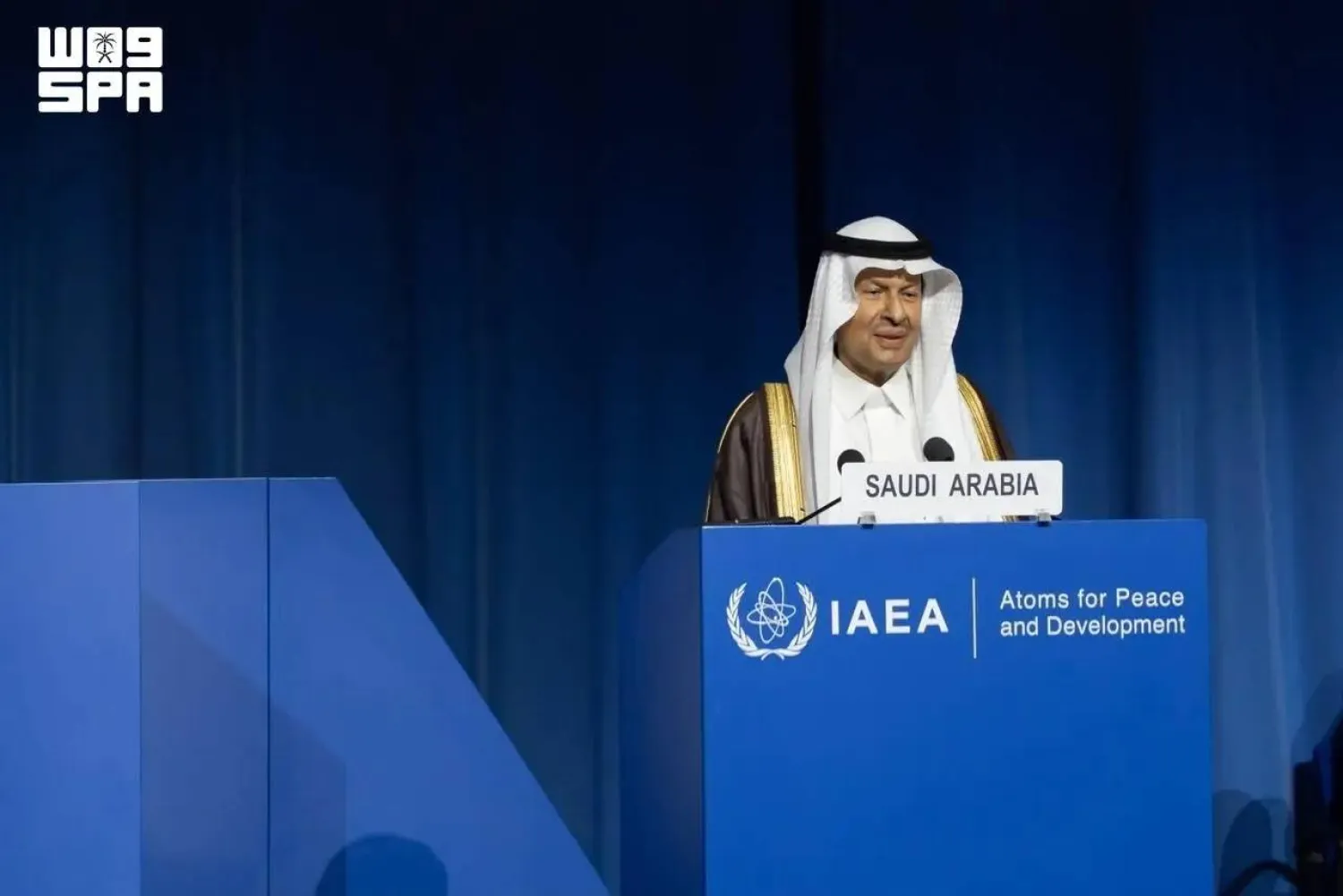
Saudi Arabia is moving forward with integrating nuclear energy into its national mix while developing its domestic uranium resources and building an integrated mineral value chain.
This chain spans from exploration and mining to processing, separation, refining, and the production of yellowcake, in an approach aimed at maximizing the economic value of its natural resources and boosting security of supply.
Speaking at the 70th General Conference of the International Atomic Energy Agency (IAEA) in Vienna, Saudi Minister of Energy, Minister of Industry and Mineral Resources Prince Abdulaziz bin Salman bin Abdulaziz said: “Over the decades, the Kingdom has established its position as a reliable energy supplier and an active partner in the stability of global energy markets.”
“Along with this role, the Kingdom is moving forward with developing a national energy mix from different energy sources that is more diverse and sustainable, based on integrated economic and development considerations,” he added.
“This includes introducing nuclear energy into this mix, within a well-established regulatory framework and in accordance with the Kingdom's international obligations,” he stressed.
“Our meeting today comes at a time when the world is witnessing rapid growth in energy demand, driven by economic, technological and industrial expansion. Amid these developments, diversifying energy sources and enhancing their reliability and sustainability have become essential to supporting economic growth and ensuring security of supply,” he said.
Prince Abdulaziz bin Salman said that the National Atomic Energy Project is advancing a program to explore uranium resources and assess opportunities for their economic utilization through several interconnected tracks.
The first involves recovering uranium associated with phosphoric acid produced in phosphate fertilizer operations in the north of the Kingdom, taking into account Saudi Arabia's position as the world's second-largest exporter of phosphate fertilizers.
He noted that pilot work carried out in cooperation with the French company Orano has yielded promising economic indicators for uranium recovery from these operations. This cooperation culminated in the signing of a memorandum of understanding during the visit of Prince Mohammed bin Salman, Crown Prince and Prime Minister, to France in August.
“Exploration and geological studies at the Jabal Sayid project in Madinah Region have identified estimated resources of around 114 million tons of ore containing high concentrations of rare earth elements, particularly heavy rare earth elements, alongside promising concentrations of uranium,” revealed Prince Abdulaziz bin Salman.
“This places the project among the most significant rare earth resource sites currently under development globally. This direction gained further momentum during the visit of the Crown Prince to the United States in November 2025, when the two countries signed a framework for cooperation on critical minerals and securing supply chains,” he went on to say.
This was followed by a partnership between the Saudi Arabian Mining Company, Ma'aden, and the American company MP Materials to develop capabilities for the processing and separation of rare earth elements and the production of associated uranium.
Prince Abdulaziz bin Salman stated that the Kingdom is continuing its efforts, through the Sedimentary Cover Survey Initiative, to explore additional uranium ores from conventional sources.
He added that these resources take on particular significance when viewed in the context of the Kingdom's broader advantages. The Kingdom combines promising mineral resources, competitive energy supplies, advanced infrastructure, growing industrial and investment capabilities, a strategic location, and effective international partnerships.
The Kingdom's ambition does not stop at producing raw materials or exporting concentrates, rather it extends to building an integrated economic and industrial value chain for all these minerals, he said.
This begins with exploration and mining and progressing through processing, separation and refining; the production of rare earth oxides; the recovery and purification of associated uranium; and the production of yellowcake and the development of its value chain, subject to economic feasibility, in accordance with the highest standards of transparency and within the framework of the Kingdom's international obligations, he noted.
Prince Abdulaziz bin Salman stressed that the Kingdom's exercise of its choices regarding the peaceful uses of nuclear energy goes hand in hand with the highest levels of responsibility and transparency.
This is consistent with the inherent right of States Parties to the Treaty on the Non-Proliferation of Nuclear Weapons to develop and use nuclear energy for peaceful purposes without discrimination.
He noted that, in exercising these rights, the Kingdom follows a clear approach founded on transparency, openness and international cooperation. It does not seek to develop its peaceful nuclear program in isolation from the international community, nor through activities conducted in secrecy or facilities concealed deep within mountains.
Rather, the Kingdom is developing its capabilities through trusted international partnerships that strengthen confidence and support the nuclear non-proliferation ecosystem, said the minister.
The Kingdom continues to strengthen its national framework and regulatory ecosystems governing nuclear energy and its applications, based on its conviction that confidence rests on strong national institutions, well-established regulatory frameworks and national capabilities said Prince Abdulaziz bin Salman.
The Kingdom also continues to boost its preparedness for nuclear and radiological emergencies, reinforce a culture of nuclear safety and security, and strengthen technical cooperation with the agency and international partners, he stressed.
He reaffirmed the Kingdom's full support for the IAEA and its commitment to continuing constructive cooperation with the agency and its member states in a manner that strengthens international confidence and contributes to a more secure, sustainable and prosperous future for all.
Prince Abdulaziz bin Salman later met IAEA Director General Rafael Mariano Grossi on the sidelines of the conference.
They discussed cooperation between Saudi Arabia and the IAEA, as well as other issues of mutual interest.