‘Breaking Bad’ Stars Reunite on Picket Line to Call for Studios to Resume Negotiations with Actors 

US actor Bryan Cranston, US actor Aaron Paul, US actress Betsy Brandt, US actor Jesse Plemons, and US actor Matt Jones, of "Breaking Bad," join the Screen Actors Guild (SAG-AFTRA) picket line in front of Sony Pictures Entertainment Studios in Culver City, California, on August 29, 2023. (AFP)
TT

‘Breaking Bad’ Stars Reunite on Picket Line to Call for Studios to Resume Negotiations with Actors 

US actor Bryan Cranston, US actor Aaron Paul, US actress Betsy Brandt, US actor Jesse Plemons, and US actor Matt Jones, of "Breaking Bad," join the Screen Actors Guild (SAG-AFTRA) picket line in front of Sony Pictures Entertainment Studios in Culver City, California, on August 29, 2023. (AFP)

The cast of “Breaking Bad” has reunited to call upon Hollywood studios to resume negotiations with striking screen actors.

“We want you to come back to the table with us,” Bryan Cranston said in a plea to the Alliance of Motion Picture and Television Producers outside Sony Pictures Studios on Tuesday.

Cranston was joined by Aaron Paul, Jesse Plemons and other members of the “Breaking Bad” universe in an effort to energize picket lines more than a month after SAG-AFTRA joined striking Hollywood writers.

Both guilds are seeking to address issues brought about by the dominance of streaming services, which have changed all aspects of production and pay in the industry.

“The way things were structured 10 years ago made a lot of sense and it made it more possible for journeymen-type actors, actors in the middle that are working just as a hard or harder,” Plemons said.

By its final season, which aired more than a decade ago, “Breaking Bad” was one of the most watched and highest rated cable TV shows ever.

The AMC hit series has achieved enduring popularity on Netflix, but its stars say that has not been reflected in their pay.

“I don’t get a piece from Netflix on ‘Breaking Bad’ to be totally honest and that’s insane to me,” Paul said. “I think a lot of these streamers know that they have been getting away with not paying people a fair wage and now it’s time to pony up.”

Cranston said they chose Sony for their reunion as the studio behind the Emmy-winning hit, along with its spinoff projects, the AMC prequel series “Better Call Saul” and the Netflix film, “El Camino.”

“We’re not making them the enemy. They are not villains. These are people that we all will be working with once again at some point,” Cranston said. “We just want them to see reality.”

Several other casts have joined picket lines during the strike, including actors from “Parks and Recreation” and the cult hit “Jury Duty,” drawing a link between popular shows and the actors’ strike goals.

Cranston also affirmed SAG-AFTRA President Fran Drescher’s recent comments to The Associated Press that these dual Hollywood strikes are galvanizing a broader movement throughout the country.

“Without organized labor, management will just keep stuffing their pockets. They don’t and will not ever just go, ‘You know what? I don’t think this is being fair to those people. I’m going to pay them more.’ It’s just not what they do,” he said.

Cast members of “Better Call Saul” were also on the picket lines, including Rhea Seehorn and Patrick Fabian, along with the series co-creator, Peter Gould, who has been on strike with the Writers Guild of America since May.


Jesse Eisenberg, Julianne Moore Bring Curtain Down on London Film Festival with ‘The Debut’

US actors Jesse Eisenberg (L) and Julianne Moore (R) attend the premiere of "The Debut" and the closing night of the BFI London Film Festival 2026 in London, Britain, 18 October 2026. (EPA)
TT

Jesse Eisenberg, Julianne Moore Bring Curtain Down on London Film Festival with ‘The Debut’

US actors Jesse Eisenberg (L) and Julianne Moore (R) attend the premiere of "The Debut" and the closing night of the BFI London Film Festival 2026 in London, Britain, 18 October 2026. (EPA)

Actor-filmmaker Jesse Eisenberg said he wrote the lead role in his musical comedy "The Debut" with Julianne Moore in mind, praising the Oscar-winning star as "the greatest actress in the world" as the film closed the London Film Festival on Sunday.

"I just thought, this is Julianne Moore, and I will write every scene with her in mind and what she likes to do and what she's great at," Eisenberg, who wrote the screenplay and directed the film, told Reuters on the red carpet.

Moore stars as Mona, a shy New Jersey housewife who is thrilled ‌to land a ‌role in a community theater musical.

Drawn to the experience ‌by ⁠a longing for ⁠something missing in her life, Mona finds purpose and community through the show.

"She's moving towards something, knowing that there's something that she needs in her life," Moore said. "Then that thing leads you towards yourself and towards community, which is really the most valuable thing of all."

The film, which marks Eisenberg's latest directing effort following his BAFTA-winning screenplay for "A Real Pain", features seven original songs written by the filmmaker. The numbers appear in the fictional stage ⁠production "Nosy Neighbors", a deliberately light-hearted, 1990s-inspired musical performed by a cast ‌including "The Little Mermaid" star Halle Bailey.

"I love songwriting, I ‌love musical theater music and I wrote these songs in earnest," Eisenberg said.

Mona's early struggles ‌on stage test the patience of director Jerry, played by "The Holdovers" star Paul Giamatti, prompting ‌her to adopt an increasingly committed method acting approach.

Eisenberg said Moore's interpretation of Mona allowed him to make a "weird movie" that still felt grounded.

"She is so unusual, she's so strange," he said. "It allowed me to make a movie that wasn't realistic."

While Mona takes method acting to ‌extremes, the "Now You See Me" star said all actors, including himself, draw on some version of the technique.

"I always wind up ⁠feeling whatever the ⁠character feels," he said. "So if my character is miserable, I spend the shoot just miserable. But I don't realize it's for the character. I just think, 'Oh God, I must be doing terribly in the movie'."

Eisenberg, who plays a minor role in "The Debut", said the story was inspired by his own childhood experiences in community theater, where he discovered "a family and a home and a life" he liked.

Patrick Fabian, who plays Mona's husband in the film, said theater offers something increasingly rare: a chance for people to connect in person with one another.

"It brings people together, and these days, it gets them out of their screens and into the dark together to watch whatever is going on," Fabian said. "I think that's a real bonding thing."

"The Debut" brought the curtain down on the 70th London Film Festival, where Ukrainian filmmaker Sergei Loznitsa's "Imperium" won Best Film in the Official Competition.


Box Office: Elizabeth Holmes Movie ‘You Can See Everything’ Is Now a Hit in Theaters Too

“You Can See Everything” made an extraordinary $15 million from only 855 screens, with over 2,000 sellout showings over the weekend, according to A24. (A24)
TT

Box Office: Elizabeth Holmes Movie ‘You Can See Everything’ Is Now a Hit in Theaters Too

“You Can See Everything” made an extraordinary $15 million from only 855 screens, with over 2,000 sellout showings over the weekend, according to A24. (A24)

North American movie theaters were flooded with new films this weekend, including a video game reboot, a big budget survival thriller and a Jane Austen adaptation.

While Paramount’s “Street Fighter” took the first-place spot, earning $31 million from 3,575 theaters according to studio estimates on Sunday, most of the attention and cultural discourse was elsewhere: On the nearly three-hour Elizabeth Holmes documentary, “You Can See Everything.”

Buzz and box office don’t always line up, but “You Can See Everything” made an extraordinary $15 million from only 855 screens, with over 2,000 sellout showings over the weekend, according to A24. It also had the biggest opening for a film playing on under 1,000 screens since “Borat” opened to $26.5 million in 2006, and the biggest non-music documentary opening in two decades, since “Fahrenheit 9/11” made nearly $24 million from 868 theaters. Those numbers do not account for inflation.

Like other hits this year, like the Gen-Z driven “Backrooms” and “Obsession,” ticket sales for “You Can See Everything” were driven by a largely younger audience. Over 70% of the opening weekend crowd was under 35.

The film, directed by Nathan Fielder and Lance Oppenheim, was made in secret over three years. Fielder spent over a month with the disgraced Theranos founder and her family, including two young children and partner Billy Evans, in her final days before reporting to federal prison. The reviews have been extremely positive, with 99% on Rotten Tomatoes and 99 on Metacritic. It also got an unprecedented 91% “definite recommend” from audiences, according to PostTrak exit polls.

“You Can See Everything” reportedly cost under $7 million to make and less than $10 million to market.

“Everybody underestimated the movie, because on paper this is like, wait, a three-hour documentary?” said Paul Dergarabedian, the head of marketplace trends for Rentrak. “But he (Fielder) is a huge draw, and he has a huge following on social media, and then Elizabeth Holmes is just a character that you couldn’t even make up. It’s stranger than fiction, and that’s really compelling.”

‘Street Fighter’ knocks out ‘Whalefall’

“Street Fighter” topped the charts as expected with a $51 million global opening, including $20 million from international showings. The movie starring Callina Liang, Noah Centineo and Andrew Koji cost a reported $82 million to make, not accounting for marketing and promotion. Audiences were 69% male.

Both “Street Fighter” and “You Can See Everything” may have contributed to “Whalefall’s” relative failure this weekend. The $60 million survival thriller starring Austin Abrams and Josh Brolin made $8 million from 3,065 locations in the US and Canada, despite being better reviewed than “Street Fighter.” With $9.5 million from international showings, the Disney release had a $17.5 million global launch.

“Whalefall” opened in fourth place, behind the Jessica Chastain horror “Other Mommy.” The Universal Pictures release added $8.4 million in its second weekend, bringing its domestic total to $44.9 million.

Fifth place went to “Sense and Sensibility,” which earned an estimated $7.3 million from 2,545 theaters. The well-reviewed Austen adaptation starring Daisy Edgar-Jones drew a predominantly younger (58% between the ages of 14 and 18) and female crowd (84%). It also got the strongest CinemaScore of the week (A-).

Warner Bros. Clockwork also released a restored presentation of Ken Russell’s 1971 film “The Devils” in 350 locations, where it made $1.6 million. It’s the first release from the studio’s specialty label.

‘Musk’ documentary facing advertising blocks

Alex Gibney's Elon Musk documentary “Musk” also expanded to 472 screens in the US and Canada, where it made $306,702. The film, which runs nearly four hours, has faced issues advertising on major social media platforms including X, which Musk owns, and TikTok, according to distributor Bleecker Street, who said TikTok this weekend permanently suspended the film’s ad account.

According to Rentrak, the weekend overall generated about $101.6 million in ticket sales, up 45% from the same weekend last year. The year to date stands at $8.2 billion, which is up almost 20% from 2025.


‘Tenzing’ Makes Sure We Know Who the Real Heroes of Everest Are

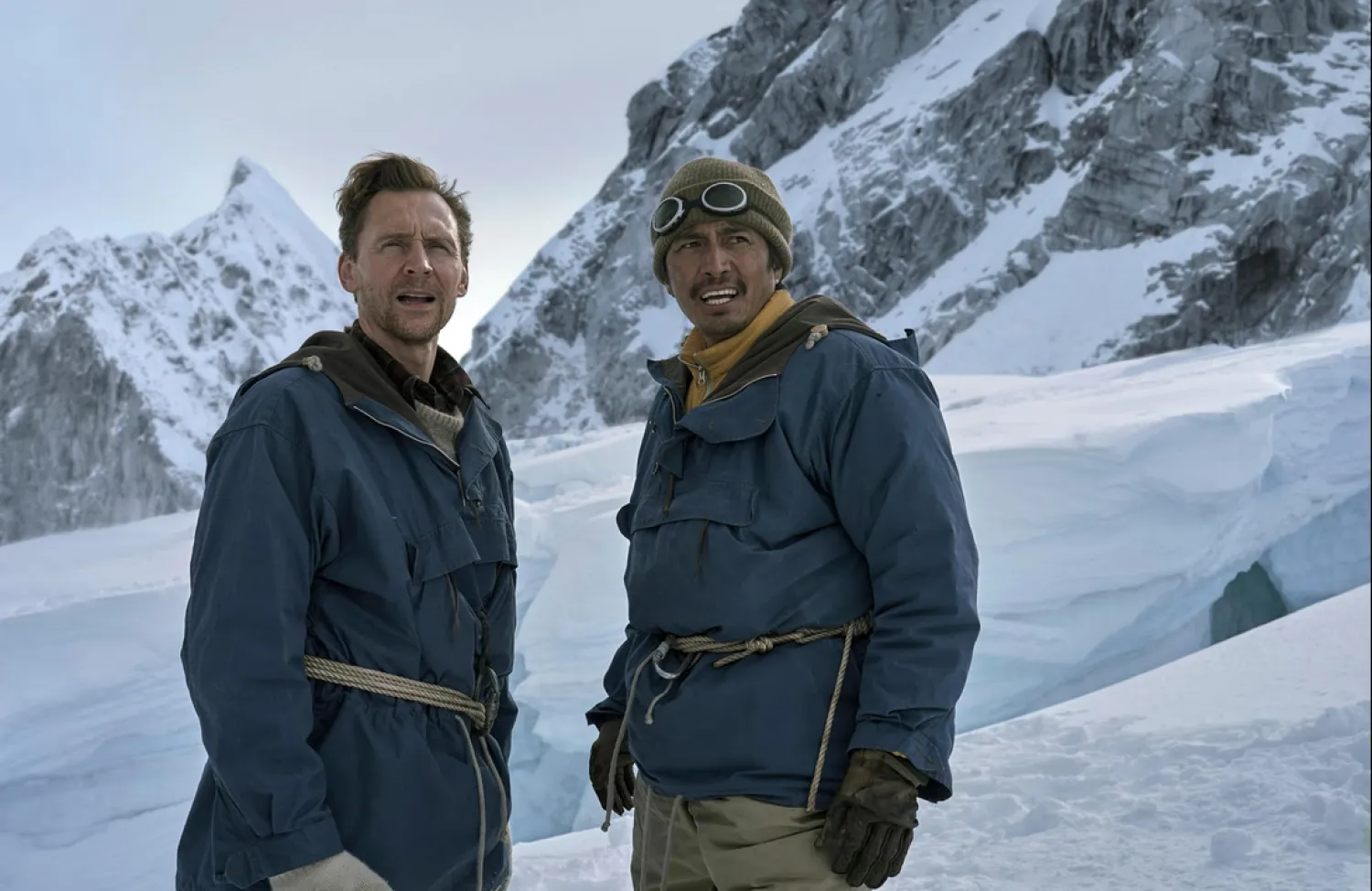
Genden Phuntsok and Tom Hiddleston in ‘Tenzing’ (Apple TV)
TT

‘Tenzing’ Makes Sure We Know Who the Real Heroes of Everest Are

Genden Phuntsok and Tom Hiddleston in ‘Tenzing’ (Apple TV)

New York: Jeanette Catsoulis

Stately and occasionally stirring, Jennifer Peedom’s movie “Tenzing” has an old-fashioned earnestness that’s gently disarming.

The film’s real-life subject is Tenzing Norgay (Genden Phuntsok), the Nepali-Indian mountaineer who, alongside Sir Edmund Hillary (Tom Hiddleston), became the first person reported to reach the summit of Mount Everest in 1953.

Neither a straight-up biopic nor a flat-out adventure yarn (its tone is too buttoned-up and British for that), “Tenzing” is instead a dramatic portrait of one man’s intense, all-consuming longing.

As a child in 1924 on the Tibetan Plateau, Tenzing watches, rapt, as the “men from away places” prepare to climb the mountain he knows only by its Tibetan name, Chomolungma.
One of those men is the English mountaineer George Mallory (Johnny Flynn), who would die on that ascent and whose brief exchange with Tenzing ignites a dream that swiftly becomes an obsession.

Almost three decades later, that drive will secure Tenzing, now an experienced climber, a spot as head Sherpa on Hillary’s expedition.

This places him in an awkward limbo: Neither a member of the British climbing team nor an ethnic Sherpa, he is viewed as an outsider by both groups.

His intelligence and preternatural climbing ability win him a promotion and respect; but Peedom, throughout her first narrative feature (after several mountain-climbing documentaries), remains keenly aware of the expedition’s class boundaries and not-so-subtle racism.

Shot in Nepal and New Zealand, “Tenzing” brings a chilly majesty to Everest’s treacherous slopes, with Stefan Duscio’s camera confirming Tenzing’s belief in the mountain’s mystical power. But a screenplay (by Luke Davies) that over-relies on confusing flashbacks and insists too often on Tenzing’s spiritual connection to Everest can cause other characters to fade to near-irrelevance. (Hillary, a polite New Zealander, is so reserved I forgot at times he was even there.) Harder to overlook is Willem Dafoe’s Colonel Hunt, the expedition leader and a man who clearly bathes in starch.

Whatever your feelings about Everest’s current ruination, there is no doubt that Tenzing — who, with Hillary, pioneered the mountain’s popular Southeast Ridge route, the site of an infamous 2014 disaster— deserves this spotlight.

And if it’s somewhat sentimental beam colors him as a little too saintly, Phuntsok’s performance is so modest and joyful that it’s difficult to mind. Whether trudging through a monsoon or hauling a grateful Hillary out of a nasty crevasse, this is a man who’s living his best life.

In any event, the film’s more worshipful tendencies are easily mitigated by its classical beauty and what can only be called its dignified — and occasionally breathtaking — handling of danger.

Tenzing may be on a spiritual quest, but the Sherpas harbor no illusions about their position or their militaristic overlords. Savvy and tart-tongued, they understand perfectly that their skills and discomfort are serving inflated foreign egos, men who “get to pretend they are heroes.”

“Tenzing,” in its quietly empathetic way, makes sure we know who the real heroes are.

The New York Times