
Israel ‘at War’ as Hamas Unleashes Surprise Attack from Gaza

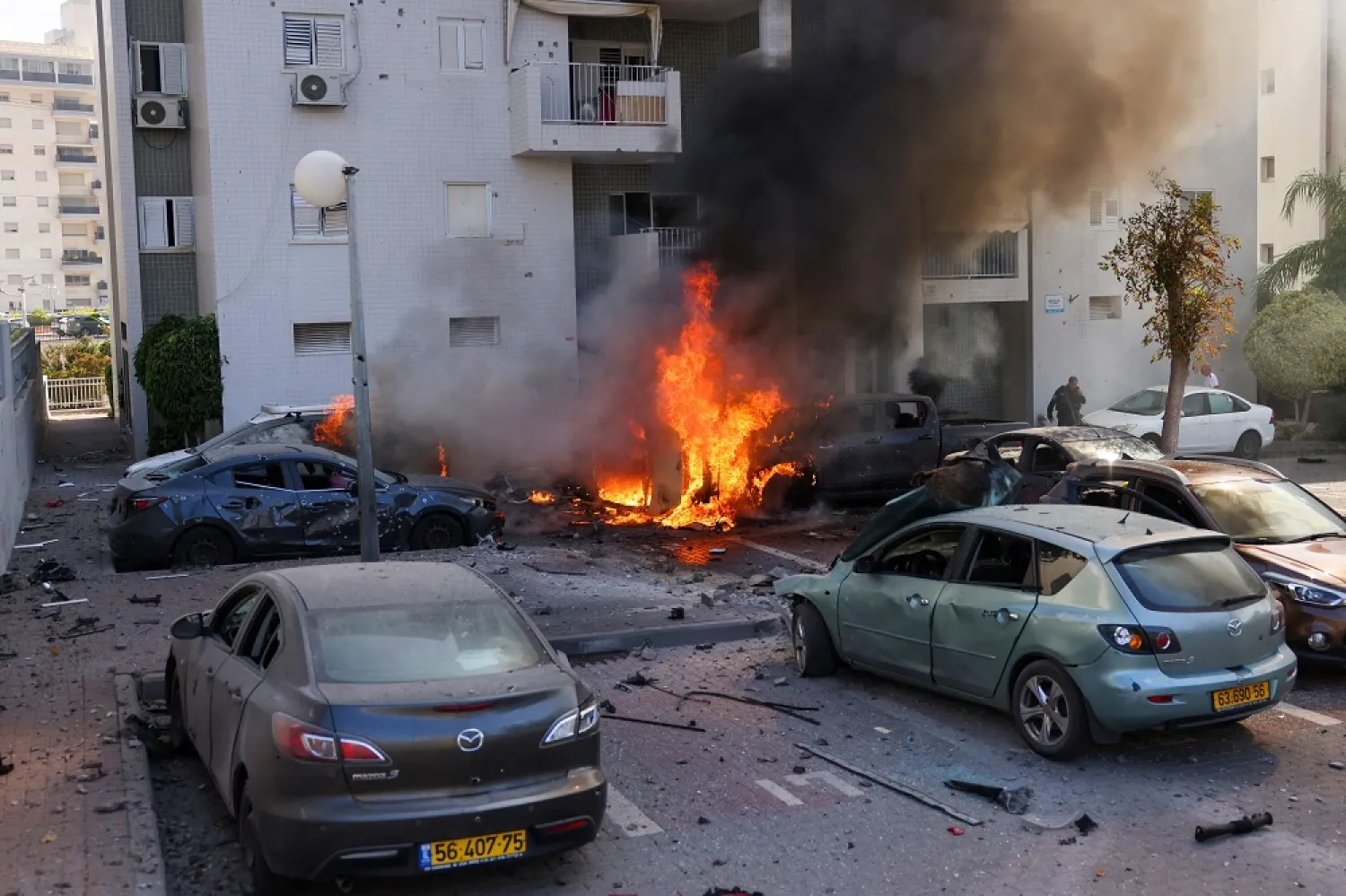
A member of the Israeli security forces stands near burning cars following a rocket attack from the Gaza Strip in Ashkelon, southern Israel, on October 7, 2023. (AFP)
TT

Israel ‘at War’ as Hamas Unleashes Surprise Attack from Gaza

A member of the Israeli security forces stands near burning cars following a rocket attack from the Gaza Strip in Ashkelon, southern Israel, on October 7, 2023. (AFP)

Palestinian movement Hamas launched the biggest attack on Israel in years on Saturday, killing dozens of people and taking hostages in a surprise assault that combined gunmen crossing into Israel with a barrage of rockets fired from the Gaza Strip.

Israel said the Iran-backed group had declared war as its army confirmed fighting with militants in several Israeli towns and military bases near Gaza, and Prime Minister Benjamin Netanyahu vowed to retaliate.

"Our enemy will pay a price the type of which it has never known," he said. "We are in a war and we will win it".

Palestinian President Mahmoud Abbas said the Palestinian people have the right to defend themselves against the "terror of settlers and occupation troops", the official news agency WAFA quoted him as saying.  

He spoke at an emergency meeting held in Ramallah with a number of top officials from the Palestinian Authority.

Israel's N12 News reported that at least 100 Israelis were killed. A Reuters photographer saw multiple bodies lying in streets of the southern town of Sderot.

The Israeli military said it had responded with air strikes into Gaza, where witnesses reported hearing heavy explosions and multiple dead and wounded being carried into hospitals. The Israeli military said navy forces killed dozens of Palestinian gunmen trying to infiltrate Israel by sea.

Hamas deputy chief Saleh al-Arouri told Al Jazeera that the group was holding a big number of Israeli captives, including senior officials. He said Hamas had enough captives to make Israel free all Palestinians in its jails.

The military confirmed Israelis were being held captive in Gaza and soldiers have been killed, according to N12 and Reshet 13 news outlets.

Gaza health officials said 198 Palestinians had been killed in air strikes as bombardments hit deep into Gaza City, sending clouds of black smoke spiraling into the sky.

Hamas said the attack was driven by what it said were Israel's escalated attacks on Palestinians in the West Bank, Jerusalem and against Palestinians in Israeli prisons.

"This is the day of the greatest battle to end the last occupation on earth," Hamas military commander Mohammad Deif said, announcing the start of the operation in a broadcast on Hamas media and calling on Palestinians everywhere to fight.

Hamas advocates Israel's destruction.

Gunbattles in Israeli towns

The attack marked an unprecedented infiltration into Israel by an unknown number of Hamas gunmen crossing from the Gaza Strip, and the heaviest blow for Israel in the conflict with Palestinians since the suicide bombings of the Second Intifada some two decades ago.

Israel and Hamas fought a 10-day war in 2021. The bloodshed came a day after Israel marked the 50th anniversary of the 1973 war that brought the country to the verge of catastrophic defeat in a surprise attack by Syria and Egypt.

The militant Islamic Jihad group said it had joined the attacks and was holding several Israeli soldiers captive. Hamas footage on its Telegram account showed its fighters pulling Israeli soldiers out of a tank.

Israeli media reported gunbattles between bands of Palestinian fighters and security forces in towns in southern Israel. Israel's police chief said there were "21 active scenes" in southern Israel.

In Gaza, people rushed to buy supplies in anticipation of days of conflict ahead. Some evacuated their homes and headed for shelters.

UN Middle East peace envoy Tor Wennesland condemned the attacks on Israel, warning in a statement: "This is a dangerous precipice, and I appeal to all to pull back from the brink."

The violence also drew criticism from Washington and other Western capitals.

"The United States unequivocally condemns the unprovoked attacks by Hamas terrorists against Israeli civilians. There is never any justification for terrorism," said White House National Security Council Spokesperson Adrienne Watson.

'Please send help'

Speaking to Israel N12 News by phone from Nir Oz, a kibbutz near Gaza, a woman identified as Dorin said gunmen had infiltrated her house and tried to open the bomb shelter where she was hiding.

"They just came in again, please send help," she said. "There are a lot of homes harmed ... My husband is holding the door closed ... They are firing rounds of bullets."

Israeli Defense Minister Gallant said "troops are fighting against the enemy at every location" and authorized the call-up of reservists.

Footage circulating on social media appeared to show clashes in city streets as well as gunmen in jeeps roaming the countryside.

"We were told there are terrorists inside the kibbutz, we can hear gunfire," a young woman named Dvir, from Beeri Kibbutz, told Israeli Army Radio from her bomb shelter.

Hamas media displayed videos of what it said were bodies of Israeli soldiers brought into Gaza by fighters, and Palestinian gunmen inside Israeli homes and touring an Israeli town in jeeps reportedly been driven into Israel by the attackers.

Reuters was not immediately able to verify the footage.

In Gaza, the roar of rocket launches could be heard and residents reported armed clashes along the separation fence with Israel, near the southern town of Khan Younis, and said they had seen significant movement of armed fighters.

Palestinians in Gaza were bracing for Israel's response.

"We are afraid," Palestinian woman, Amal Abu Daqqa, told Reuters as she left her house in Khan Younis.

The escalation comes against a backdrop of surging violence between Israel and Palestinian militants in the West Bank, which together with the Gaza Strip is part of the territories where Palestinians have long sought to establish a state.

It also comes at a time of political upheaval in Israel, which has been riven by deep divisions over moves to overhaul the judiciary.

An adviser to Iran's Supreme Leader Ali Khamenei congratulated Palestinian fighters for the attack.


Tunisia Flood Death Toll Rises to Five

 A man removes water from his flooded home in La Goulette, near the Tunisian capital Tunis. AFP 
 A man removes water from his flooded home in La Goulette, near the Tunisian capital Tunis. AFP 
TT

Tunisia Flood Death Toll Rises to Five

 A man removes water from his flooded home in La Goulette, near the Tunisian capital Tunis. AFP 
 A man removes water from his flooded home in La Goulette, near the Tunisian capital Tunis. AFP 

Authorities in Tunisia said flooding caused by three days of exceptional rainfall has killed five people, causing property damage in several provinces and leaving schools and businesses shut and transportation disrupted after parts of the country experienced their heaviest rainfall in years.

The death toll rose to five, Khalil Mechri, a civil defense spokesman told AFP. “Two people swept away by floodwaters, while a woman drowned in her home,” he said.

Mechri said since the flooding started, the emergency services pumped water from 466 inundated homes and have rescued 350 people trapped by floodwaters.

Tunisian media said four fishermen were missing on Wednesday. A fifth was rescued in Teboulba, south of Monastir, while authorities are searching for the remaining crew.

Mechri said while the bad weather was now less intense, “the level of alert remains high.”

President Kais Saied visited several affected areas on Tuesday, including Moknine and Teboulba, local media said.

Footage and videos widely circulated on social media showed significant flooding to homes and roads, with cars stranded in water, particularly in the capital, Tunis.

Authorities suspended classes on Wednesday in public and private schools and universities in 15 of the country's 24 governorates because of the weather. Transportation was also disrupted in several areas.

Abderazak Rahal, head of forecasting at the National Institute of Meteorology (INM), told AFP some Tunisian regions had not seen so much rain since 1950.

“We have recorded exceptional amounts of rainfall for the month of January,” Rahal said, with the regions of Monastir, Nabeul and greater Tunis the hardest hit.

The latest rainfall has proved record-breaking, but Tunisian streets often flood after heavy downpours, largely because of the state of the country's infrastructure.

Drainage and stormwater networks are often old and poorly maintained, particularly in rapidly expanding urban areas, with waste sometimes clogging the system.

Rapid urbanization of some areas has also led to less rainwater being absorbed into the ground, increasing runoff.

The dramatic deluge comes as Tunisia grapples with a seven-year drought, worsened by climate change and marked by a sharp decline in water reserves in dams nationwide.

In neighboring Algeria, several regions have also been hit by massive downpours and floods.

Algerian civil defense authorities said they had recovered the body of a man in his sixties who died in flooding in the northwestern province of Relizane.


Lebanon: Israel Launches New Phase of Escalation in the South

Lebanese residents flee after an Israeli air strike on the town of Qennarit in the South on Wednesday (AP). 
TT

Lebanon: Israel Launches New Phase of Escalation in the South

Lebanese residents flee after an Israeli air strike on the town of Qennarit in the South on Wednesday (AP). 

Israel has intensified its military campaign in areas north of the Litani River in South Lebanon over the past two weeks, carrying out air strikes at least twice a week—well above the tempo seen before the start of the year.

The intensified moves have been accompanied by near-daily surveillance and pursuit operations, signaling a sharper escalation as the Lebanese army prepares to launch the second phase of its plan to place weapons under state control north of the Litani.

After heavy strikes on Monday targeting areas north of the river, the Israeli army issued evacuation warnings on Wednesday afternoon for residents of five towns in southern Lebanon. The alerts came hours after Israeli strikes that killed two people, whom Israel said were Hezbollah members.

Local sources monitoring the developments told Asharq Al-Awsat that Israeli air raids now occur every two to three days — at least twice weekly — double the frequency recorded last year.

Previously, strikes were largely confined to areas south of the Litani and its banks at a rate of about once a week, often on Thursdays. The current campaign includes strikes on valleys and village outskirts, alongside repeated evacuation warnings in several towns north of the river. The warnings increasingly target large buildings and entire neighborhoods, with heavy munitions causing widespread damage to property and surrounding areas.

On Wednesday afternoon, the Israeli army issued evacuation orders in two phases for five villages north of the Litani, triggering the displacement of hundreds of residents. Israeli army Arabic-language spokesperson Avichay Adraee said the military would strike Hezbollah infrastructure to counter what he described as attempts to rebuild its activities in the region.

He identified targets in Jarjoua and Kfar Kila in Nabatieh district and Qennarit in Sidon district, about 40 kilometers from the border, and urged residents to evacuate immediately. After strikes destroyed the targeted buildings and damaged nearby structures, further evacuation orders were issued for Ansar and Zrariyeh, around 30 kilometers from the Israeli border.

The Lebanese army is expected next month to submit a plan to the government outlining mechanisms for disarming Hezbollah north of the Litani, following its announcement that it had dismantled the group’s weapons in border areas south of the river.

Earlier in January, the army said it had completed the first phase of the plan, aimed at placing weapons exclusively under state control, and asserted that it had established operational control over areas south of the Litani — roughly 30 kilometers from the Israeli border — except for territories still under Israeli occupation.

Israel has questioned the adequacy of these measures, describing them as insufficient. Under the ceasefire agreement, Israel was expected to withdraw from South Lebanon but has maintained its presence at five strategic positions, which Lebanon continues to demand it vacate.


Lebanese Army Affirms Commitment to Protect Borders with Syria

Lebanese Army Commander General Rodolphe Haykal holds a meeting of the High Supervision Committee on the Border Protection Assistance Program in the presence of British, US and Canadian Ambassadors to Lebanon (Lebanese Army Directorate of Orientation) 
TT

Lebanese Army Affirms Commitment to Protect Borders with Syria

Lebanese Army Commander General Rodolphe Haykal holds a meeting of the High Supervision Committee on the Border Protection Assistance Program in the presence of British, US and Canadian Ambassadors to Lebanon (Lebanese Army Directorate of Orientation) 

The Lebanese Army on Wednesday reaffirmed its commitment to protect the border with Syria, stressing that achieving this goal successfully “requires qualitative military support.”

The announcement came in parallel with preparations to hold a fundraising conference in support of the country’s army, scheduled to be held in Paris on March 5.

The Lebanese Army is deployed along its northern and eastern border with Syria, where its forces work on implementing security measures and combat smuggling.

Other tasks include deployment on the southern border with Israel, implementing the Lebanese government’s plan to dismantle all armed militias, as well as protecting internal stability and combating drug smuggling.

In this regard, a meeting of the Higher Supervisory Committee on the Assistance Program for Land Borders Protection was held in Yarzeh, in the presence of Lebanese Army Commander General Rodolphe Haykal, British Ambassador to Lebanon Hamish Cowell, US Ambassador, Michel Issa, Canadian Ambassador Gregory Galligan, and members of the joint working team.

In a statement, the Lebanese Army Command said the meeting highlighted the implemented phases of the program and the necessary steps to support the LAF units tasked with protecting Lebanon’s eastern and northern borders and combat smuggling and illegal activities.

The British embassy said in a statement that the ambassadors underlined the LAF’s pivotal role in maintaining security and stability during a period of significant challenge.

They stressed the need to support the military institutions to further strengthen Lebanon’s security, stability, and territorial integrity.

“The Committee convened to review progress and challenges in securing Lebanon’s eastern and northern borders, and reaffirmed support for the LAF’s (Lebanese Army’s) efforts to reinforce state authority at this critical time,” the British embassy said.

For his part, General Haykal said, “We are committed to protect the borders and we have made many efforts and sacrifices to this end.”

However, he added, “achieving this goal successfully requires qualitative military support, given the size of challenges on the northern and eastern borders.”

Haykal hailed the US, British, and Canadian authorities for their continuous support to the army, which plays a fundamental role in enhancing the capabilities of military units and enabling them to carry out their missions amid the current challenges.