


Israel Ramps up Strikes on Gaza as US Advises Delaying Ground Offensive to Allow Talks on Captives

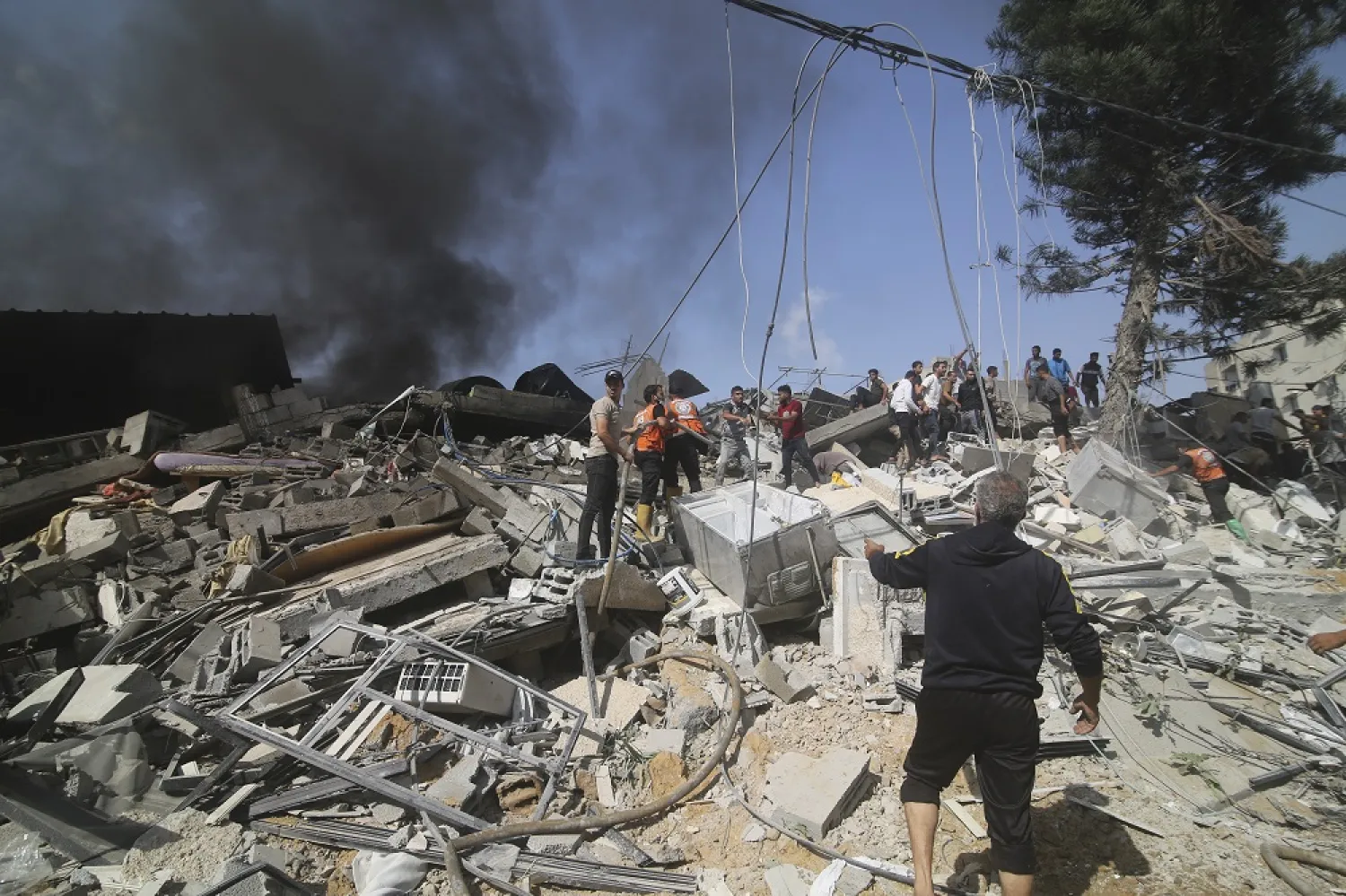
Palestinians look for survivors of the Israeli bombardment of the Gaza Strip in Rafah on Monday, Oct. 23, 2023. (AP)
TT

Israel Ramps up Strikes on Gaza as US Advises Delaying Ground Offensive to Allow Talks on Captives

Palestinians look for survivors of the Israeli bombardment of the Gaza Strip in Rafah on Monday, Oct. 23, 2023. (AP)

Israel ramped up its airstrikes Monday in Gaza, where the death toll was rising rapidly, and the United States advised Israel to delay an expected ground invasion to allow more time to negotiate the release of hostages taken by Hamas militants.

A third small aid convoy from Egypt entered Gaza, where the population of 2.3 million has been running out of food, water and medicine under Israel's two-week seal. Israel was still barring the entry of fuel, and Gaza hospitals say they are struggling to keep generators running to power life-saving medical equipment and incubators for premature babies.

Heavy airstrikes demolished buildings across Gaza, including in areas where Palestinians have been told to seek refuge, killing hundreds and sending new waves of wounded into already packed hospitals, according to Palestinian officials and witnesses.  

After a strike in Gaza City, a woman with blood on her face wept as she clasped the hand of a dead relative. At least three bodies were sprawled on the street, one lying in a gray stream of water.

Israel is widely expected to launch a ground offensive in Gaza following Hamas’ brutal Oct. 7 rampage into southern Israeli communities. That is raising fears of the war spreading beyond Gaza and Israel, as Iranian-backed fighters in the region are warning of possible escalation, including targeting US forces deployed in the Mideast.

The US has urged Iranian-backed Hezbollah in Lebanon and other groups not to join the fight. Israel has frequently traded fire with Hezbollah, which is armed with tens of thousands of rockets. Israeli warplanes have struck targets in the occupied West Bank, Syria and Lebanon in recent days.

The US has advised Israeli officials that delaying the expected ground offensive would give Washington more time to work with regional mediators on securing the release of people captured by Hamas during its deadly incursion, according to a US official.

The official, who requested anonymity to discuss the private discussions, said it was unclear how much the argument will “move the needle” on Israeli thinking. Hamas released an American woman and her teenage daughter last week in what it said was a humanitarian gesture mediated by Qatar.

Tanks and troops have been massed at the Gaza border, and Israel says it has stepped up airstrikes in order to reduce the risk to troops in the next stages. A ground excursion is likely to dramatically increase casualties in what is already the deadliest by far of five wars fought between Israel and Hamas in less than 15 years.

More than 1,400 people in Israel have been killed — mostly civilians slain during the initial Hamas attack. At least 222 people were captured and dragged back to Gaza, including foreigners, the military said Monday, updating a previous figure.

More than 5,000 Palestinians, including some 2,000 minors and around 1,100 women, have been killed, the Hamas-run Health Ministry said Monday. That includes the disputed toll from an explosion at a hospital last week. The toll has climbed rapidly in recent days, with the ministry reporting 436 additional deaths in just the last 24 hours.

Israel said it had struck 320 militant targets throughout Gaza over the last 24 hours in preparation for “a maneuver,” an apparent reference to a ground operation. The military says it does not target civilians, and that Palestinian militants have fired over 7,000 rockets at Israel since the start of the war.

The Israeli military released footage showing what it said were attacks on Hamas infrastructure. Flashes of yellow light were followed by an explosion that sent gray smoke and debris shooting upward as multi-story buildings collapsed or toppled over.

Israel carried out limited ground forays into Gaza, and on Sunday, Hamas said it had destroyed an Israeli tank and two armored bulldozers inside the territory it has ruled since 2007. The Israeli military said a soldier was killed and three others were wounded by an anti-tank missile during a raid inside Gaza.

The military said the raid was part of efforts to rescue hostages abducted in the Oct. 7 attack. Hamas hopes to trade the captives for Palestinian prisoners held by Israel.

On Monday the Palestinian Red Crescent said 20 trucks entered Gaza carrying food, water, medicine and medical supplies, through the Rafah crossing with Egypt, the only way into Gaza not controlled by Israel. It was the third delivery in as many days, each around the same size.

An airstrike hit a residential building some 200 meters (yards) from the UN headquarters in Rafah on Monday, killing and wounding several people, according to an Associated Press reporter at the scene, underscoring the perils of humanitarian operations.

Abu Youssef Al-Najjar Hospital, in Rafah, registered 61 deaths since Monday morning, the hospital’s spokesperson said, following a day of intense airstrikes in southern Gaza. With no room in the morgue for the bodies, “more than half of them are lying on the (hospital) ground,” spokesperson Talaat Barghout said.

In a Sunday phone call, Netanyahu and US President Joe Biden “affirmed that there will now be continued flow of this critical assistance into Gaza,” the White House said in a statement.

Relief workers said far more aid was needed to address the spiraling humanitarian crisis in Gaza. Much of the population is drinking dirty water; the lack of fuel has crippled water and sanitation systems. The UN humanitarian agency said 20 trucks amounts to 4% of an average day’s imports before the war.

More than half the territory’s population have fled their homes, and hundreds of thousands are sheltering in UN-run schools and tent camps.

The World Health Organization said seven hospitals in northern Gaza have been forced to shut down due to damage from strikes, lack of power and supplies, or Israeli evacuation orders.

Israel repeated its calls for people to leave northern Gaza, including by dropping leaflets from the air. It estimated 700,000 have already fled. But hundreds of thousands remain. That would raise the risk of mass civilian casualties in any ground offensive.

Secretary of State Antony Blinken said Israel “can't go back to the status quo” in which Hamas controls Gaza and is able to threaten it, but that Israel has “absolutely no intent” to govern Gaza itself.  

Speaking to NBC’s “Meet the Press” on Sunday, he said the question of how Gaza will be governed needs to be worked out "even as Israel is dealing with the current threat.”

Israel captured Gaza, along with the West Bank and east Jerusalem, in the 1967 Mideast war. The Palestinians want all three territories for a future state. Israel withdrew troops and settlers from Gaza in 2005, but Israel has imposed a blockade of varying degrees since Hamas seized power from rival Palestinian forces in 2007.



Axios: US Plans Meeting for Gaza 'Board of Peace' in Washington on Feb 19

Trump and leaders and representatives of the countries participating in the signing of the founding charter of the “Peace Council” in Davos (AFP - Archive)
TT

Axios: US Plans Meeting for Gaza 'Board of Peace' in Washington on Feb 19

Trump and leaders and representatives of the countries participating in the signing of the founding charter of the “Peace Council” in Davos (AFP - Archive)

The White House is planning the first leaders meeting for President Donald Trump's so-called "Board of Peace" in relation to Gaza on February 19, Axios reported on Friday, citing a US official and diplomats from four countries that are on the board.

The plans for the meeting, which would also be a fundraising conference for Gaza reconstruction, are in early stages and could still change, Axios reported.

The meeting is planned to be held at the US Institute of Peace in Washington, the report added, noting that Israeli Prime ‌Minister Benjamin Netanyahu ‌is scheduled to meet Trump at the ‌White ⁠House on ‌February 18, a day before the planned meeting.

The White House and the US State Department did not respond to requests for comment.

In late January, Trump launched the board that he will chair and which he says will aim to resolve global conflicts, leading to many experts being concerned that such a board could undermine the United Nations, Reuters said.

Governments around ⁠the world have reacted cautiously to Trump's invitation to join that initiative. While some ‌of Washington's Middle Eastern allies have joined, many ‍of its traditional Western allies have ‍thus far stayed away.

A UN Security Council resolution, adopted in ‍mid-November, authorized the board and countries working with it to establish an international stabilization force in Gaza, where a fragile ceasefire began in October under a Trump plan on which Israel and Palestinian militant group Hamas signed off.

Under Trump's Gaza plan revealed late last year, the board was meant to supervise Gaza's temporary governance. Trump thereafter said ⁠it would be expanded to tackle global conflicts.

Many rights experts say that Trump overseeing a board to supervise a foreign territory's affairs resembled a colonial structure and have criticized the board for not including a Palestinian.

The fragile ceasefire in Gaza has been repeatedly violated, with over 550 Palestinians and four Israeli soldiers reported killed since the truce began in October.

Israel's assault on Gaza since late 2023 has killed over 71,000 Palestinians, caused a hunger crisis and internally displaced Gaza's entire population.

Multiple rights experts, scholars and a UN inquiry say it amounts to genocide. Israel calls its actions self-defense after Hamas-led ‌militants killed 1,200 people and took over 250 hostages in a late 2023 attack.


A Man Detonates Explosive Belt during Arrest Attempt in Iraq, Injuring 2 Security Members

A man wearing an explosives belt blew himself up Friday while a security force was trying to arrest him in western Iraq near the Syrian border, killing himself and wounding two security members, an Iraqi security official said. (Reuters/File)
TT

A Man Detonates Explosive Belt during Arrest Attempt in Iraq, Injuring 2 Security Members

A man wearing an explosives belt blew himself up Friday while a security force was trying to arrest him in western Iraq near the Syrian border, killing himself and wounding two security members, an Iraqi security official said. (Reuters/File)

A man wearing an explosives belt blew himself up Friday while a security force was trying to arrest him in western Iraq near the Syrian border, killing himself and wounding two security members, an Iraqi security official said.

The raid was being conducted in the al-Khaseem area in Qaim district that borders Syria, said the official who spoke on condition of anonymity in line with regulations.

The official added that “preliminary information” confirms that no members of the security forces were killed, while two personnel were injured and transferred for medical treatment, The Associated Press said.

Iraq’s National Security Agency said in a statement that its members besieged a hideout of an ISIS group security official and two of his bodyguards. One bodyguard ignited his explosives belt, killing him. It gave no further details.

ISIS once controlled large parts of Syria and Iraq and declared a caliphate in 2014. The extremist group was defeated on the battlefield in Iraq in 2017 and in Syria in 2019 but its sleeper cells still carry out deadly attacks in both countries.

In December, two US service members and an American civilian were killed in an attack in Syria that the United States blamed on ISIS. The US carried out strikes on Syria days later in retaliation.

US and Iraqi authorities in January began transferring hundreds of the nearly 9,000 ISIS members held in jails run by the US-backed and Kurdish-led Syrian Democratic Forces in northeast Syria to Iraq, where Iraqi authorities plan to prosecute them.


UN Peacekeepers in Lebanon Allege Surge in Israeli Violence toward Them

United Nations Spanish UNIFIL forces arrive to inspect chalets, after the Israeli army reportedly booby-trapped and blew them up at dawn, on the outskirts of the town of al-Khiam, southern Lebanon on January 31, 2026. (Photo by Rabih DAHER / AFP)
TT

UN Peacekeepers in Lebanon Allege Surge in Israeli Violence toward Them

United Nations Spanish UNIFIL forces arrive to inspect chalets, after the Israeli army reportedly booby-trapped and blew them up at dawn, on the outskirts of the town of al-Khiam, southern Lebanon on January 31, 2026. (Photo by Rabih DAHER / AFP)

UN peacekeepers patrolling southern Lebanon have faced a dramatic surge of “aggressive behavior” by Israeli forces over the last year, including drone-dropped grenades and machine-gun fire, according to an internal report seen by The Associated Press.

The report by one of the 48 nations that together have more than 7,500 peacekeepers in southern Lebanon says the number of incidents jumped from just one in January to 27 in December. The hilly frontier zone where the UNIFIL force patrols has seen decades of cross-border violence. Israel and Lebanon's Hezbollah militants fought a full-scale war in 2024.

The targeting of peacekeepers appears aimed at undermining the international force and strengthening Israel’s military footprint along the UN-drawn border with Lebanon, known as the Blue Line, the report alleges. It was shared with AP on condition that the news organization not identify the country whose peacekeepers compiled the findings for internal use by their senior command.

Israel has long mistrusted UNIFIL, accusing it of failing to prevent Hezbollah from building up its military presence along the border in violation of ceasefire agreements going back two decades.

The growing catalog of run-ins comes as a half-century of international peacekeeping efforts along the border face an uncertain future. UNIFIL’s mission is scheduled to end this year and US President Donald Trump ’s administration regards it as a waste of money.

Israel says it tries to reduce harm

In a statement to AP, the Israeli military said it “is not conducting a deterrence campaign against UNIFIL forces" and is working within accepted frameworks to dismantle Hezbollah, largely based in southern Lebanon.

The military “takes steps to reduce harm to UNIFIL forces and other international actors operating in the area,” it said.

UNIFIL said in a statement that “the number of attacks on or near peacekeepers, as well as aggressive behavior toward peacekeepers, have increased since September 2025,” with most of those incidents attributed to the Israeli military.

“The majority of incidents do not involve physical harm to peacekeepers, but any action that interferes with our mandated activities is a matter of concern,” it said.

The UN force has reported additional incidents this year. An Israeli tank opened fire with small-caliber bullets on a UNIFIL post on Jan. 16, it said. This week, it reported that a drone dropped a stun grenade that exploded in the vicinity of a peacekeeping patrol before flying toward Israeli territory.

Report details array of incidents

The report seen by AP details multiple instances in 2025 of grenades being dropped by Israeli drones near UNIFIL patrols, including an attack in October that wounded a peacekeeper, as well as machine-gun fire near UNIFIL positions. In some cases, UNIFIL vehicles were damaged.

The last four months of 2025 also saw a surge in incidents of direct fire at all targets from Israeli positions on both sides of the Blue Line, the report says. Such incidents spiked to 77 in December, up from just two in January, it says.

UNIFIL vehicles and positions are clearly marked as belonging to the UN, and Hezbollah militants have not maintained a visible presence or fired on Israeli forces in recent months.

The report says “it cannot be excluded” that Israel is using the incidents to maintain a military presence north of the border and prevent people who have fled the zone from returning.

Israel-Hezbollah conflict

After the Oct. 7, 2023, Hamas -led attack on Israel that triggered war in Gaza, Hezbollah began firing rockets from Lebanon into Israel in support of Hamas and the Palestinians.

Israel responded with airstrikes and shelling. The low-level conflict escalated into full-scale war in September 2024, later reined in but not fully stopped by a US-brokered ceasefire two months later.

Since then, Israel has accused Hezbollah of trying to rebuild in the south, in violation of the ceasefire, and has carried out near-daily strikes in Lebanon that it says target Hezbollah militants and facilities. Israeli forces also continue to occupy five hilltop points on the Lebanese side of the border. Hezbollah has claimed one strike against Israel since the ceasefire.

Spraying of chemicals spurs an outcry

The UN and Lebanon say Israeli forces dropped herbicide on Lebanese territory on Sunday, forcing a more than nine-hour pause in peacekeeping activities, including patrols.

“The use of herbicides raises questions about the effects on local agricultural lands, and how this might impact the return of civilians to their homes and livelihoods in the long-term,” UN spokesperson Stéphane Dujarric said. There was no Israeli comment.

Dujarric added that “any activity” by the Israeli military north of the Blue Line violates a UN resolution adopted in 2006 that expanded the UNIFIL mission, in hopes of restoring peace to the area after a monthlong war between Israel and Hezbollah.

Uncertain future for border area UNIFIL was created nearly five decades ago to oversee Israel's withdrawal from southern Lebanon after its troops invaded in 1978.

The UN Security Council voted last August to terminate its mission at the end of 2026.

Israel had long sought an end to its mandate, saying UNIFIL failed to keep Hezbollah away from the border. Under the 2006 UN ceasefire, the Lebanese army was supposed to maintain security in the south with backing from UNIFIL and militants were to disarm.

Hezbollah supporters in Lebanon have frequently accused UNIFIL of collusion with Israel and have sometimes attacked its patrols.

The Lebanese government says UNIFIL serves a necessary purpose. Prime Minister Nawaf Salam said in December that Lebanon will need a follow-up force to fill the vacuum and to help Lebanese troops along the border as they expand their presence there.

In an AP interview this week, Lebanese Deputy Prime Minister Tarek Mitri said several proposals are under discussion.

One possibility is an expansion of the United Nations Truce Supervision Organization, or UNTSO, which maintains a small observer force in Lebanon. The European Union has also offered to contribute to an international observer force, he said.

Whatever the arrangement, Mitri said: “We need a neutral, internationally mandated force to observe and make sure that whatever is agreed upon in negotiations is fully respected."