


‘Many More to Die’ from Gaza Siege, UN Warns on Day 21 of War

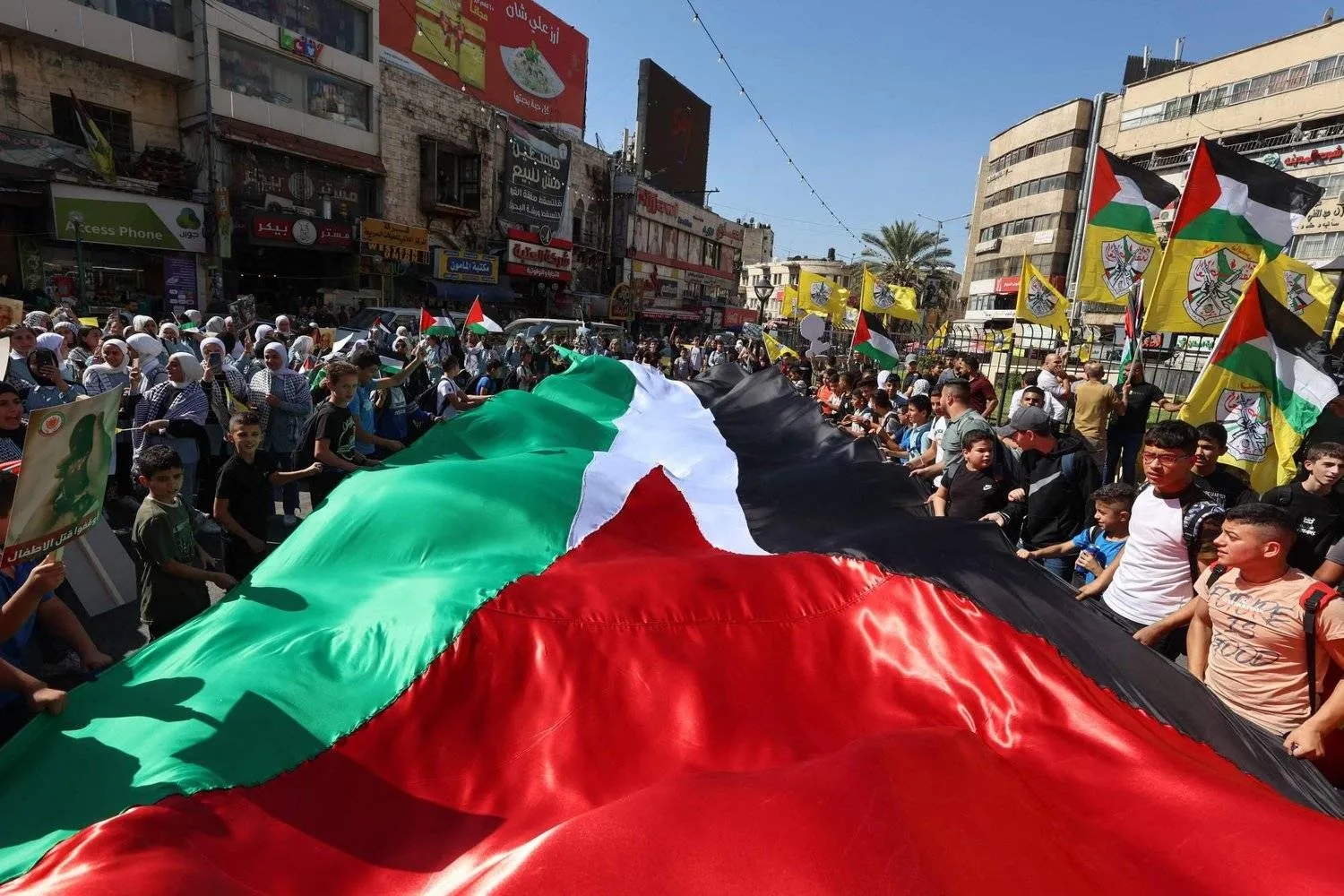
A protest in the city of Nablus in the West Bank on Thursday to show solidarity with Gazans. (AFP)
TT

‘Many More to Die’ from Gaza Siege, UN Warns on Day 21 of War

A protest in the city of Nablus in the West Bank on Thursday to show solidarity with Gazans. (AFP)

The UN warned Friday that "many more will die" in Gaza from catastrophic shortages after nearly three weeks of bombardment by Israel in response to Hamas staging the deadliest attack in its history.  

And it raised the alarm over "war crimes" being committed as the Israel-Hamas conflict raged into its 21st day. The army said it had mounted another brief land incursion into Gaza as it prepares for a ground offensive.  

Concern is growing about regional fallout from the conflict, with the United States warning Iran against escalation while striking facilities in Syria it says were used by Iran's Revolutionary Guard Corps and others.

Israel has heavily bombarded Gaza since Hamas gunmen stormed across the border on October 7, killing 1,400 people, mostly civilians, kidnapping over 220 others, according to Israeli officials.

The health ministry in the Hamas-run Gaza Strip, in an update on Friday, said the strikes had now killed 7,326 people, mainly civilians and many of them children.

Israel's military on Friday accused Hamas of using hospitals in Gaza as operations centers for directing attacks.

"Hamas wages war from hospitals," in the territory, military spokesman Daniel Hagari said.

He also alleged the group was also using fuel stored in these facilities for its operations.

War crimes  

Israel has cut supplies of food, water and power to Gaza, notably blocking all deliveries of fuel saying it would be exploited by Hamas to manufacture weapons and explosives.

"People in Gaza are dying, they are not only dying from bombs and strikes, soon many more will die from the consequences of (the) siege," said Philippe Lazzarini, head of the UN's agency for Palestinian refugees (UNRWA).

"Basic services are crumbling, medicine is running out, food and water are running out, the streets of Gaza have started overflowing with sewage," Lazzarini said of the overcrowded territory where 45 percent of housing is reported to have been damaged or destroyed.

In Geneva, the UN human rights office raised the alarm over war crimes, saying "the atrocious attacks by Hamas... amounted to war crimes" but also pointing to Israel's Gaza bombardment.  

"Nowhere is safe in Gaza. Compelling people to evacuate in these circumstances... and while under a complete siege raises serious concerns over forcible transfer, which is a war crime," spokeswoman Ravina Shamdasani said of Israel's order for northern Gaza residents to flee south. 

And a humanitarian catastrophe was unfolding for Gazans who were "being collectively punished" which "is a war crime", she said.

French President Emmanuel Macron called for a "humanitarian truce" for the protection of civilians in Gaza, as he said Israel's response must "better target... terrorists".  

And a first team of six medics from the International Committee of the Red Cross entered Gaza Friday via its Rafah crossing with Egypt, along with six aid trucks, the ICRC said.  

'Nothing more than crumbs'  

A first tranche of critically needed aid was allowed in at the weekend, but since then only 74 trucks have crossed. Before the conflict, the UN says an average of 500 trucks were entering Gaza every day.

"These few trucks are nothing more than crumbs that will not make a difference," Lazzarini said, insisting Gaza needed a "meaningful and uninterrupted aid flow" and a "humanitarian ceasefire to ensure this aid reaches those in need".

His words echoed an EU leaders' call on Thursday for "continued, rapid, safe and unhindered humanitarian access and aid" to those in need via "humanitarian corridors and pauses for humanitarian needs".

Between the bombardments and the fuel shortages, 12 of Gaza's 35 hospitals have been forced to close, and UNRWA said it has had to "significantly reduce its operations".

The agency also said 57 of its staff had been killed since the war began.

With tens of thousands of Israeli troops massed along the Gaza border ahead of a widely expected ground offensive, the army said it had staged another brief ground incursion into Gaza, the second in as many days.  

"We carried out a ground operation in central Gaza... as part of preparations for the coming stages of the war," the army's Hagari added. The first incursion had targeted northern Gaza.  

Hamas also said Israeli troops had tried to stage "a large-scale amphibious operation on Rafah's coast" in southern Gaza at dawn but it had been thwarted, saying the soldiers had "fled by sea, leaving behind a quantity of weapons".  

Israel confirmed the operation, saying troops had struck "Hamas military infrastructure and... a compound" used by Hamas militants.  

'Wherever we go, we will die'  

The army also updated to 229 the number of hostages held by Hamas, many of whom hold foreign passports, with their families frantic about their fate.

"I have never felt such a feeling of helplessness," said 23-year-old Ella Ben Ami whose parents were kidnapped. With recurring nightmares every single night, she says she feels "like the living dead".

"Almost every family has lost someone. Nobody can comprehend that there are so many people that we won't see again," she told AFP as Israeli therapists said they had been overwhelmed by the number of traumatized people.  

Militants fired rockets on Friday towards Tel Aviv, where people could be seen running for cover as sirens wailed, AFP correspondents said. One stuck the city, wounding three people, one moderately and two lightly, medics said.  

Despite Israel's call for civilians in northern Gaza to move south for their safety, strikes have continued to hit southern areas, with many saying they could find nowhere to shelter.  

"Wherever we go, we will die," said Rahma Saqallah who fled her Gaza City home to go south with her family but decided to turn back after strikes killed her husband and three of her children.  

"They told us to leave for the south and then they killed us (here)," she said on leaving the southern town of Khan Yunis to head home with her one remaining child.  

Violence has also risen sharply in the occupied West Bank since the October 7 attacks, with more than 100 Palestinians killed and over 1,900 wounded.  

Another four Palestinians were killed Friday during Israeli raids in the northern cities of Jenin and Qalqilya, the health ministry said.



Rescue Teams Search for Survivors in Building Collapse that Killed at Least 2 in Northern Lebanon

A Lebanese flag is pictured, in the aftermath of a massive explosion, in Beirut's damaged port area, Lebanon August 17, 2020. REUTERS/Hannah McKay
TT

Rescue Teams Search for Survivors in Building Collapse that Killed at Least 2 in Northern Lebanon

A Lebanese flag is pictured, in the aftermath of a massive explosion, in Beirut's damaged port area, Lebanon August 17, 2020. REUTERS/Hannah McKay

At least two people were killed and four rescued from the rubble of a multistory apartment building that collapsed Sunday in the city of Tripoli in northern Lebanon, state media reported.

Rescue teams were continuing to dig through the rubble. It was not immediately clear how many people were in the building when it fell.

The bodies pulled out were of a child and a woman, the state-run National News Agency reported.

Dozens of people crowded around the site of the crater left by the collapsed building, with some shooting in the air.

The building was in the neighborhood of Bab Tabbaneh, one of the poorest areas in Lebanon’s second largest city, where residents have long complained of government neglect and shoddy infrastructure. Building collapses are not uncommon in Tripoli due to poor building standards, according to The AP news.

Lebanon’s Health Ministry announced that those injured in the collapse would receive treatment at the state’s expense.

The national syndicate for property owners in a statement called the collapse the result of “blatant negligence and shortcomings of the Lebanese state toward the safety of citizens and their housing security,” and said it is “not an isolated incident.”

The syndicate called for the government to launch a comprehensive national survey of buildings at risk of collapse.


Israel to Take More West Bank Powers and Relax Settler Land Buys

A view of Israeli settlement of Maale Adumim, in the West Bank, Sunday, June 18, 2023. (AP)
TT

Israel to Take More West Bank Powers and Relax Settler Land Buys

A view of Israeli settlement of Maale Adumim, in the West Bank, Sunday, June 18, 2023. (AP)

Israel's security cabinet approved a series of steps on Sunday that would make it easier for settlers in the occupied West Bank to buy land while granting Israeli authorities more enforcement powers over Palestinians, Israeli media reported.

The West Bank is among the territories that the Palestinians seek for a future independent state. Much of it is under Israeli military control, with limited Palestinian self-rule in some areas run by the Western-backed Palestinian Authority (PA).

Citing statements by Finance Minister Bezalel Smotrich and Defense Minister Israel Katz, Israeli news sites Ynet and Haaretz said the measures included scrapping decades-old regulations that prevent Jewish private citizens buying land in the West Bank, The AP news reported.

They were also reported to include allowing Israeli authorities to administer some religious sites, and expand supervision and enforcement in areas under PA administration in matters of environmental hazards, water offences and damage to archaeological sites.

Palestinian President Mahmoud Abbas said the new measures were dangerous, illegal and tantamount to de-facto annexation.

The Israeli ministers did not immediately respond to requests for comment.

The new measures come three days before Prime Minister Benjamin Netanyahu is scheduled to meet in Washington with US President Donald Trump.

Trump has ruled out Israeli annexation of the West Bank but his administration has not sought to curb Israel's accelerated settlement building, which the Palestinians say denies them a potential state by eating away at its territory.

Netanyahu, who is facing an election later this year, deems the establishment of any Palestinian state a security threat.

His ruling coalition includes many pro-settler members who want Israel to annex the West Bank, land captured in the 1967 Middle East war to which Israel cites biblical and historical ties.

The United Nations' highest court said in a non-binding advisory opinion in 2024 that Israel's occupation of Palestinian territories and settlements there is illegal and should be ended as soon as possible. Israel disputes this view.


Arab League Condemns Attack on Aid Convoys in Sudan

A general view shows the opening session of the meeting of Arab foreign ministers at the Arab League Headquarters (Reuters)
TT

Arab League Condemns Attack on Aid Convoys in Sudan

A general view shows the opening session of the meeting of Arab foreign ministers at the Arab League Headquarters (Reuters)

Arab League Secretary-General Ahmed Aboul Gheit strongly condemned the attack by the Rapid Support Forces on humanitarian aid convoys and relief workers in North Kordofan State, Sudan.

In a statement reported by SPA, secretary-general's spokesperson Jamal Rushdi quoted Aboul Gheit as saying the attack constitutes a war crime under international humanitarian law, which prohibits the deliberate targeting of civilians and depriving them of their means of survival.

Aboul Gheit stressed the need to hold those responsible accountable, end impunity, and ensure the full protection of civilians, humanitarian workers, and relief facilities in Sudan.