


'Black Lives 4 Palestine': US Activists Find Common Cause

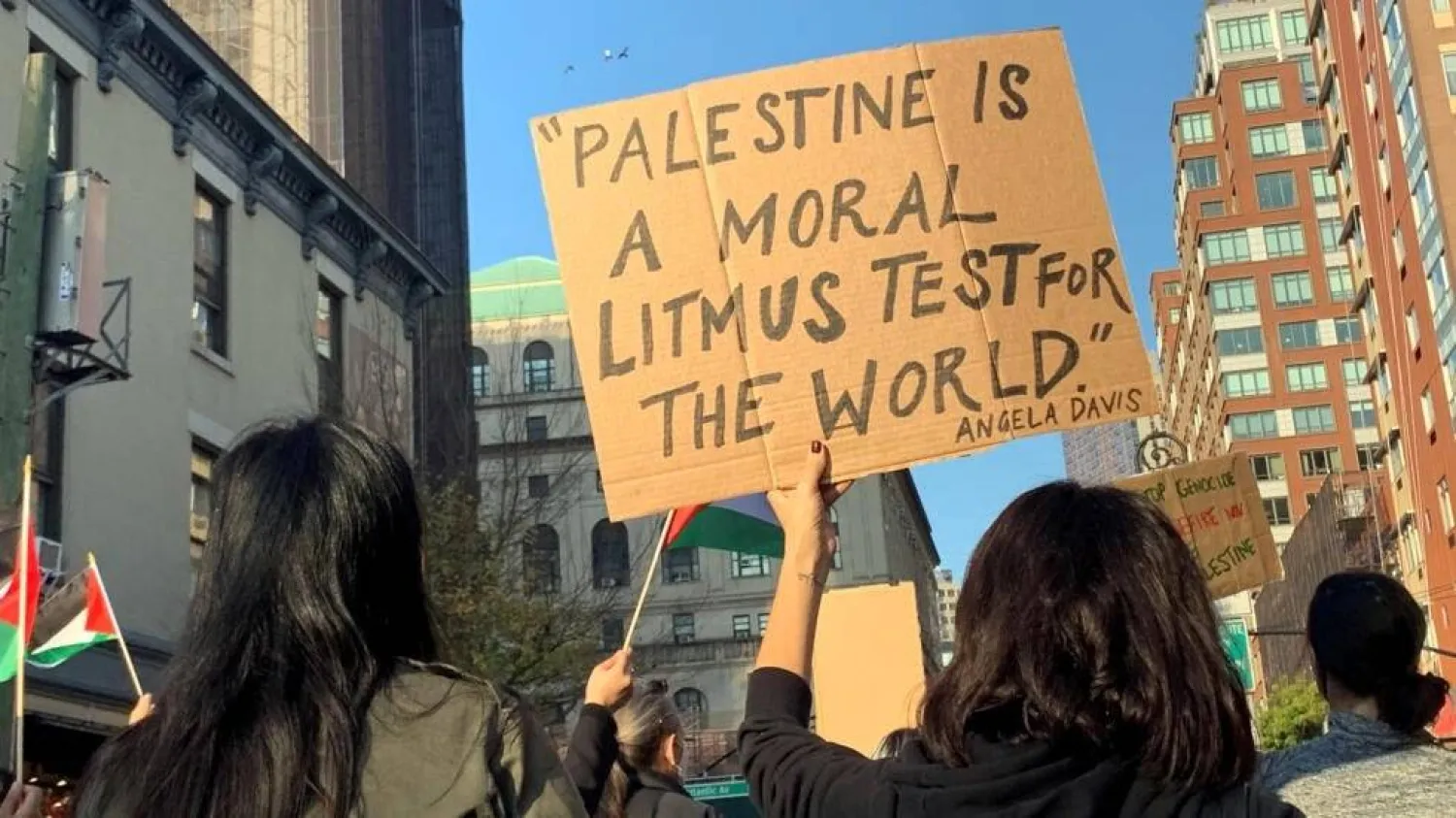
Demonstrators march during the "Palestine to Africa - Palestinian Liberation is Black Liberation" protest in New York on November 5, 2023. Maggy Donaldson / AFP
TT

'Black Lives 4 Palestine': US Activists Find Common Cause

Demonstrators march during the "Palestine to Africa - Palestinian Liberation is Black Liberation" protest in New York on November 5, 2023. Maggy Donaldson / AFP

Marching in Black Lives Matter protests in 2020 was the first time AnnEliza Canning-Skinner "experienced what solidarity is," she says.

Fast-forward three years and the 28-year-old has been a regular on the streets of New York, marching in support of Palestinians as Israel's bombing campaign of the Gaza Strip hits the one month-mark, said AFP.

Israel launched the offensive, which the UN warns is creating a humanitarian "catastrophe," after brutal Hamas attacks in Israel on October 7.

Canning-Skinner is one of thousands of demonstrators across the United States who've turned out for protests, with appeals including a ceasefire of deadly violence in Gaza and an end to US funding of the Israeli military.

And increasingly demonstrators stateside are drawing clear connections between the Palestinian and Black liberation movements.

At a recent protest in Brooklyn, Canning-Skinner, a Black woman, marched alongside fellow protestors who hoisted signs with messages including "Black Lives 4 Palestine" and "White Silence Is Violence."

"It all correlates," Canning-Skinner told AFP.

The historic roots of solidarity between Black organizers and Palestinians run deep, but both activists and scholars say events in recent years have crystallized the parallels for protestors.

"In terms of doing the kind of ideological work to convince people that Palestine is an issue that they ought to take up, I think Black Lives Matter has been tremendously important," Derek Ide, a historian at the University of Michigan focused on the topic, told AFP.

"There are more people out in the streets and that is definitely a result of the kind of organizing that Black activists have been doing alongside Palestinian groups and organizations."

'Shared condition'

Dating back to the 19th century, some Black nationalist thinkers found inspiration in the Zionist cause for a Jewish state, seeing an analog of their own vision for a Black homeland.

But with the mid-20th century emergence of the Black Power and anti-war movements, "it became much more common in African American activist circles to understand the Palestinians as an oppressed people," explained Sam Klug, an African American studies historian focused on decolonization.

The 1967 Six-Day War marked an important turning point, he said, noting the Student Nonviolent Coordinating Committee (SNICC) -- a major organizing force during the US Civil Rights Movement -- published a primer that "took a really strong pro-Palestinian stance."

It "described a kind of shared condition of oppression and occupation among African Americans, Palestinians and a kind of global colonial community."

Decades later, the 2014 police killing of Michael Brown in Ferguson, Missouri triggered mass protests over racism and state violence, as the Black Lives Matter (BLM) movement started gaining national attention.

That same summer Israel launched a seven-week military campaign against Gaza: "Seeing these two things happen simultaneously... solidified that these were united struggles" for many activists, historian Ide said.

"We saw a kind of flurry of action and dialogue between protesters in Ferguson as well as Palestinians in Gaza... sharing tactics and strategies and stories of repression and resistance to oppression."

The 2020 police murder of George Floyd even further galvanized anti-racism efforts in the United States, sparking an enormous protest movement.

Once more, Palestinians posted advice online on how to deal with tactics deployed by riot police, including rubber-coated bullets and tear gas.

For Klug, "it's hard to imagine" the current protests in the United States reaching their current scope without BLM.

"It's certainly not the only factor," he said. "But I do think it's an important one."

'Global solidarity'

Several recent demonstrators interviewed by AFP drew connections between Israeli law enforcement and US police, in particular pointing to programs that see US officers train alongside Israeli counterparts.

Prior to the current war, Israel already had been carrying out stepped-up military raids, some including deadly force against civilians.

Klug pointed to "a clear shared visual language that people can see when Israeli security services are brutalizing Palestinian civilians, that Americans have become very familiar with from the scenes of white police officers committing acts of violence against African American civilians."

Such factors can help explain in part why American public opinion on the Palestinian cause, particularly among young people, has warmed in recent years, in a country whose governmental support for Israel is unwavering.

Klug said the uprising over George Floyd and the BLM activism that preceded it has shifted the Palestinian conversation for many Black activists -- but also more broadly "among younger Americans of all races."

He pointed to growing activism on the left among anti-Zionist Jewish groups, including Jewish Voice for Peace and If Not Now, both of which have taken a strong organizing role in recent weeks.

For Jo Behanzin, who cited BLM organizing as inspiration for marching in a recent Manhattan demonstration for Gaza, it's a question of "global solidarity."

The 25-year-old noted the international support for BLM in 2020: "I want to reciprocate that, as part of the continued global movement against white supremacy and colonialism."



Top Trump Iran Negotiator Says Visits US Aircraft Carrier in Middle East

US Special Envoy Steve Witkoff delivers a press conference upon the signing of the declaration on deploying post-ceasefire force in Ukraine, during the so-called "Coalition of the Willing" summit, at the Elysee Palace in Paris, France, January 6, 2026. (Reuters)
TT

Top Trump Iran Negotiator Says Visits US Aircraft Carrier in Middle East

US Special Envoy Steve Witkoff delivers a press conference upon the signing of the declaration on deploying post-ceasefire force in Ukraine, during the so-called "Coalition of the Willing" summit, at the Elysee Palace in Paris, France, January 6, 2026. (Reuters)

US President Donald Trump's lead Iran negotiator Steve Witkoff on Saturday said he visited the USS Abraham Lincoln aircraft carrier currently in the Arabian Sea, with Washington and Tehran due to hold further talks soon.

"Today, Adm. Brad Cooper, Commander of US Naval Forces Central Command, Jared Kushner, and I met with the brave sailors and Marines aboard the USS Abraham Lincoln, her strike group, and Carrier Air Wing 9 who are keeping us safe and upholding President Trump's message of peace through strength," said Witkoff in a social media post.

Iranian Foreign Minister Abbas Araghchi said on Saturday he hoped talks with the United States would resume soon, while reiterating Tehran's red lines and warning against any American attack.


Israel’s Netanyahu Expected to Meet Trump in US on Wednesday and Discuss Iran

Israeli Prime Minister Benjamin Netanyahu delivers a speech during a special session to mark the 77th anniversary of the Knesset's establishment and the 60th anniversary of the dedication of the current building at the Knesset, the Israeli parliament, in Jerusalem, 02 February 2026. (EPA)
TT

Israel’s Netanyahu Expected to Meet Trump in US on Wednesday and Discuss Iran

Israeli Prime Minister Benjamin Netanyahu delivers a speech during a special session to mark the 77th anniversary of the Knesset's establishment and the 60th anniversary of the dedication of the current building at the Knesset, the Israeli parliament, in Jerusalem, 02 February 2026. (EPA)

Israeli Prime Minister Benjamin Netanyahu is expected to meet US President Donald Trump on Wednesday in Washington, where they will discuss negotiations with Iran, Netanyahu's office said on Saturday.

Iranian and US officials held indirect nuclear ‌talks in the ‌Omani capital ‌Muscat ⁠on Friday. ‌Both sides said more talks were expected to be held again soon.

A regional diplomat briefed by Tehran on the talks told Reuters Iran insisted ⁠on its "right to enrich uranium" ‌during the negotiations with ‍the US, ‍and that Tehran's missile capabilities ‍were not raised in the discussions.

Iranian officials have ruled out putting Iran's missiles - one of the largest such arsenals in the region - up ⁠for discussion, and have said Tehran wants recognition of its right to enrich uranium.

"The Prime Minister believes that any negotiations must include limiting ballistic missiles and halting support for the Iranian axis," Netanyahu's office said in a ‌statement.


Italy FM Rules Out Joining Trump’s ‘Board of Peace’

Italy's Minister for Foreign Affairs Antonio Tajani speaks to the press during the EPP Leaders’ meeting, in Zagreb, Croatia, 30 January 2026. (EPA)
TT

Italy FM Rules Out Joining Trump’s ‘Board of Peace’

Italy's Minister for Foreign Affairs Antonio Tajani speaks to the press during the EPP Leaders’ meeting, in Zagreb, Croatia, 30 January 2026. (EPA)

Italy will not take part in US President Donald Trump's "Board of Peace", Italian Foreign Minister Antonio Tajani said Saturday, citing "insurmountable" constitutional issues.

Trump launched his "Board of Peace" at the World Economic Forum in Davos in January and some 19 countries have signed its founding charter.

But Italy's constitution bars the country from joining an organization led by a single foreign leader.

Prime Minister Giorgia Meloni, a Trump ally, last month noted "constitutional problems" with joining, but suggested Trump could perhaps reopen the framework "to meet the needs not only of Italy, but also of other European countries".

Tajani appeared Saturday to rule that out.

"We cannot participate in the Board of Peace because there is a constitutional limit," he told the ANSA news agency.

"This is insurmountable from a legal standpoint," he said, the day after meeting US Secretary of State Marco Rubio and US Vice President JD Vance at the Olympics in Milan.

Although originally meant to oversee Gaza's rebuilding, the board's charter does not limit its role to the Palestinian territory and appears to want to rival the United Nations.