

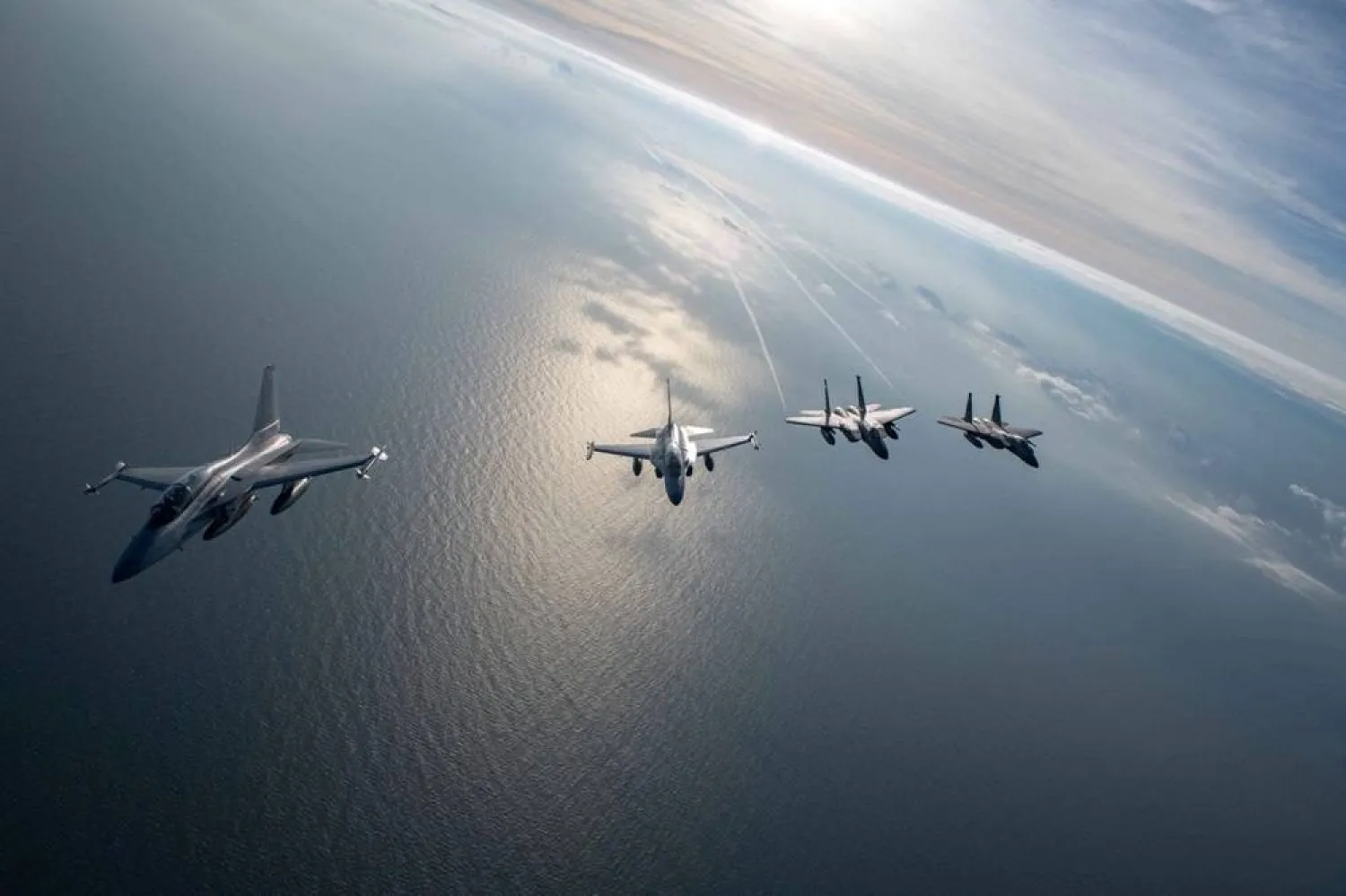

US, Philippines Conduct Joint Air, Sea Patrols in South China Sea Not Far from Taiwan

Aircraft of the Philippine Air Force and the US Indo-Pacific Command participate in the joint Philippines-US Maritime Cooperative Activity in the vicinity of Batanes and an area of the South China Sea that falls within the exclusive economic zone of the Philippines, November 21, 2023. (Philippine Air Force/Handout via Reuters)
TT

US, Philippines Conduct Joint Air, Sea Patrols in South China Sea Not Far from Taiwan

Aircraft of the Philippine Air Force and the US Indo-Pacific Command participate in the joint Philippines-US Maritime Cooperative Activity in the vicinity of Batanes and an area of the South China Sea that falls within the exclusive economic zone of the Philippines, November 21, 2023. (Philippine Air Force/Handout via Reuters)

The United States and the Philippines are conducting joint air and maritime patrols in the South China Sea, which come as the two countries step up cooperation in the face of growingly aggressive Chinese activity in the area.

The Philippine Air Force said Wednesday its aircraft had taken part in joint patrols the day before in the vicinity of Batanes, the northernmost province of the Philippines, which is only about 200 kilometers (125 miles) from Taiwan, a self-governed island that China claims as its own.

The patrols run through Thursday and also include both the US and Philippine navies. They come only days after Philippines President Ferdinand Marcos Jr. called the situation in the South China Sea increasingly “dire” as China seeks to assert its presence in an area where multiple nations have competing territorial claims.

Asked about the patrols, Chinese Foreign Ministry spokesperson Mao Ning said Beijing's position had been made clear to both the Philippines and the US.

“The Philippines-US joint patrol drill must not undermine China's territorial sovereignty and maritime rights and interests,” she said.

The US 7th Fleet said the patrols were part of routine American interaction with its allies and partners in “preserving a free and open Indo-Pacific region.”

China claims virtually the entire South China Sea as its own waters, which has led to disputes not only with the Philippines but also with Vietnam, Malaysia, Taiwan and Brunei. These claims have long been regarded as potential flashpoints in the region, and have fueled US-China rivalry.

Earlier this month a Chinese coast guard ship blasted a Philippine supply ship with a water cannon in disputed waters, and last month a Chinese coast guard ship and an accompanying vessel rammed a Philippine coast guard ship and a military-run supply boat near a contested shoal, according to Philippine officials.

Speaking on Sunday in Honolulu, Marcos said China has been showing interest in atolls and shoals that are “closer and closer” to the coast of the Philippines, with the nearest atoll about 60 nautical miles (111 kilometers) away.

“Unfortunately, I cannot report that the situation is improving,” Marcos said. “The situation has become more dire than it was before.”

In announcing the start of the joint patrols, Marcos said on X, formerly known as Twitter, that they were “testament to our commitment to bolster the interoperability of our military forces.”

“Through collaborative efforts, we aim to enhance regional security and foster a seamless partnership with the United States in safeguarding our shared interests,” he wrote.

Under Marcos, who was elected last year, the Philippines has been deepening its relationship with the US in a shift from his predecessor, Rodrigo Duterte, who had been closer to China and Russia.

In February, Marcos approved an expansion of the US military presence in the Philippines to add four new bases from five existing sites under a 2014 Enhanced Defense Cooperation Agreement between the longtime treaty allies.

The move, which Marcos said would boost the Philippines’ coastal defense, dovetails with the Biden administration’s efforts to strengthen an arc of military alliances in the Indo-Pacific to better counter China.

Marcos has also been strengthening ties with others, including Tokyo, signing an agreement earlier in the year to allow Japanese troops to join training exercises.



Sources: Trump Rejects Efforts to Launch Iran Ceasefire Talks

President Donald Trump prepares to board Air Force One after speaking to reporters at Joint Base Andrews, Md., Friday, March 13, 2026. (AP Photo/Luis M. Alvarez)
TT

Sources: Trump Rejects Efforts to Launch Iran Ceasefire Talks

President Donald Trump prepares to board Air Force One after speaking to reporters at Joint Base Andrews, Md., Friday, March 13, 2026. (AP Photo/Luis M. Alvarez)

President Donald Trump's administration has rebuffed efforts by Middle Eastern allies to start diplomatic negotiations aimed at ending the Iran war that started two weeks ago with a massive US-Israeli air assault, according to three sources familiar with the efforts.

Iran, for its part, has rejected the possibility of any ceasefire until US and Israeli strikes end, two senior Iranian sources told Reuters, adding that several countries had been trying to mediate an end to the conflict.

The lack of interest from Washington and Tehran suggests both sides are digging in for an extended conflict, even as the widening war inflicts civilian casualties and Iran's closure of the Strait of Hormuz sends oil prices soaring.

US strikes on Iran's Kharg Island, the country's main oil export hub, on Friday night underscored Trump's determination to press ahead with his military assault.

Iran's new Supreme Leader Mojtaba Khamenei has vowed to keep the Strait of Hormuz shut and threatened to step up attacks on neighboring countries.

The war has killed more than 2,000 people, mostly in Iran, and created the biggest-ever oil supply disruption as maritime traffic has halted in the Strait of Hormuz, through which a fifth of the world's oil is transported.

Oman, which mediated talks before the war, has tried multiple times to open a line of communication, but the White House has made clear it is not interested, according to two sources, who like others in this story were granted anonymity in order to speak freely about diplomatic matters.

A senior White House official confirmed Trump has rebuffed those efforts to start talks and is focused on pressing ahead with the war to further weaken Tehran's military capabilities.

"He's not interested in that right now, and we're going to continue with the mission unabated. Maybe there's a day, but not right now," the official said.

"President Trump said new potential leadership in Iran has indicated they want to talk and eventually will talk. For now, Operation Epic Fury continues unabated," a second senior White House official said when asked to comment on this story.

The Iranian sources said Tehran has rejected efforts by several countries to negotiate a ceasefire until the US and Israel end their airstrikes and meet Iran's demands, which include a permanent end to US and Israeli attacks and compensation as part of a ceasefire.

Egypt, which was involved in mediation before the war, has also tried to reopen communications, according to three security and diplomatic sources.

While the efforts do not appear to have made progress, they have secured some military restraint from neighboring countries hit by Iran, according to one of the sources.

Both the United States and Iran appear even less willing to engage than during the opening days of the war, when senior US officials reached out to Oman to discuss de-escalating, according to several sources.

One source said Iran's top security official, Ali Larijani, and Foreign Minister Abbas Araghchi had also sought to use Oman as a conduit for ceasefire discussions that would have involved US Vice President JD Vance.

But those discussions have not materialized.

Instead, Iran's position has hardened, said a third senior Iranian source.
"Whatever was communicated previously through the diplomatic channels is irrelevant now," said the source.

"The Guards strongly believe that if they lose control over the Strait of Hormuz, Iran will lose the war," the source added, referring to the Revolutionary Guard Corps.

"Therefore, the Guards will not accept any ceasefire, ceasefire talks, or diplomatic efforts, and Iran’s political leaders will not engage in such talks despite attempts by several countries."


Dutch Authorities Seek 2 Suspects in Blast Outside Amsterdam Jewish School

Policemen stand at the scene following an overnight explosion at a Jewish school on Zeelandstraat in the Buitenveldert district of Amsterdam, the Netherlands, 14 March 2026. EPA/MICHEL VAN BERGEN
TT

Dutch Authorities Seek 2 Suspects in Blast Outside Amsterdam Jewish School

Policemen stand at the scene following an overnight explosion at a Jewish school on Zeelandstraat in the Buitenveldert district of Amsterdam, the Netherlands, 14 March 2026. EPA/MICHEL VAN BERGEN

Dutch authorities were hunting Saturday for two people suspected of setting off an explosion outside a Jewish school in Amsterdam. The mayor denounced the attack as a cowardly act of aggression against the city's Jewish community.

A City Hall statement said the overnight blast against the outer wall of the school in the Dutch capital’s Buitenveldert district caused only limited damage.

According to The Associated Press, a police statement said investigators established that the two suspects arrived on a motor scooter. One placed an object against the wall and then ran back to the scooter, with the detonation following as they sped away.

Mayor Femke Halsema said that Amsterdam’s Jewish residents feel “fear and anger” and are increasingly being targeted by antisemitism.

"That is unacceptable. A school must be a place where children can learn safely.

Amsterdam must be a place where Jews can live safely," she said.

Security around Jewish schools and other sites was reinforced after an explosion near a synagogue in Liege, Belgium, and a blast that caused a small fire at the entrance of a synagogue in the Dutch port city of Rotterdam on Friday.

“Two nights in a row, a cowardly attack with an explosive at a Jewish building. First in Rotterdam, now in Amsterdam," the Dutch justice and security minister, David van Weel, posted on X.

“The safety of Jewish institutions has our full attention. An investigation into the perpetrators is underway.”


Trump Urges Other Nations to Send Ships to Secure Hormuz

FILE PHOTO: A map showing the Strait of Hormuz and Iran is seen in this illustration taken June 22, 2025. REUTERS/Dado Ruvic/Illustration/File Photo
TT

Trump Urges Other Nations to Send Ships to Secure Hormuz

FILE PHOTO: A map showing the Strait of Hormuz and Iran is seen in this illustration taken June 22, 2025. REUTERS/Dado Ruvic/Illustration/File Photo

US President Donald Trump on Saturday urged other nations to send ships to help secure the Strait of Hormuz, the critical chokepoint for global oil supplies disrupted by the Mideast war.

Trump, who has said the United States will soon start escorting tankers through the strait, posted on Truth Social that "Many countries, especially those who are affected by Iran's attempted closure of the Hormuz Strait, will be sending War Ships, in conjunction with the United States of America, to keep the Strait open and safe."

The US president added: "Hopefully China, France, Japan, South Korea, the UK, and others, that are affected by this artificial constraint, will send Ships to the area."

Iranian strikes have all but halted maritime traffic in the strait, through which a fifth of global crude oil and liquefied natural gas normally pass. It is just 54 kilometers (34 miles) wide at its narrowest point.

With oil prices spiking, Trump was asked Friday when the US Navy would begin escorting tankers through the Strait of Hormuz. "It'll happen soon, very soon," he said.

In his post on Saturday, Trump asserted that Iran's military capability had been eliminated but he conceded that it was still able to attack the strait.

"We have already destroyed 100% of Iran's Military capability, but it's easy for them to send a drone or two, drop a mine, or deliver a close range missile somewhere along, or in, this Waterway, no matter how badly defeated they are," he wrote.

As he urged nations to send ships to the strait, he added that "the United States will be bombing the hell out of the shoreline, and continually shooting Iranian Boats and Ships out of the water. One way or the other, we will soon get the Hormuz Strait OPEN, SAFE, and FREE!"