
Scores Reported Killed in Gaza as Fighting Shatters Israel-Hamas Truce

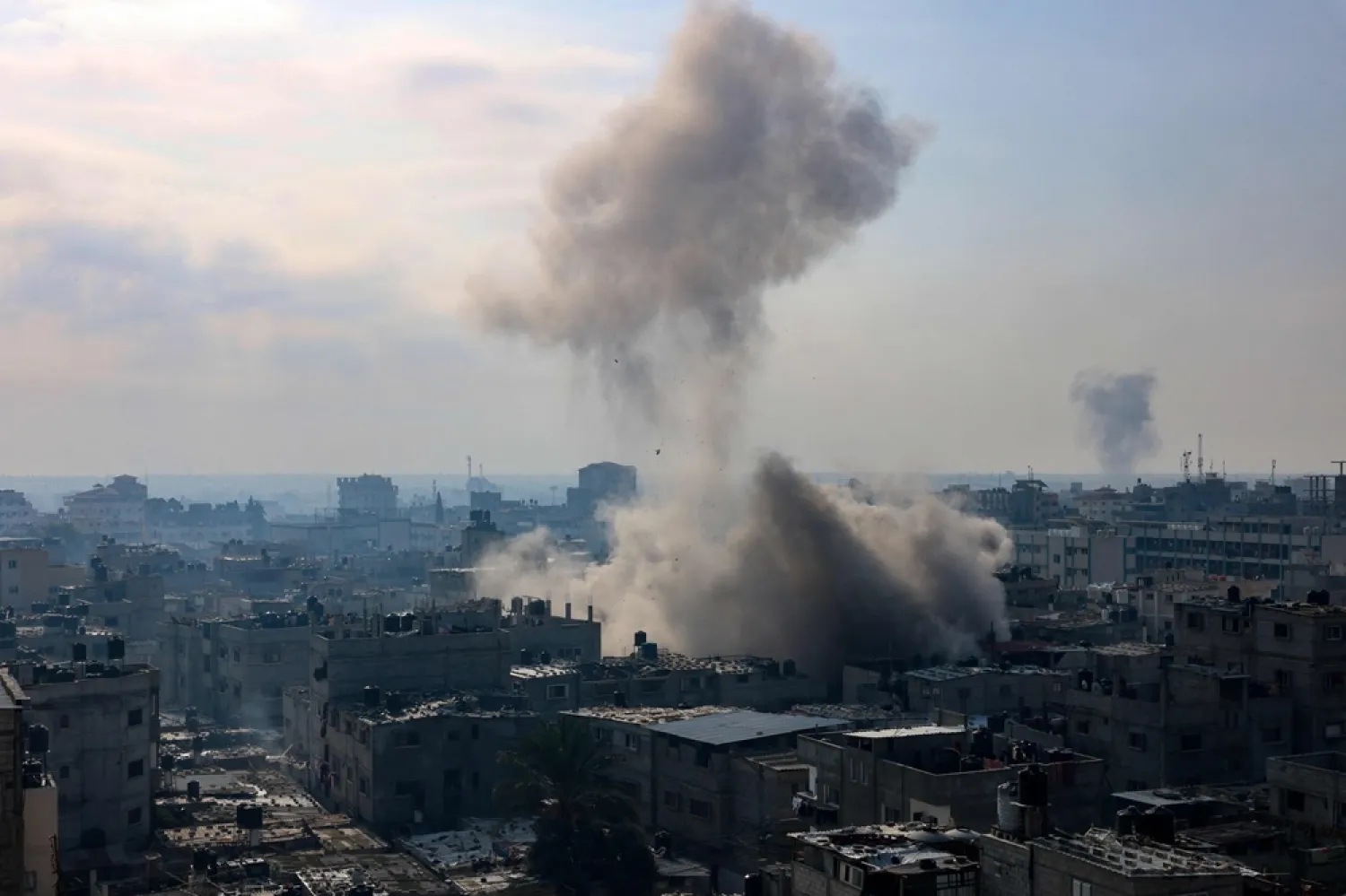
A plume of smoke rises during an Israeli strike on the Rafah refugee camp in the southern Gaza Strip on December 1, 2023, as fighting resumed shortly after the expiration of a seven-day truce between Israel and Hamas militants. (AFP)
TT

Scores Reported Killed in Gaza as Fighting Shatters Israel-Hamas Truce

A plume of smoke rises during an Israeli strike on the Rafah refugee camp in the southern Gaza Strip on December 1, 2023, as fighting resumed shortly after the expiration of a seven-day truce between Israel and Hamas militants. (AFP)

Israel's warplanes pounded Gaza on Friday after talks to extend a week-old truce with Hamas broke down, sending wounded and dead Palestinians into hospitals and others onto the streets to seek safety.

Eastern areas of Khan Younis in southern Gaza came under intensive bombardment as the deadline lapsed shortly after dawn, with columns of smoke rising into the sky, Reuters journalists in the city said. Residents took to the road with belongings heaped up in carts, fleeing for shelter further west.

In the north of the enclave, previously the main war zone, huge plumes of smoke rose above the ruins, seen from across the fence in Israel. The rattle of gunfire and thud of explosions rang out above the sound of barking dogs.

Sirens blared across southern Israel as militants fired rockets from the coastal enclave into towns. On another faultline, Lebanon's Hezbollah group said it had fired at Israeli troops on Israel's northern border to support the Palestinians.

Israel and Hamas accused each other of wrecking the negotiations, though the White House singled out the Palestinian militant group, saying it had failed to produce a new list of hostages to release to enable an extension of the truce.

The UN said the fighting would worsen an extreme humanitarian emergency. "Hell on Earth has returned to Gaza," Jens Laerke, spokesperson for the UN humanitarian office in Geneva, said.

Within hours of the truce expiring, Gaza health officials reported that 109 people had been killed and dozens wounded in air strikes.

Israel's military said its ground, air and naval forces had struck more than 200 of what it called "terror targets" in the enclave since the morning.

"This morning, as promised, we resumed our attack," former defense minister Benny Gantz, who joined Prime Minister Benjamin Netanyahu in an emergency unity government last month, said in a statement.

He said Israel had spent the past week making plans to expand its operations "based on ... the recognition that we must change the reality in the south as well as the in the north".

Medics and witnesses said the bombing was most intense in Khan Younis and Rafah in the southern Gaza Strip, where hundreds of thousands of Gazans have been sheltering from fighting further north. Houses in central and northern areas were also hit.

"Anas, my son!" wailed the mother of Anas Anwar al-Masri, a boy lying on a stretcher with a head injury in the corridor of Nasser hospital in Khan Younis. "I don't have anyone but you!"

‘You have been warned’

Further south in Rafah, residents carried several small children, streaked with blood and covered in dust, out of a house that had been struck. Mohammed Abu-Elneen, whose father owns the house, said it was sheltering people displaced from elsewhere.

At the nearby Abu Yousef al-Najjar hospital, the first wave of wounded were men and boys.

Gazans said they feared that the bombing of southern parts of the enclave could herald an expansion of the war into areas Israel had previously described as safe.

Leaflets dropped on eastern areas of the main southern city Khan Younis ordered residents of four towns to evacuate - not to other areas in Khan Younis as in the past, but further south to the crowded town of Rafah on the Egyptian border.

"You have to evacuate immediately and go to the shelters in the Rafah area. Khan Younis is a dangerous fighting zone. You have been warned," said the leaflets, written in Arabic.

Israel released a link to a map showing Gaza divided into hundreds of districts, which it said would be used in future to communicate which areas were safe.

White House working with mediators

Each of the warring sides blamed the other for causing the collapse by rejecting terms to extend the daily release of hostages held by militants in exchange for Palestinian detainees.

The pause which began on Nov. 24 had been extended twice, and Israel had said it could continue as long as Hamas released 10 hostages each day. But after seven days during which women, children and foreign hostages were freed, mediators failed at the final hour to find a formula to release more, including Israeli soldiers and civilian men.

Israel accused Hamas of refusing to release all the women it held. A Palestinian official said the breakdown occurred over female Israeli soldiers.

Qatar, which has played a central role in mediation efforts, said negotiations were still ongoing with Israelis and Palestinians to restore the truce, but that Israel's renewed bombardment of Gaza had complicated its efforts.

The White House said it continued to work on extending the humanitarian pause in Gaza and that President Joe Biden would remain deeply engaged in efforts to free hostages.

Israel has sworn to annihilate Hamas in response to the Oct. 7 rampage by the militant group, when Israel says gunmen killed 1,200 people and took 240 hostages. Hamas, sworn to Israel's destruction, has ruled Gaza since 2007.

On the streets of the Israeli city of Tel Aviv, passersby placed the blame firmly on Hamas.

"They didn't return all the captives. They didn't reunite the families together. We had no other choice. You know, it's not the war that we choose," said Dvir Feller.

Israel's bombardment and ground invasion have laid waste to much of the territory. Palestinian health authorities deemed reliable by the United Nations say more than 15,000 Gazans have been confirmed killed and thousands more are missing and feared buried under rubble.

The United Nations says as many as 80% of Gaza's 2.3 million people have been driven from their homes, with no way to escape the narrow territory, many sleeping rough in makeshift shelters.

Egypt Signals Possible Activation of Joint Defense Pact to Safeguard Sudan’s Unity

Abdel Fattah el-Sisi during the reception of Abdel Fattah al-Burhan in Cairo on Thursday (Egyptian Presidency)
TT

Egypt Signals Possible Activation of Joint Defense Pact to Safeguard Sudan’s Unity

Abdel Fattah el-Sisi during the reception of Abdel Fattah al-Burhan in Cairo on Thursday (Egyptian Presidency)

Egypt has drawn explicit “red lines” regarding the conflict in Sudan, warning that any attempt to cross them would directly threaten Egyptian national security.

Cairo signaled it is prepared to take all measures permitted under the Joint Defense Agreement between the two countries, a position analysts describe as Cairo’s most forceful since the outbreak of war in Sudan in 2023.

The statement coincided with President Abdel Fattah el-Sisi receiving on Thursday Lt. Gen. Abdel Fattah al-Burhan, Chairman of Sudan’s Transitional Sovereignty Council.

El-Sisi reaffirmed Egypt’s “full support for the Sudanese people in overcoming the current critical phase,” stressing Cairo’s unwavering commitment to Sudan’s unity, sovereignty, security, and stability, according to presidential spokesman Mohamed El-Shennawy.

During the visit, Egypt also renewed its support for US President Donald Trump’s vision for achieving peace and stability in Sudan, aligning with Washington’s broader approach to de-escalation and conflict resolution.

For the first time since the conflict began, Cairo publicly articulated non-negotiable red lines, stressing that Sudan’s unity and territorial integrity are inseparable from Egypt’s own national security. These red lines include preventing the partition of Sudan, protecting the country’s resources, and preserving its state institutions.

The Egyptian presidency underscored that safeguarding Sudan’s institutions is highly important and affirmed Egypt’s “full right to take all necessary measures under international law,” including the possible activation of the Joint Defense Agreement to prevent any violations.

Egypt and Sudan signed a military cooperation agreement in March 2021 covering training, border security, and countering shared threats, building on a Joint Defense Agreement concluded in 1976 to confront external dangers.

Maj. Gen. Yahya Kadwani, a member of Egypt’s parliamentary Committee on Defense and National Security, warned that efforts to divide Sudan necessitate firm red lines to protect Sudanese state assets and Egypt’s own security.

He told Asharq Al-Awsat that invoking the joint defense pact signals strong coordination within international legitimacy and existing bilateral agreements.

The presidency said Egypt is deeply concerned by ongoing escalation in Sudan and the resulting “horrific massacres and flagrant violations of basic human rights,” particularly in El Fasher.

Cairo categorically rejected the creation or recognition of any parallel political or military entities, warning that such moves would undermine Sudan’s unity and territorial integrity.

Ambassador Salah Halima, a member of the Egyptian Council for Foreign Affairs, said Egyptian-Sudanese coordination aims to protect Egyptian, Sudanese, and Arab national security, noting that both countries are members of the Council of Red Sea Coastal States, which plays a strategic role in defense and development.

He added that Egypt’s stance aligns with the International Quartet initiative and a proposal advanced by Saudi Crown Prince and Prime Minister Mohammed bin Salman during his visit to the United States.

The roadmap calls for a three-month humanitarian truce, integration of the Rapid Support Forces into the Sudanese Armed Forces, and preservation of military cohesion.

The Quartet, which includes Saudi Arabia, Egypt, the United Arab Emirates, and the United States, proposed last August a plan for a three-month humanitarian ceasefire, followed by a permanent cessation of hostilities and a political process leading to an independent civilian government within nine months.

Al-Burhan’s visit to Cairo followed talks in Saudi Arabia, where he affirmed Sudan’s readiness to work with Trump, US Secretary of State Marco Rubio, and US envoy Massad Boulos to end the war.

Amani Al-Tawil, Director of the Africa Program at the Al-Ahram Center for Political and Strategic Studies, said Egypt’s position represents its strongest stance yet and aligns with Saudi and US calls to preserve Sudan’s unity, halt the war, reject parallel entities, and protect state institutions.


Israel Considers Special Military Court to Seek Death Penalty for Hamas Fighters

A fighter from the Izz ad-Din al-Qassam Brigades, affiliated with Hamas, oversees the search for the bodies of Israeli hostages, with the participation of Red Cross personnel, in the Jabalia refugee camp in northern Gaza, Dec. 1, 2025. (EPA) 
TT

Israel Considers Special Military Court to Seek Death Penalty for Hamas Fighters

A fighter from the Izz ad-Din al-Qassam Brigades, affiliated with Hamas, oversees the search for the bodies of Israeli hostages, with the participation of Red Cross personnel, in the Jabalia refugee camp in northern Gaza, Dec. 1, 2025. (EPA) 

Israel is weighing extraordinary legal measures that could result in the execution of up to 100 Hamas fighters accused of taking part in the Oct. 7, 2023 attack.

Defense Minister Israel Katz and Justice Minister Yariv Levin have discussed the creation of a dedicated military court to try hundreds of members of Hamas’ elite “Nukhba” unit, part of the Izz ad-Din al-Qassam Brigades, according to Israeli media reports.

Officials familiar with the deliberations said the proposed court would have the authority to impose the death penalty, with military prosecutors expected to seek capital punishment for about 100 defendants facing the gravest charges.

Senior figures from the Israeli army and the Justice Ministry attended the talks, including Itai Ofir, the chief military prosecutor, the Times of Israel reported. Katz said Israel was determined to punish those responsible for the attack “in a way that leaves no ambiguity,” adding that anyone who harms Israeli civilians “will be held fully accountable.”

The discussions come shortly after the far-right Otzma Yehudit party, led by National Security Minister Itamar Ben-Gvir, released updated principles for controversial legislation that would mandate the death penalty for those involved in the October 7 assault.

The bill, which passed an initial Knesset vote in November and is now being debated in the National Security Committee, would allow military courts to impose capital punishment on Palestinians by a simple majority of judges.

Military sources said Israel is holding about 450 Palestinian prisoners classified as Hamas “elite” fighters, far fewer than the thousands initially cited at the start of the war.

According to Israeli officials, prosecutors intend to seek death sentences, most likely by firing squad, after the Israeli Medical Association reportedly declined to take part in executions by lethal injection.

Channel 14 said the detainees are being held at a special military facility under heavy guard, in conditions that have drawn criticism from international human rights organizations.

Officials have spent nearly two years debating how to prosecute the suspects in a way that would ensure execution.

The preferred option, according to the report, is to conduct trials outside the regular judicial system in highly public proceedings, likened to the trial of Nazi official Adolf Eichmann, who was abducted by the Mossad in Argentina in 1960, tried by a special tribunal in Jerusalem, and executed in 1962.

Critics warned that such high-profile trials could become a platform for putting Israel itself on trial over events preceding Oct. 7 and the subsequent war in Gaza.

Israeli authorities said they have compiled extensive evidence, including documents seized in Gaza, interrogations of detainees, and video footage recorded by Hamas and Palestinian Islamic Jihad fighters during the attack.

The move comes amid rising tensions in Israeli prisons. Prison Service Commissioner Kobi Yaakobi recently warned of a possible inmate uprising due to harsh conditions.

The Prison Service later said his comments were taken out of context, insisting its policies, which are overseen by Ben-Gvir, are effective and that it is prepared for “any scenario.”

More than 9,500 Palestinians are currently held in Israeli prisons, including 3,360 in administrative detention without charge or trial. Palestinian prisoner groups say at least 110 detainees have died in custody since the war began, including 50 from Gaza.


US-Yemen Engagement Seeks to Bolster Partnership, Contain Divisions

Al-Alimi met with US Ambassador Steven Fagin in Riyadh (SABA)
TT

US-Yemen Engagement Seeks to Bolster Partnership, Contain Divisions

Al-Alimi met with US Ambassador Steven Fagin in Riyadh (SABA)

Several meetings held by US Ambassador to Yemen Steven Fagin with the leadership of Yemen’s Presidential Leadership Council (PLC) point to American attempts to reinforce the political and security partnership with the Yemeni government while containing internal divisions within the internationally recognized camp.

The move comes amid a complex domestic environment and growing regional challenges affecting Yemen’s security and stability.

The engagement included talks with PLC President Rashad al-Alimi, a meeting with council member Sheikh Othman Mujalli, and a video call with Major General Sultan al-Aradah.

Discussions focused on bilateral relations, political and military developments, and certain priorities, notably counterterrorism and confronting threats posed by the Iran-backed Houthi militia.

Discussions with al-Alimi reportedly centered on the scope of Yemeni-US partnership and Washington’s role in supporting the Yemeni state, politically in international forums and through counterterrorism cooperation, as well as efforts to curb Iran-linked arms smuggling and financial networks.

Government reforms were also raised, in light of the need for international backing to ease economic and humanitarian pressures.

The talks addressed recent developments in Yemen’s eastern governorates and unilateral measures taken there, alongside regional efforts led by Saudi Arabia and the United Arab Emirates to contain tensions and restore normal conditions.

Yemeni leaders stressed the need to preserve consensus within the framework of legitimacy and prevent internal disputes from undermining unified security and military decision-making.

Yemeni officials also stressed adherence to the key references governing the transitional phase, particularly the Declaration on the Transfer of Power and the Riyadh Agreement, warning that bypassing these frameworks could create security vacuums exploited by the Houthis and terrorist groups.

In a broader assessment during his call with Fagin, al-Aradah described Yemen’s current phase as one in which political, military, and economic challenges intersect, calling for a firmer international stance and practical support to restore state institutions, cut off militia funding, and safeguard UN-led efforts.

In his meeting with Mujalli, Fagin discussed Iran’s role in enhancing Houthi military capabilities and the resulting risks to Yemen, neighboring states, and maritime security in the Red Sea and the Arabian Sea.

According to Yemeni official media, the US ambassador reaffirmed Washington’s support for the country’s unity and territorial integrity, the cohesion of the PLC and government, and continued partnership in counterterrorism, humanitarian relief, and efforts to promote stability and development.