Two Months of War in Gaza Leave Elderly and Newborns Destitute and Displaced

A flare falls over Gaza, amid the ongoing conflict between Israel and the Palestinian group Hamas, as seen from southern Israel, December 7, 2023. (Reuters)
TT

Two Months of War in Gaza Leave Elderly and Newborns Destitute and Displaced

A flare falls over Gaza, amid the ongoing conflict between Israel and the Palestinian group Hamas, as seen from southern Israel, December 7, 2023. (Reuters)

After two months of war in Gaza, most of its people are homeless, crammed by a pounding Israeli bombardment into yet smaller areas of an already tiny enclave where the elderly and newborns live alike in tents amid the rubble.

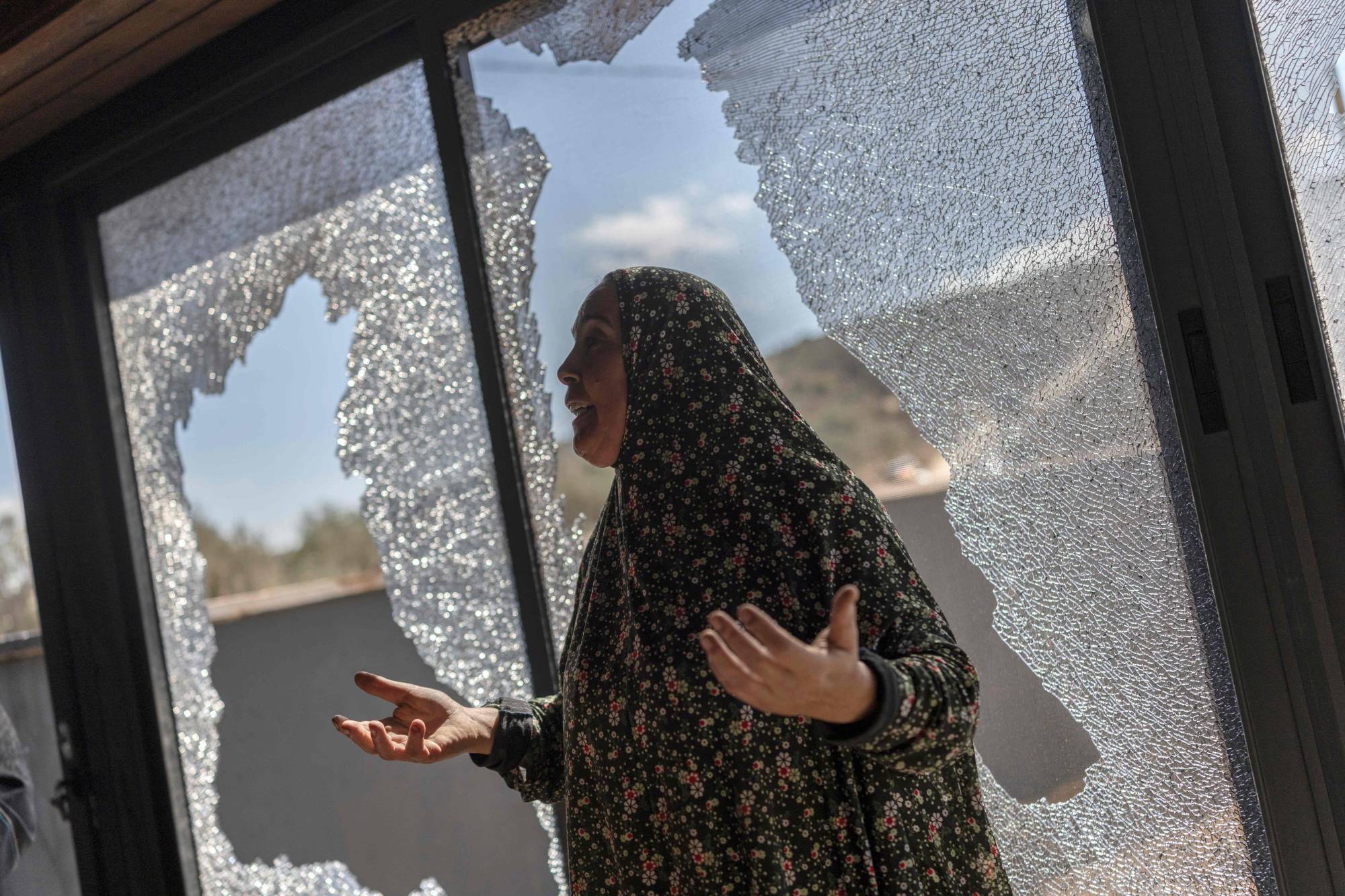
Three women pushed from their homes in the Gaza Strip over 61 days of fighting have now ended up desperate for shelter and safety after fleeing from one place to another under air strikes and shellfire.

Zainab Khalil, 57, is seeking to move for a fourth time as Israeli tanks roll into the southern city of Khan Younis. Israa al-Jamala, 28, lives in a tent tending her infant daughter who was born the night a short-lived truce began. And Mai Salim walks by the Egyptian border fearing she and her family will be forced across it into a life of permanent exile.

Most of Gaza's 2.3 million people were taken unawares by the sudden disaster that began to unfold for them on Oct. 7 as Israeli jets began strikes to retaliate for a surprise Hamas attack across the border that Israel says killed 1,200 people, mostly civilians.

The Israeli military has vowed to crush Hamas, the Islamist movement that rules Gaza and is pledged to Israel's destruction, but says the group hides its weapons, command centers and fighters among a civilian population it uses as "human shields". Hamas denies this.

Four-fifths of Gaza residents have now been displaced, many of them several times over. Their homes, businesses, mosques and schools have been damaged, destroyed or abandoned as too dangerous in the face of the Israeli assault. Health authorities in Hamas-run Gaza say 17,177 people have been killed there.

With no real sign of any imminent respite, Palestinians are living with little food or clean water, often on the street, trying to calm screaming children at night as bombs and shells fall.

"A new mother should be in her home raising the child with her mother, with her family," said Jamala, cradling her tiny daughter, also called Israa, amid the tents that have sprung up around a hospital in Deir al-Balah in central Gaza.

After the Jamala home was shelled, the family moved into the makeshift camp outside Shuhada al-Aqsa hospital, she said. Little Israa was born there on Nov. 24, the night a week-long truce began, raising hope that the conflict might relent.

But after a week, fighting resumed and the family remains in the tent, a carpet covering the sand and Israa sleeping in a small cot.

Like others in Gaza, they struggle to find food and other necessities. "See how much we're in need. There's no milk. No powdered milk," Jamala said.

Even when the war finally ends, she does not know what she will do as their home was shelled. "Where will we stay? Where can we raise this baby? Where can we live?" she said.

Bombardment

Khalil lived in Sheikh Radwan, a suburb of Gaza City near Beach Refugee Camp in the enclave's north. Israel started telling residents to go south in mid-October, though it continued with air strikes across the territory.

She did not want to leave, calling it the most difficult decision of her life. She finally moved to a shelter nearby where she thought she would be safer from bombardment, but as air strikes intensified over 10 days she decided to move on.

"A journey mixed with fear, despair, displacement and sadness under heavy bombardment," was how she described her odyssey from shelter to shelter.

When Israeli troops pushed into Gaza City and surrounded al-Shifa Hospital, she headed south with a friend and her family, alternately walking and riding in a donkey cart.

As they crossed a front line, Israeli soldiers ordered them to "walk a bit and stop, walk and stop" over four hours, she said.

She wound up living in a school in Khan Younis being used as a shelter for around 30 displaced people, where some of her nieces had already ended up. "In this war, who doesn't get killed by bombs gets killed by disease, sadness and despair," she said.

But Israel's military is now ordering people in Khan Younis too to leave and Khalil must look for a new place to stay.

The only major town left to run to is Rafah, hard against the border with Egypt. Most Gaza residents are descended from refugees who fled or were forced from their homes in what is now Israel during the war of 1948. Many are terrified they will end up as refugees again, forced from Gaza altogether.

Walking by the border fence, Salim and a friend peered over towards Egypt. She had fled her home in Gaza City, moving first to Nuseirat and later to Khan Younis before finally ending up in Rafah after the Israeli military ordered people to move again.

"For us, this is the last stop. After that, if they want to forcibly displace us we will not leave. They can kill us right here but we will not leave our land and our entire lives. We will not do that," she said.


The Perfect Storm That Turbocharged Venezuela’s Twin Quakes

A view of a building destroyed by the June earthquakes; in Catia La Mar, Venezuela, 05 August 2026. (EPA)
TT

The Perfect Storm That Turbocharged Venezuela’s Twin Quakes

A view of a building destroyed by the June earthquakes; in Catia La Mar, Venezuela, 05 August 2026. (EPA)

A dangerous cocktail of tectonic positioning, loose earth and shoddy construction contributed to the unprecedented damage caused by Venezuela's twin earthquakes, experts say.

Jennire Garcia's home in the coastal Catia La Mar neighborhood was rendered unlivable by the tremors in late June, which devastated the state of La Guaira.

The 7.2 and 7.5 magnitude quakes killed over 6,300 people and sent 190 buildings crashing down, while 856 more sustained damage.

Garcia and her family are now living in tents next to the ruins, and the 42-year-old says she is "sick with stress all day long."

This was the same site as deadly mudslides that killed thousands of people in 1999.

The region's "unconsolidated" soils, where construction requires specific geotechnical studies, added to the severity of the damage, according to engineer Feliciano De Santis.

"These soils generally tend to be loose soils" and caused the ground to move with even greater intensity, said De Santis, who is president of the Venezuelan Geologists Society.

Garcia's residential complex, which was declared uninhabitable, was built after the landslide.

Deep cracks run through its yellow walls, several balconies have dislodged from the building and some high-rises have crumbled altogether.

- 'So anxious' -

Rescuers across the quake zone have not abandoned the search for victims under the rubble, and are working through the debris of buildings up to 12 stories high.

The last adjustment made to earthquake regulations for buildings was in 2019, and before that, in 1967 when a horrific 6.6 magnitude tremor struck the country.

A closer look at La Guaira's infrastructure reveals significant construction flaws, said Japanese engineer Kit Miyamoto, who is touring the state with support from Washington.

For instance, large quantities of steel "seems like it's really good," he told AFP.

"But once you get down to look at how actually the rebar (steel reinforcement) is connected to the foundation, it's not much," the engineer added.

In the early 2010s, the government of late leader Hugo Chavez built 43 flagship social housing high-rise buildings.

The quakes flattened 16 of them, crushing hundreds of residents underneath.

A recent investigation by Armando.info revealed that "contracts awarded at discretion to companies whose experience was unknown" fueled the damage.

In Caracas' worst-hit neighborhood Chacao, 68 people died while three buildings collapsed and dozens more are uninhabitable.

Most of these buildings were constructed before the 1967 earthquake, Venezuela's Engineering Order said.

"Some had been reinforced," said organization representative and engineer Felix Ojeda, adding that rubble samples taken on site can provide clues about the state of the infrastructure.

"The obvious next step," said Miyamoto, "is to take down the buildings," adding that retrofitting and strengthening buildings was also important to do as much as possible.

Public fury about the government's slow response to the quakes is widespread.

Interim leader Delcy Rodriguez -- who effectively governs under Washington's thumb since her predecessor Nicolas Maduro's ouster -- has promised to deliver around 4,000 housing units this year.

Back in Catia La Mar, Garcia pines for her former home.

"It makes me sad because I see it there every day. I think about the comforts I had and that I can't have here," she said.

"We are so anxious," she said, "waiting for an answer, and we don't have one."


China Missile Test Deepens Pacific Divide Over Growing Militarization

The headquarters for the Pacific Islands Forum in Suva, Fiji, August 7, 2026. (Reuters)
TT

China Missile Test Deepens Pacific Divide Over Growing Militarization

The headquarters for the Pacific Islands Forum in Suva, Fiji, August 7, 2026. (Reuters)

China's test of a nuclear-capable missile last month has exposed the limits of Pacific leaders' ambition to make the region an "Ocean of Peace", free from the crossfire of major-power rivalry.

The July launch, China's first known ballistic-missile test into the Pacific since September 2024, was fired into the Pacific just hours after Fiji and Australia signed a major defense treaty, marking Fiji's first ever alliance.

More than a month after the test, Pacific Islands foreign ministers were unable to agree on a collective statement condemning Beijing's missile test, despite individual leaders expressing alarm, publicly and privately, about militarization of the region.

The test was "totally inappropriate", Papua New Guinea Foreign Minister Justin Tkatchenko told Reuters on the sidelines of the foreign ministers' meeting in Suva last week.

"China is a very close friend and ally to Papua New Guinea, but we feel this doesn't help at all," he said, adding that Beijing had given PNG advance notice of the launch but no details on where ‌the missile would ‌land.

At the time of the launch, Chinese Foreign Ministry spokesperson Mao Ning said it was ‌conducted "safely", ⁠adding: "We hope relevant ⁠countries will not over-interpret the matter."

The missile launch capped a year of more visible military activity across the Pacific, which is fiercely contested between the US and China for influence. That has included Chinese naval deployments and live-fire drills in the Tasman Sea, US-allied exercises around Guam and Hawaii, and a steady flow of warship visits linked to expanding security partnerships.

The United States, meanwhile, retains a substantial military presence across the region, including in Hawaii, Guam and the Marshall Islands.

Tuvalu permanent foreign secretary Pasuna Tuaga, who was speaking in a personal capacity, was concerned about growing militarization, not only because of the missile test but also security arrangements such as the AUKUS partnership between Australia, ⁠Britain and the United States.

UNITED, BUT DIVIDED

In September 2025, Pacific Leaders endorsed the Ocean ‌of Peace Declaration, which committed to safeguard the region, recognized the right of the ‌people to peace, and resolved to contribute to and strengthen international peace and security.

David Peebles of the Australian National University's Pacific Security College said ‌Pacific countries had long resisted having peace and security defined by outside powers and their competing Indo-Pacific strategies. The Ocean ‌of Peace initiative was an attempt to reclaim that agenda, he said.

The regional declaration inspired the defense pact signed between Australia and Fiji last month, known as the Ocean of Peace Alliance.

Australia's Department of Foreign Affairs and Trade did not immediately respond to a request for comment on concerns that the growing number of regional security pacts could further militarize the Pacific.

For many governments, security partnerships bring benefits: surveillance against illegal fishing, ‌disaster response, policing support and access to equipment and training. But critics fear a proliferation of bilateral arrangements could leave Pacific countries with little say over how their territory, waters and infrastructure ⁠are used.

Solomon Islands Foreign Minister ⁠Rick Houenipwela, who chaired the talks in Suva, said the region's agenda must remain "conceived by the Pacific, shaped by the Pacific and only by the Pacific."

Yet by the end of the one-day meeting, no unified statement in response to the missile test had emerged.

Kiribati and Nauru, which have deepened ties with Beijing since switching diplomatic recognition from Taiwan in 2019 and 2024 respectively, did not support the statement's wording, according to an official familiar with the discussions.

New Zealand Foreign Minister Winston Peters blamed foreign influence for the failure to reach consensus, without naming a country.

The impasse illustrates the central challenge facing these small island nations which have different economic, political and security interests.

In the northern Pacific, where the US has maintained a military presence for decades, some governments want deeper security engagement with the US while others remain wary.

Fiji Foreign Minister Sakiasi Ditoka said Pacific governments faced an unavoidable tension.

Countries wanted "to be free of all these war-making paraphernalia," he said, but also recognized that some security capabilities helped keep them safe. "I believe it's maintaining that balance."

Fiji for the first time participated last month in US-led war games in the Pacific known as RIMPAC.

Pacific leaders will meet in Palau in three weeks for the Pacific Islands Forum leaders meeting, where the missile test and regional unity are expected to return to the agenda.


One year after Putin-Trump Summit, 'Spirit of Anchorage' Dissipated

FILE - US President Donald Trump greets Russian President Vladimir Putin, Aug. 15, 2025, at Joint Base Elmendorf-Richardson, Alaska. (AP Photo/Julia Demaree Nikhinson, File)
TT

One year after Putin-Trump Summit, 'Spirit of Anchorage' Dissipated

FILE - US President Donald Trump greets Russian President Vladimir Putin, Aug. 15, 2025, at Joint Base Elmendorf-Richardson, Alaska. (AP Photo/Julia Demaree Nikhinson, File)

In the year since Donald Trump hosted Vladimir Putin on US soil for a summit designed to broker an end to Russia's offensive on Ukraine, the diplomatic initiative has fizzled out and the conflict has escalated.

For months, Russian officials talked up the "spirit of Anchorage" -- a supposed climate of detente, renewed dialogue with Washington and a framework for finding a way out of the deadliest European conflict since World War II, said AFP.

Now there are few traces of that atmosphere. US mediation efforts are at a standstill, both Russia and Ukraine are ramping up attacks and more civilians are being killed than at any point since the first months of the war.

- 'Ending the war'-

On August 15, 2025, Trump broke with the West's policy of isolating Putin, rolling out the red carpet as the Kremlin chief stepped off his plane at the Elmendorf-Richardson air base in Alaska.

It remains unclear what was decided or discussed behind closed doors.

Russia has always maintained some kind of understanding on a peace deal was struck -- "a compromise proposal", as Foreign Minister Sergei Lavrov called it.

Washington has rebuffed any talk of a deal being reached.

"There was a proposal in Alaska, but there was no agreement. If there had been an agreement, we would have had an end of the war," Secretary of State Marco Rubio said in June.

Moscow had hoped the summit would lay the foundations for a "lasting peace" by addressing what it calls the "root causes" of the conflict, said political analyst Sergei Markov -- designated a "foreign agent" but still close to the Russian authorities.

For years -- including right before launching its offensive in February 2022 -- Russia has called for a new overarching security deal with the United States over Europe, NATO and arms control.

The "compromise" Russia tabled in Alaska, Markov told AFP, was to limit its territorial claims on Ukraine to the eastern Donbas region in exchange for recognition of Russia's new borders by Washington and the lifting of sanctions.

- Disenchantment -

Those Russian demands were included in a 28-point document drafted by the United States -- later cut down to 19 -- after separate negotiations with Kyiv and Moscow.

The document was never published officially and never came to fruition.

US-brokered direct talks between Russia and Ukraine in early 2026 broke down, chiefly over the issue of territory.

Ukraine refuses to cede land it still controls and wants an immediate ceasefire along the current front line, with territorial status to be decided during fuller peace talks.

And since late February, Washington's attention has been consumed by the war on Iran.

Trump has since issued fresh sanctions on Russia and the last remaining nuclear arms control agreement -- New Start -- has been allowed to lapse.

Having once sensed a window of opportunity to press its demands and been at pains to praise Trump's efforts, Russia has lately allowed itself to publicly question Washington's commitment to diplomacy.

"I don't even want to imagine that Alaska ... was conceived to gain time in order to strengthen Ukraine militarily," Lavrov said in June.

A meeting between Lavrov and Rubio in Manila in July -- their first since September 2025 -- lasted only around 30 minutes.

"We'll have to find new suggestions and new ideas" that both "Russia and Ukraine can agree to," Rubio said after that meeting.

"That's going to require a lot of work," he added.

- Escalation -

The two sides' conditions for peace are irreconcilable.

Russia demands territory alongside political and military concessions that Ukraine rejects as capitulation.

At the same time, both are convinced force can improve their negotiating position.

"The Russian armed forces will continue their mission to liberate the Donbas and Novorossiya in line with the approved plan," Russia's army chief Valery Gerasimov told Putin in a televised meeting in early July -- referring to land stretching across eastern and southern Ukraine.

Buoyed by European support, Kyiv is banking on its long-range strike campaign to tip Russia's economy and society over the edge.

Its attacks triggered a nationwide fuel crisis over the summer, and have forced Moscow-installed authorities to put the annexed Crimean peninsula under a local "state of emergency".

Russia has upped its missile attacks on Kyiv, killing dozens there in recent weeks.

It has also brought Ukrainian exports through the Black Sea to a standstill through a campaign of port and ship strikes.

"The spirit of Anchorage has dissipated," said Russian political analyst Fyodor Lukyanov -- close to the ruling elite -- in August.

The result? "Brutal escalation."