Jordan's Mission to Save Its Ancient Olive Trees

"These trees represent the history of Jordan," says Ali Salih Atta, 84. Khalil MAZRAAWI / AFP
TT

Jordan's Mission to Save Its Ancient Olive Trees

"These trees represent the history of Jordan," says Ali Salih Atta, 84. Khalil MAZRAAWI / AFP

Every morning, Jordanian farmer Ali Saleh Atta swallows two cloves of garlic with a cup of olive oil before heading out to check on his ancient olive trees.
"These trees represent the history of Jordan," said the 84-year-old, looking at the 2,000-year-old trees whose enormous gnarled trunks hoist up branches with delicate, pale green leaves.
The trees are a beloved national symbol, but they are also under threat from urban sprawl, illegal logging for firewood and uprooting to the homes and gardens of the wealthy for decoration.
The land of Atta, a father of 10, is in Al-Hashimiyya, a wooded area about 70 kilometers (45 miles) northwest of Amman.
"I have given my children and grandchildren a written will that after my death, you preserve them and (live) from what they produce," he said.
Jordan is the tenth-largest producer of olives globally, according to the World Olive Council.
Its many ancient trees that have survived thousands of years are an integral part of the country's identity and culture.
Across many regions, "you can hardly visit a house ... without finding an olive tree in every garden", said Nizar Haddad, director general of the National Agricultural Research Center.
"We were raised from childhood on this culture."
But today, he said, the trees' beauty has put them in danger.
"Some hotels, villas, businessmen and companies like to add a touch to their institutions' decoration, so they buy such trees and transport them" away, he said.
The trees often do not survive the move, said Haddad, adding that new laws aim to protect them.
"New Jordanian legislation protects these trees from being uprooted or removed, and there is coordination between the Ministry of Interior, our center and the police to prevent transport operations except in very exceptional cases."
'National treasure'
Jordan has 11 million olive trees in groves that make up 20 percent of all cultivated land in the country.
They produce 50,000 tons of olives and 25,000 tons of olive oil annually, contributing 120 million Jordanian dinars ($169 million) to the economy.
Haddad noted that the olive tree has symbolic meaning for both Muslim and Christian Jordanians, saying they are mentioned in the Koran and "Jesus Christ spent his last hours praying on the Mount of Olives".
"These trees must be preserved so that they can remain a source of inspiration for the community, especially since they are the type capable of adapting to all the environmental challenges facing not only our region, but the world."
The tree variety, commonly known as Roman or Mehras, should be preserved as a "national treasure", said Amer Gharaibeh, head of the Mehras Cooperative Society.
"Here you can see the oldest olive trees... they have been here since the Romans ruled this region, before Muslims controlled it," he said.
Research has shown that the Mehras has a common ancestor with cultivated olives in Italy, Cyprus and Spain.
Alongside Jordan's culture ministry, Gharaibeh's organization is working to add the trees to the UNESCO Intangible World Heritage List, hoping this "will ultimately contribute to preserving them and protecting them".
Jordan is working on a plan to engage the public with the trees by placing a QR code on every bottle of olive oil produced.
It lists the tree's location, the name of its owner, its history, the quality of the oil and the age of the tree, said Haddad, whose organization is working on the project.
"We will not only sell olive oil," he said, "but we spread a relevant story through which we can fully market our country".



Saudi Arabia: King Abdulaziz Library to Launch 26th Free Reading Festival

The King Abdulaziz Public Library. SPA
TT

Saudi Arabia: King Abdulaziz Library to Launch 26th Free Reading Festival

The King Abdulaziz Public Library. SPA

The King Abdulaziz Public Library, in cooperation with the Riyadh Education Department, will launch its 26th annual Free Reading Festival for public school students on Sunday.

Running from May 10 to 14 in Riyadh, the festival will bring together more than 100 schools, over 1,550 students, and a number of educators and teachers.

It aims to foster a love of reading and learning, expand students’ literary, scientific, and cultural horizons, and encourage teachers to promote independent reading. It will also provide a platform to showcase student talents and strengthen Arabic language skills.

Through initiatives like this festival, the King Abdulaziz Public Library promotes reading through diverse programs and a wide range of books that foster pride in the Kingdom’s heritage.


Qassim's Monday Market Retains Heritage Role as Economic and Cultural Hub

The Monday market in the governorate of Uyun Al-Jiwa. (SPA)
TT

Qassim's Monday Market Retains Heritage Role as Economic and Cultural Hub

The Monday market in the governorate of Uyun Al-Jiwa. (SPA)

The Monday market in the governorate of Uyun Al-Jiwa, north of Qassim Region, stands as one of the oldest traditional weekly markets, enduring through changing times while maintaining its role as a vibrant economic and cultural hub.

The market draws a growing number of visitors from across Qassim and beyond, supported by the governorate’s strategic location.

During a field tour, the Saudi Press Agency observed lively activity throughout the market, with stalls displaying a diverse range of products. These include agricultural goods such as almonds and dried figs; animal products like ghee and milk, for which the region is renowned; as well as handicrafts and natural items such as henna and sidr.

Visitors noted that the market has retained its authentic character, continuing to serve as a vital source of income for small vendors and families working in the cottage industry, reinforcing its role as a key platform for preserving traditional culture while supporting the local rural economy.


Heritage Commission Revives Al-Nasb Heritage District as Abha Cultural Tourism Destination

The district’s significance lies in its unique architectural composition - SPA
TT

Heritage Commission Revives Al-Nasb Heritage District as Abha Cultural Tourism Destination

The district’s significance lies in its unique architectural composition - SPA

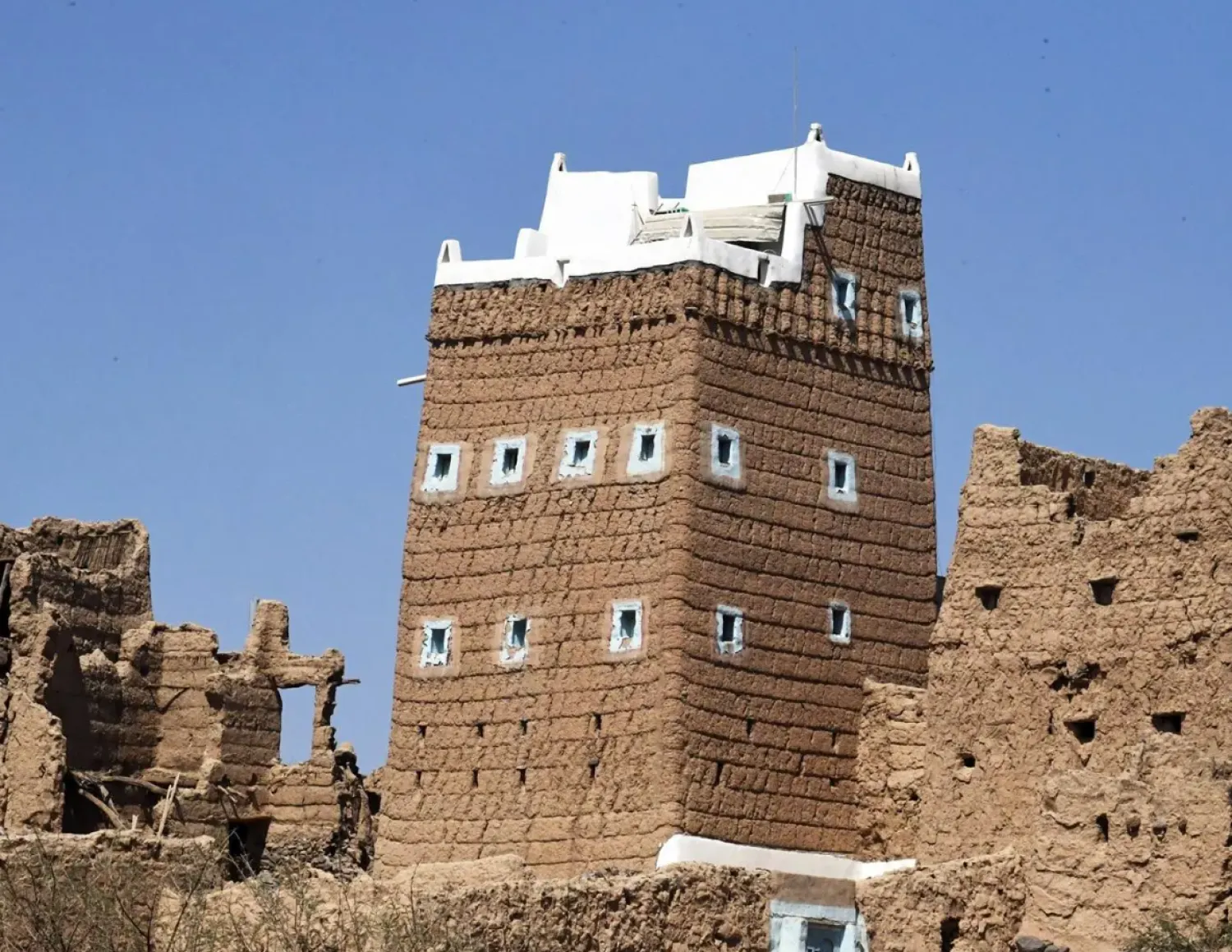
Al-Nasb Heritage District in Abha is one of the most prominent living examples of traditional architecture in Aseer Region, preserving its long history and architectural details that embody people’s connection to their local environment and document the social and cultural patterns that have shaped the identity of the place across generations.

The district’s significance lies in its unique architectural composition, where mud and stone buildings stand side by side in visual harmony. They were built using local materials such as stone, clay, and juniper trunks, while the narrow alleyways and closely set buildings give the district a cohesive social character that reflects the spirit of past communities in the region and the close relationship between people and place.

The Heritage Commission has revived the district through an integrated restoration and rehabilitation project aimed at preserving its original elements and enhancing its sustainability, as part of national efforts to protect urban heritage and highlight it as a cultural and tourism asset, SPA reported.

The site is also distinguished by its natural setting, as the district overlooks the banks of Abha Valley and surrounding farms, giving it a distinctive visual and aesthetic dimension. Its narrow passageways and closely set buildings illustrate a traditional urban pattern that strengthens ties among residents and captures the nature of social life in that era.

The district is now a growing destination for culture and tourism in Abha, attracting visitors and heritage enthusiasts who come to explore the details of authentic architecture and learn about the traditional ways of life that have shaped Aseer Region’s identity across generations. The project helps raise awareness of the importance of preserving archaeological sites as a key pillar in forming national memory.

The project is part of the Kingdom’s efforts to protect and effectively manage cultural heritage, in line with the targets of Saudi Vision 2030, which gives special attention to the cultural sector. It seeks to turn heritage sites into vibrant spaces that support cultural tourism and sustainable development while reconnecting society with its historical roots.