


Red Sea Shipping Workarounds Add Costs, Delays for Suppliers, Retailers 

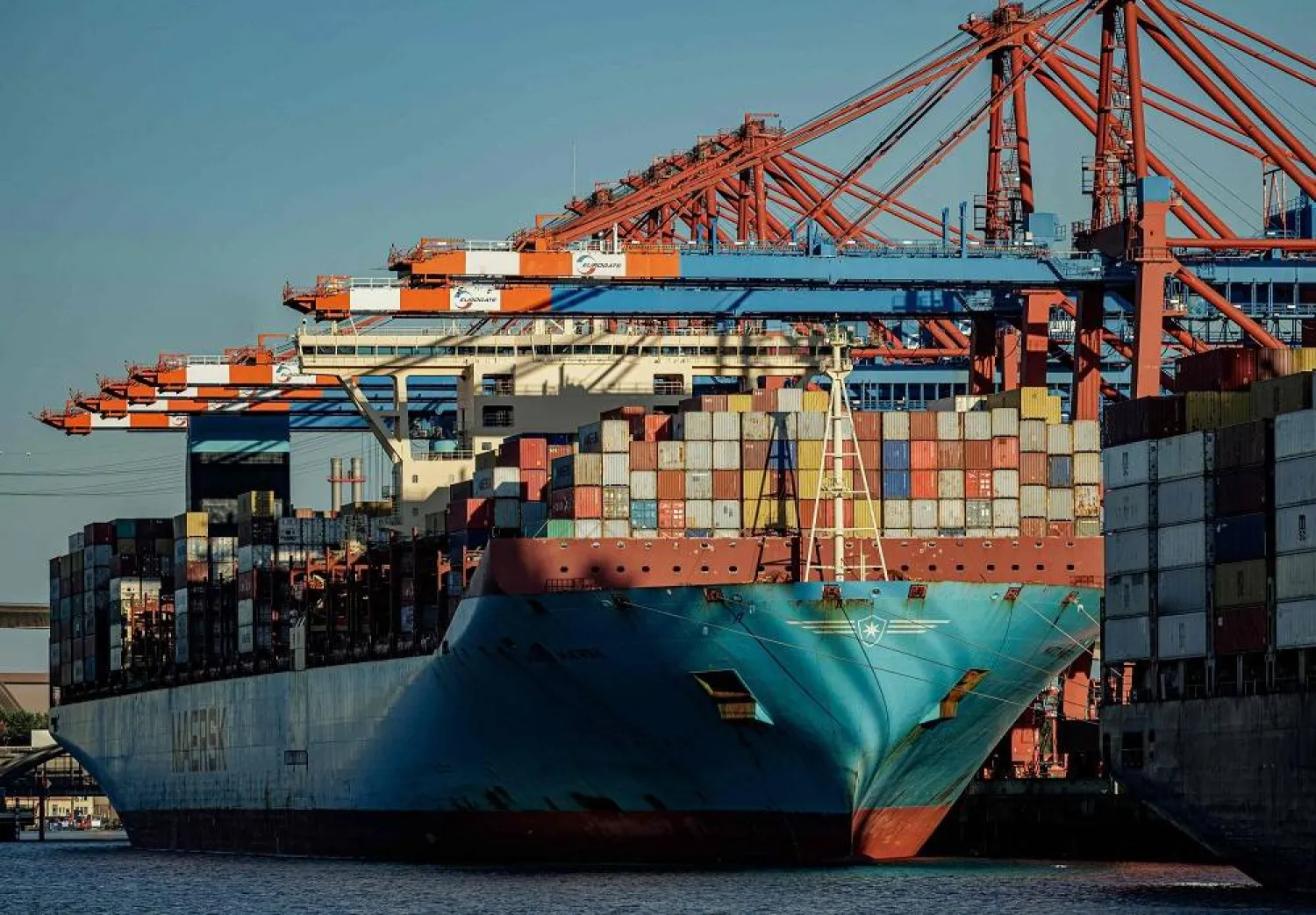
The Container ship "Maersk Bratan" is discharged at the terminals of HHLA (Hamburg Port Logistics Inc) in Hamburg on June 22, 2022. (AFP)
TT

Red Sea Shipping Workarounds Add Costs, Delays for Suppliers, Retailers 

The Container ship "Maersk Bratan" is discharged at the terminals of HHLA (Hamburg Port Logistics Inc) in Hamburg on June 22, 2022. (AFP)

Toymaker Basic Fun's team that oversees ocean shipments of Tonka trucks and Care Bears for Walmart and other retailers is racing to reroute cargo away from the Suez Canal following militant attacks on vessels in the Red Sea.

Suppliers for the likes of IKEA, Home Depot, Amazon and retailers around the world are doing the same as businesses grapple with the biggest shipping upheaval since the COVID-19 pandemic threw global supply chains into disarray, sources in the logistics industry said.

Florida-based Basic Fun usually ships all Europe-bound toys from its China factories via the Suez Canal, the quickest way to move goods between those geographies, CEO Jay Foreman said in a telephone interview from his Hong Kong office.

That trade route is used by roughly one-third of global container ship cargo, and re-directing ships around the southern tip of Africa is expected to cost up to $1 million extra in fuel for every round trip between Asia and Northern Europe.

Yemeni Houthis' drone and missile attacks in the Red Sea to show their support for Palestinian Islamist group Hamas fighting Israel in Gaza have upended shipping plans.

Basic Fun is now working through the holidays to send toys from China to ports in the UK and Rotterdam via the longer route.

It is also diverting some goods bound for ports on the US East Coast from the Suez Canal to the drought-choked Panama Canal, while switching others to the West Coast via the direct route across the Pacific Ocean.

"It's just going to take longer and it's going to cost more," said Foreman, who added that rates for some China-UK freight have more than doubled to around $4,400 per container since the Israel-Hamas conflict began in October.

The Suez Canal situation remains fast changing, and shippers Maersk and CMA CGM are moving to resume voyages with military escorts through the Red Sea.

The biggest impact likely will come over the next six weeks, said Michael Aldwell, executive vice president of sea logistics for Switzerland's Kuehne + Nagel

"You can't flick a switch" and reorganize global shipping, said Aldwell, who expects the diversions to cause a shortage of vessel space, strand empty containers needed for China exports in wrong places and send short-term transport price indexes sharply higher.

According to estimates from freight platform Xeneta, it costs $2,320 to ship a 40-foot equivalent unit (FEU) container from the Far East to the Mediterranean "post escalation" versus $1,865 per FEU in early December. It costs $1,625 to ship an FEU from China to the United Kingdom "post escalation" versus $1,425 per FEU in early December.

These rates do not include "extra ordinary" risk surcharges and "Emergency Recovery Cost" that can be between $400 and $2,000 per FEU, Peter Sand, chief analyst at Xeneta, said.

Scramble for space

As of Wednesday, nearly 20% of the global container fleet - or 364 hulking container vessels capable of carrying just over 2.5 million full-sized containers - had been set on a new course due to the Red Sea attacks, according to Kuehne + Nagel data.

Mitsui O.S.K. Lines and Nippon Yusen, Japan's largest shipping companies, said their vessels with links to Israel were avoiding the Red Sea area and both companies were monitoring the situation carefully for next steps.

Vessel owners already have begun rationing the less expensive, contract-rate space they reserve for customers, said Anders Schulze, head of the ocean business at digital freight forwarder Flexport.

For example, he said, a customer who delivers five containers a month versus the 10 promised in their contract may only get five containers at contract rates. The remainder would be subject to expensive spot market rates.

This has set off a scramble to reserve space ahead of the early February deadline to get goods out of China before factories there close for the extended Lunar New Year celebrations, logistics experts said.

"Every single booking (out of China) now needs to be reconfirmed. The dates could change, the routing may change," said Alan Baer, CEO of OL USA, which handles freight shipments for clients. OL has contracts with ship owners and is part of the rush to secure spots on ships.

Small shippers are most at risk of being elbowed out.

Marco Castelli, who has an import/export business in Shanghai, has been trying to rebook three containers of Chinese-made machinery components bound for Italy after the shipments were cancelled due to the crisis.

"Transfer my situation to a large corporation and you get what's going on," he said.

Foreman at Basic Fun, which plans to have about 40 containers on the water before the Lunar New Year, said the company's contracts with customers don't include a way to recover the extra expense. "The price is fixed. (Most suppliers) are going to have to eat those costs."



Japan Sets $19 Billion Business Target in Central Asia

TOKYO, JAPAN - DECEMBER 20: Japan's Prime Minister Sanae Takaichi, Kazakhstan's President Kassym-Jomart Tokayev, Tajikistan's President Emomali Rahmon, Turkmenistan's President Serdar Berdimuhamedov,  Kyrgyzstan's President Sadyr Zhaparov, and Uzbekistan’s President Shavkat Mirziyoyev attend the leaders-level "Central Asia plus Japan" Dialogue (CA+JAD) summit, in Tokyo, Japan, on December 20, 2025.     David MAREUIL/Pool via REUTERS
TOKYO, JAPAN - DECEMBER 20: Japan's Prime Minister Sanae Takaichi, Kazakhstan's President Kassym-Jomart Tokayev, Tajikistan's President Emomali Rahmon, Turkmenistan's President Serdar Berdimuhamedov, Kyrgyzstan's President Sadyr Zhaparov, and Uzbekistan’s President Shavkat Mirziyoyev attend the leaders-level "Central Asia plus Japan" Dialogue (CA+JAD) summit, in Tokyo, Japan, on December 20, 2025. David MAREUIL/Pool via REUTERS
TT

Japan Sets $19 Billion Business Target in Central Asia

TOKYO, JAPAN - DECEMBER 20: Japan's Prime Minister Sanae Takaichi, Kazakhstan's President Kassym-Jomart Tokayev, Tajikistan's President Emomali Rahmon, Turkmenistan's President Serdar Berdimuhamedov,  Kyrgyzstan's President Sadyr Zhaparov, and Uzbekistan’s President Shavkat Mirziyoyev attend the leaders-level "Central Asia plus Japan" Dialogue (CA+JAD) summit, in Tokyo, Japan, on December 20, 2025.     David MAREUIL/Pool via REUTERS
TOKYO, JAPAN - DECEMBER 20: Japan's Prime Minister Sanae Takaichi, Kazakhstan's President Kassym-Jomart Tokayev, Tajikistan's President Emomali Rahmon, Turkmenistan's President Serdar Berdimuhamedov, Kyrgyzstan's President Sadyr Zhaparov, and Uzbekistan’s President Shavkat Mirziyoyev attend the leaders-level "Central Asia plus Japan" Dialogue (CA+JAD) summit, in Tokyo, Japan, on December 20, 2025. David MAREUIL/Pool via REUTERS

Japan unveiled a five-year goal on Saturday for business projects totalling $19 billion in Central Asia as Tokyo vies for influence in the resource-rich region.

The announcement came after Prime Minister Sanae Takaichi hosted an inaugural summit with the leaders of five Central Asia nations -- Kazakhstan, Kyrgyzstan, Tajikistan, Turkmenistan and Uzbekistan -- in Tokyo.

Japan "set a new target of business projects at a total amount of 3 trillion yen in 5 years in Central Asia", a joint statement said after Takaichi wrapped up her meeting with the five leaders.

Like the United States and the European Union, Japan is drawn by the region's enormous, but still mostly unexploited, natural resources in a push to diversify rare earths supplies and reduce dependence on China, AFP reported.

"It is important for Central Asia, blessed with abundant resources and energy sources, to expand its access to international markets," the statement said.

The leaders agreed to promote cooperation that can help the "strengthening of critical minerals supply chains", while also pledging to achieve economic growth and decarbonisation.

They also held separate summits with Russia's Vladimir Putin, China's Xi Jinping and EU chief Ursula von der Leyen this year.

The summit was seen as important for Japan to increase its presence in the region, said Tomohiko Uyama, a professor at Hokkaido University specializing in Central Asian politics.

"Natural resources have become a strong focus, particularly in the past year, because of China's moves involving rare earths," Uyama told AFP on Friday, referring to tight export controls introduced by Beijing this year.

The leaders agreed on Saturday to expand cooperation regarding "Trans-Caspian International Transport Route", a logistics network connecting to Europe without passing through Russia.

Efforts towards "safe, secure, and trustworthy Artificial Intelligence" were also agreed.

Tokyo has long encouraged Japanese businesses to invest in the region, although they remain cautious.

Xi visited Astana in June, and China -- which shares borders with Kazakhstan, Kyrgyzstan and Tajikistan -- has presented itself as a main commercial partner, investing in huge infrastructure projects.

The former Soviet republics still see Moscow as a strategic partner but have been spooked by Russia's invasion of Ukraine.

Other than rare earths, Kazakhstan is the world's largest uranium producer, Uzbekistan has giant gold reserves and Turkmenistan is rich in gas.

Mountainous Kyrgyzstan and Tajikistan are also opening up new mineral deposits.

However, exploiting those reserves remains complicated in the harsh and remote terrains of the impoverished states.


World Bank Approves $700 Million for Pakistan's Economic Stability

A view of traffic circulating amid dense fog in Islamabad, Pakistan, 18 December 2025. EPA/SOHAIL SHAHZAD
TT

World Bank Approves $700 Million for Pakistan's Economic Stability

A view of traffic circulating amid dense fog in Islamabad, Pakistan, 18 December 2025. EPA/SOHAIL SHAHZAD

The World Bank said on Friday that it has approved $700 million in financing for Pakistan under a multi-year initiative aimed at supporting the country's macroeconomic stability and service delivery.

The funds will be released under the bank's Public Resources for Inclusive Development - Multiphase Programmatic ⁠Approach (PRID-MPA), which could provide up to $1.35 billion in total financing, the lender said. Of this amount, $600 million will go for federal programs and $100 million will ⁠support a provincial program in the southern Sindh province.

The approval follows a $47.9 million World Bank grant in August to improve primary education in Pakistan's most populous Punjab province.

In November, an IMF-World Bank report, uploaded by Pakistan's finance ministry, said Pakistan's fragmented ⁠regulation, opaque budgeting and political capture are curbing investment and weakening revenue. Regional tensions may surface over international financing for Pakistan.

In May, Reuters reported that India would oppose World Bank funding for Pakistan, citing a senior government source in New Delhi.


Oil Set for Second Straight Weekly Decline on Supply Outlook

A view of an oil pump jack on the prairies near Claresholm, Alberta, Canada January 18, 2025. REUTERS/Todd Korol
TT

Oil Set for Second Straight Weekly Decline on Supply Outlook

A view of an oil pump jack on the prairies near Claresholm, Alberta, Canada January 18, 2025. REUTERS/Todd Korol

Oil prices rose on Friday but were poised for a second straight weekly decline as a potential supply glut and prospects of a Russia-Ukraine peace deal limited gains driven by concerns over disruptions from a blockade of Venezuelan tankers.

Brent crude futures were up 52 cents, or 0.87%, at $60.34 a barrel by ‌1357 GMT ‌while US West Texas Intermediate crude ‌rose ⁠51 ​cents, ‌or 0.9%, to $56.66.

On a weekly basis, the Brent and WTI benchmarks were down 1.3% and 1.4% respectively, according to Reuters.

"That we're ⁠staying down at these levels indicates that the market is awash with ‌oil right now," said Ole Hansen, ‍head of commodity strategy at ‍Saxo Bank. "There's enough oil to mitigate any disruptions."

Uncertainty over ‍how the US would enforce President Donald Trump's intent to block sanctioned tankers from entering and leaving Venezuela tempered geopolitical risk premiums, IG analyst Tony Sycamore said.

Venezuela, which pumps about 1% ​of global oil supplies, on Thursday authorised two unsanctioned cargoes to set sail for China, said two ⁠sources familiar with Venezuela's oil export operations.

Optimism over a potential US-led Ukraine peace deal also eased supply risk concerns, Sycamore said.

However, Bank of America analysts said they expect lower oil prices to curb supply, which could stop prices from going into freefall.

Investors also watched developments in Russia's war in Ukraine after Kyiv ramped up attacks on Russia's energy infrastructure. Ukraine struck a "shadow fleet" oil tanker in the Mediterranean Sea with aerial drones for the first time, ‌a Ukrainian official said on Friday.