

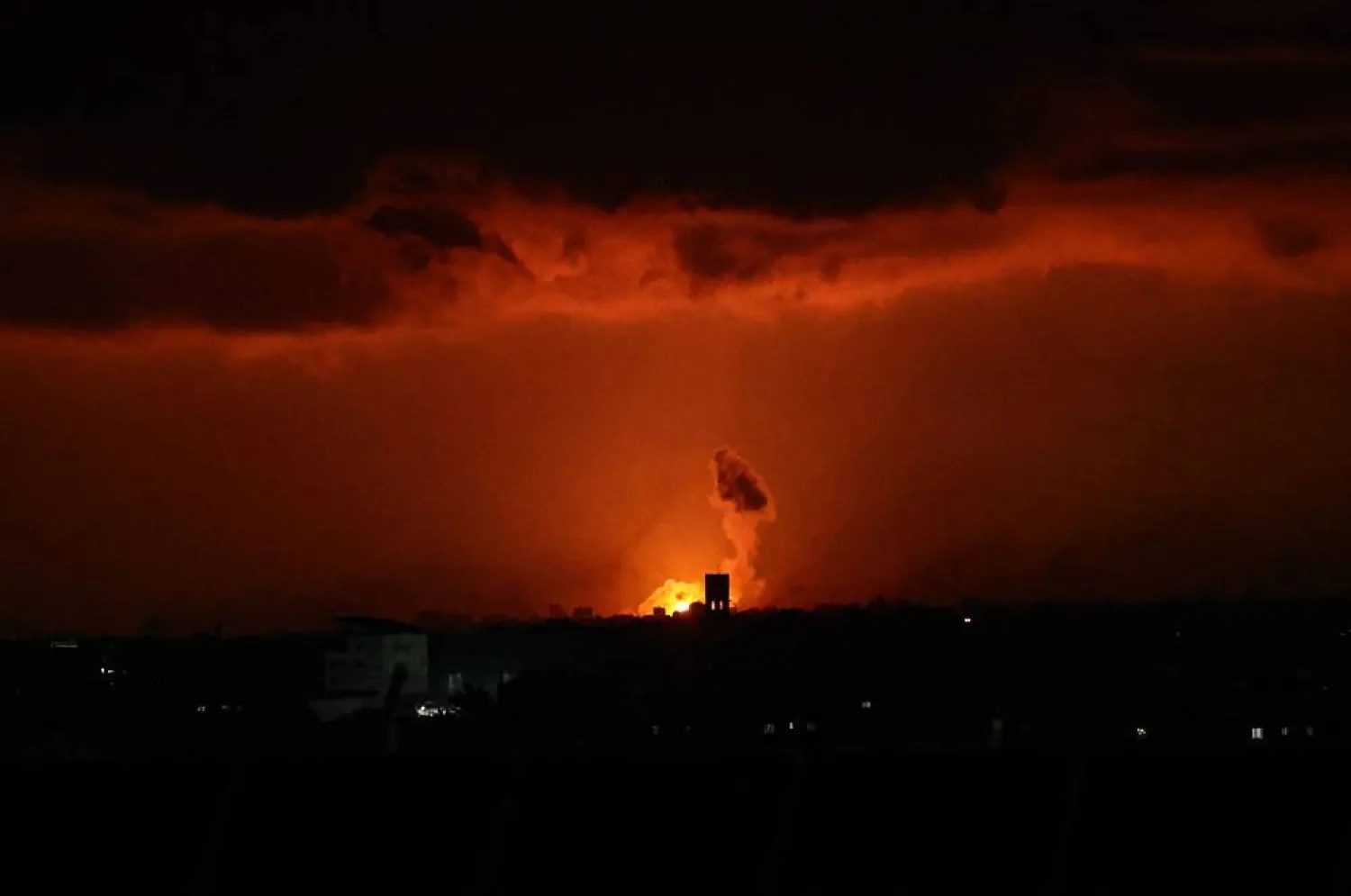

Israel Charges Back into Gaza City as US Plans Response to Killing of Its Troops

Smoke and flames rise in Rafah in the southern Gaza Strip during Israeli bombardment on January 29, 2024, amid ongoing battles between Israel and the Palestinian militant group Hamas. (AFP)
TT

Israel Charges Back into Gaza City as US Plans Response to Killing of Its Troops

Smoke and flames rise in Rafah in the southern Gaza Strip during Israeli bombardment on January 29, 2024, amid ongoing battles between Israel and the Palestinian militant group Hamas. (AFP)

Israel launched an assault on Gaza's main northern city weeks after pulling back from it, while Washington vowed to take "all necessary action" to defend its troops after they suffered the first deadly strike in the Middle East since the Gaza war began.

A day after three US servicemen on the Syrian-Jordanian border were killed and at least 34 wounded in what Washington called a drone attack by Iran-backed militants, President Joe Biden's administration was under pressure to respond firmly without triggering a wider war.

"The President and I will not tolerate attacks on US forces and we will take all necessary actions to defend the US and our troops," Defense Secretary Lloyd Austin said on Monday at the Pentagon.

Iran denied any role, but the first fatalities in what have been scores of attacks on US forces in the Middle East since the Israel-Hamas war broke out prompted calls from US politicians for a direct response.

Biden has ordered retaliatory attacks on Iranian-backed groups but has so far stopped short of hitting Iran directly.

"Have no doubt - we will hold all those responsible to account at a time and in a manner of our choosing," he said on Sunday.

Inside Gaza, residents said air strikes on neighborhoods across Gaza City killed and wounded many people. While tanks shelled the eastern areas of the city, naval boats fired shells and gun rounds at the beachfront areas in the west, they said.

Israel said late last year that it had largely completed operations in northern Gaza. The push back into Gaza City, where residents reported fierce gun battles near the main Al-Shifa hospital, indicated that the war was not going to plan.

Among those killed were two Palestinian journalists, Essam El-lulu and Hussein Attalah, along with several members of their families, health officials and the journalist union said.

Hamas, for its part, fired its first volley of rockets for weeks into Israeli cities, proving that the militant group running Gaza still had the capability to launch them after nearly four months of war.

The Israeli military said it shot down six of 15 rockets. Hamas said it had fired them to avenge deaths in Gaza. There were no reports of any casualties in Israel, where air raid sirens sounded and explosions of interceptions were heard overhead.

GAZANS SAY ISRAEL IS IGNORING THE WORLD COURT

Gazans said renewed violence in the enclave made a mockery of a ruling last week by the World Court calling on Israel to do more to help civilians. Health officials say 26,637 Palestinians have been killed in the conflict with thousands more bodies likely under the rubble of destroyed buildings.

"The war continues in a dirtier manner," said Gaza City resident Mustafa Ibrahim, a Palestinian human rights activist now displaced with his family in Rafah near the southern border with Egypt, along with more than a million other Gazans.

Israel ordered new evacuations of the most populated areas of Gaza City, but people said communications blackouts meant many would miss them. Israel blames Hamas for the deaths of civilians for operating among them, which the fighters deny.

People in the north have been grinding animal feed to make flour after flour, rice and sugar ran out, part of an aid crisis now exacerbated by a withdrawal of support for the United Nations' aid agency for Palestinian refugees, UNRWA.

The United States and another major donor, Germany, are among countries to have suspended aid to the agency since Friday after Israel said 12 of UNRWA's 13,000 staff in Gaza were involved in the Oct. 7 Hamas attacks on Israel which killed about 1,200 people.

The Israeli report, seen by Reuters, said 190 UNRWA staff were militants, naming 11 of them.

UNRWA, which says more than 150 of its staff have been killed since October and a million Palestinians are sheltering in its buildings, said it would have to end operations within a month if funding was not restored. It said it had promptly fired staff after being alerted to Israel's allegations.

Air strikes also hit the southern city of Khan Younis, main focus of Israel's attack since last week, which has brought fighting deep into territory holding hundreds of thousands of people who had already fled other areas.

Thousands have now been forced to flee again in a desperate exodus. People fled south on foot carrying children and bedding. Suleiman Abusari, a boy in a wheelchair pushed by his father, said his legs were amputated after an Israeli drone hit him.

"My dream was to play football," he said. "They stole my dream."

'NOT OVER THE FINISH LINE'

Biden and other leaders have been pushing for a new temporary ceasefire to allow for the release of hostages held by Hamas and get more aid into Gaza.

Talks on Sunday initiated by Qatar and involving US, Israeli and Egyptian intelligence chiefs were "constructive", Israel said, while adding that "significant gaps" remain.

White House national security spokesman said there was a framework for a hostage deal, but: "We're not over the finish line right yet."

Violence has also engulfed the occupied West Bank, where the Palestinian health ministry said five people were killed by Israeli forces in four incidents in 24 hours. The Israeli military said three were in response to attempted gun, knife or stone-throwing attacks on its soldiers.

Within Israel, the military said an unidentified motorist in Haifa rammed a soldier and then tried to attack him with an axe before being shot.

In neighboring Syria, two people were killed and several wounded in an Israeli attack on the outskirts of the Syrian capital, Iranian and Syrian media said. Iran's ambassador to Damascus denied reports the location was an Iranian military post.  

Israel has a longstanding reputation for attacks on Iran-linked targets in Syria. An Israeli military spokesperson declined to comment.



Coalition Thwarts Houthi Attempt to Smuggle Weapons at Sea as Taiz Withstands Militant Assaults

This frame grab taken on October 9, 2026, from AFPTV video footage shows a member of the Yemeni government forces firing a machine gun mounted on a pick-up truck during clashes with Houthi fighters in Hayfan district, south of Taiz, on October 8, 2026. (AFPTV /AFP)
TT

Coalition Thwarts Houthi Attempt to Smuggle Weapons at Sea as Taiz Withstands Militant Assaults

This frame grab taken on October 9, 2026, from AFPTV video footage shows a member of the Yemeni government forces firing a machine gun mounted on a pick-up truck during clashes with Houthi fighters in Hayfan district, south of Taiz, on October 8, 2026. (AFPTV /AFP)

The Coalition to Support Legitimacy in Yemen thwarted an attempt by the terrorist Houthi group to smuggle weapons at sea to Yemen’s Hodeidah governorate in a development that highlights efforts to cut off the militants’ military supply lines.

On the ground, clashes continued along fronts in Taiz as Operation Dawn of Yemen expands.

In a video on the X platform about the smuggling operation, Coalition spokesperson Major General Turki al-Malki said: "We strike them on land... we sink them in the sea."

On Saturday, Operation Dawn of Yemen entered its 13th day amid ongoing Houthi attacks on the fronts in the southwestern city of Taiz. Government forces and the Popular Resistance repelled the attacks in fierce battles, with the Houthis incurring heavy losses, according to Yemeni military statements.

The Yemeni Armed Forces announced that it carried out 1,417 precise and direct operations, using warplanes, drones and field artillery, targeting militia gatherings, reinforcements, fortified positions, firing sources, armored vehicles, combat equipment, and drone launch sites.

Yemeni Armed Forces spokesman Majed al-Nuzaili said the operations have disrupted Houthi movement, preventing them from deploying their reserves to the fronts or achieving any tactical objective on the ground.

The operations killed and injured around 800 militants, and destroyed or damaged more than 190 armored, transport and supply vehicles, as well as fortifications and firing positions, he added.

The Armed Forces on the eastern front managed to clear hostile positions and expand their scope of control, securing a new tactical field position, he went on to say.

In Taiz, al-Nuzaili said the Armed Forces and the Popular Resistance thwarted continuous waves of attacks, while warplanes targeted the militia's positions and reinforcements with concentrated strikes, inflicting heavy losses among their ranks.

The Armed Forces confirmed that their operations are strictly confined to legitimate military targets and are executed in accordance with international humanitarian law and its customary rules.

They renewed their call to citizens in areas under the control of the militias to protect their children from recruitment campaigns and from being dragged into losing battles in defense of a project that does not represent the Yemeni people and does not serve their homeland.

In another development, al-Nuzaili said that government forces and the Popular Resistance detained a number of Houthi field commanders.

According to government forces' statements, the Houthi militia continues to send reinforcements to the frontlines to compensate for its losses.

The steadfastness of government forces is preventing the Houthis from achieving their field goals, despite the continuous military pressure, they added.

The developments are not limited to Taiz. The Armed Forces announced that they made new progress in Marib, taking control of strategic positions. Meanwhile, operations on the southern and western fronts aim to deplete the group's capabilities and weaken its movements.

According to al-Nuzaili, military engineering units continue to remove mines and explosive devices planted by the Houthis, as well as securing the recaptured areas and opening roads for the armed forces.


Are the Iran-backed Iraq Factions Facing a Financial Crisis?

A PMF patrol in Iraq. (PMF)
TT

Are the Iran-backed Iraq Factions Facing a Financial Crisis?

A PMF patrol in Iraq. (PMF)

Iraqi sources revealed that the armed factions are suffering from a “financial crisis” due to US sanctions against their commanders.

They ruled out however that the salaries of fighters of the Popular Mobilization Forces (PMF) would come to a halt because they are being funded from the state budget.

Commander of the US Central Command Brad Cooper said on Friday the US naval blockade has cost Iran $25 billion in lost oil revenue and the Treasury Department have managed in recent weeks to freeze $350 million that Iran had in cryptocurrency.

In a video message released Friday, Cooper revealed that Iran-backed groups such as Hezbollah, Hamas and armed factions in Iraq, which have been funded by the Iranian Revolutionary Guards Corps (IRGC) for years, now have to give the money back, reported Axios.

"The financial strain on Iran's military has become so significant that there are reports about Iran-aligned militia groups across the region withholding payments for their soldiers in order to funnel money back to the IRGC, which also isn't paying its troops," he said.

Cooper said the Iranian government is withholding salaries, pensions and benefits from public sector workers, including the internal security forces and the IRGC.

However, reliable sources, including some familiar with the internal dynamics of Iraqi factions, dismissed the US claims as “inaccurate”.

One of the sources told Asharq Al-Awsat that the factions are generally experiencing genuine financial problems, which began months ago as a result of US Treasury sanctions against most of their leaders, as well as associated banks and institutions accused of financial dealings with Tehran.

However, the source stressed that all members of the factions, who mostly operate under the PMF, receive their salaries regularly, and they have not been cut.

Financial allocations for the PMF reached around 3.6 billion US dollars under the 2025 budget to fund a force boasting around 238,000 members. This coincides with government efforts to reorganize the legal and security structure of the PMF, amid local and regional scrutiny.

The sources explained that the total number of members linked to the factions does not exceed 50,000 fighters, or slightly more. Even assuming Cooper's statements are true, their total salaries could not cover a financial deficit in Iran.

A source, who spoke on the condition of anonymity, said that Iran and IRGC circles are linked to vast financial interests inside Iraq, spanning the energy, construction, and trade sectors. Furthermore, they control state-linked contracts that generate revenues far exceeding what they spend on the salaries of faction members.

The source did not rule out the existence of shadow institutions or banks linked to the factions that could continue their secret financial dealings with Iran, similar to what was recently uncovered in the case of one of the banks.

The US Treasury had placed the Iraqi International Development Bank on the sanctions list last Thursday for facilitating Iran's access to dollars, assisting it in obtaining American currency, and circumventing the economic sanctions imposed on it.

Washington accused the bank of being linked to Iranian companies that contributed to its establishment from the very beginning, and of working to transfer and deliver profits to Tehran, in addition to its connection to Iranian state and banking entities, including Bank Melli.


Sisi Says Egypt Ready for Any Measure to Protect Saudi Arabia

President Abdel Fattah al-Sisi (Egyptian Presidency)
TT

Sisi Says Egypt Ready for Any Measure to Protect Saudi Arabia

President Abdel Fattah al-Sisi (Egyptian Presidency)

Egypt's parliament will meet on Sunday after President Abdel Fattah al-Sisi asked lawmakers to authorize support for Saudi defenses.

Speaking at a graduation ceremony at the Egyptian military academy, Sisi said on Saturday that it was "inconceivable" for Cairo to stand by while Saudi Arabia was "harmed or its security and stability threatened.”

"Egypt, of course, with the directives of His Majesty King Salman and Crown Prince Mohammed bin Salman, will carry out any measure to protect you or defend you," he said.

Sisi said Cairo stood "with full force and support to protect and defend the lands of our brothers in the Gulf,” before asking attendees to stand and give a military salute to Gulf states.

"I'm not talking about fighting anyone or attacking anyone," he added. "We are speaking only about defense."

Shortly after Sisi's remarks, state media reported that parliament would convene an emergency session on Sunday at the president's request.

Former Egyptian Assistant Foreign Minister Ambassador Mohamed Hegazy said that al-Sisi’s remarks about Egypt’s willingness to take measures to protect its Gulf Arab brethren, if requested, “carry a clear political and strategic message: Egypt views Gulf security as an integral part of Egyptian and Arab national security, and Arab solidarity is not limited to political and diplomatic positions, but extends to a readiness to shoulder responsibility when Arab states face threats to their security and stability.”

Hegazy told Asharq Al-Awsat that “the president’s remarks also underscore that any potential Egyptian action would be defensive and protective in nature, undertaken at the request of its Gulf partners, rather than aimed at attacking any party or entering into an open military confrontation.”

He said this “reflects the distinction between possessing the capability to protect Arab interests and seeking escalation.”

“The president’s remarks affirm that force in this context is a tool of deterrence and protection, not an instrument of war and escalation. This comes within the framework of Egypt’s longstanding commitment to Arab solidarity, while safeguarding security, stability, and the resources of the countries of the region,” he added.