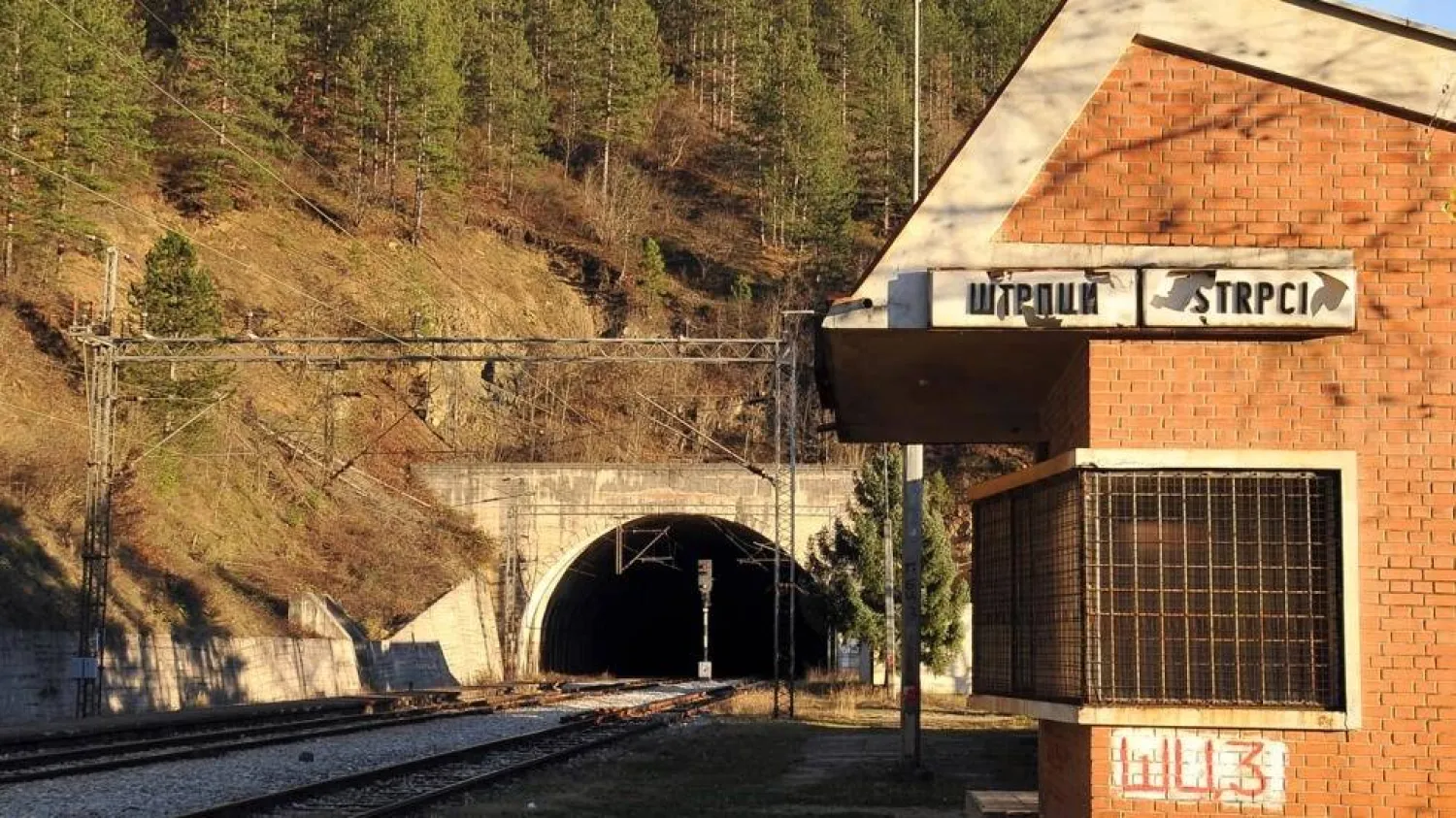
Decades on, Serbia Struggles to Prosecute Yugoslav War Crimes

The murder of 20 civilians in the village of Strpci was one of an untold number of atrocities in the bloody wars that broke up Yugoslavia. ELVIS BARUKCIC / AFP/File
TT

Decades on, Serbia Struggles to Prosecute Yugoslav War Crimes

The murder of 20 civilians in the village of Strpci was one of an untold number of atrocities in the bloody wars that broke up Yugoslavia. ELVIS BARUKCIC / AFP/File

Exactly 31 years ago, gunmen forced 20 civilians off a train in the Bosnian village of Strpci. They were beaten, robbed and later murdered.
It was one of an untold number of atrocities in the bloody wars that broke up Yugoslavia -- and justice in many such cases is painfully slow.
In the Serbian capital Belgrade, the trial of those accused of carrying out the Strpci massacre is still going on, with the suspects free, AFP said.
"It is unforgivable that 30 years after the kidnapping and murder of 20 civilians in Strpci, the Serbian judicial authorities are incapable of conducting the trials in a professional manner and rendering a verdict," said the Balkans-based Humanitarian Law Center.
An estimated 130,000 people were killed in the wars that tore the former Yugoslavia apart in the 1990s.
In the decades since, several leading figures from the fighting -- including Bosnia Serb commander Ratko Mladic -- have been prosecuted at an international tribunal in The Hague. Scores more have been tried by local courts across the Balkans.
But in Serbia, convicted war criminals released from prison have been celebrated by top state officials and hailed in pro-government media.
Others have resumed their political careers or written works of revisionist history distributed by state-run publishers.
Stop-start Serbian trials
In the Strpci case, four former members of the Avengers, a paramilitary group linked with the Bosnian Serb army, got prison sentences ranging between five and 10 years after an initial trial that ended in February 2022.
But just a year later the verdict was overturned. A new trial opened in January.
The start-stop nature of the proceedings has angered advocacy groups that push for justice in war crimes trials.
According to the indictment, a special armed group was formed in Visegrad, Bosnia in February 1993 and tasked with kidnapping non-Serb passengers from the train connecting Belgrade to Bar in Montenegro.
The four accused in the trial -- Gojko Lukic, Dusko Vasiljevic, Jovan Lipovac and Dragana Djekic -- are suspected of kidnapping the passengers in Strpci and handing them to their killers.
The executioners have never been identified and no investigation has ever been opened into who masterminded the massacre.
Just four of the victims' bodies have been recovered, roughly 70 kilometers (43 miles) from the scene of the kidnapping along the shores of Lake Perucac.
Milan Lukic -- a prominent Serb paramilitary commander linked to the Avengers -- was sentenced to life imprisonment by the International Criminal Tribunal for the former Yugoslavia for crimes against humanity.
But he was never convicted of having a role in the Strpci killings.
Convictions outside Serbia
While Serbia has been accused of dragging its heels in war crimes cases, other countries in the region have shown greater initiative in tackling the issue, including the prosecutions of Serb paramilitary members.
A court in Montenegro convicted Nebojsa Ranisavljevic in 2004 and sentenced him to 15 years in prison for his role in the Strpci kidnappings.
And in neighboring Bosnia, seven former members of the Avengers were sentenced in August 2023 to 13 years in prison each for their part in the crime.
"The sentences should certainly have been more severe. But they show to a certain extent the willingness of society in Bosnia-Herzegovina to try war criminals," Edvin Kanka Cudic, a war crimes specialist for the Bosnia-based Association for Social Research and Communication, told AFP.
"Unfortunately, the same cannot be said for Serbia, since the trials, like that of Strpci, also last a long time."



Fighting Reaches Outskirts of Ukraine’s Stronghold Kostiantynivka

 This photograph shows a barbed wire defense line running across a field at an undisclosed location in the Kharkiv region, eastern Ukraine, on May 1, 2026, amid the Russian invasion of Ukraine. (AFP)
This photograph shows a barbed wire defense line running across a field at an undisclosed location in the Kharkiv region, eastern Ukraine, on May 1, 2026, amid the Russian invasion of Ukraine. (AFP)
TT

Fighting Reaches Outskirts of Ukraine’s Stronghold Kostiantynivka

 This photograph shows a barbed wire defense line running across a field at an undisclosed location in the Kharkiv region, eastern Ukraine, on May 1, 2026, amid the Russian invasion of Ukraine. (AFP)
This photograph shows a barbed wire defense line running across a field at an undisclosed location in the Kharkiv region, eastern Ukraine, on May 1, 2026, amid the Russian invasion of Ukraine. (AFP)

Russian troops are ‌inching towards the city of Kostiantynivka in Ukraine's eastern Donetsk region, trying to establish a foothold close to a heavily defended area, Ukraine's top army official said on Saturday.

Kostiantynivka, along with other cities, forms a so-called fortress belt in the country's east - an area well-fortified by the Ukrainian military.

"We are repelling the Russian occupiers' persistent attempts to gain a foothold in the outskirts of Kostiantynivka using infiltration tactics. Counter-sabotage measures are going on in the ‌city," Oleksandr Syrskyi, ‌Ukraine's army chief, said on the Telegram ‌app.

A ⁠Ukrainian battlefield mapping ⁠project called DeepState shows Russian troops control an area around only one kilometer (0.6 mile) from the city's southern outskirts.

Small chunks of Kostiantynivka in the southeast are marked as a grey zone, meaning neither Ukraine nor Russia has full control over them.

Russia's defense ministry said on ⁠Wednesday its forces had taken control of ‌Novodmytrivka, just north of Kostiantynivka. Moscow's ‌top general Valery Gerasimov said in April that troops were ‌advancing in the north and south of the ‌city.

Syrskyi said that Russian offensive attempts had risen noticeably in April. Since Monday, Russian troops have carried out 83 assaults in this sector using small infantry groups, he added.

Russia demands that ‌Ukraine pull back from areas in the Donetsk and neighboring Luhansk regions that it ⁠failed to capture ⁠in its four-year full-scale war. US-brokered peace talks stalled over the issue as Ukrainian officials say Kyiv will not cede land it still controls.

For the past few years, Russian troops have not managed to capture any big city agglomerations in Ukraine, inching forward and taking control over small settlements, mostly in Ukraine's east.

The small city of Pokrovsk, whose more than 60,000 pre-war population mostly fled, was the most significant gain in the past year. It took Moscow's troops months to advance, and Kyiv says it still has some positions in the city.


Report: Explosion of Bombs Left Over from Strikes Kill 14 Iranian Revolutionary Guard Members

Smoke billows from an Israeli strike on Tehran. (Reuters file)
TT

Report: Explosion of Bombs Left Over from Strikes Kill 14 Iranian Revolutionary Guard Members

Smoke billows from an Israeli strike on Tehran. (Reuters file)

An explosion of leftover bombs from strikes during the war against Iran killed 14 members of the Revolutionary Guard, Iranian media reported Friday.

A report by the Nournews website, believed to be close to Iran’s security, said the explosion happened near the northern city of Zanjan, which is northwest of Tehran.

It was the largest number of Revolutionary Guard members reported to be killed since the ceasefire began on April 7.

The report said the ammunition included cluster bombs and air mines dropped during the fighting.


US, Philippines Deploy Anti-Ship Missile System in Batanes Near Taiwan for War Games

 A vehicle used for the Navy-Marine Expeditionary Ship Interdiction System (NMESIS), stands during joint Philippine-US military exercises in Basco, Batanes province, Philippines, May 2, 2026. (Reuters)
A vehicle used for the Navy-Marine Expeditionary Ship Interdiction System (NMESIS), stands during joint Philippine-US military exercises in Basco, Batanes province, Philippines, May 2, 2026. (Reuters)
TT

US, Philippines Deploy Anti-Ship Missile System in Batanes Near Taiwan for War Games

 A vehicle used for the Navy-Marine Expeditionary Ship Interdiction System (NMESIS), stands during joint Philippine-US military exercises in Basco, Batanes province, Philippines, May 2, 2026. (Reuters)
A vehicle used for the Navy-Marine Expeditionary Ship Interdiction System (NMESIS), stands during joint Philippine-US military exercises in Basco, Batanes province, Philippines, May 2, 2026. (Reuters)

Philippine and US forces on Saturday showcased the NMESIS anti-ship missile system in Batanes province, near Taiwan, during annual war games, as tensions simmer over the self-governed island that China views as its own territory.

The Philippines' northernmost province, with about 20,000 residents, sits around 100 miles south of Taiwan, along the Luzon Strait, a strategic corridor on the frontline of the great power competition between the US and China for dominance in the Asia-Pacific region.

"Training out here in Batanes allows us a different environment than what we're normally allowed to operate in," said US Staff Sergeant Darren Gibbs.

"So it gives us unique opportunities to actually utilize the system and train within our capabilities, and it offers experiences we don't normally get offered in our day-to-day training."

Gibbs said the NMESIS is designed for remote operation, and that "the purpose of this system is for it to be ‌fully autonomous, for us ‌not to require a driver or passenger inside the vehicle itself."

"We will tell it ‌where ⁠to go and ⁠then we program what it needs to do," he said.

The NMESIS, a highly mobile coastal anti-ship missile system designed to target surface vessels from land-based positions at ranges of about 185 km (115 miles), was flown into Batanes on a US C-130 transport aircraft, and positioned in the capital Basco, which has one of the island province's two small runways.

Francisco Lorenzo, Philippine exercise director, told Reuters that deployment of US weapons such as the NMESIS to Batanes was part of efforts to test operational feasibility in remote locations. The NMESIS was also deployed to Batanes in last year's war games.

"It is part of training so ⁠as to test the feasibility or rehearse their deployment there when need arises," Lorenzo ‌said. One of the objectives of the Balikatan, as the annual "shoulder-to-shoulder" drills ‌of US and Philippine forces are called, is to practice "defense of our territory with our allies", he said.

The NMESIS would not ‌be used in live exercise operations and was brought to Batanes only for deployment rehearsal and simulation support during ‌the war games.

He said the system would be withdrawn from Batanes once the drills were finished. The US also deployed its Typhon missile system to the Philippines in 2024 for use in joint exercises.

Beijing routinely criticizes the deployment of US weapons in the Philippines, saying it heightens regional tension.

Security analyst Chester Cabalza, founder and president of the Manila-based think tank International Development and Security Cooperation, told ‌Reuters "the NMESIS can spark a powder keg for Beijing and asymmetric deterrence for Manila and Taipei in the Bashi Channel along the Luzon Strait."

The system can be ⁠airlifted and deployed to ⁠any coastline in the Philippine archipelago within hours, Cabalza said, and its placement in Batanes is likely viewed by Beijing as part of the "US-led encirclement" of China.

WAR GAMES INVOLVE 17,000 TROOPS

Philippine and US forces also carried out maritime strike drills in Itbayat, a Batanes municipality about 155 km from Taiwan and the northernmost part of the country.

More than 17,000 troops are taking part in this year's war games, including about 10,000 from the US, even as Washington remains heavily engaged in the Middle East.

China recently intensified its activities in the South China Sea and the Taiwan Strait, increasing its naval presence around Taiwan and sending an aircraft carrier through the strait. It also put up a barrier this month at the mouth of the Scarborough Shoal, according to satellite images reviewed by Reuters.

Philippine President Ferdinand Marcos Jr has said Filipinos working and living in Taiwan would have to be evacuated in the event of war over the self-governed island and that would "drag the Philippines kicking and screaming into the conflict."

Philippine Defense Secretary Gilberto Teodoro said in an April 28 interview with Reuters that Manila has a contingency plan to evacuate Filipinos in Taiwan if conflict erupts but gave no further details.